Reviewed by Daniel M. · Last Updated October 27, 2026 · How we review
A paper wasp is a slender, long-legged wasp of the genus Polistes that hangs an open, umbrella-shaped paper nest under an eave, railing or branch. It stings mainly to defend that nest, and University of California pest specialists describe paper wasps as much less defensive than yellowjackets.
Educational information only, not medical or pest-control advice. For allergy care, follow your doctor and the American College of Allergy, Asthma and Immunology’s insect sting guidance.
Emergency: if anyone has trouble breathing, a swelling tongue or throat, hives away from the sting, dizziness or fainting after any sting, call 911 and use their epinephrine auto-injector if they carry one.
Key Takeaways
- Paper wasps are slender, narrow-waisted wasps whose legs dangle in flight. Their nest is one open comb with no paper cover.
- A paper wasp colony holds about 15 to 200 wasps. A yellowjacket colony holds 1,500 to 15,000 (UC Statewide IPM).
- Colonies last one season. Workers live a few weeks, queens up to a year, and only mated females survive winter.
- Adults drink nectar and fruit juice. They feed their young chewed caterpillars, and the Missouri Department of Conservation calls paper wasps among the most beneficial insects.
- Paper wasps sting mainly when a nest is disturbed, but they can sting repeatedly. Five of seven Polistes species in Justin Schmidt’s 2019 pain ratings scored a 3 on his 1-to-4 scale.
- For beekeepers, the evidence is thin: one 1986 report of a paper wasp eating a honey bee and one apiary study finding no impact. Yellowjackets and hornets are the real apiary problem.
Table of Contents
- How to Identify a Paper Wasp
- The Open Umbrella Nest
- Native and European Paper Wasps
- Paper Wasp vs Yellowjacket, Hornet and Mud Dauber
- Life Cycle: How Long Paper Wasps Live
- What Paper Wasps Eat
- Are Paper Wasps Aggressive? Temperament and Stings
- Leave the Nest or Remove It?
- Paper Wasps Around Honey Bees
- Frequently Asked Questions
How to Identify a Paper Wasp
Paper wasps belong to the genus Polistes in the wasp family Vespidae. The Missouri Department of Conservation counts about 24 Polistes species in North America north of Mexico and describes them as half an inch to an inch long, black or brown, often with rusty or yellowish markings.
Three features give them away. They have an obvious narrow waist and long legs, which make them look more delicate than bees or yellowjackets, according to Cornell’s integrated pest management program. Their legs dangle in flight. And unlike bees, they are smooth rather than fuzzy. Color varies by species: some are yellow and black, others brown and orange.
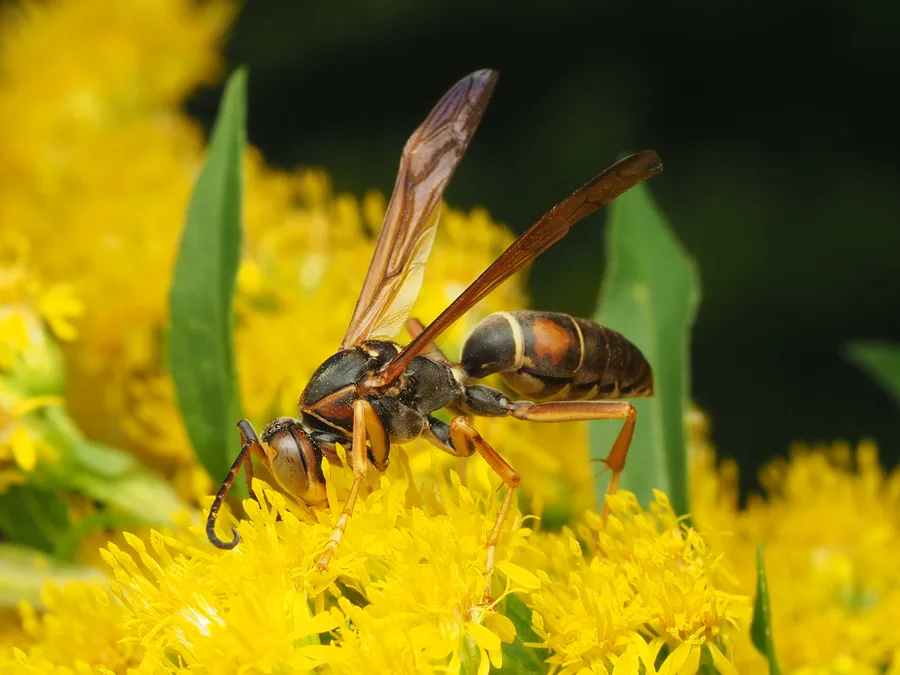
At rest, wasps fold their wings into a narrow strip over the abdomen, the University of Nebraska-Lincoln notes in its guide to paper wasps and yellowjackets. Only females can sting. Cornell explains that a wasp’s stinger is a modified egg-laying organ, so the males, which exist only to mate with new queens, have none.
For the wider question of what separates a bee from a wasp, see our guide to telling bees, wasps and hornets apart and the complete bee vs. wasp identification guide.
The Open Umbrella Nest
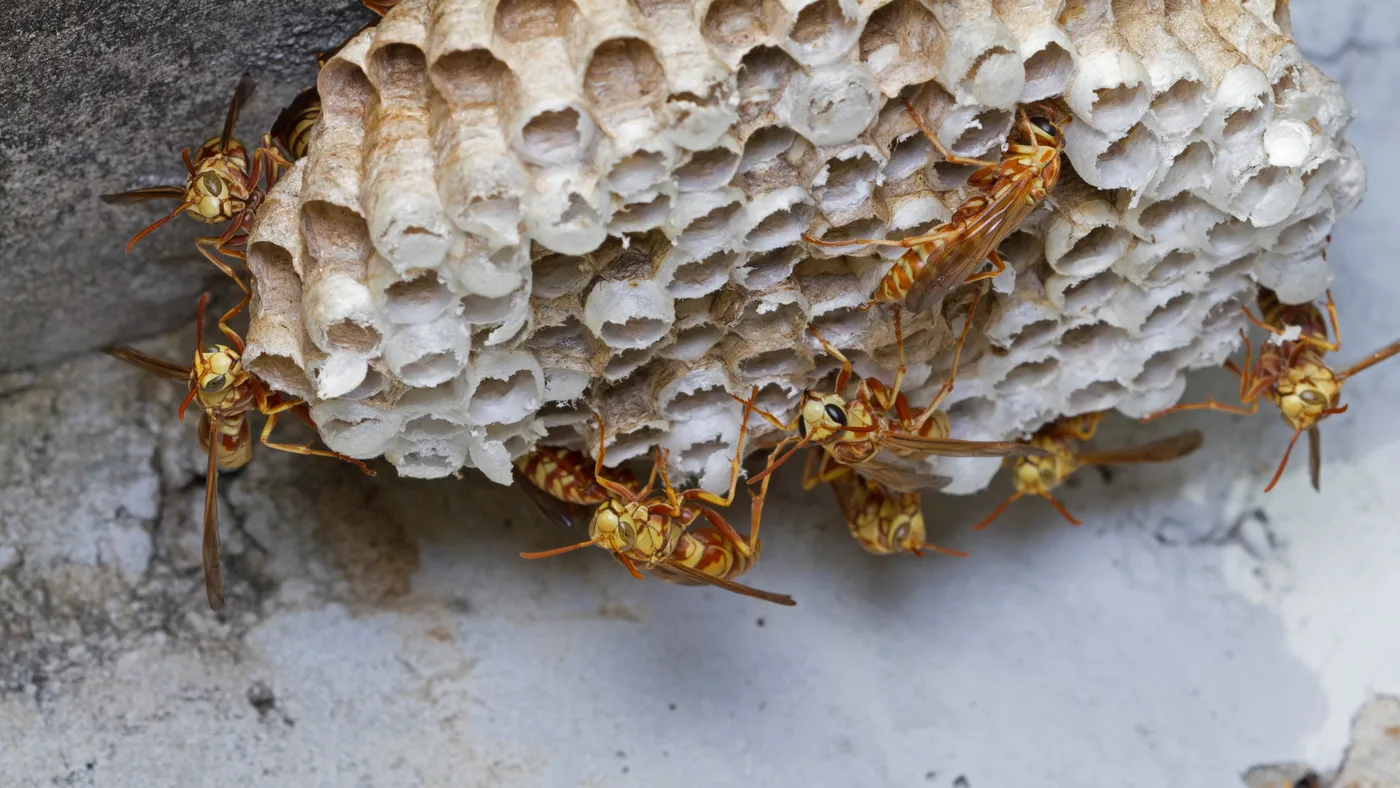
The nest is the surest identifier. The Missouri Department of Conservation describes a single layer of hexagonal cells, side by side like a honeycomb, hanging from one stalk beneath an overhang. The cells face downward and there is no outer covering. The paper is wood fiber scraped from weathered boards and branches and mixed with saliva, which is why you see wasps chewing on old fence rails.
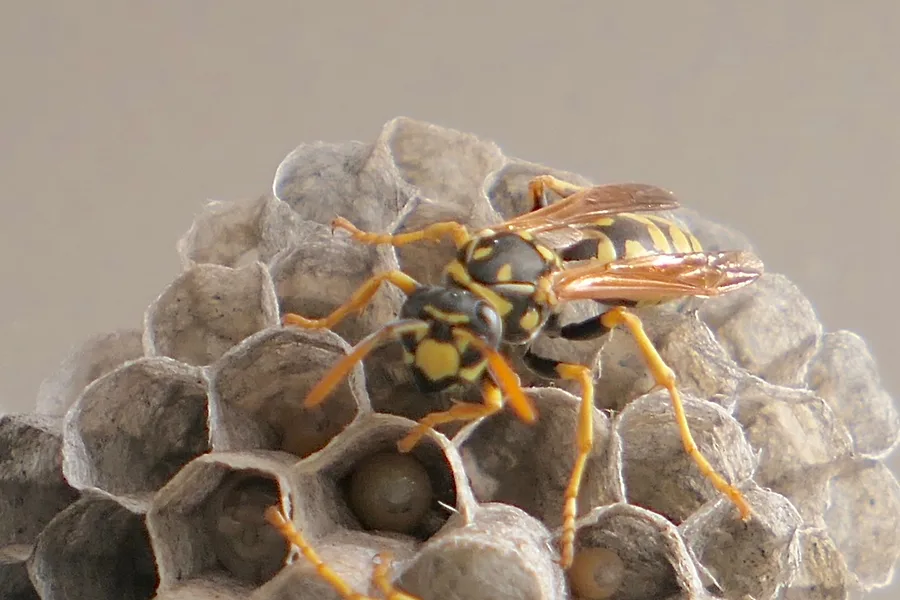
Size is modest. UC Statewide IPM’s Pest Notes on yellowjackets and other social wasps says paper wasp nests rarely grow larger than an outstretched hand and hold 15 to 200 individuals, and that white, legless larvae can sometimes be seen from below.
Location is where people get surprised. Nests hang under eaves, porch ceilings, deck rails, beams, outdoor furniture and tree limbs. Cornell warns that wasps also build inside metal fence pipes and under unused equipment, so a nest is often overlooked until someone disturbs it. The Nebraska guide adds that the European paper wasp will also nest in small cavities such as hollow posts of outdoor furniture, appliances and light fixtures.
Native and European Paper Wasps
The paper wasp in your yard may be a native or a European import, and the difference changes little about how you treat it. Cornell lists two common Northeast species. The European paper wasp (Polistes dominula) is three-quarters to seven-eighths of an inch long, has long legs, a long tapered abdomen and orange-tipped antennae, and is the most common paper wasp in the Northeast. The northern paper wasp (Polistes fuscatus) is dark brown with lighter brown, coppery or yellow markings. Cornell reports the northern species is less common now because the European one has taken over much of its habitat.
Washington State University’s HortSense fact sheet gives the quickest field mark for the Pacific Northwest: the European species is the only paper wasp there with mostly orange antennae. It also says native paper wasps live in small groups of 6 to 20 in their nests.
How the European species arrived, how far it has spread, and what it does to native wasps and monarch caterpillars is a separate story, covered in our European paper wasp guide.
Paper Wasp vs Yellowjacket, Hornet and Mud Dauber
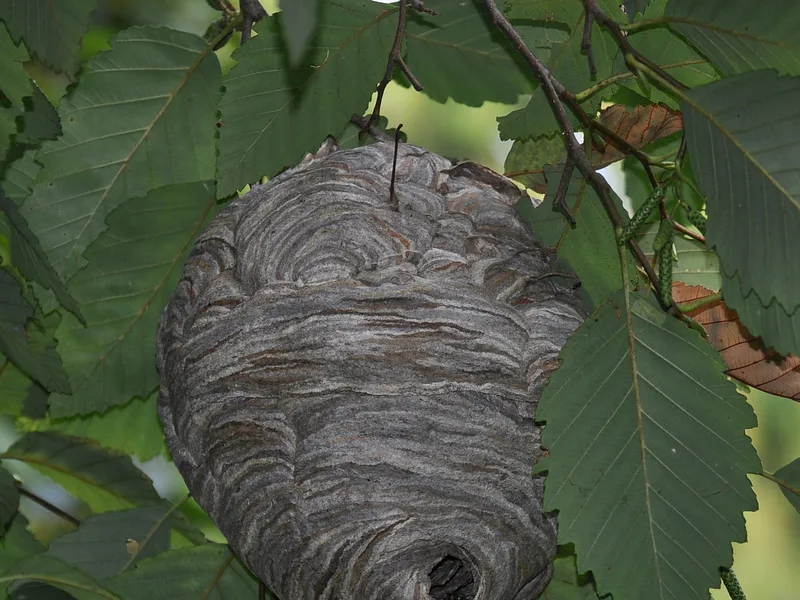
The wasps most often mistaken for paper wasps are yellowjackets, bald-faced hornets and mud daubers. Nest shape settles it fastest: open comb for the paper wasp, a closed paper ball or buried nest for the others, hard mud for the dauber. The table sums up UC Statewide IPM’s descriptions.
| Paper wasp | Yellowjacket | Bald-faced hornet | Mud dauber | |
|---|---|---|---|---|
| Body | Slender, long legs, distinct narrow waist | Medium-sized, black with bright yellow bands, very short narrow waist | Black with white bands; an aerial-nesting yellowjacket species | Dark, thread-waisted |
| Nest | Open comb of cells with no cover, under eaves and similar spots | Tiers of combs inside a paper envelope; underground, in wall voids or hanging | Enclosed gray paper nest hung from eaves or limbs, one hole at the bottom | Hard mud nest on ceilings and walls |
| Colony size | 15 to 200 | 1,500 to 15,000 | Not given by UC IPM | One female per nest |
| Scavenges human food | Not typically | Yes, especially late summer | No; aerial nesters do not turn scavenger | No |
| Temperament | Much less defensive; rarely sting humans | Defend nests vigorously, especially ground and cavity nests | Extremely defensive when the nest is disturbed | Do not defend nests; rarely sting |
Source: UC Statewide IPM, Yellowjackets and Other Social Wasps, Pest Notes 7450 (the hornet column uses its aerial-yellowjacket entry for Dolichovespula maculata); nest descriptions also match University of Nebraska-Lincoln Extension.
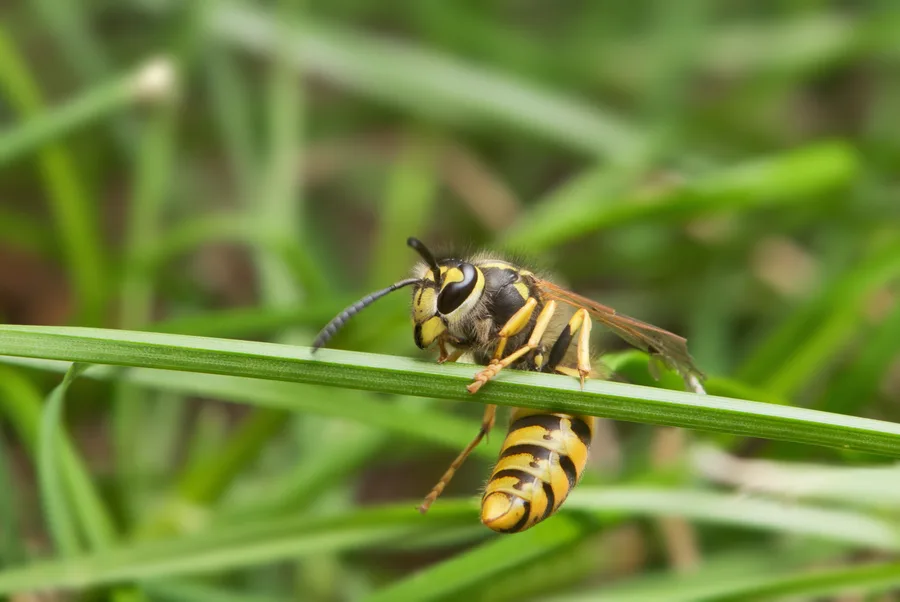
Cornell adds a flight cue: yellowjackets have short legs and a more compact body than the long-legged paper wasp, though the two can share similar coloring. The bald-faced hornet is covered in our bald-faced hornet guide, true hornets in the European hornet article, and the mud builder in our mud dauber guide. For every stinging species on the site side by side, use the predatory wasp comparison chart.
Life Cycle: How Long Paper Wasps Live
A paper wasp colony lives for one season. The Missouri Department of Conservation says each colony is started by one or a few overwintered females, usually in April; the earliest activity of the European species in Colorado can come in the first half of March, Colorado State University Extension reports. The first offspring are usually worker females, and for most of the summer the colony is mother and daughters working together. Males and new queens appear in mid- to late summer.
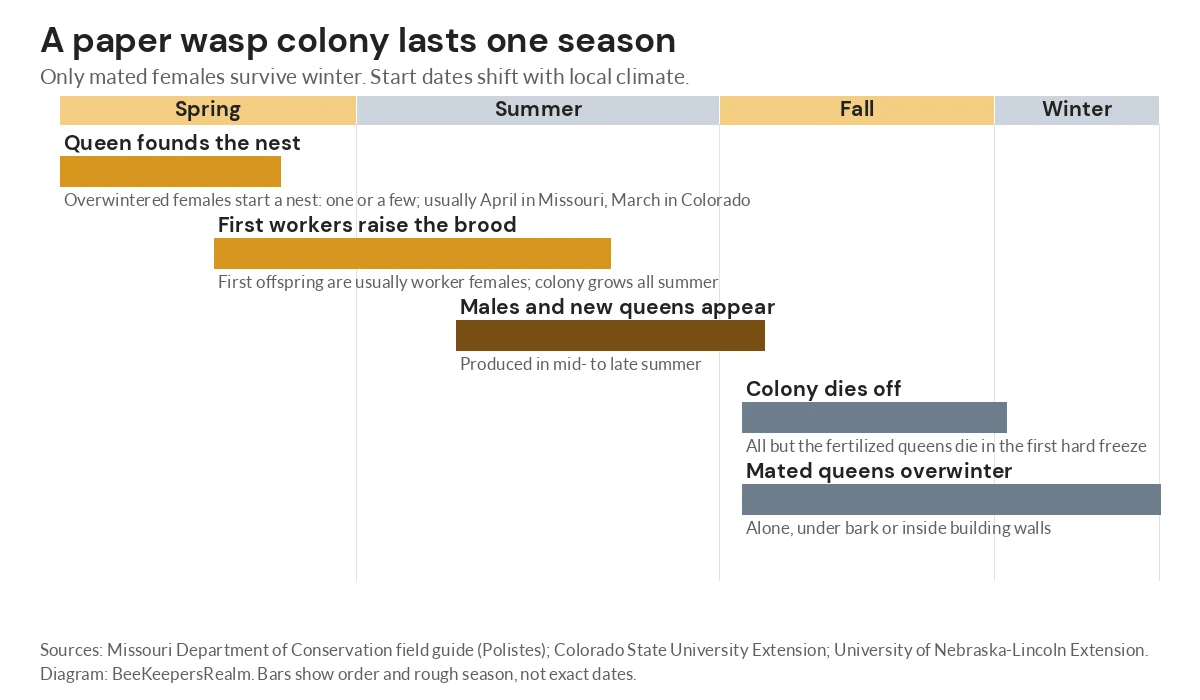
Lifespans are short. A 2021 Scientific Reports study of Polistes dominula states that workers usually live a few weeks while queens live as long as a year. Nebraska says only fertilized queens overwinter, and Missouri’s field guide says each passes the winter in a protected site such as under tree bark or inside building walls while the rest of the colony dies in the freezing weather of late fall. A warm spell can wake her, which is why a wasp sometimes flies on a February day.
Old nests are not reused. The Missouri field guide says nests are begun from scratch each spring and are very rarely reused, and Colorado State says nests are almost always built in new places. Cornell adds that queens are known to invade and take over other queens’ nests. The Nebraska guide’s advice for anyone with a harmless nest is that the colony dies after the first hard freeze.
What Paper Wasps Eat
Adults drink nectar from flowers and juice from fruits, according to Missouri’s field guide, and play a minor role in pollination. The young eat meat. A worker that finds a caterpillar kills it, chews it up and rolls it into a ball to carry home, NC State Extension explains. Colorado State lists hornworms, cabbageworms, tent caterpillars and sawfly larvae among the pests the European species preys on.
“Paper wasps specialize in feeding caterpillars to their young and so are among the most beneficial insects.”
NC State notes that conservation biological control efforts once focused on wooden nest boxes around tobacco fields to raise wasp numbers and cut caterpillar numbers. The same appetite has a cost: Colorado State says the European species sometimes feeds on sweet materials and can damage ripe fruit, notably cherries and stone fruit on Colorado’s Western Slope. Paper wasps do not make honey; their combs hold the brood.
Are Paper Wasps Aggressive? Temperament and Stings
Mostly no, away from the nest. UC Statewide IPM puts it plainly:
“Paper wasps are much less defensive and rarely sting humans.”
The Missouri Department of Conservation agrees that wasps foraging away from the nest are usually not aggressive, but workers defend the nest, and a late-summer nest bristling with dozens of wasps can be worrying. Cornell reports that paper wasps often warn intruders who come too close by flying into them without stinging. Take that as a cue to back away.
Sources do disagree on one species. Washington State calls the introduced European paper wasp aggressive and says to discourage it in gardens, while Colorado State calls it relatively non-aggressive and generally less likely to sting than most yellowjackets, with stings almost always following an accidental nest disturbance.
What a sting involves
Paper wasps can sting more than once. Their sting lancets do have small barbs, usually five or six each in the North American Polistes species measured in a 2021 study of 51 wasp species, but they almost never lodge in human skin, so the wasp pulls free and can sting again. Our bee sting vs. wasp sting article explains why a honey bee’s stinger stays behind and a wasp’s does not.
How much it hurts depends on the species. Entomologist Justin Schmidt rated the pain of 96 stinging insects on a 1-to-4 scale anchored on the honey bee at 2, and measured how toxic each venom was to mice. His 2019 paper in Toxins includes seven Polistes species. The table does not list P. fuscatus or P. dominula, the two species most Northeast readers will meet.
| Species | Pain rating (1 to 4) | Venom LD50 in mice (mg/kg; lower is more toxic) |
|---|---|---|
| Polistes instabilis (paper wasp) | 2 | 1.6 |
| Polistes arizonicus (paper wasp) | 2 | 2 |
| Polistes infuscatus (paper wasp) | 3 | 1.3 |
| Polistes erythrocephalus (paper wasp) | 3 | 1.5 |
| Polistes canadensis (paper wasp) | 3 | 2.4 |
| Polistes tepidus (paper wasp) | 3 | 7.7 |
| Polistes annularis (paper wasp) | 3 | 11 |
| Honey bee | 2 | 2.8 |
| German yellowjacket | 2 | 2.8 |
| Western yellowjacket | 2 | 6.4 |
| Bald-faced hornet | 2 | 6.1 |
Source: Schmidt, Toxins, 2019, Table 1. The lethal dose is the intravenous amount that killed half of the mice within 24 hours; it measures venom toxicity, not danger to people.
Read it this way: the rated paper wasps hurt about as much as, or a little more than, a honey bee or yellowjacket, and the mouse figures do not show a clear gap in venom strength. Their milder reputation rests on behavior, not on a weaker sting. Anyone allergic to wasp venom should treat any sting seriously; for first aid, warning signs and when to call for help, use our guide on how to treat a bee or wasp sting, and for the scale itself see the Schmidt sting pain index page.
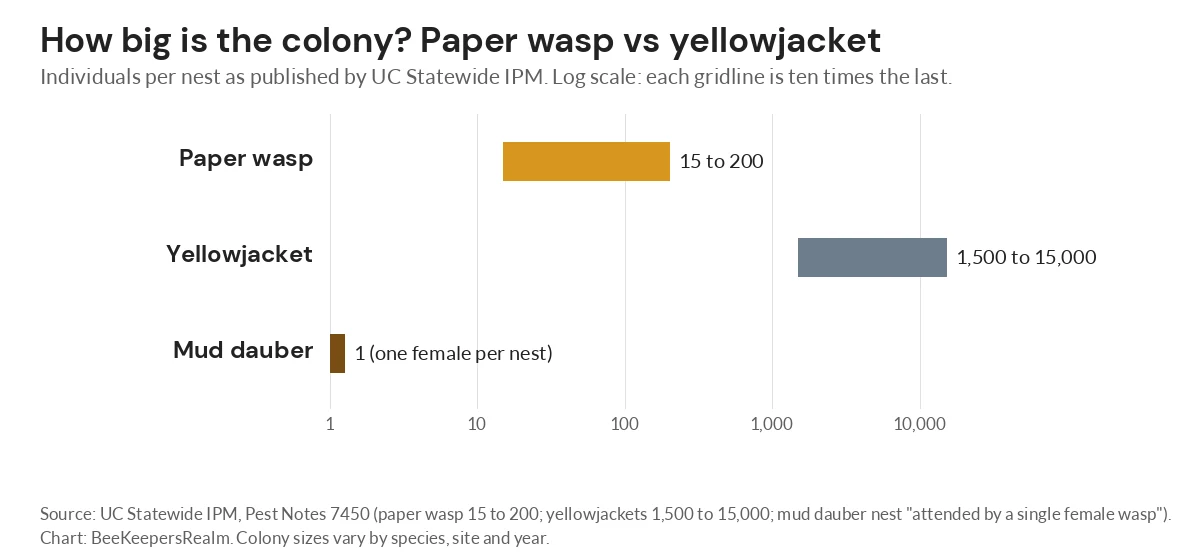
Colony size is the other half of the story. A nest of a few dozen wasps puts far fewer defenders in the air than a yellowjacket colony of thousands.
Leave the Nest or Remove It?
Extension specialists lean toward leaving a nest that is out of the way. UC Statewide IPM says paper wasp nests should not require treatment unless they are near people. Nebraska says that if you can avoid a nest and it is not bothering anyone, leave it alone, since the colony dies after the first hard freeze. Colorado State suggests waiting until the season ends and the nest is abandoned, then removing it.
A nest over a doorway, on a play structure or by a window is different. The Nebraska guide recommends treating after dark, when foragers have returned and it is cooler, in protective clothing covering body, face and hands, and recommends a professional for nests in wall voids or very high up. The pest-industry group PestWorld goes further and advises against any do-it-yourself removal. Our wasp nest removal guide covers identification, costs and when to call a pro, so we leave the steps there.
Wasps indoors in winter are usually not a nesting problem. PestWorld notes that future queens look for sheltered spots, sometimes indoors, to wait out the cold, and Colorado State says a winter encounter does not mean an active colony.
Paper Wasps Around Honey Bees
Beekeepers search for paper wasps too, so here is what the evidence supports. It is thin. A 1986 note in Entomological News by Patricia and Justin Schmidt, of the University of Arizona and the USDA’s Carl Hayden Bee Research Center, described a Polistes major castaneicolor catching a worker honey bee at a flowering tree in Arizona and eating it.
“this is apparently the first report of Polistes preying on honey bees.”
The authors saw it only once despite several years of collecting where both insects were common. A study of an apiary in South Korea’s Jirisan National Park, published in the Journal of Ecology and Environment in 2015, found that Polistes, Orancistrocerus and Bombus species had no impact on the honey bee colonies there. The damage came from Vespa hornets, with the yellow-legged hornet (V. velutina) the most frequent visitor, and from Vespula yellowjackets stealing honey. That is one park and one season, so treat it as a data point, not a rule.
On this evidence, a paper wasp nest near an apiary is a minor concern next to yellowjackets robbing weak colonies in late summer. See how to protect beehives from yellow jackets, our European hornet article and the yellow-legged hornet guide for the predators that matter.
Paper wasp colonies end each year too; see when wasps die off in autumn.
Paper wasps also carry pollen; see paper wasps as pollinators.
For the two rust-red eastern species, see red paper wasp identification and range.
Frequently Asked Questions
Will paper wasps sting you?
They can, but UC Statewide IPM says they rarely sting humans. Stings usually follow a disturbed nest or a wasp that is trapped or handled. If one flies at you near a nest, back away. See our sting first-aid guide if it happens.
What is the difference between a paper wasp and a yellowjacket?
A paper wasp is slender with long, dangling legs and an open, uncovered comb. A yellowjacket is stockier, nests in an enclosed paper nest that is often underground, scavenges at picnics and lives in far larger colonies. The table above compares them.
Can paper wasps sting more than once?
Yes. Their stingers have only small barbs that almost never lodge in skin, so they can sting repeatedly. Only females have a stinger.
What do paper wasps eat?
Adults drink nectar and fruit juice. Workers feed caterpillars and other soft-bodied insects, chewed up, to the larvae.
How long do paper wasps live?
Workers live a few weeks and queens as long as a year. The colony itself ends with the first hard freeze, and only mated females overwinter.
Do paper wasps reuse their nests?
Almost never. The Missouri Department of Conservation says nests are begun from scratch each spring and are very rarely reused.
Do paper wasps nest in the ground?
No. Their nests hang from overhangs, branches and structures. A hole in the ground with wasps streaming in and out points to yellowjackets, which the Nebraska guide says can nest underground in abandoned rodent burrows.
Why are paper wasps in my house?
In fall or winter, a single wasp indoors is usually a mated queen seeking shelter, not a nest. Colorado State says a winter encounter does not mean an active colony. A nest in a wall void or attic, with many wasps coming and going in summer, is another matter; see our nest removal guide.
Do paper wasps recognize faces?
Each other’s, yes. In a 2002 study in Proceedings of the Royal Society B, Elizabeth Tibbetts showed that Polistes fuscatus wasps recognize nestmates by their yellow facial and abdominal markings, and a 2011 Science paper by Sheehan and Tibbetts found that P. fuscatus has specialized face learning while a close relative, P. metricus, does not. We found no study showing they recognize people, so a wasp that keeps buzzing you is more likely guarding a nest nearby.
Should you get rid of paper wasps?
Not if the nest is out of the way: they eat caterpillars and die off at the first hard freeze. Remove or treat one only where people pass close by, using the steps in the wasp nest removal guide or a professional.
Header photo: Alejandro Santillana, Insects Unlocked project (University of Texas at Austin), via Wikimedia Commons, CC0, cropped and resized.