Reviewed by Michael R. · How we review
A fig wasp is a tiny insect, smaller than a sesame seed, that pollinates figs and does not sting people. Most figs sold in the U.S. never met one: Black Mission, Brown Turkey and Celeste figs set fruit without pollination. Only wasp-pollinated types, such as Calimyrna, can have had a wasp inside, and the fig breaks her body down, so you will not find wasp parts. The crunch you feel is seeds.
This page covers what the wasp is, how its life cycle works step by step, what really happens to a wasp that dies in a fig, and which common U.S. fig varieties need one. The facts come from the U.S. Forest Service, the University of Maryland, the Alabama Cooperative Extension System and a UC Davis extension specialist quoted in Bon Appétit, each linked where used.
Key Takeaways
- Fig wasps are pollinators, not stingers. Live Science says they are about the size of a fruit fly and cannot sting humans.
- An adult female lives roughly one to two days, so everything she does (find a fig, pollinate, lay eggs) happens fast.
- Extension specialists sort edible figs into three groups: common figs need no wasp, Smyrna types need one, and San Pedro types sit in between.
- A wasp that dies in an edible fig is broken down as the fruit ripens. Sources differ slightly on how, but agree that no recognizable wasp is left.
- If you grow figs at home, a common fig such as Brown Turkey or Celeste needs no wasp at all.
Table of Contents
- What a Fig Wasp Is (and Is Not)
- Why Honey Bees Cannot Pollinate Figs
- A Fig Is a Flower Cluster Turned Inside Out
- The Fig Wasp Life Cycle, Step by Step
- Are There Dead Wasps in the Figs You Eat?
- Which Figs Need a Wasp? U.S. Varieties Compared
- Fig Wasps in the United States
- Cheaters: Fig Wasps That Do Not Pollinate
- Why Fig Wasps Matter in the Wild
- Frequently Asked Questions
- The Bottom Line
What a Fig Wasp Is (and Is Not)
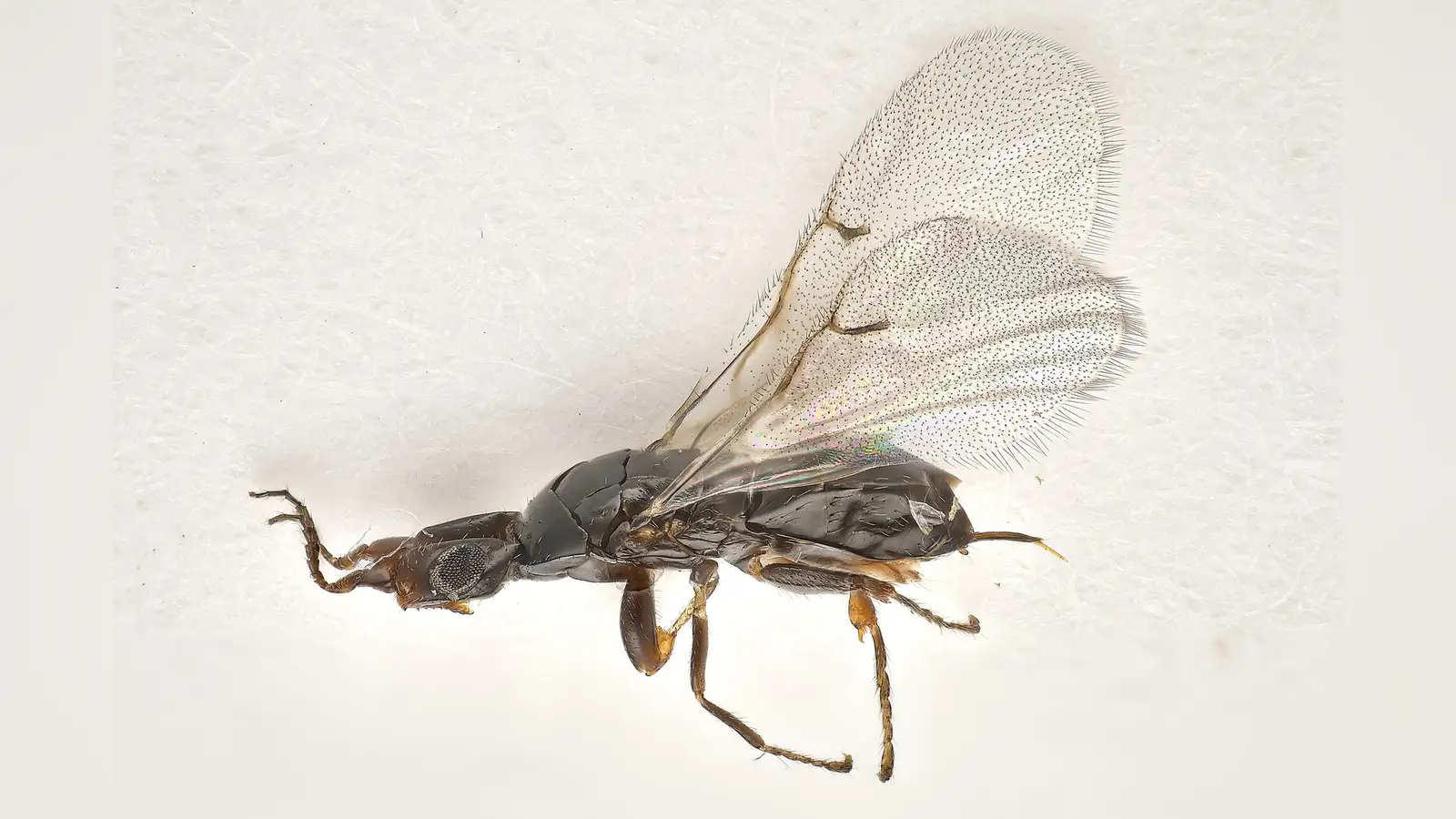
A fig wasp is not the kind of wasp that nests under your eaves. Live Science describes fig wasps as about the size of a fruit fly and says they are not the wasps that sting humans. The University of Maryland calls the insect tinier than a sesame seed. The U.S. Forest Service says all fig trees are pollinated by very small wasps of the family Agaonidae, and that the two species serving the United States’ native figs are so well hidden they have no common name, only scientific ones.
Fig trees come in roughly 850 or more species. Uppsala University researcher Charlotte Jandér told Live Science that each one can be pollinated by one specific fig wasp species. Treat that as a rule of thumb. University of Maryland genetic work found that fig wasps sometimes jump to a new fig species, occasionally displacing the original wasp.
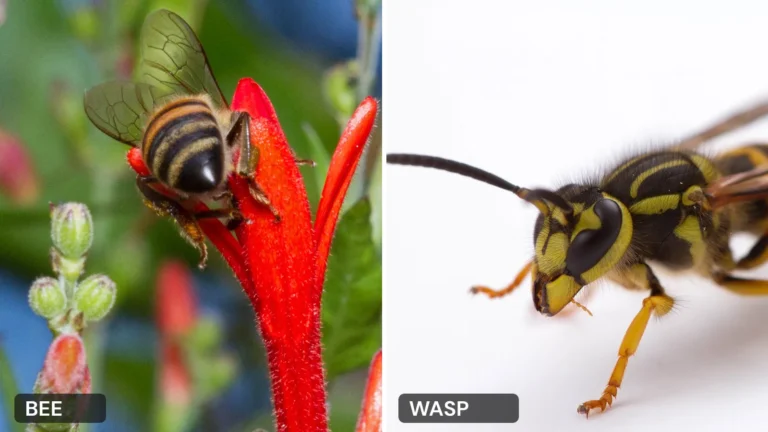
Other tiny wasps that gardeners meet, such as braconid wasps and ichneumon wasps, are insect-hunting parasites, not fig partners. For the stinging kind, see our bee vs. wasp identification guide and hornet vs. wasp.
Why Honey Bees Cannot Pollinate Figs
A fig tree shows no visible flowers, which is why figs surprise people. The Forest Service explains that the fig is the swollen stem of a flower cluster, with the tiny flowers sealed inside. University of Maryland biology professor Carlos Machado says those flowers cannot be pollinated by wind or by other insects; they depend on host-specific wasps.
That has a practical meaning for anyone who keeps bees: a hive in the yard does nothing for a fig that needs pollination. Our guide to pollination syndromes shows how a flower’s shape decides who can visit it, and the bee orchid is another plant built around a single trick.
A Fig Is a Flower Cluster Turned Inside Out
The fruit you eat is a syconium. The Alabama Cooperative Extension System’s fig guide describes it as a fleshy stem with a hollow center that envelops many tiny flowers. The small drupelets that develop from those flowers are the true fruit, so when you eat a fig you are eating the container around the true fruit. At the tip is a small opening called the ostiole, or eye, which lets a pollinating wasp in. The guide adds that not every fig type has one.
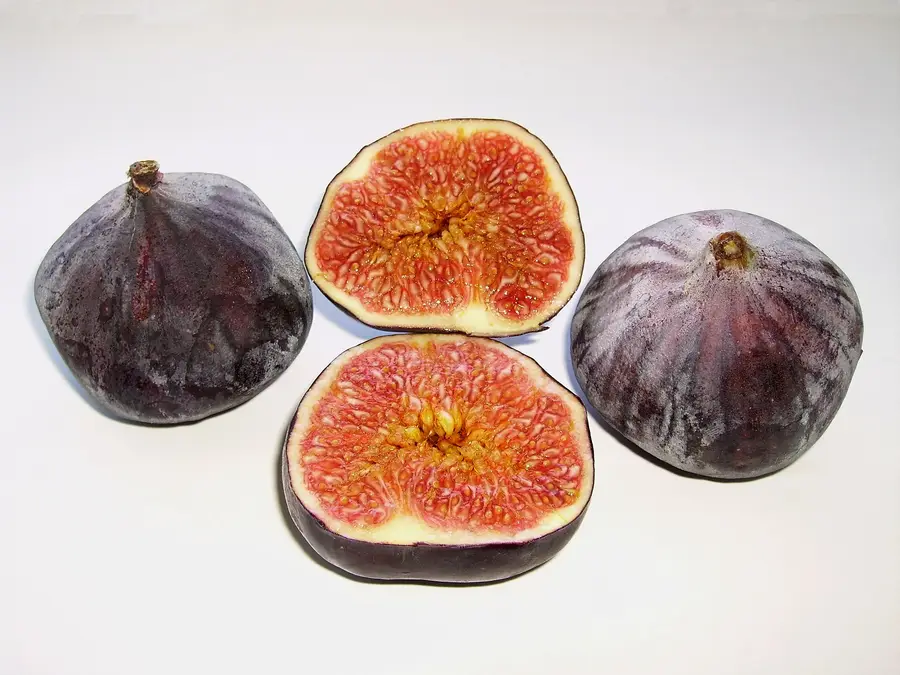
The crunchy bits are seeds. The Forest Service notes that each one corresponds to a single flower. A hidden flower cluster with a nearly sealed door needs a pollinator small enough to walk in, which is where the fig wasp comes from.
The Fig Wasp Life Cycle, Step by Step
The cycle below is for a pollinating species, simplified from the Forest Service, the University of Maryland and Bon Appétit. Individual species differ in the details.
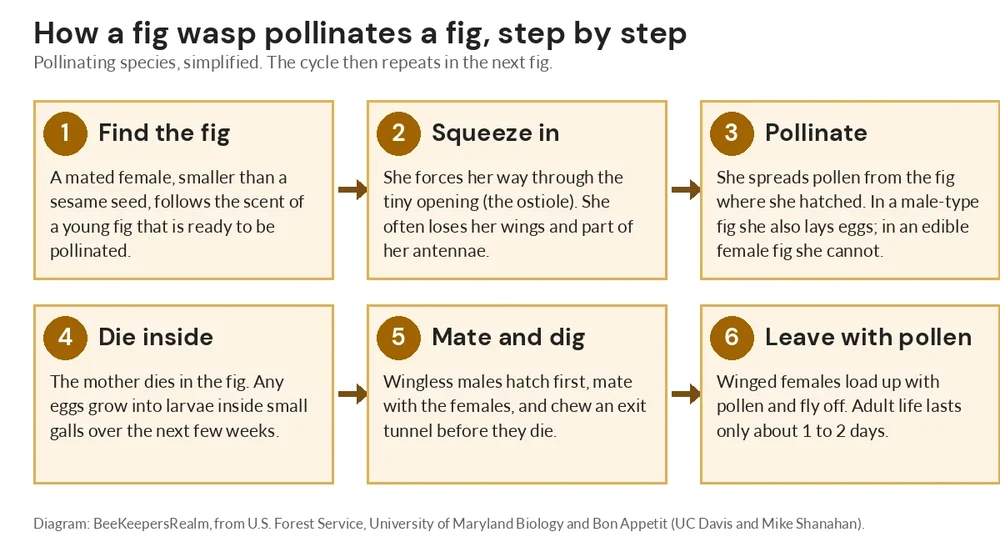
- Follow the scent. When the female flowers in a young fig are ready, the fig gives off a scent that attracts only female wasps of the right species, according to the Forest Service. Guided by these chemical signals, the University of Maryland says, a wasp may travel long distances, sometimes more than 100 miles.
- Squeeze through the eye. The passage is so tight that the wasp usually loses her wings and pieces of her antennae. She will not need them again.
- Pollinate and lay eggs. She walks over many flowers, spreading pollen from the fig where she was born, and lays eggs inside some of the flower ovaries. The Forest Service says pollen reaches every flower, but the eggs go only into ovaries she can reach. The flowers she cannot reach develop into seeds. The University of Maryland notes that the wasps evolved “pollen pockets” in their abdomens and combs on their legs for collecting and carrying fig pollen.
- Die inside. The mother dies in the fig. Her eggs hatch into grubs that grow inside the flowers and finish developing in a few weeks.
- Males hatch, mate and dig. The Forest Service says the males emerge first. They are smaller than the females and have no wings. They mate with the females, and the University of Maryland adds that the males use their mandibles to chew a hole through the fig wall before dying inside.
- Females leave with pollen. The winged, already-mated females collect pollen and leave through the tunnel to find another fig. Bon Appétit puts an adult female’s life at rarely more than 48 hours.
There is a wrinkle that explains the whole “wasp in my fig” story. Bon Appétit’s source, ecologist Mike Shanahan, says the figs we eat generally come from species where each tree behaves as either male or female. If the wasp enters a male-behaving fig, she lays eggs and the cycle repeats. If she mistakenly enters a female-behaving fig, there is no room to lay eggs, so she only pollinates and dies without offspring. Live Science says the same: a female wasp in a fig from a female tree, the kind we eat, only pollinates, because the flowers inside are too long for her eggs. Male-type figs, called caprifigs, are generally not eaten. In other words, an edible fig is a dead end for the wasp.
The timing also explains why wild figs seem to fruit all year. With adult lives this short, Shanahan says, there must always be some unripe figs for the wasps to find, or they would go extinct.
Are There Dead Wasps in the Figs You Eat?
Short answer: in a few fig types a wasp may have died inside, but she does not stay as a recognizable wasp. It depends on which of three situations the fig is in.
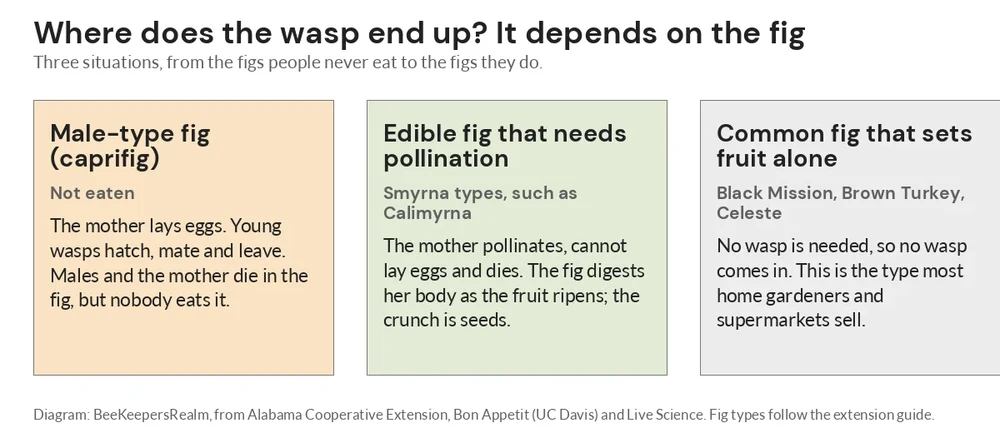
In a caprifig, the wasp’s offspring hatch, mate and leave, but nobody eats the fruit. The Alabama guide calls caprifigs generally unpalatable, dry and pithy. In a common fig, no pollination is needed, so there is no reason for a wasp to be involved. The interesting case is an edible fig that does need pollination, such as Calimyrna, where a female may enter, pollinate and die.
What happens next is the part the viral posts leave out. Louise Ferguson, an extension specialist in UC Davis’s Department of Plant Sciences, told Bon Appétit that the fig itself takes care of it.
“There’s no fig wasp in there by the time people are eating the fruit.”
Bon Appétit reports that the female fig produces an enzyme that completely digests the wasp’s exoskeleton, and that the crunchy bits are seeds, not wasp parts. The Alabama extension guide is consistent with this: it says fig latex, the milky sap, contains an enzyme that degrades protein. The enzyme is usually called ficin, also spelled ficain.
Live Science gives the same outcome with a slightly different emphasis. Jandér said a wasp that dies inside is squished and decomposes as the fig matures, so even if remnants remained you would probably not see them. Live Science also notes that in the common fig species the opening is large enough that a wasp can sometimes leave again after entering. So the sources agree on the result, no recognizable wasp, and differ a little on how much credit the enzyme gets.
Which Figs Need a Wasp? U.S. Varieties Compared
The Alabama Cooperative Extension System sorts edible figs into three fruiting classes. This table combines that guide with the varieties Ferguson named in Bon Appétit.
| Fig group | Needs a wasp to set fruit? | Varieties the sources name | Could a wasp have been inside? |
|---|---|---|---|
| Common (persistent) | No. These set crops without pollination. | Black Mission, Brown Turkey, Celeste, Brunswick, Adriatic (Alabama Extension); also Kadota and Sierra (Ferguson) | No wasp is needed, so none is expected |
| San Pedro (intermediate) | The early breba crop does not; the main crop needs it in some environments | King, Lampeira, San Pedro | Possible in a pollinated main crop |
| Smyrna (caducous) | Yes. Without pollination the fruit drops before it matures. | Calimyrna (also Sari Lop), Marabout, Zidi | Possible; the fig breaks her body down |
| Caprifig (male type) | Supplies the pollen and the wasps’ nursery | Wild and male trees, generally not eaten | Not applicable; not sold as food |
Sources: Alabama Cooperative Extension System, Fig Production Guide (last reviewed June 2023); Louise Ferguson, in Bon Appétit (September 2022).
The same guide cites Ira Condit’s monograph on fig varieties, which counts 89 caprifig, 129 Smyrna, 21 San Pedro and 481 common varieties, 720 in all. By that count about two in three catalogued varieties are the no-wasp kind, although the guide notes that some were never introduced into the United States.
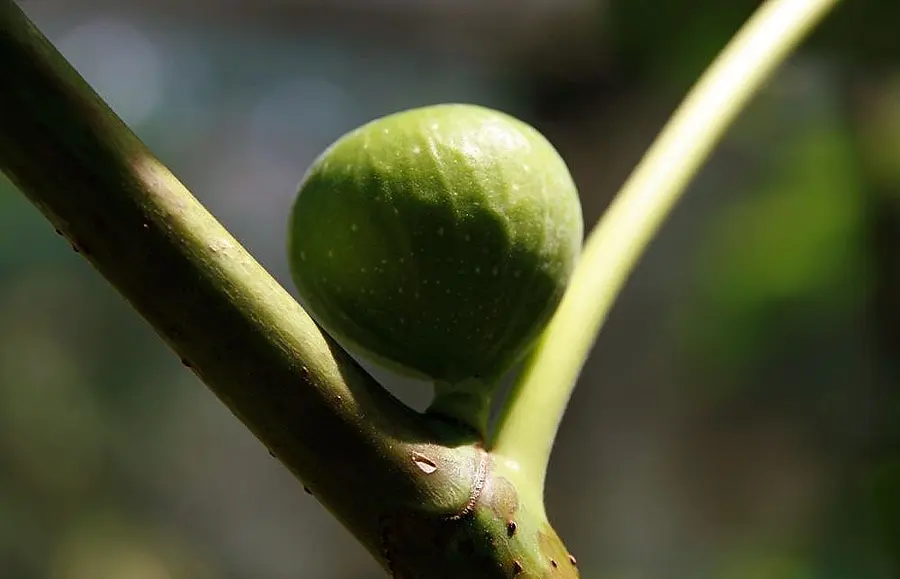
“Persistent (or common) figs do not need pollination to set crops and are the type home gardeners most commonly grow.”
The one name on the wasp-dependent list that shoppers actually meet is Calimyrna. The Alabama guide calls it the California commercial fig and says it needs pollination and is not practical for southern growers. Bon Appétit adds that Calimyrna has yellow-green skin and is typically sold dried.
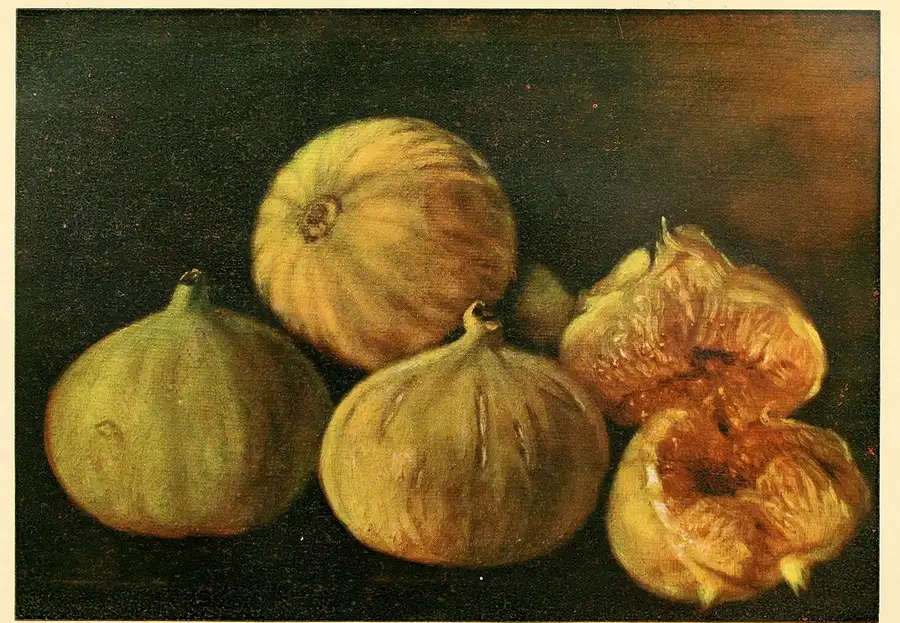
Can you tell from the outside which type you bought? Not really. Shanahan told Bon Appétit there is no way to tell from the outside, but a fig that contains seeds will have been pollinated by a fig wasp. That fits the biology: the seeds are the pollinated flowers.
Fig Wasps in the United States
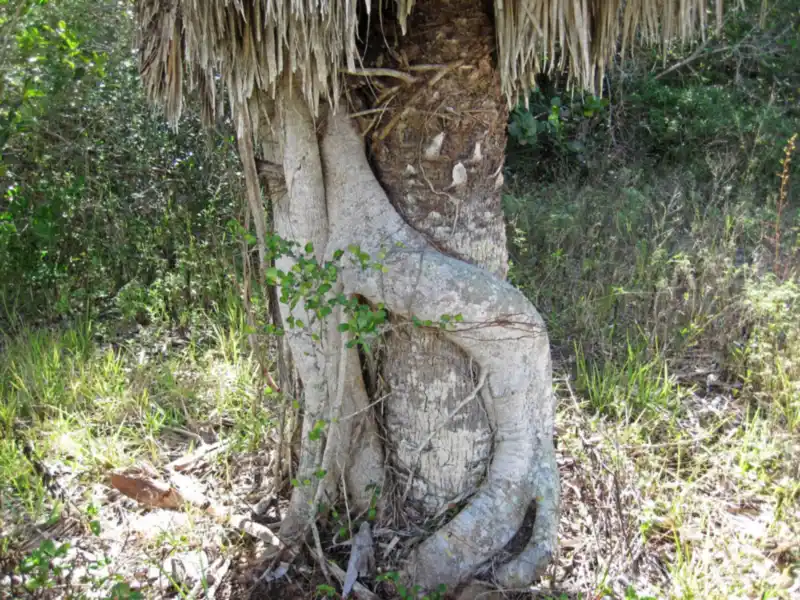
The wild fig wasps nobody notices live in Florida. The Forest Service names just two fig species native to the United States: the Florida strangler fig (Ficus aurea) and the shortleaf fig (Ficus citrifolia). Each needs one wasp species. The strangler fig is pollinated by Pegoscapus mexicanus and the shortleaf fig by Pegoscapus tonduzi.
The eating-fig side of the story is mostly Californian, because that is where Calimyrna grows. Everywhere else, the figs in a typical U.S. home garden are the common type that needs no wasp. The Alabama guide also reminds growers that these are warm-climate plants: in the southeastern United States, cold injury typically holds fig trees to 15 to 25 feet.
“Most figs we eat in the US have no wasps inside them.”
Cheaters: Fig Wasps That Do Not Pollinate
Not every fig wasp is a partner. The University of Maryland describes some wasps that enter figs and lay eggs without pollinating, a kind of cheating. In most cases, fig trees evolved to punish them by dropping the unpollinated figs, so the cheaters’ offspring do not survive. Machado’s team studied two wasp species that became full-time cheaters and lost their pollen-carrying structures entirely, because without that punishment they could survive.
It is a good reminder that “fig wasp” covers many insects with different lifestyles. If you want to see how other wasps compare, our predatory wasp comparison chart sorts the species we cover by what they hunt.
Why Fig Wasps Matter in the Wild
Outside the orchard, the partnership holds up whole ecosystems. Machado says figs are central to tropical forest diversity because they produce fruit year-round, which feeds animals that in turn spread fig seeds. Shanahan told Bon Appétit that figs feed more animals than any other fruit. He also puts the partnership at around 80 million years old, which he says means it began before the last of the giant dinosaurs were extinct. Machado worries that more extreme weather and habitat fragmentation could strain the relationship in the future.
Fig wasps are not the only ones; see which other plants wasps pollinate.
Frequently Asked Questions
Do figs still contain wasps?
Mostly no. Common figs set fruit without pollination, and in wasp-pollinated types the dead wasp is broken down as the fruit ripens, so you will not find wasp parts.
What is the fig wasp theory?
The idea is that figs and fig wasps evolved together. The University of Maryland says the partnership has been shaping life on Earth for over 70 million years. The same researchers found it is not perfectly one-to-one, since wasps sometimes switch to a new fig species.
Do fig wasps sting people?
No. Live Science says fig wasps cannot sting humans and are much smaller than the wasps that do. For real stings, see bee sting vs. wasp sting.
Are there any figs without wasps?
Yes, most of the figs sold in the U.S. According to the Alabama guide, common figs such as Black Mission, Brown Turkey and Celeste set crops without pollination.
Do all figs involve wasps?
No. Only Smyrna types, the main crop of San Pedro types in some environments, and wild figs depend on wasps. Machado told Live Science that most wild figs do require pollination to ripen.
Can figs be grown without wasps?
Yes. Pick a common fig for a home garden. The Alabama guide says common figs are the type home gardeners most commonly grow and that Calimyrna is not practical for southern growers.
Is there a myth about fig wasps in figs?
The myth is that every fig is packed with dead wasps. Live Science calls the truth somewhere in between: wasps are essential to many wild figs, but most supermarket figs are likely bug-free.
How long do fig wasps live?
Adult females live only one to two days, according to the University of Maryland, and Bon Appétit puts it at rarely more than 48 hours.
Are figs vegan?
Most supermarket figs involve no wasp, as above. Whether a wasp-pollinated fig is acceptable is an ethics call this page cannot settle. For a similar debate with honey, see is honey vegan?
The Bottom Line
The wasp-in-every-fig story mixes a real partnership with a sweeping claim. To avoid the question entirely, choose common figs. To learn more, the Forest Service page is a good short read, and the University of Maryland piece covers the cheaters.
Header photo: Blastophaga psenes, female, collected in Germany in 2022. Photo: Dr. Stefan Schmidt, SNSB-Zoologische Staatssammlung München, via Wikimedia Commons, CC BY-SA 4.0, background extended to 16:9.