Last Updated September 15, 2026
Few insects trigger a more instant, panicked reaction than an ichneumon wasp trailing what looks like a massive, menacing stinger several times longer than its own body, and few insects deserve that reaction less. That intimidating appendage isn’t a stinger at all, and the wasp attached to it is entirely incapable of hurting a person regardless of how alarming it looks up close. This guide covers what ichneumon wasps actually are, the genuine parasitic lifecycle behind that dramatic tail structure, why it’s an ovipositor rather than a weapon, and why this family, sometimes now called “Darwin wasps,” represents one of the most ecologically important, genuinely misunderstood insect groups covered on this site.
Table of Contents
- Key Takeaways
- What Ichneumon Wasps Actually Are
- The “Stinger” Is Actually an Ovipositor, Not a Weapon
- The Genuine Parasitic Lifecycle Behind the Long Tail
- A Genuinely Massive, Diverse Family
- Why This Family Matters Ecologically
- Can Ichneumon Wasps Sting or Bite People at All?
- Ichneumon Wasps vs. Actual Stinging Wasps on This Site
- How Females Actually Find Hidden Hosts
- A Historically Significant Family in the History of Evolutionary Biology
- Genuine Agricultural and Garden Pest Control Value
- Common Mistakes
- Frequently Asked Questions
Key Takeaways
- The long “tail” on a female ichneumon wasp is an ovipositor, an egg-laying organ with no venom-delivery capability — not a stinger, and not a weapon.
- Ichneumonidae is the largest family in Hymenoptera: roughly 25,000 species formally described as of 2016, with total estimates ranging from 60,000 to over 100,000 species.
- In the giant ichneumon genus Megarhyssa, a female’s body reaches about 1.5 inches, while her ovipositor alone can run 4 to 5 inches — several times her own body length.
- Charles Darwin cited this exact family in an 1860 letter to Asa Gray as a genuine source of theological difficulty, writing that he couldn’t persuade himself a benevolent God would “designedly” create wasps that feed within the living bodies of caterpillars — a passage still cited in evolutionary biology and philosophy-of-science literature today.
- No documented evidence links ichneumon wasps to honeybee predation or parasitism; their host range is entirely separate from bee-related concerns.
What Ichneumon Wasps Actually Are
Ichneumon wasps belong to the family Ichneumonidae, the largest family in the entire order Hymenoptera and one of the most species-rich animal families on Earth: roughly 25,000 species have been formally described as of 2016, but total estimates range from 60,000 to well over 100,000 species once undescribed diversity is accounted for. They’re found across virtually every terrestrial habitat worldwide, including throughout North America specifically. Unlike every stinging hunting wasp already covered on this site, ichneumon wasps are parasitoids rather than predators in the conventional sense, meaning their larvae develop by feeding on a host insect from the inside, ultimately killing it, rather than being provisioned with paralyzed prey the way mud dauber or potter wasp larvae are.
The “Stinger” Is Actually an Ovipositor, Not a Weapon
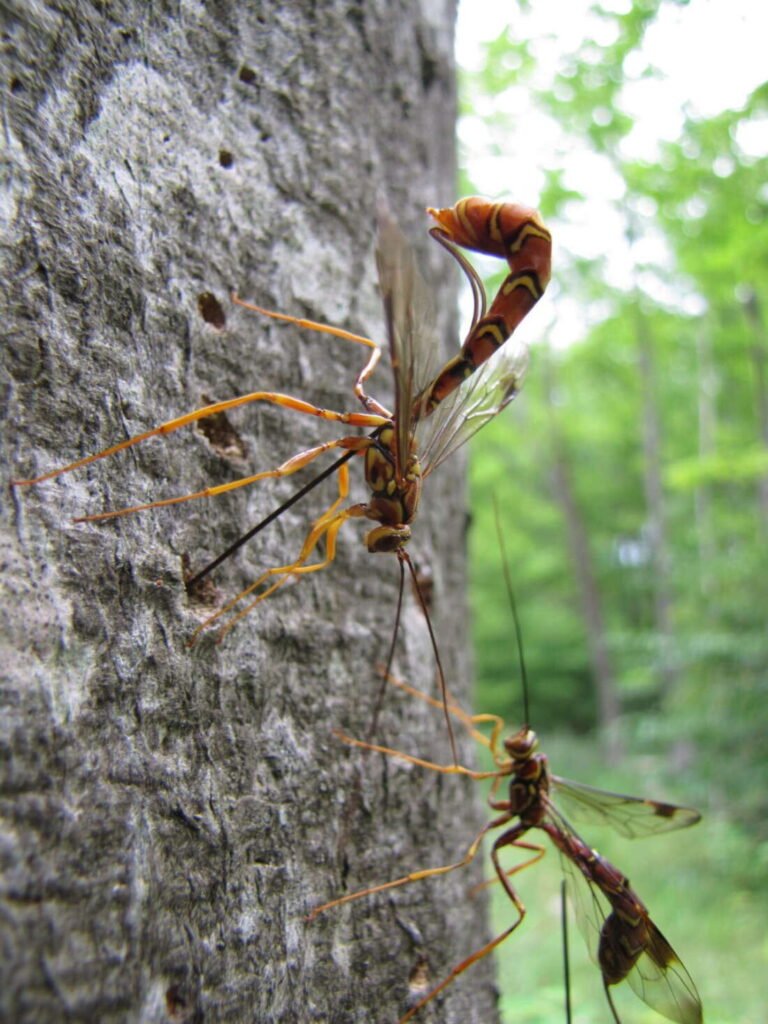
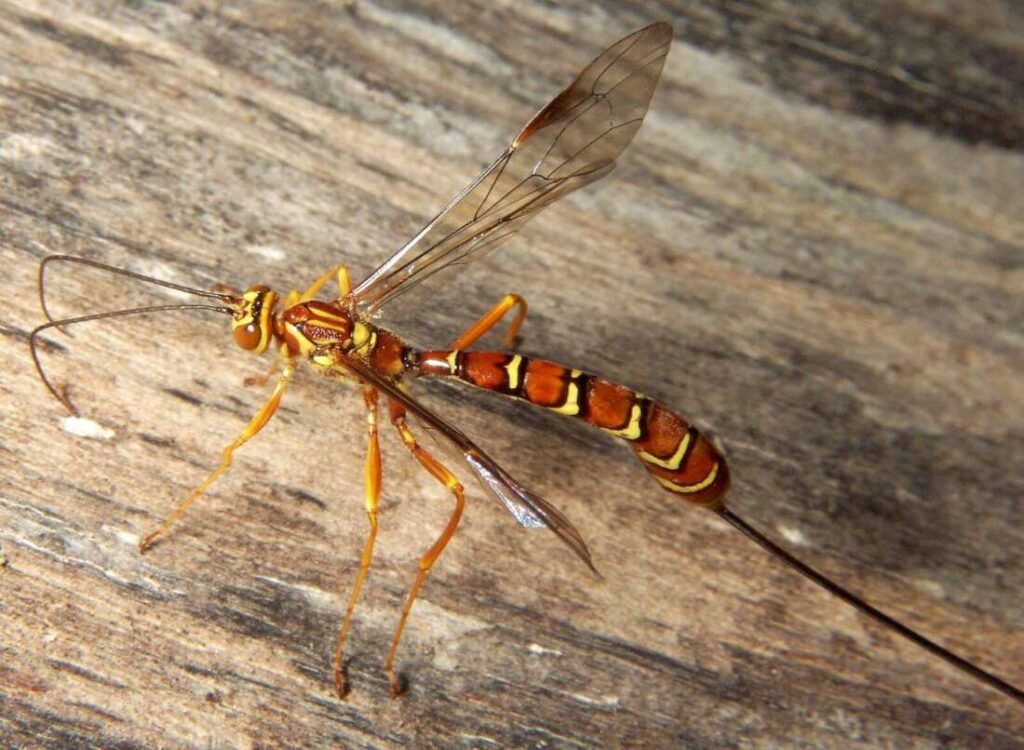
The dramatic, often intimidatingly long tail structure seen on many female ichneumon wasps is genuinely not a stinger at all; it’s an ovipositor, an egg-laying organ used to insert eggs into or onto a host insect, sometimes reaching deep into wood or plant material to access a hidden host larva. In the giant ichneumon genus Megarhyssa, this reaches its most extreme form: according to the Missouri Department of Conservation, a female Megarhyssa atrata has a body around 1.5 inches long but an ovipositor that can extend 5 inches, and Megarhyssa macrurus females carry an ovipositor around 4 inches long — several times the length of the wasp’s own body. This is a genuinely important, easily verified distinction: a stinger is a modified, venom-delivering egg-laying structure repurposed for defense, while an ichneumon’s long ovipositor is used exclusively for its original reproductive function and simply cannot deliver a venomous sting the way a true stinging wasp’s modified ovipositor can.
Why does the ovipositor need to be so dramatically long in some species?
Many ichneumon wasp species specifically target host insects that themselves are hidden deep inside wood, plant stems, or other concealed locations, so an unusually long ovipositor allows the female to physically reach and deposit an egg on or near a host she can’t directly access with a shorter structure, a genuinely practical adaptation to a hidden-prey-location problem rather than a defensive feature.
The Genuine Parasitic Lifecycle Behind the Long Tail
A female ichneumon wasp locates a suitable host, often the larva of a beetle, moth, or another insect, and uses her ovipositor to lay one or more eggs directly in or on that host. The ichneumon larva that hatches then feeds on the host from the inside, generally consuming non-essential tissue first to keep the host alive as long as possible before eventually killing it as the parasitoid larva completes development, a genuinely different and more gradual strategy than the immediate paralysis-and-consumption pattern used by the hunting wasps covered elsewhere on this site.
A Genuinely Massive, Diverse Family
The sheer scale of the Ichneumonidae family is genuinely remarkable: alongside the closely related family Braconidae, it’s one of the two largest families within Hymenoptera, and individual species vary enormously in size, host preference, and ovipositor length. Identification features shared across most of the family include unusually long antennae, at least half the length of the body and made up of 16 or more segments (compared to 13 or fewer in most other wasps), often marked with a yellow or white band. This diversity means “ichneumon wasp” describes an entire vast family rather than one uniform-looking insect, and the specific dramatic long-tailed appearance that triggers the most alarm represents just one visible subset of the family’s actual range of forms.
Why This Family Matters Ecologically
Because ichneumon wasps parasitize such an enormous range of host insects, including many genuine agricultural and garden pests, the family as a whole plays a genuinely significant role in natural pest population control, similar in principle to the role covered for braconid wasps elsewhere on this site, though through an independently evolved, taxonomically distinct lineage. This ecological importance is part of why entomologists generally regard ichneumon wasps as overwhelmingly beneficial insects despite their frequently alarming appearance to the average person encountering one for the first time.
Can Ichneumon Wasps Sting or Bite People at All?
The vast majority of ichneumon wasp species are genuinely incapable of stinging people at all, since their ovipositor lacks the venom-delivery function of a true stinger; some larger species can deliver a minor, mostly harmless pinch or prick if handled roughly, but this bears no resemblance to an actual venomous sting from a wasp like a yellowjacket or paper wasp. This makes ichneumon wasps, despite their frequently unsettling appearance, among the most genuinely low-risk insects covered anywhere on this site.
Ichneumon Wasps vs. Actual Stinging Wasps on This Site
| Trait | Ichneumon Wasp | Actual Stinging Wasps (e.g. Yellowjacket) |
|---|---|---|
| Long tail structure | Ovipositor (egg-laying only) | N/A – stinger is short and hidden |
| Can sting with venom? | No (in the vast majority of species) | Yes |
| Reproductive strategy | Parasitoid – larva consumes a host from inside | Predatory or scavenging, not parasitoid |
| Ecological role | Major biological pest control | Mixed – some beneficial, some considered pests |
How Females Actually Find Hidden Hosts
Locating a host larva concealed deep inside solid wood or plant stem tissue, with no visible entrance to guide her, is a genuinely impressive sensory feat, and researchers believe many ichneumon wasp species accomplish this using highly sensitive vibrational and chemical detection through their antennae, picking up on subtle cues like the host’s feeding vibrations or associated fungal activity within the wood. Once a suitable host is detected, the female positions her ovipositor precisely and drives it through the intervening material, a process that can take considerable time and effort depending on how deeply buried the target host actually is.
A Historically Significant Family in the History of Evolutionary Biology
The genuinely brutal, slow-consuming parasitic lifecycle covered earlier in this guide famously troubled Charles Darwin himself. In a letter to the botanist Asa Gray dated 22 May 1860, Darwin wrote directly about this family by name, and the letter survives in full today through the Darwin Correspondence Project.
“I cannot persuade myself that a beneficent & omnipotent God would have designedly created the Ichneumonidæ with the express intention of their feeding within the living bodies of caterpillars.”
This historical connection has made ichneumon wasps a genuinely notable reference point in broader discussions of evolutionary biology and natural selection well beyond entomology specifically, cited repeatedly in philosophy-of-science and biology-history literature discussing how such a lifecycle fits into evolutionary theory. That legacy is part of why some entomologists have more recently begun using “Darwin wasps” as an alternative common name for the family.
Genuine Agricultural and Garden Pest Control Value
Because ichneumon wasp species collectively parasitize such an enormous range of insect hosts, including numerous species considered significant agricultural and garden pests, the family provides genuinely substantial natural pest suppression that many gardeners and farmers benefit from without realizing it. Some agricultural pest management programs specifically account for and try to preserve existing ichneumon wasp populations when planning pesticide use, recognizing their real, measurable contribution to keeping certain pest insect populations in check without any chemical intervention required.
Common Mistakes
The most common mistake, by a wide margin, is assuming the long tail on an ichneumon wasp is a stinger and treating the insect as dangerous, when it’s genuinely an egg-laying ovipositor with no venom-delivery capability at all. Another mistake is assuming all ichneumon wasps look the same or share one narrow appearance, when the family’s genuine scale and diversity means species vary enormously in size, color, and ovipositor length. People also sometimes kill ichneumon wasps out of fear, when the family’s overwhelming ecological role is beneficial pest control rather than any threat to people, pets, or garden plants.
Frequently Asked Questions
What’s the easiest way to tell an ichneumon wasp apart from an actual stinging wasp at a glance?
The presence of a visibly long, thread-like tail structure trailing well behind the body is a strong indicator of an ichneumon wasp specifically, since true stinging wasps keep their stinger internal and don’t display an externally visible egg-laying tail of that kind. Unusually long antennae with 16 or more segments are another reliable clue even on species without a dramatic ovipositor.
Do ichneumon wasps target honeybee colonies or pose any threat to beekeeping?
No documented evidence links ichneumon wasps to honeybee predation or parasitism; their host range centers on other insect groups entirely, making them ecologically unrelated to the predator concerns covered in this site’s bee vs. wasp identification guide.
Did Darwin specifically use the ichneumon wasp as an argument against religious belief entirely, or was it more nuanced?
Darwin’s actual point was more nuanced than a blanket rejection of religion; the same letter opens with him calling the theological question “always painful to me” and insisting he had “no intention to write atheistically” — a genuinely specific struggle to reconcile the group’s consumption-based lifecycle with a benevolently designed world, rather than a broader argument against faith itself.
Is it true that some ichneumon wasps parasitize other parasitic wasps rather than a typical host insect?
Yes, this genuinely occurs and is called hyperparasitism, where one parasitic wasp species targets the larva of another already-parasitic species as its host, adding a genuinely fascinating additional layer of complexity to the family’s already elaborate host relationships covered throughout this guide.
Are ichneumon wasps ever intentionally used in commercial biological pest control the way some other beneficial insects are sold to gardeners?
Yes, certain ichneumon wasp species and their close relatives are used in commercial and agricultural biological control programs specifically because of their genuine effectiveness against particular pest insects, though this practice is generally more established at a commercial agricultural scale than as a widely available retail product for home gardeners.
How does the ichneumon wasp’s parasitic strategy compare to other parasitic wasp families?
The closely related braconid wasps use a broadly similar parasitoid strategy and share the same superfamily, Ichneumonoidea, but are an independently distinct family with their own identifying features, most visibly the white external cocoons often seen on parasitized tomato hornworms, meaning “ichneumon wasp” describes just one specific, if genuinely enormous, branch of the broader parasitic-wasp world rather than the entire category.
Further Reading
- Cicada Killer Wasps: The Giant, Harmless Wasp Everyone Panics About
- European Paper Wasp: The Invasive Species Now Outcompeting Native Paper Wasps
- Pelecinid Wasps: The Insect With the Longest “Tail” You’ll Ever See on a Wasp
- Braconid Wasps: Nature’s Tiny, Devastatingly Effective Pest Controllers
- Bee vs. Wasp: The Complete Identification Guide
Image credits: Photo: Seney Natural History Association / Mike McCarthy, via Wikimedia Commons. Licensed CC BY-SA 2.0; Photo: Bruce Marlin, via Wikimedia Commons. Licensed CC BY-SA 2.5.