Reviewed by Sofia T. · Last Updated November 4, 2026 · How we review
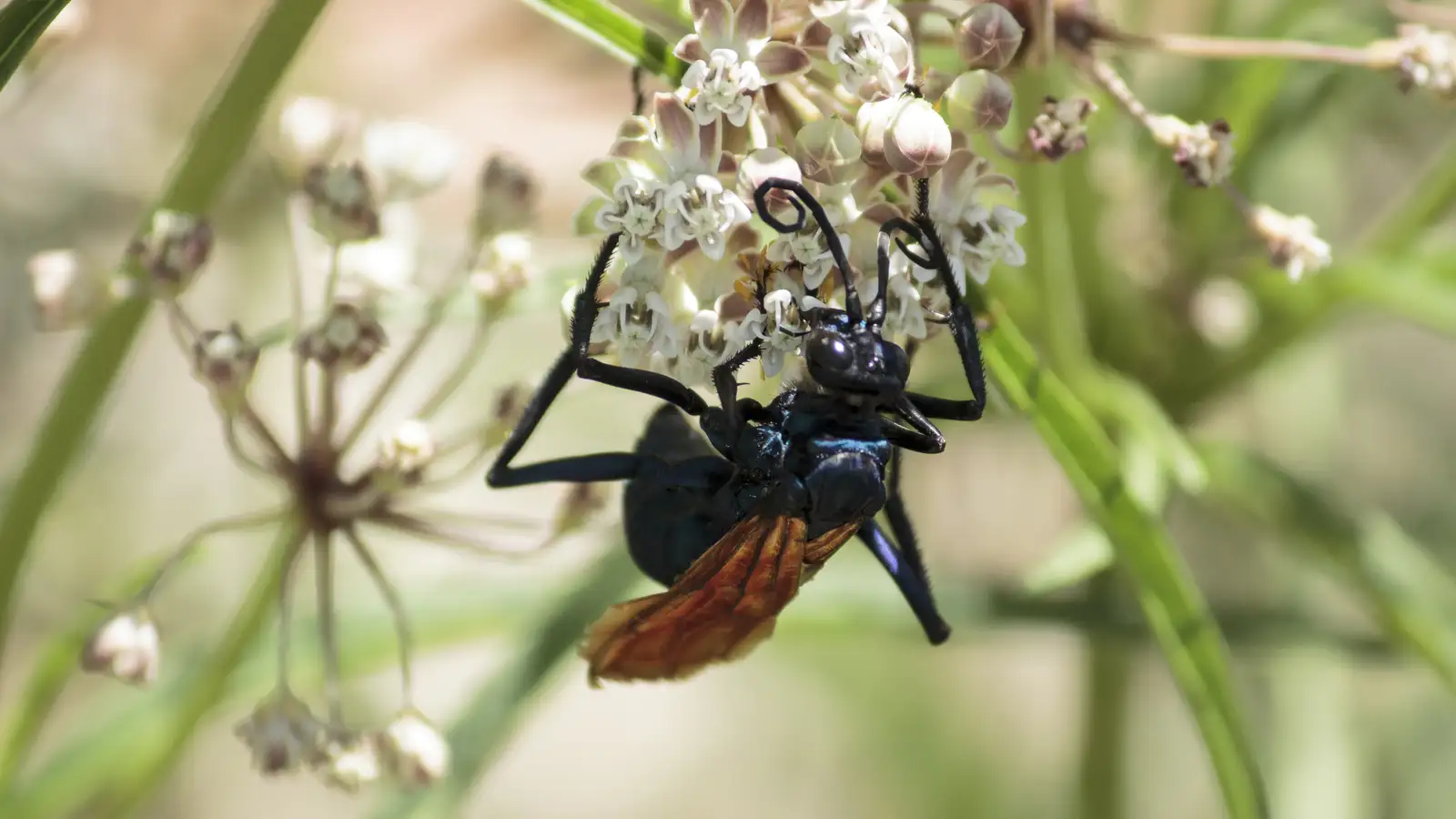
A tarantula hawk wasp is a large, blue-black spider wasp with bright orange wings. Its sting scores 4 out of 4 on the Schmidt sting pain index, the top of the scale, but the pain usually fades in about five minutes and the venom is rarely dangerous unless you are allergic. Only females can sting, and they rarely do unless grabbed or stepped on. Tarantula hawks live in warm parts of the Americas, including the Southwest’s deserts, and hunt tarantulas to feed their young.
This guide leans on the entomologist who built the pain scale, plus the National Park Service, Colorado State University Extension and London’s Natural History Museum.
Key Takeaways
- A tarantula hawk sting is rated 4.0, the maximum on the Schmidt index, and the pain lasts about five minutes.
- The danger is the pain, not the venom. Entomologist Justin Schmidt reports that its lethality to mammals is only about 3% of honey bee venom. Allergy is the main medical risk.
- Only females sting. Males are harmless, and females are docile toward people unless handled.
- Females paralyze a tarantula in seconds, lay one egg on it and seal it in a burrow. Adults eat nectar.
- They live mostly in the desert Southwest and are New Mexico’s state insect.
- If stung: move away, wash, apply ice, and call 911 for breathing trouble or swelling of the face or mouth.
Table of Contents
- What a Tarantula Hawk Wasp Is
- How to Identify a Tarantula Hawk
- Where Tarantula Hawks Live
- Tarantula Hawk Sting: How Painful It Is
- Are Tarantula Hawks Dangerous?
- What to Do After a Sting
- How a Tarantula Hawk Hunts a Tarantula
- Life Cycle From Egg to Adult
- Flowers, Predators and Lookalikes
- Frequently Asked Questions
- The Bottom Line
What a Tarantula Hawk Wasp Is
“Tarantula hawk” is the common name for wasps in the genera Pepsis and Hemipepsis, part of the spider wasp family Pompilidae. The name comes from their prey, not from any bird. The Natural History Museum counts 133 known Pepsis species, and all of them live alone: no colony, no queen, no workers and no above-ground nest.
That makes them cousins of the great black wasp, which provisions its nest with katydids, rather than relatives of hornets or yellowjackets. A solitary wasp has no colony to defend, which helps explain their calm temperament.
How to Identify a Tarantula Hawk
Look for a glossy, iridescent blue-black body, long legs and orange to rust-colored wings. Most species are 1 to 2 inches long. The largest, Pepsis heros, reaches about 11 centimeters (4 inches), according to the Natural History Museum. The bright wings are a warning signal.
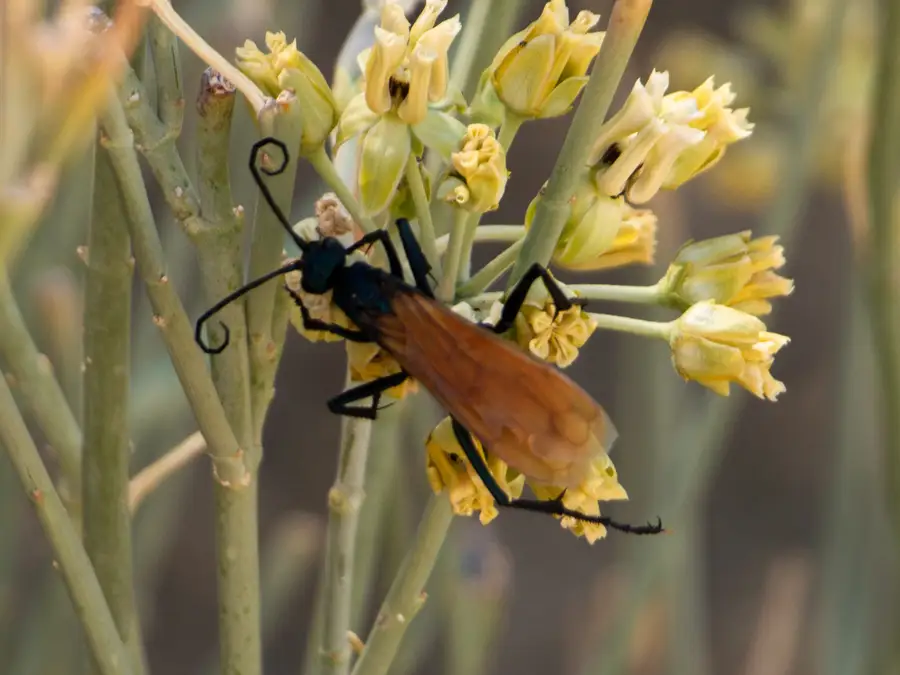
To sex one, check the antennae. The National Park Service says males have straight antennae and females curly ones. Only the female has a stinger, about a quarter inch (7 mm) long.
Colorado State University Extension lists the common Southwestern species:
| Species | Size | Look |
|---|---|---|
| Pepsis thisbe | Up to 50 mm | Black body with blue sheen, orange-brown wings; most common in Colorado |
| Pepsis grossa | 25 to 50 mm | Iridescent blue-black body, orange wings with black tips |
| Pepsis mildei | 20 to 30 mm | Blue-black body, orange-brown wings with black tips |
| Hemipepsis ustulata | Up to 50 mm | Black body, orange-brown wings with black tips |
Source: CSU Extension, “Tarantula Hawks of Colorado”. Sizes are body length; colors vary between individuals.
Where Tarantula Hawks Live
The wasps occur on every continent except Europe and Antarctica, but the genus Pepsis is restricted to the New World. In the United States they favor desert and scrubland, mainly in the Southwest. Wikipedia notes 18 Pepsis and 3 Hemipepsis species in the country, with sightings as far north as Logan, Utah. Zion National Park describes females hunting in late summer, and the wasps tend to be most active in daytime in summer.
New Mexico made the tarantula hawk its state insect in 1989, after schoolchildren from Edgewood proposed it and a statewide school vote picked it. If you walk Arizona’s Sonoran Desert or the Grand Canyon rim, you are in prime territory: the Park Service says Pepsis thisbe is the most common species in the Grand Canyon.
Tarantula Hawk Sting: How Painful It Is
Justin Schmidt rated the tarantula hawk sting a 4.0, the top of his 0 to 4 scale, and described it as “blinding, fierce, shockingly electric.” The Natural History Museum places it second only to the bullet ant, which shares the top level. The pain is brief: it lasts only about five minutes, while a bullet ant’s can last up to 24 hours.
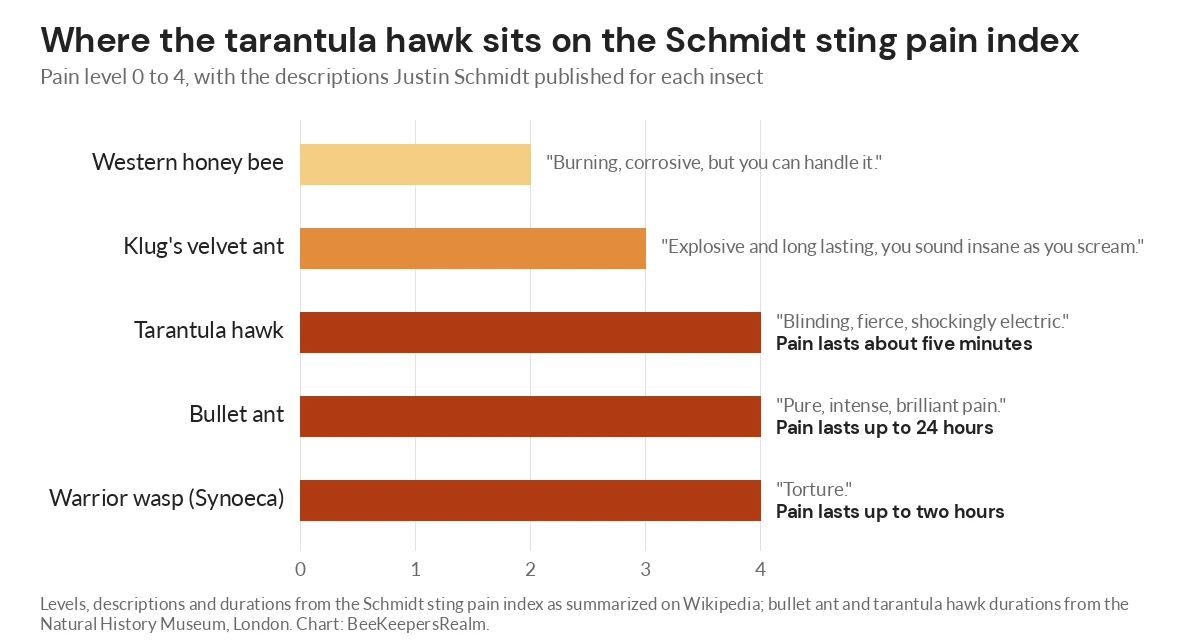
The scale is anchored on the honey bee at level 2. Our Schmidt sting pain index guide covers the whole list, and our velvet ant guide explains why only some velvet ants reach level 3.
“The pain is instantaneous, electrifying, excruciating, and totally debilitating.”
Why does it hurt so much? Schmidt argues the sting is aimed at predators: the goal is to make a bird or lizard open its mouth and release the wasp, and the pain alone does that. He adds that the chemistry behind the pain is not known.
Are Tarantula Hawks Dangerous?
Rarely. In his own essay, Schmidt writes that the venom’s lethality to mammals is only about three percent of that of honey bee venom. Wikipedia adds that, aside from allergic reactions, the sting does not usually need medical attention, though local redness can last up to a week.
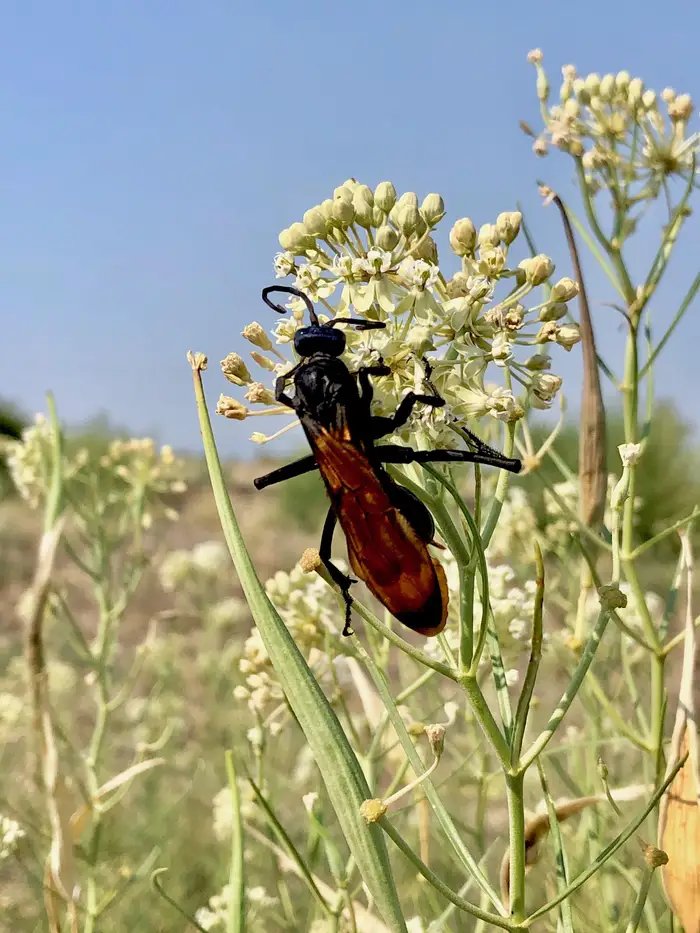
The wasps are also docile. CSU Extension says females “require extreme provocation” before stinging, in its words, and the Natural History Museum calls them fairly docile unless provoked. Schmidt notes that the stings he knows of happened while collectors grabbed specimens.
The wasp warns first. Schmidt lists a jerky walk with flicking wings, a loud buzz when threatened and a strong odor. If one buzzes at you, back away.
Two myths stay popular: that the sting is lethal for most people, and that the wasp attacks unprovoked. A third is that it kills the tarantula outright; the spider is paralyzed and kept alive.
A female can sting more than once. Schmidt describes a film shoot in which a female stung an entomologist under the thumbnail and then flew off unharmed, so the stinger is evidently not left behind as a honey bee’s is.
What to Do After a Sting
The advice below is educational, not medical advice. MedlinePlus, from the US National Library of Medicine, gives these general steps for insect stings:
- Wash the site thoroughly with soap and water.
- Place ice wrapped in a washcloth on the sting for 10 minutes, then off for 10 minutes, and repeat.
- Take an antihistamine or use an itch cream if needed.
- Watch for signs of infection over the next several days.
Call 911 for trouble breathing, wheezing, swelling of the face or mouth, throat tightness, weakness or turning blue; these are signs of a severe allergic reaction. See MedlinePlus on insect bites and stings for the full list.
“The advice I give in speaking engagements is to lie down and scream.”
It sounds like a joke, but Schmidt explains that the pain is so debilitating that people trip and fall onto cactus or barbed wire. Get away from the wasp, then sit or lie down somewhere safe. For general first aid, see how to treat a bee or wasp sting, and for how it differs from the honey bee, bee sting vs wasp sting.
How a Tarantula Hawk Hunts a Tarantula
Only females hunt. According to Schmidt, a female stings the tarantula between a leg base and the breastplate, aiming at the large nerve ganglion that controls the legs and fangs. The spider is permanently paralyzed within about one and a half to two and a half seconds. She then drags it, sometimes eight times her own weight, to a burrow she dug or to the tarantula’s own.
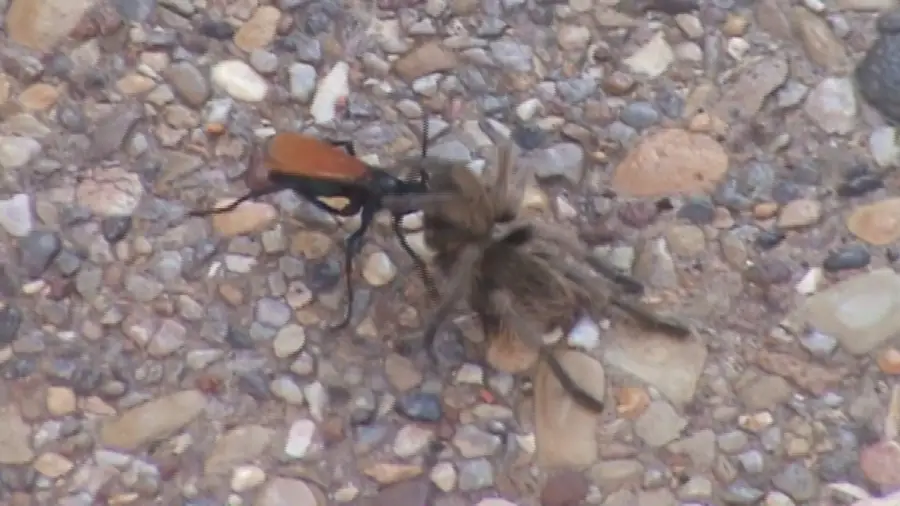
Why do tarantulas rarely win? Schmidt notes the wasp’s hard, smooth, rounded body, so a tarantula’s fangs slide off. The spider is nearly blind and probably recognizes the wasp by its odor.
“The wasps always win. I don’t think anyone has ever seen a tarantula kill the wasp.”
Prey choice shapes the wasps. Schmidt says mothers choose the sex of their young: a fertilized egg becomes a female and an unfertilized one a male. Large, plump female tarantulas tend to feed female larvae and smaller male spiders the male ones, which is why male tarantula hawks are often much smaller than females. For another solitary hunter that provisions its nest, see the cicada killer wasp.
Life Cycle From Egg to Adult
She lays one egg on the spider and seals the tunnel. Per Schmidt, it hatches in a few days. The larva then drinks blood from the paralyzed but living spider and grows for 20 to 25 days, molting four times. By then it has eaten most of the spider except the heart and nervous system, and the final-stage larva finishes the rest quickly, before it can spoil.
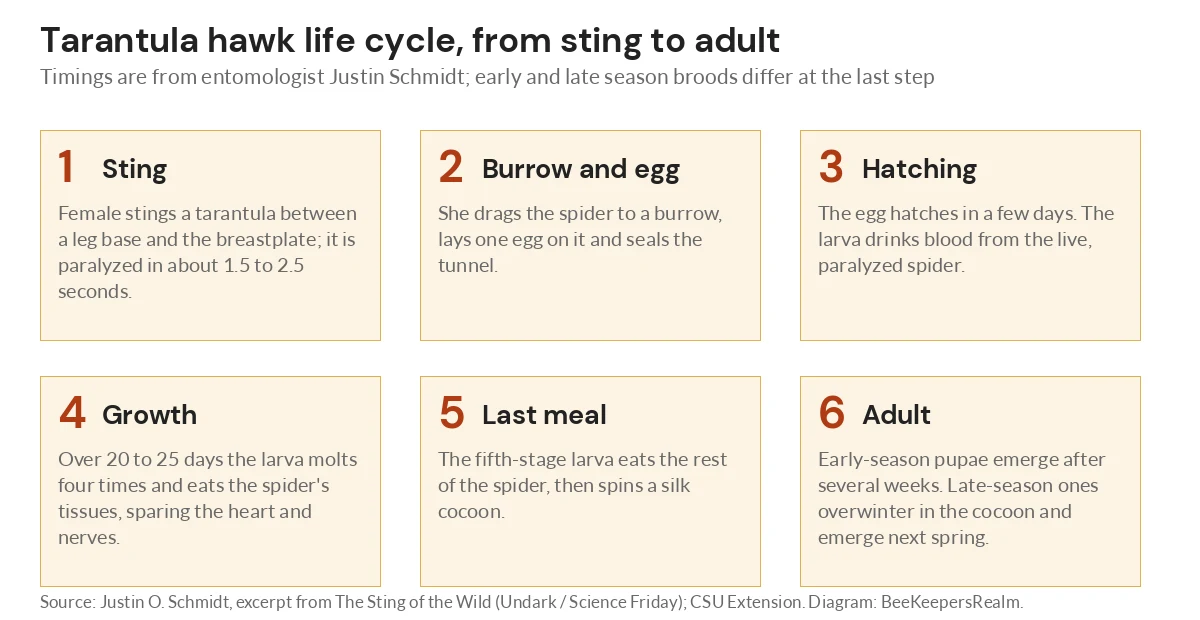
The larva spins a silk cocoon. In early season, the adult emerges after several weeks, while later in the season the wasp overwinters in the cocoon and emerges the next spring. Sources disagree on how long adults live. Schmidt writes that adult males live a few weeks and females four to five months; CSU Extension, citing his earlier work, gives 40 to 50 days for a female.
Flowers, Predators and Lookalikes
Adults are not hunters. They drink nectar from milkweed, mesquite and soapberry flowers, and CSU Extension calls them important milkweed pollinators. The wasps seem nearly predator-free: Schmidt writes that no predators successfully take healthy females, and CSU Extension credits their venom, odor and hard shell. The Park Service, however, says roadrunners will risk a sting to eat them. Schmidt’s one roadrunner report involved a bird stealing a paralyzed tarantula from a wasp, not eating the wasp.
Because the wasp looks fearsome, other insects copy it. Wikipedia notes that various wasps, bees, moths, flies and beetles mimic the warning pattern.
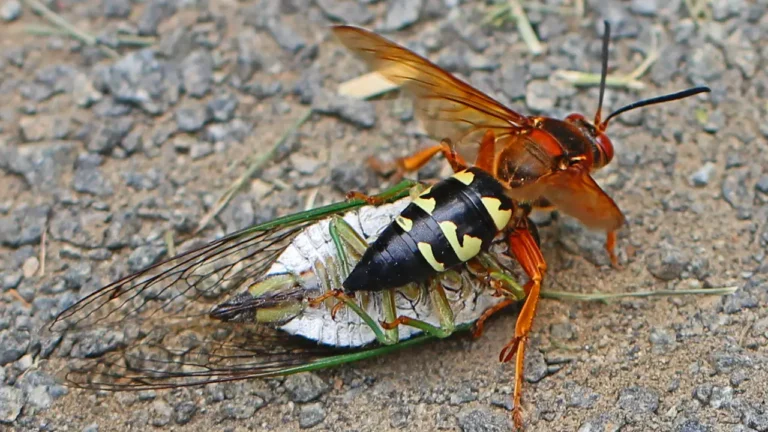
Lookalikes are not always related. A fuzzy red velvet ant is a wingless wasp, covered in our velvet ant guide. A cicada killer is big but rated only 1 to 1.5 on Schmidt’s scale, depending on the species, and the Asian giant hornet is a true hornet. Our mud dauber guide and the predatory wasp comparison chart help you sort the rest.
Frequently Asked Questions
Is a tarantula hawk wasp dangerous to humans?
Seldom. The sting is extremely painful but short, the wasp is docile, and the venom is far less lethal to mammals than honey bee venom. An allergy is the main risk.
How long does a tarantula hawk sting hurt?
About five minutes of intense pain, according to the Natural History Museum and Britannica. Redness can linger for up to a week.
Can a tarantula hawk kill you?
We found no source documenting a human death from the venom itself. A person with a severe allergy could die from anaphylaxis, as with any sting.
Do tarantula hawks sting more than once?
Yes. Schmidt’s essay describes a naturalist who kept reaching into a net and was stung repeatedly, and a wasp that flew off unharmed after stinging.
Do tarantula hawks bite?
The sting is the danger. The wasp has strong jaws, which Schmidt counts among its defenses against other arthropods, but the sources describe pain from stings, not bites.
Where do tarantula hawks live in the United States?
Mostly in southwestern deserts, including Arizona and New Mexico, with some species reaching Colorado and Utah.
Do tarantula hawks have a nest or queen?
No. They are solitary, and each female digs or borrows an underground burrow for a single spider and egg.
Why do tarantula hawks have orange wings?
The color is aposematic, a warning to predators of the painful sting, according to CSU Extension and Schmidt.
Do tarantula hawks threaten honey bees?
We found no source linking them to bee predation. Adults eat nectar, females hunt spiders, and CSU Extension says they generally do not harm agriculture. For bee predators, see our bee vs wasp identification guide.
The Bottom Line
Admire a tarantula hawk from a few feet away and never grab one. If you do get stung, expect a few awful minutes, not lasting harm, and watch for allergy signs.
Image credits: Photos from Wikimedia Commons. National Park Service (public domain, PD-USGov-NPS); NPS / Paul Martinez, Joshua Tree National Park (public domain); Keegan Delurey / USFWS (public domain, PD-USGov-FWS); Zion National Park, CC BY 2.0. All cropped or resized. Charts: BeeKeepersRealm.