Last Updated September 15, 2026
Watch closely and you’ll notice something genuinely dramatic about the wasp genus that gives this whole family of insects its common name: a waist so narrow it looks almost impossibly thin, connecting the thorax to an abdomen that seems to dangle rather than attach. Thread-waisted wasps take this trait to its most extreme expression among the solitary hunting wasps already covered on this site, and their caterpillar-hunting behavior includes a genuinely clever, well-documented trick involving a pebble used almost like a hand tool. This guide covers what thread-waisted wasps actually are, the extreme body shape behind their name, their caterpillar-provisioning strategy, and the century-old documented tool-use behavior that’s drawn real scientific interest ever since.
Table of Contents
- Key Takeaways
- What Thread-Waisted Wasps Actually Are
- The Genuinely Extreme Waist Behind Their Name
- Caterpillar Hunters With Precise Paralyzing Stings
- A Documented Tool-Use Behavior That Surprised Researchers
- Digging and Provisioning Behavior
- Sting Risk and Temperament
- Thread-Waisted Wasps vs. Other Solitary Hunters on This Site
- The Historical Observers Behind This Documented Behavior
- Why Caterpillars Specifically Make Sense as Prey
- What Adult Thread-Waisted Wasps Actually Eat
- Life Cycle and Seasonal Timing
- Common Mistakes
- Frequently Asked Questions
Key Takeaways
- Thread-waisted wasps (genus Ammophila, family Sphecidae, subfamily Ammophilinae) get their name from an elongated, thread-like petiole connecting thorax to abdomen — a fully functional joint, not an injury or deformity.
- Naturalists George and Elizabeth Peckham directly documented a female Ammophila urnaria using a pebble as a hammer to tamp down soil over a sealed nest in their 1905 book Wasps, Social and Solitary — one of the earliest well-documented cases of tool use in any insect.
- A complete nesting cycle — digging, hunting, provisioning, and permanently sealing a burrow — takes roughly 8 to 10 hours of active work for a single female.
- The genus is genuinely large: over 200 species worldwide, found on every continent except Antarctica, with “Ammophila” literally meaning “sand lover” in Greek.
- No documented evidence links thread-waisted wasps to honeybee predation — their prey is exclusively caterpillars, and adults feed only on nectar.
What Thread-Waisted Wasps Actually Are
Thread-waisted wasps belong primarily to the genus Ammophila, the type genus of subfamily Ammophilinae within the broader hunting-wasp family Sphecidae — a genuinely large, cosmopolitan group of over 200 species found in warmer regions on every continent except Antarctica. The genus name itself, from the Greek for “sand lover,” reflects how many species dig their nests specifically in sandy soil. Found widely and reliably across North America in open, sunny habitats with suitable loose soil for nesting, each female works entirely alone to hunt, dig, and provision her own individual nest, with no colony structure, queen, or worker caste involved, consistent with every other solitary wasp covered on this site.
The Genuinely Extreme Waist Behind Their Name
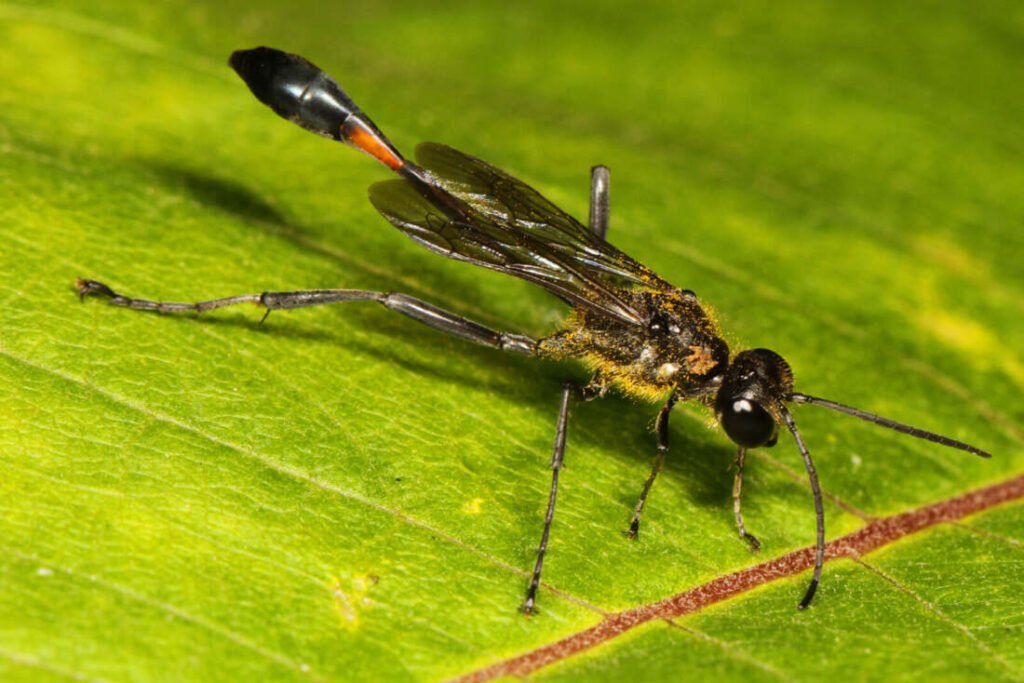
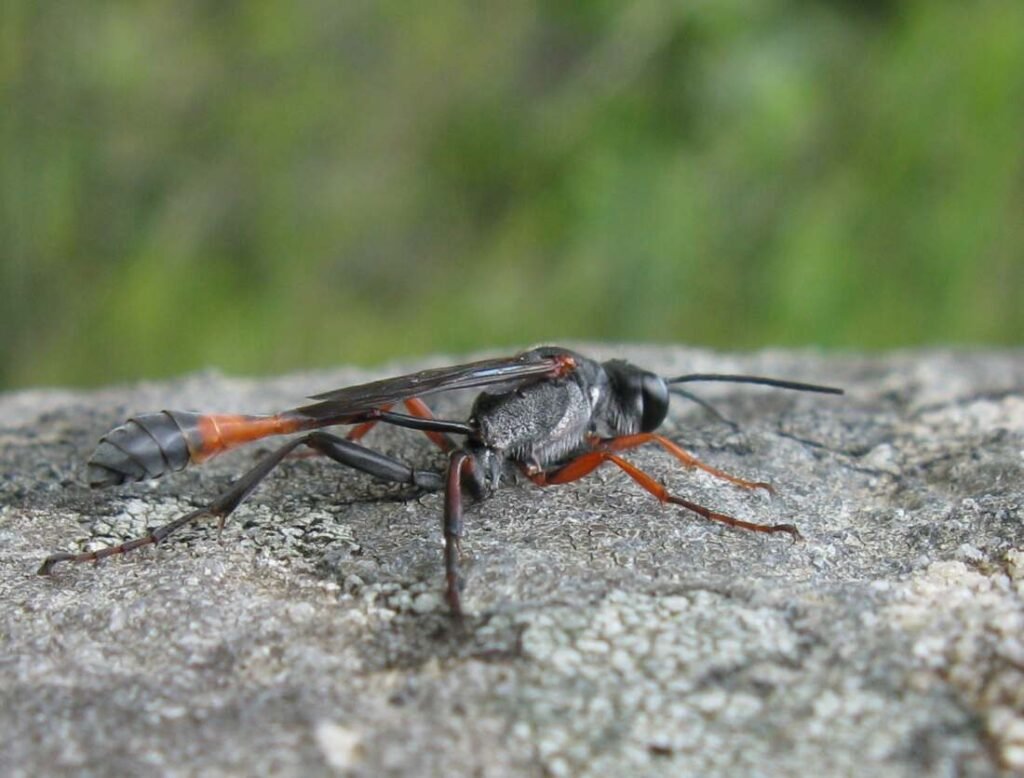
Every wasp covered on this site technically has a narrowed waist, the defining structural trait separating wasps from bees and most other Hymenoptera, but Ammophila species take this trait to a genuinely more extreme, visually striking degree than nearly any other wasp discussed here, with an elongated, thread-like petiole connecting the thorax and abdomen that’s immediately noticeable even to a casual observer. This narrow waist is a fully functional joint, not a structurally weak or fragile connection, and doesn’t impair normal flight or movement despite its dramatic appearance. Common species range from about 16mm to 55mm in length, typically colored in some combination of black, yellow, orange, or red.
Caterpillar Hunters With Precise Paralyzing Stings
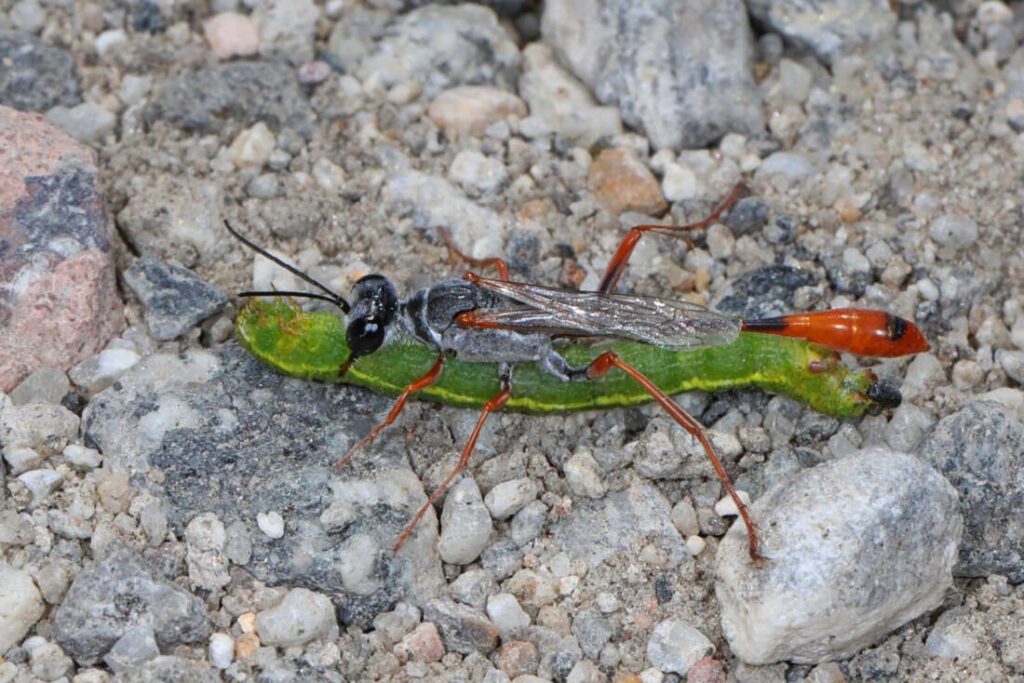
Female thread-waisted wasps hunt caterpillars specifically, generally preferring hairless prey, and deliver a precise sting that paralyzes without killing it, keeping the prey fresh but unable to crawl away, then dragging or carrying it back to a pre-dug burrow to provision a nest cell. This caterpillar specialization is shared with potter wasps already covered on this site, though the two groups differ meaningfully in nest architecture and construction method, covered in more detail in the comparison section later in this guide.
A Documented Tool-Use Behavior That Surprised Researchers
One of the most genuinely remarkable documented behaviors in this genus is a form of tool use: after sealing a provisioned nest cell with soil, some Ammophila females have been observed picking up a small pebble or compacted piece of debris in their mandibles and using it to tamp down and firmly pack the soil covering the sealed entrance, functionally using the object as a hand tool rather than relying on their body alone. This behavior, first carefully documented over a century ago and still referenced in discussions of insect tool use, is a genuinely rare, well-documented example of object manipulation in a solitary wasp, and it remains one of the more scientifically notable behaviors covered anywhere on this site.
“She brought a quantity of fine grains of dirt to the spot, and picking up a small pebble in her mandibles, used it as a hammer in pounding them down with rapid strokes.”
Is this pebble-tamping behavior considered true tool use in the same sense researchers use the term for primates or birds?
It’s genuinely debated among researchers exactly how to classify insect tool use relative to more cognitively flexible tool use in vertebrates, but the behavior is widely cited in entomological literature specifically because it involves picking up and purposefully manipulating an external object to accomplish a task, meeting a reasonably strict definition of tool use even if the underlying cognitive mechanism differs considerably from mammalian tool use.
Digging and Provisioning Behavior
A female thread-waisted wasp typically digs her nest burrow before hunting, a sequencing choice that lets her immediately provision and seal the cell once she’s successfully captured and paralyzed a caterpillar, rather than searching for a burrow site while carrying vulnerable prey. She excavates using her mandibles as earthmovers, often emitting an audible buzz while digging, and once the cell is fully provisioned, permanently closes the burrow with a deeper plug of soil and camouflages the entrance with surface debris. A complete nesting cycle, from initial digging through final sealing, typically takes roughly 8 to 10 hours of active work. Some species provision a cell with a single large caterpillar, while others use multiple smaller ones to stock the same cell, a variation in provisioning strategy documented across different species within the broader genus.
Sting Risk and Temperament
Thread-waisted wasps share the same generally low-aggression temperament seen across nearly every solitary wasp covered on this site: with no shared colony or brood cluster to defend, females have little evolutionary incentive to behave defensively toward people, and documented stings are uncommon, typically occurring only with direct handling or accidental contact.
Thread-Waisted Wasps vs. Other Solitary Hunters on This Site
| Wasp | Prey | Distinctive Trait | Nest Type |
|---|---|---|---|
| Thread-waisted wasp (this article) | Caterpillars | Extreme narrow waist; pebble-tamping tool use | Dug burrow |
| Potter wasp | Caterpillars | Egg suspended on a silk thread | Mud pot on twig/surface |
| Sand wasp | Flies | Progressive provisioning | Loose sand burrow |
The Historical Observers Behind This Documented Behavior
The pebble-tamping behavior covered earlier in this guide was carefully documented by naturalists George and Elizabeth Peckham in their 1905 book Wasps, Social and Solitary, whose detailed direct field observations of Ammophila nesting behavior became genuinely foundational reference material for later discussions of insect tool use in entomology and animal behavior literature. Their painstaking direct observation, watching individual wasps repeatedly complete the same sealing-and-tamping sequence across multiple nests, gave the behavior a level of documented credibility that’s allowed it to remain a genuinely cited example in tool-use discussions for well over a century since — the original book is still freely available in full today through Project Gutenberg for anyone wanting to read the Peckhams’ actual field notes.
Why Caterpillars Specifically Make Sense as Prey
Caterpillars represent a genuinely practical prey choice for a provisioning wasp: they’re relatively large, soft-bodied, and abundant across many habitats, offering a substantial, calorie-dense food source per successful hunt compared to smaller prey types. This is part of why caterpillar-hunting has independently evolved as a strategy in multiple unrelated solitary wasp lineages covered on this site, including both thread-waisted wasps and potter wasps, despite the two groups using genuinely different nest-building approaches to store and protect that same general prey type.
What Adult Thread-Waisted Wasps Actually Eat
While female thread-waisted wasps hunt caterpillars specifically to provision their offspring, adult wasps of both sexes feed entirely on flower nectar for their own nutrition, not on the caterpillars they capture for their larvae. This nectar-feeding habit means thread-waisted wasps are frequently observed visiting flowers during the day, giving them a secondary role as incidental pollinators alongside their better-known role as caterpillar predators, a pattern shared by nearly every solitary wasp covered on this site.
Life Cycle and Seasonal Timing
Thread-waisted wasps are typically active during the warmer months, generally spring through late summer across most of their North American range, with timing varying somewhat by region and specific species. After a nest cell is provisioned and sealed, the egg hatches within a couple of days and the larva feeds on the paralyzed caterpillar over the following days before pupating within the protected burrow, and depending on the timing of the original nesting activity and regional climate, the resulting adult either emerges later the same season or overwinters within the sealed cell to emerge the following spring.
Common Mistakes
The most common mistake is assuming the thread-waisted wasp’s dramatically narrow waist indicates some kind of injury, deformity, or unusual individual specimen, when it’s actually the completely normal, defining anatomical trait of the entire genus. Another mistake is confusing thread-waisted wasps with potter wasps simply because both hunt caterpillars, when the two use genuinely different nesting strategies, dug burrows versus constructed mud pots. People also sometimes assume the pebble-tamping behavior is a rare fluke rather than a documented, repeatedly observed behavior specifically referenced in scientific tool-use literature going back to the Peckhams’ original 1905 field notes.
Frequently Asked Questions
Do modern researchers still study Ammophila tool use, or is it considered settled science from a century ago?
Interest genuinely continues; while the original Peckham observations remain foundational, contemporary researchers studying insect cognition and tool use have revisited and built on this early documentation with more rigorous modern methodology, keeping the behavior an active point of reference rather than a purely historical footnote.
Do thread-waisted wasps pose any risk to honeybee colonies?
No documented evidence links thread-waisted wasps to honeybee predation; their prey is specifically caterpillars, making them ecologically unrelated to the predator concerns covered in this site’s bee vs. wasp identification guide.
How does a thread-waisted wasp actually carry a caterpillar that can be larger than she is back to the nest?
Females typically drag or partially carry a paralyzed caterpillar along the ground rather than fully flying it back to the burrow, especially when the prey is genuinely large relative to her own body size, a practical solution to the real physical challenge of transporting prey that can meaningfully exceed her own body weight.
Are thread-waisted wasps considered beneficial for gardeners specifically dealing with caterpillar pests?
Yes, genuinely; since they hunt caterpillars broadly rather than specializing narrowly on one particular species, thread-waisted wasps can provide a real, if incidental, form of natural pest control in gardens and landscapes where caterpillar damage to plants is a concern, similar in spirit to the caterpillar-control role documented for potter wasps elsewhere on this site.
How many caterpillars does a single nest cell typically need before a female seals it?
This varies by species and by the size of the caterpillars being used, with some females provisioning a cell with just one large caterpillar and others using several smaller ones to reach an equivalent amount of food for the developing larva.
Are thread-waisted wasps found throughout the United States?
Ammophila species are widespread across most of North America, with different species adapted to regional climates and locally available caterpillar prey, making them a genuinely common, if under-recognized, presence in open sunny habitats across a broad range.
Further Reading
- Potter Wasps: The Tiny Mud-Pot Builders
- Sand Wasps: The Beach-Nesting Predator You’ve Probably Never Noticed
- Great Golden Digger Wasp: Identification and Why It’s Beneficial
- Bee vs. Wasp: The Complete Identification Guide
Image credits: Photo: Judy Gallagher, via Wikimedia Commons. Licensed CC BY 2.0; Photo: JonRichfield, via Wikimedia Commons. Licensed CC BY-SA 3.0.