Reviewed by Michael R. · Last Updated November 1, 2026 · How we review
The cicada killer wasp (Sphecius speciosus) is a large, solitary wasp that digs burrows in bare soil and stocks them with paralyzed cicadas for its young. Males, the ones that dive-bomb people, cannot sting. Females can, but extension entomologists say stings almost always happen when someone steps on or grabs one. With no colony to defend, a lawn full of burrows is a nuisance, not a danger.
This guide covers what the wasp looks like next to its look-alikes, including the “murder hornet,” what a female’s sting is really like, how deep the burrows go, when the season ends and what works if you need to act. Where published sources disagree, as they do on size and burrow dimensions, the tables show the spread instead of picking one number.
Key Takeaways
- Males have no working stinger. Females can sting, but sources say it takes rough handling, a bare foot or a trapped wasp.
- Reported length runs from about 1⅛ to nearly 2 inches, depending on the source. The Asian giant hornet is a different insect, and Missouri’s conservation department says it was declared eradicated from the US as of December 2024.
- Each female digs her own burrow, from about 12 inches to over 4 feet of tunnel by different measures, and stocks it with paralyzed annual cicadas.
- Adults fly from about early July to mid-September. There is one generation a year, and the burrows empty by fall.
- Nothing in the extension advice kills them “instantly.” The usual steps are to ignore them, thicken the turf, add mulch or moisture, or dust burrow entrances at dusk as a last resort.
- Cicadas feed the larvae; the adults drink nectar and sap. Honey bee colonies are not a target.
Table of Contents
- What a Cicada Killer Wasp Looks Like
- Cicada Killer vs Murder Hornet and Other Look-Alikes
- Can a Cicada Killer Wasp Sting You?
- Why Male Cicada Killers Buzz Your Face
- How a Cicada Killer Hunts and Provisions Its Nest
- Cicada Killer Burrows: Size, Soil and Mounds
- When Cicada Killers Appear and When They Leave
- Do Cicada Killers Damage Lawns?
- How to Get Rid of Cicada Killer Wasps
- Do Cicada Killers Threaten Honey Bees?
- Natural Enemies, Benefits and Related Species
- Frequently Asked Questions
- The Bottom Line
What a Cicada Killer Wasp Looks Like
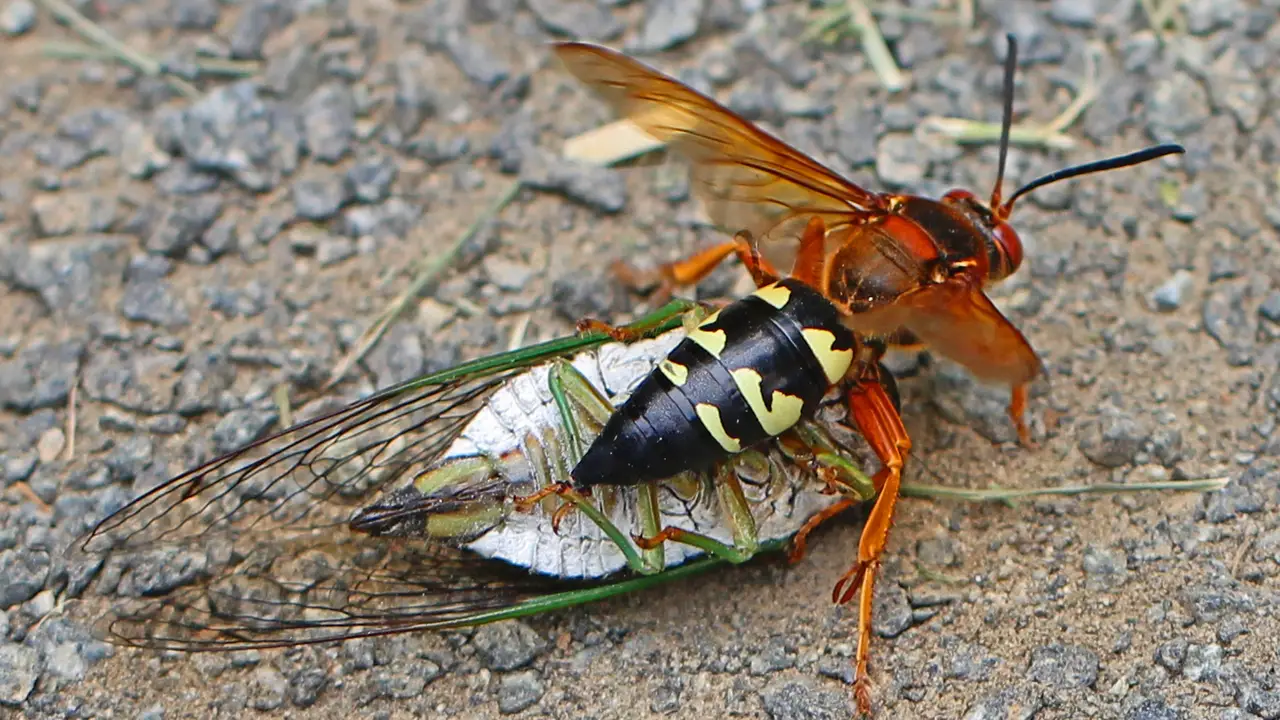
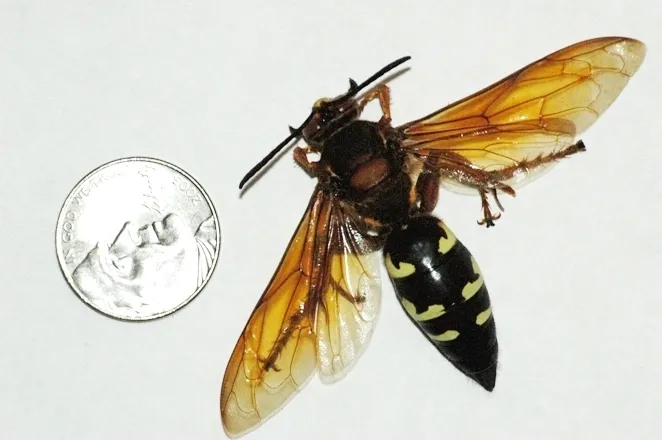
A cicada killer is a robust wasp with a dark orange to rust-red head and thorax, a black abdomen with pale yellow bands, and amber wings and orange-tinged legs. The University of Kentucky’s fact sheet ENTFACT-004 describes three light-yellow stripes on the abdomen. Females are bigger than males.
The size gap has a reason. According to the species entry on Wikipedia, which draws on Evans and O’Neill’s The Sand Wasps (Harvard University Press, 2007), females are given more food as larvae, and their size helps them carry heavy cicadas back to the burrow. Males get less food and stay smaller.
Published lengths differ more than you might expect:
| Source | Reported length |
|---|---|
| Ohio State University Extension, ENT-63 | About 1⅛ to 1⅝ in; males typically smaller |
| Illinois Extension (Ken Johnson, 2020) | Up to 1½ in |
| Missouri Department of Conservation | Can exceed 1½ in |
| University of Kentucky, ENTFACT-004 | Females 1½ to nearly 2 in; males up to 1½ in |
| Penn State Extension (updated July 2026) | Females up to 2 in; males about 1½ in |
None of these sources reports a length over about 2 inches. Part of the spread likely comes from who was measured: a big female sits at the top of any range, a small male at the bottom.
Cicada Killer vs Murder Hornet and Other Look-Alikes
Yellow-and-black bands and a big body make people report cicada killers as Asian giant hornets. Penn State Extension notes that the Asian giant hornet has not been found in North America outside the Pacific Northwest. The Missouri Department of Conservation adds that it was declared eradicated from the United States as of December 2024.
| Insect | Length | How to tell it apart | Nest |
|---|---|---|---|
| Cicada killer (Sphecius speciosus) | Up to about 2 in | Rust-red thorax; black abdomen with pale yellow bands that have black hook-shaped edges | Solitary burrow in bare soil with a soil mound |
| Eastern stizus (Stizus brevipennis) | Looks almost the same, per Missouri | Yellow marks are smooth-edged; a distinct yellow pattern on two thorax plates | Stocked with katydids, not cicadas |
| European hornet (Vespa crabro) | About 1 in; queens nearly 1½ in | Yellow and brown; black-and-yellow abdomen with V-shaped marks; flies at night | Social; papery nest in hollow trees or wall voids |
| Asian giant hornet (Vespa mandarinia) | 1½ to 1¾ in | Yellow to orange head, larger than a cicada killer’s, with bigger jaws and smaller eyes | Social; not found in North America outside the Pacific Northwest |
| Bald-faced hornet (Dolichovespula maculata) | About ½ to ¾ in | Black with white face markings and white bands near the tip | Social; paper nest at least 3 ft above ground |
Sources: Missouri Department of Conservation (eastern stizus, European hornet queens), Illinois Extension (sizes, European and bald-faced hornets) and the University of Kentucky (Asian giant hornet head).
The quickest test is the nest. A single wasp coming and going from a hole in bare ground, with a pile of dirt beside it, is a solitary digger. A papery nest in a tree, wall or eave means a social hornet or wasp. For those species, see our guides to the Asian giant hornet, the European hornet and bald-faced hornets, or hornet vs wasp.
Other solitary diggers share the habit but differ in prey and looks. The great golden digger wasp and the great black wasp are examples. The predatory wasp comparison chart sets them side by side.
Can a Cicada Killer Wasp Sting You?
Male cicada killers cannot sting. Females can, and they use the sting on cicadas, not on people. The Wikipedia species entry says females rarely sting unless they are grasped roughly, stepped on with bare feet or caught in clothing, and Purdue Extension adds that females do not defend their burrows.
“The eastern cicada-killer wasp may be the scariest-looking wasp in our state. But it is not aggressive to people and is virtually harmless, unless handled roughly.”
Males do have a pointed projection at the tip of the abdomen. Missouri calls it a false stinger that a male may poke at an enemy, but says males are “completely incapable of stinging.” The University of Kentucky says the same: stings “can occur but are almost always the result of a human directly stepping on or grasping the wasp.”
Why so mild? Missouri’s explanation is that a solitary wasp has little reason to risk herself. A social yellowjacket will die defending a nest full of sisters and young. A cicada killer who dies leaves no sisters to carry on her nest.
What a female’s sting feels like
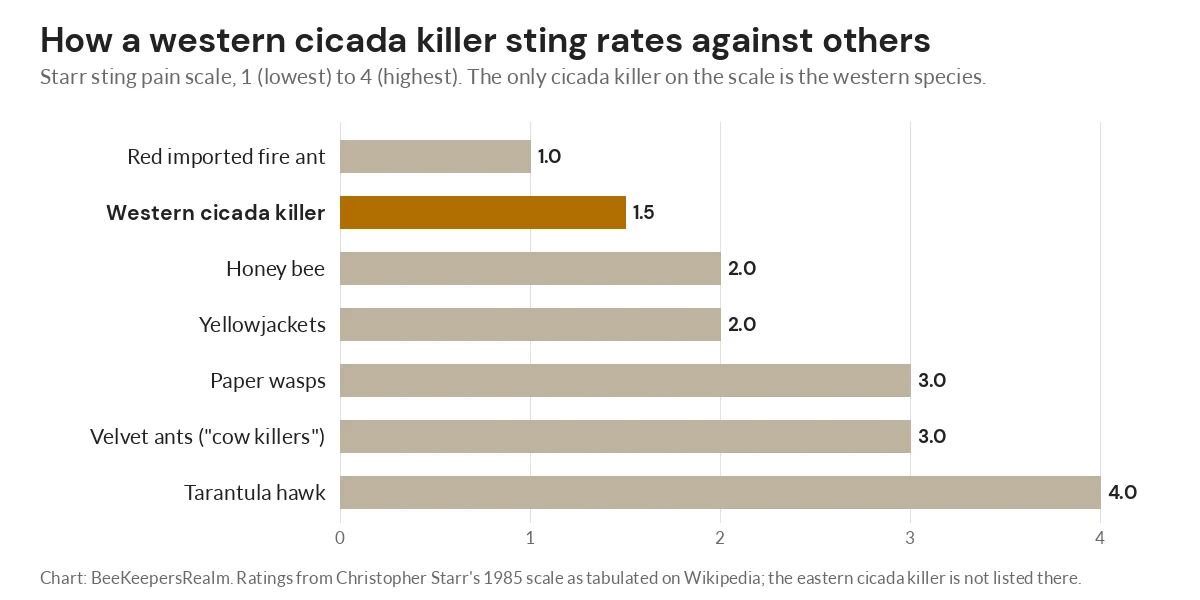
One author cited on Wikipedia, who has been stung, calls it not much more than a “pinprick.” On the Starr sting pain scale, which runs from 1 to 4, the western cicada killer (Sphecius grandis) is rated 1.5. That rating is for the western species; we found no published rating for the eastern one, so treat the comparison as a guide, not a measurement. For comparison, honey bees and yellowjackets are rated 2, several paper wasps 3, and velvet ants 1 to 3 depending on the species (3 for the large Dasymutilla klugii).
“Mild” is not “harmless” for everyone. Missouri’s advice is that people allergic to wasp stings should stay away from all wasps. If a sting happens, follow the steps in our sting first-aid guide, and get emergency help for trouble breathing, facial swelling or hives spreading beyond the sting. For how wasp and bee stings compare, see bee sting vs wasp sting. This is general information, not medical advice.
Why Male Cicada Killers Buzz Your Face
Males emerge before females and stake out patches of ground where females will appear. The University of Kentucky says they hover at eye level to “inspect” people. Wikipedia explains the behavior: a male is checking anything that moves nearby in case it is a female ready to mate. Two or three males are often seen locked together in midair as they fight for position, and a male grapples only with other insects.
It looks like an attack but is not one. Wikipedia notes that males usually fly away when swatted at, and Penn State’s advice is to ignore them if you can because they “have no desire to tangle” with you. Male carpenter bees behave the same way, as covered in our carpenter bee guide. The scare is mostly noise and size.
How a Cicada Killer Hunts and Provisions Its Nest
The female digs her burrow first, then goes hunting. She targets annual “dog-day” cicadas (Neotibicen species, per Missouri), which appear in July and August. Penn State describes cicadas as the wasp’s sole larval food. Adults feed on nectar and plant sap.
Ohio State says she stings the cicada at the base of a foreleg. The sting paralyzes without killing, so the prey stays fresh. Purdue notes that a paralyzed cicada sometimes keeps buzzing while it is dragged to the hole.
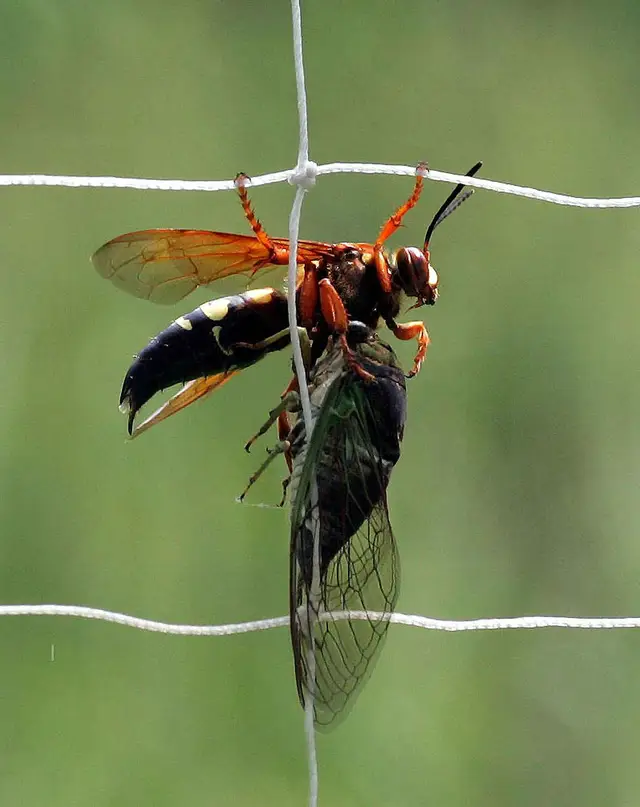
The load is the hard part. Wikipedia says the cicada is often more than twice the wasp’s weight. She holds it upside down beneath her body and often climbs the nearest tree or plant to launch into a glide, a method the University of Kentucky also describes. When that fails she drags it across the ground.
In the nest, she lays one egg on a cicada and seals the cell with soil. Sources differ on how many cicadas go into a cell. Missouri and Ohio State say one or two. Wikipedia says a male’s cell gets one cicada and a female’s gets two or three, because a female grows to twice the size. One burrow can hold ten or more cells.
The egg hatches within a few days: Wikipedia says one to two days, Purdue and Ohio State two to three. The larva eats the cicada from the inside while it is still alive, a detail Purdue and Illinois Extension both describe. It finishes in about two weeks, spins a cocoon and stays underground through winter.
Cicada killers are described as a natural check on cicada numbers, and Ohio State calls them generally beneficial because cicadas can damage young trees. We found no source that measures the effect, so we would not claim they reduce a local cicada population in any meaningful way.
Cicada Killer Burrows: Size, Soil and Mounds
The wasps choose well-drained, light or sandy soil in full sun with sparse vegetation. Ohio State lists sidewalk and patio edges, home lawns, golf course tees and sand traps, sandy playgrounds and volleyball courts. Illinois Extension’s Ken Johnson adds flower beds and gardens.
The giveaway is the mound. Excavated soil is pushed out in a U-shaped or horseshoe-shaped pile at the entrance, and Missouri notes a shallow furrow often leads to the hole, “as if a person had made the furrow by dragging a thumb across the soil.” Ohio State says a female may displace several pounds of soil while tunneling.
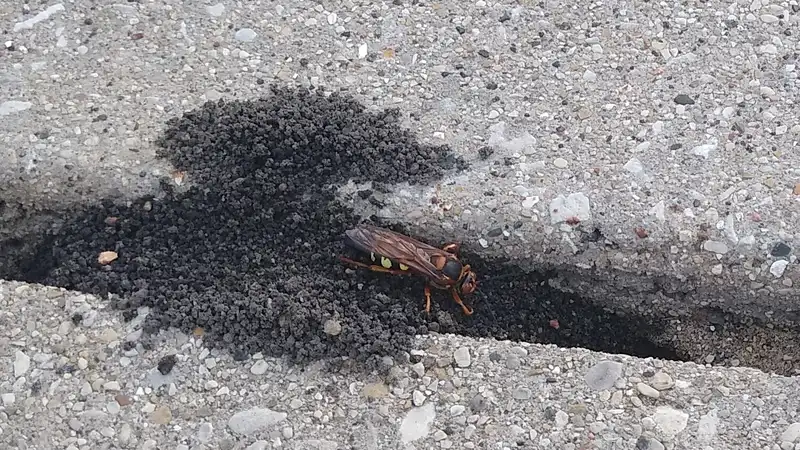
Burrows cluster. Purdue says an aggregation can run from a few burrows to about a hundred and may persist for years in one spot.
“If you find many wasps in one area, it is because they have all found the conditions to their liking, not because they are forming a social colony.”
How big is a burrow? The sources do not agree, so here are all of them:
| Source | Entrance width | Depth | Tunnel length | Cells |
|---|---|---|---|---|
| Purdue Extension (2018) | 1½ in | 6 to 10 in | 12 to 18 in | 4 to 5 cells |
| Ohio State (2015) | ½ in | 6 to 10 in | Not stated | 10 to 20 over the burrow’s life |
| Penn State (2026) | About 1½ in | Up to 12 in | 12 to 24 in | A side chamber per larva |
| University of Kentucky | Not stated | 12 to 15 in | Up to 36 in | Several |
| Missouri Dept. of Conservation | Not stated | “Not particularly deep” | 4 ft or more | 9 or 10 is not unusual |
| Wikipedia species entry | About 0.6 in (1.5 cm) | 10 to 20 in | Not stated | 10 or more |
Entrance width is the biggest gap: two sources say 1½ inches, one says ½ inch and Wikipedia says 1.5 centimeters. One of them may have mixed units, but we cannot tell which. Expect a hole roughly finger-wide, deeper than a trowel, and plan for a tunnel that wanders well beyond it.
When Cicada Killers Appear and When They Leave
In the eastern and midwestern US, adults emerge from late June into July, in step with the annual cicadas. Ohio State puts first emergence around the first week of July and says the wasps are present for about 60 to 75 days. Wikipedia and Purdue have them gone by mid-September, with stragglers into October.
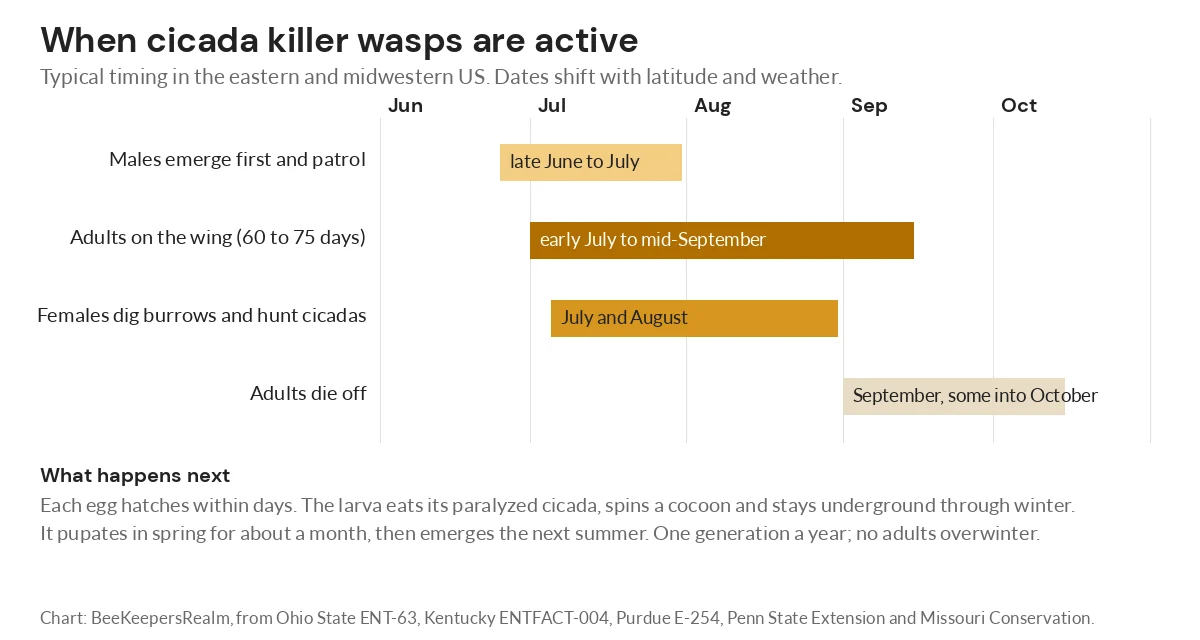
Males come first and die soon after mating, per Ohio State. Females may live about a month, according to Missouri. Warm weather, not cicada song, triggers emergence, according to Illinois Extension’s Ken Johnson. Timing therefore shifts with latitude and with the weather that year.
There is one generation a year. Larvae overwinter as mature larvae in cocoons, pupate in spring for about a month, and emerge the following summer. No adults survive the winter. If you saw them in July and want to know when they will be gone, plan on September.
Do Cicada Killers Damage Lawns?
Mostly in looks. The University of Kentucky says the problem is usually soil piles smothering turf, and Missouri says tunneling sometimes disfigures lawns but also aerates the soil and helps rain soak in. Thin, bare, sunny ground draws them, which is why thickening the turf is the first fix extension sources suggest. The wasps also return to good ground: Purdue says aggregations can persist for years.
How to Get Rid of Cicada Killer Wasps
Most extension sources say you usually should not. The University of Kentucky states that control “is not necessary or typically feasible,” and the University of Maryland describes nest building as a temporary behavior. Act when burrows sit in a high-traffic spot such as a patio, pool edge or playground, or when someone in the household has a sting allergy.
| Method | What the sources say |
|---|---|
| Wait it out | Adults live only about two to three months (Penn State), and nest building is temporary (Maryland). |
| Thicken the lawn | Overseed bare and thin spots in fall; run a sprinkler over the nest area to discourage activity temporarily (University of Maryland). |
| Cover or shade bare soil | Mulch 2 to 3 inches deep or plant a dense groundcover in beds (Maryland); wood or stone mulch, shade or extra irrigation can push them to nest elsewhere (Kentucky); clear plastic tarp over a few nests (Penn State). |
| Keep soil moist | The wasps dislike wet soil, and watering may help the soil settle into tunnels (Illinois Extension). |
| Swat | A tennis or badminton racket on flying wasps is a long-time standby (Kentucky, Penn State, Ohio State). |
| Dust the burrow entrance | Labeled insecticidal dust placed at the hole, applied after dark or at dawn, without disturbing the opening (Penn State, Ohio State). Maryland adds that many wasps will still survive. |
| Spray the lawn | Not effective: liquid insecticide on turf does not reduce populations (Kentucky), and sprays rarely leave enough residue (Ohio State). |
“Another potential strategy to discourage them from nesting in an area is to make sure that the soil remains moist. The wasps don’t like wet soil, and watering the ground may help the soil settle into their tunnels, further discouraging them.”
If you use dust
Timing matters. Penn State says to apply it in late evening or early morning when wasps are inactive and early enough in the season to catch the female while she is still provisioning. She carries the dust on her feet as she goes in and out, so do not fill or disturb the hole. Purdue names a 5% carbaryl dust, Penn State a synthetic pyrethroid dust and Kentucky bifenthrin. Ohio State recommends protective clothing and treating after dark or before dawn, ideally below 60°F.
Two cautions. Product registrations differ by state, and the Kentucky sheet warns that its recommendations apply to Kentucky only. Always read the label. As a beekeeping site we add one more: apply dust only at the burrow, keep it off flowering plants where bees forage, and follow the label’s pollinator warnings.
What kills cicada killer wasps instantly? Nothing in these sources. The dust works as the female walks through it, and Ohio State says a licensed pest control operator is the better choice if anyone is sensitive to stings. If what you found is a papery or ground nest of yellowjackets, that is a different job: see wasp nest removal.
Do Cicada Killers Threaten Honey Bees?
No source we read lists bees as cicada killer prey. Penn State names cicadas as the sole larval food, and adults feed on nectar and sap. A cicada killer on your clover is a visitor, not a hive robber.
The wasps that do take honey bees are different species. The European beewolf hunts honey bees for its larvae, and the European hornet preys on bees too. For telling bees, wasps and hornets apart at the hive, see bee vs wasp.
Natural Enemies, Benefits and Related Species
Cicada killers have their own parasite. Missouri and Wikipedia both describe velvet ants (Wikipedia names Dasymutilla occidentalis, the “cow killer”) slipping into a burrow and laying an egg in a cell, so that the velvet ant larva eats the cicada killer’s pupa. Learn more in our velvet ant guide.
The eastern cicada killer is one of about 21 species in the genus Sphecius worldwide, according to Wikipedia. Ohio State lists the Pacific, western and Caribbean cicada killers as other North American species, and Wikipedia places the western species (S. grandis) in the mid- and western US and the Caribbean one (S. hogardii) in Florida. These are native species, not recent arrivals, and we found no source reporting an invasive cicada killer established in the US.
Another giant solitary wasp is the tarantula hawk, a spider-hunting wasp.
To tell cicada killers from the gentle bees that also nest in soil, see ground bees vs yellowjackets.
Frequently Asked Questions
Do cicada killer wasps sting humans?
Females can, but rarely do. Extension sources say stings almost always follow stepping on, grabbing or trapping one. Males cannot sting.
Should I get rid of cicada killer wasps?
Usually not. Most extension advice is to wait out the season, improve turf and soil conditions, and treat only high-traffic spots or households with sting allergies.
What happens if you get stung by a cicada killer?
Reports describe a mild sting; one author compares it to a pinprick. Anyone allergic to wasp stings should get medical help for trouble breathing, facial swelling or widespread hives.
What kills cicada killer wasps instantly?
No source describes an instant kill. Insecticidal dust at the burrow entrance works as the female crosses it, and a racket can knock down flying wasps.
What is the difference between male and female cicada killers?
Females are larger, dig the burrows, hunt cicadas and can sting. Males are smaller, patrol territory, bump into people and cannot sting.
How long do cicada killer wasps live?
Sources vary. Missouri says a female may live about a month, Penn State says two to three months, and Ohio State says the wasps are present locally for 60 to 75 days.
Do cicada killers come back to the same spot every year?
Often. Purdue says aggregations may persist in the same location for several years, because the next generation emerges from burrows in that ground.
Are cicada killers the same as murder hornets?
No. The Asian giant hornet is a social hornet with a larger head and yellow-orange face. Missouri says it was declared eradicated from the United States as of December 2024.
The Bottom Line
Treat a cicada killer like a big, noisy neighbor that leaves in September. Do not grab one, give the males room, and fix thin turf if you do not want the burrows back next July. If you have a sting allergy or a burrow at the front door, call a licensed pro rather than treating it yourself.
Sources
- University of Kentucky Entomology, ENTFACT-004: Cicada Killer Wasps
- Ohio State University Extension, ENT-63: Cicada Killer Wasp (2015)
- Penn State Extension: Warning to Cicadas: Watch Out (updated July 19, 2026)
- Missouri Department of Conservation: Eastern Cicada-Killer Wasp
- Purdue Extension Entomology, E-254: Cicada Killers (2018)
- Illinois Extension: Cicada killer wasps in search of cicadas, not humans (2021)
- Illinois Extension: It’s big, but it’s not a murder hornet (2020)
- University of Maryland Extension: Cicada Killer Wasps (updated 2023)
Image credits: Hero photo by Judy Gallagher, via Wikimedia Commons, CC BY 2.0, cropped. Other photos as credited in the captions; charts by BeeKeepersRealm.