Reviewed by Daniel M. · How we review
Wasp nest removal starts with knowing what built the nest. A small, open paper wasp nest you can reach from the ground can often be treated by a careful homeowner with a product labeled for wasp nests. Nests in the ground, inside a wall, high in a tree, or near anyone with a sting allergy are jobs for a professional. Wax comb means honey bees, which need a beekeeper, not a pesticide. In most of the U.S., wasp and hornet colonies die at the first hard frost and never reuse the nest.
Educational information, not professional pest-control or medical advice. Use any pesticide exactly as its label directs; the U.S. Environmental Protection Agency explains why in its introduction to pesticide labels. The guidance below comes from the university extension services named in each section, not from our own pest-control work. Daniel M. reviewed the beekeeping and honey bee details.
If someone is stung and has trouble breathing, a tight throat, or a swelling face or tongue, call 911. For ordinary stings, follow our step-by-step bee and wasp sting first aid.
Key Takeaways
- Open comb means paper wasps; a gray paper ball means an aerial yellowjacket such as the bald-faced hornet; a busy hole in the ground or siding usually means yellowjackets; wax comb means honey bees.
- Leaving a nest alone is a real option: colonies die at the first hard frost in most of the country, and old nests are not reused.
- Call a professional for ground nests, wall voids, attics, nests that need a ladder, and any household with a sting allergy.
- Never seal the entrance of a nest in a wall; trapped yellowjackets can chew through drywall into the house.
- Treating after dark lowers the risk but does not remove it.
Table of Contents
- Identify the Nest Before You Do Anything
- Wasp Nest vs Hornet Nest: What Actually Differs
- Leave It, Treat It, or Call a Pro?
- Treating a Small, Exposed Nest Yourself
- Nests in the Ground or Inside a Wall
- What Not to Do
- What Wasp Nest Removal Costs
- After the Nest Is Gone
- Frequently Asked Questions
Identify the Nest Before You Do Anything
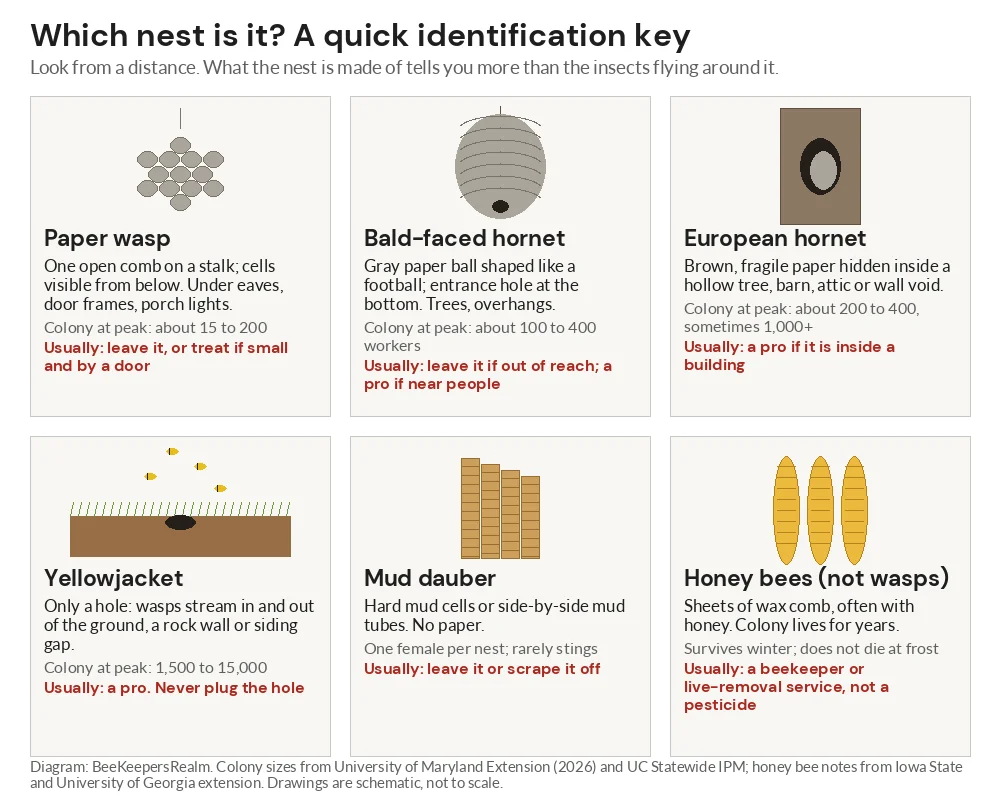
Identify the nest from a distance by watching where insects fly in and out, then match it to the key and table below. What the nest is made of matters more than the insects around it.
| Nest | What you see | Typical spot | Colony at peak | Usual next step |
|---|---|---|---|---|
| Paper wasp | One open, umbrella-shaped comb on a stalk | Eaves, door frames, porch lights, shrubs | 20 to 75 (UMD); 15 to 200 (UC IPM) | Leave it, or treat if small and beside a doorway |
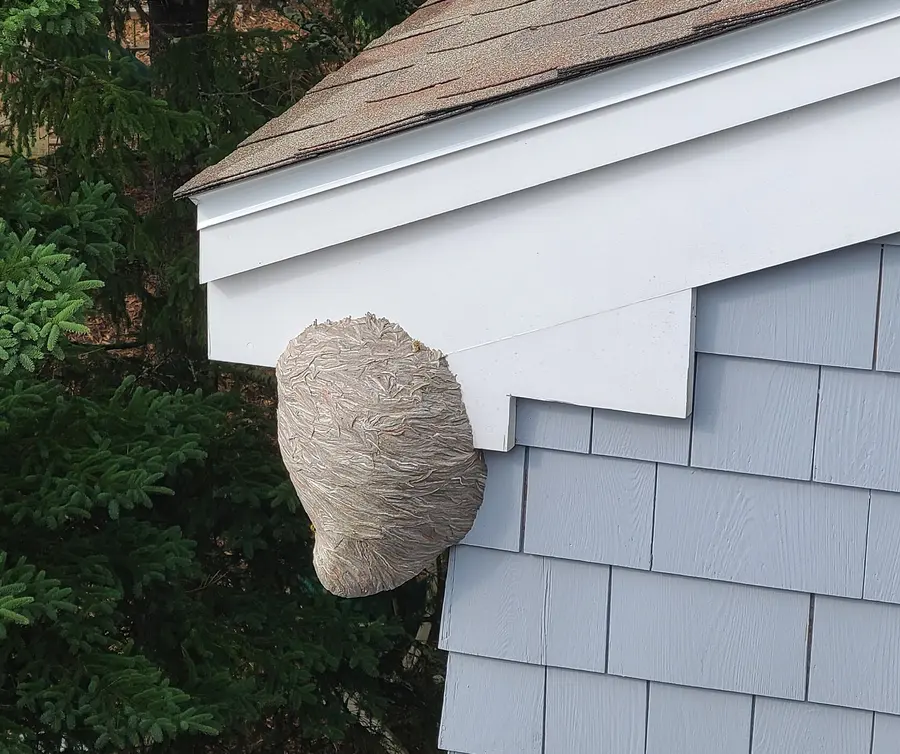
| Bald-faced hornet (aerial yellowjacket) | Gray, football- or egg-shaped paper ball, entrance at the bottom | Tree branches, building overhangs, poles | About 100 to 400 workers | Leave it if out of the way; a pro if high or near traffic |
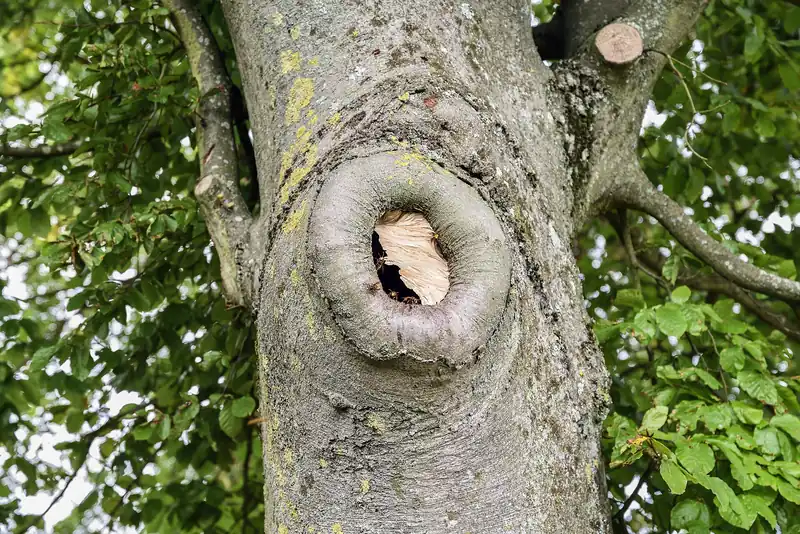
| European hornet | Tan-brown, fragile paper, usually out of sight | Hollow trees, barns, wall voids, attics | About 200 to 400 workers, sometimes over 1,000 | A pro if it is in a structure |
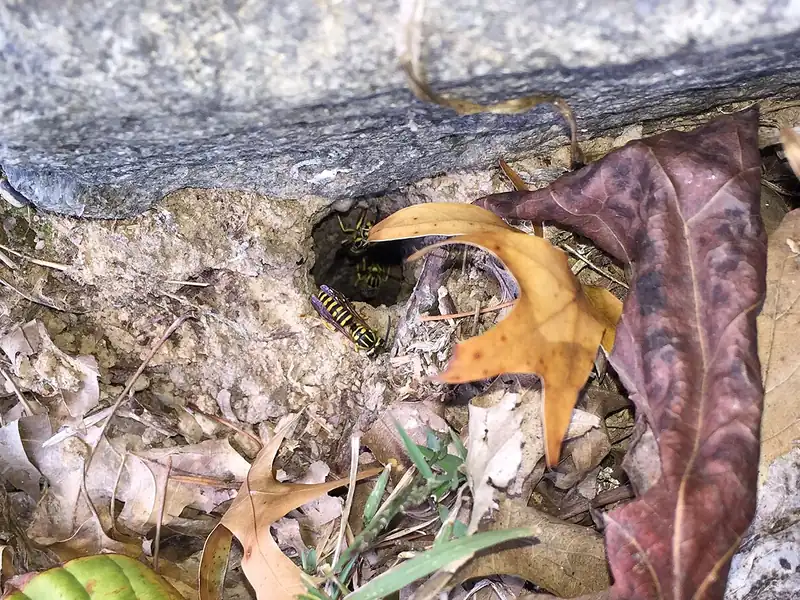
| Ground or wall yellowjacket | Wasps streaming through one hole; nest hidden | Rodent burrows, under rocks, behind siding, wall voids | 1,500 to 15,000, by species | A pro; never plug the hole |
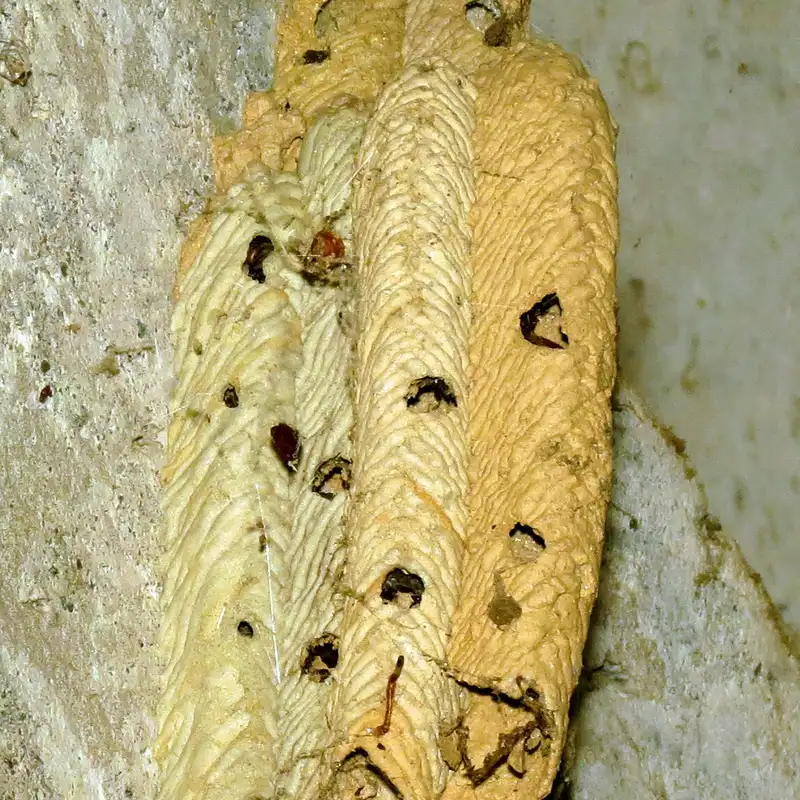
| Mud dauber | Hard mud cells or “organ pipe” tubes | Porch, shed and garage ceilings and walls | One female per nest | Leave it or scrape it off |
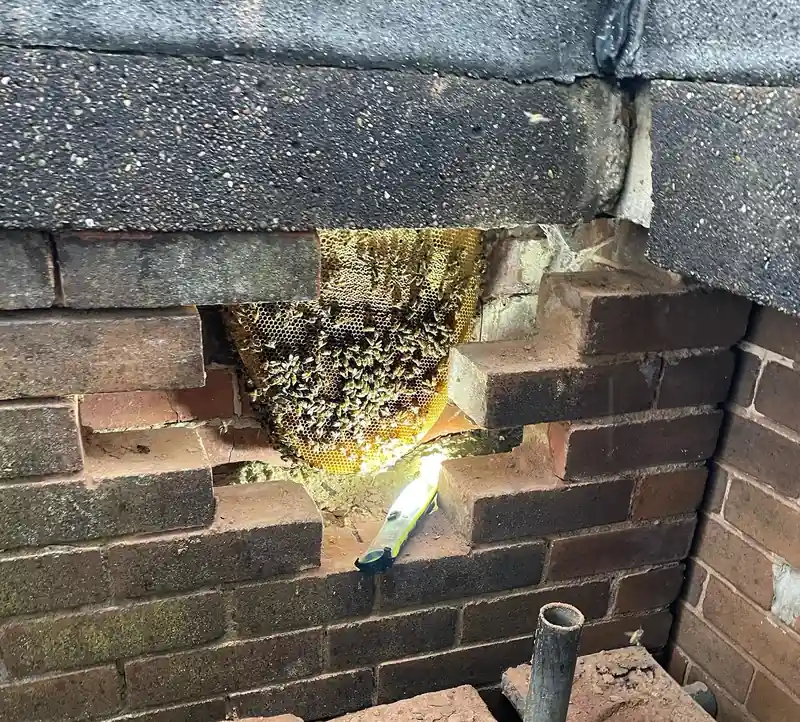
| Honey bees | Sheets of wax comb, often with honey | Wall voids, chimneys, hollow trees | A perennial colony that survives winter | A beekeeper or live-removal service |
Sources: University of Maryland Extension (UMD, 2026), UC Statewide IPM Program (UC IPM), Iowa State and University of Georgia.
In this two-minute UC IPM video, the narrator explains that yellowjackets usually nest underground or in wall cavities, while open eave nests are paper wasps that generally need no control. It recommends a professional, or, for people who treat their own, protective clothing, dusk or night treatment and a product labeled for yellowjacket nests.
Paper wasps: the open umbrella
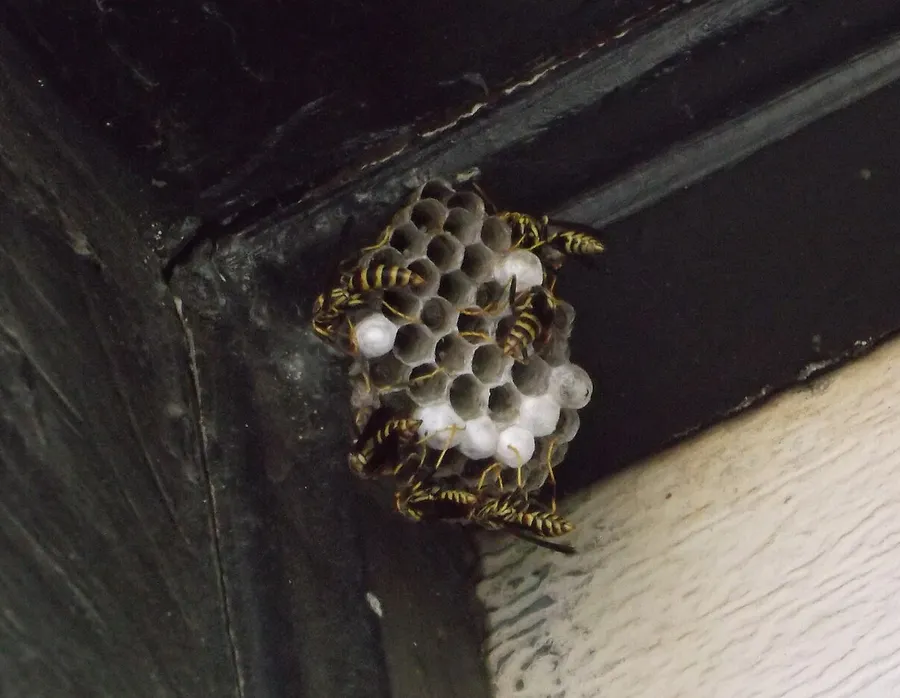
A paper wasp nest is a single layer of comb, usually a few inches across, hanging from one stalk with no cover. UC IPM calls paper wasps much less defensive than yellowjackets; trouble starts when a nest sits by a door. The invasive European paper wasp builds the same nest but is colored like a yellowjacket.
Bald-faced hornets and other aerial nests
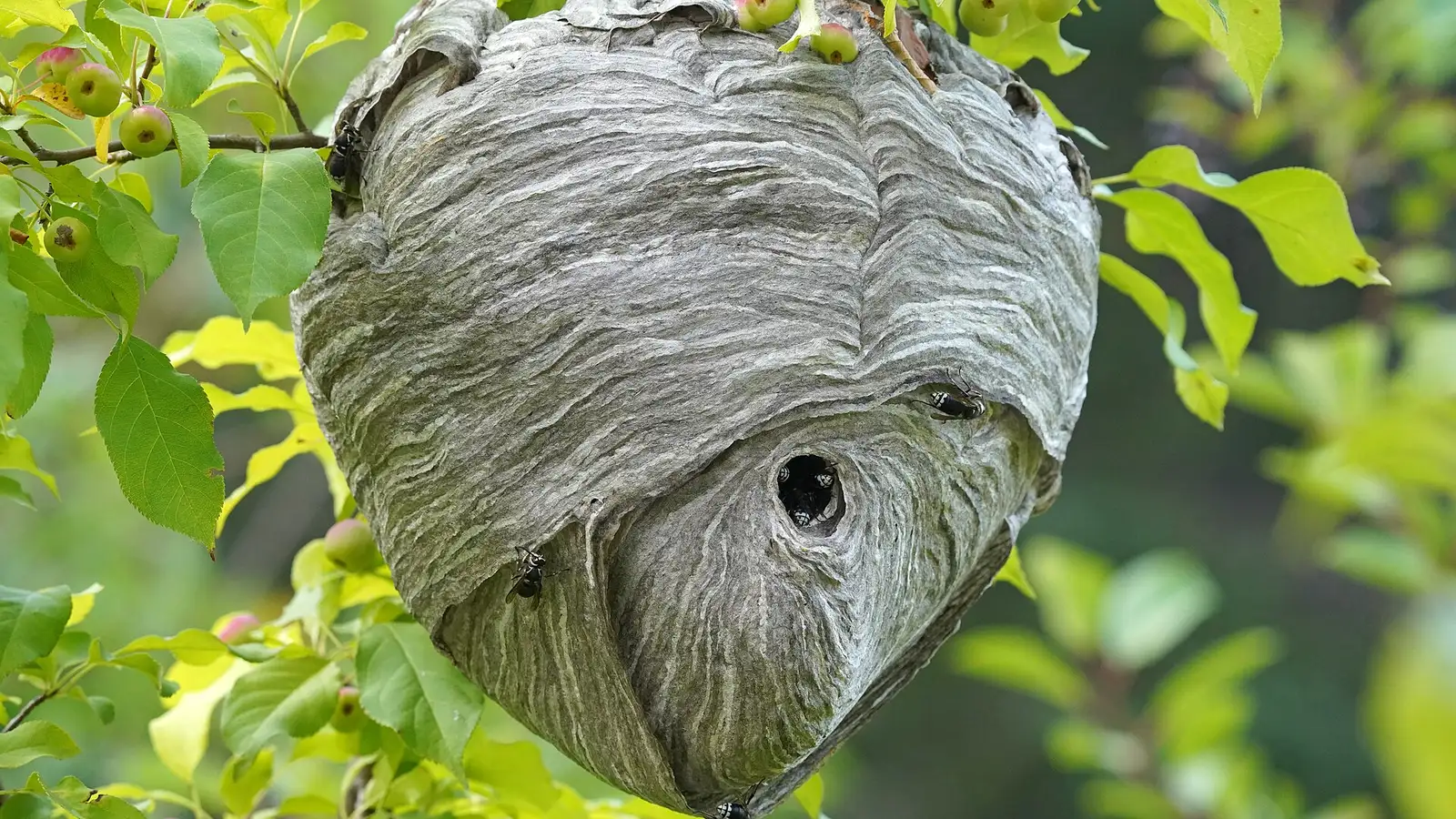
Gray, football-shaped nests in trees and under overhangs belong to aerial yellowjackets. The best known, the bald-faced hornet, is not a true hornet. UMD Extension says its nests can hang 60 feet or more up in the canopy or sit at least 3 feet up on a building, and are easy to miss until winter reveals them. University of Kentucky entomologist Michael F. Potter rates hornets as much harder and more dangerous to control than paper wasps.
European hornets: hidden in a cavity
The European hornet is the only true hornet established in the U.S., and it nests out of sight in hollow trees, barns, wall voids, attics and old beehives. UMD notes that it flies by night as well as by day and can be drawn to a flashlight, which undercuts the usual “treat it after dark” advice.
Yellowjackets: in the ground or the wall
Most yellowjacket nests are underground, often in an old rodent burrow, or inside wall and ceiling voids; all you see is a stream of wasps using one opening. UC IPM puts a colony at 1,500 to 15,000 wasps, and notes that digging indoors can leave a wet patch that becomes a hole in a wall or ceiling. UMD warns that mower vibration can trigger an attack.
Mud daubers: mud, not paper
Mud daubers are solitary wasps that build hard mud cells. UC IPM says they do not defend their nests, rarely sting, and their nests can be removed in winter without spraying. See our mud dauber guide.
Honey bees: wax comb is not a wasp nest
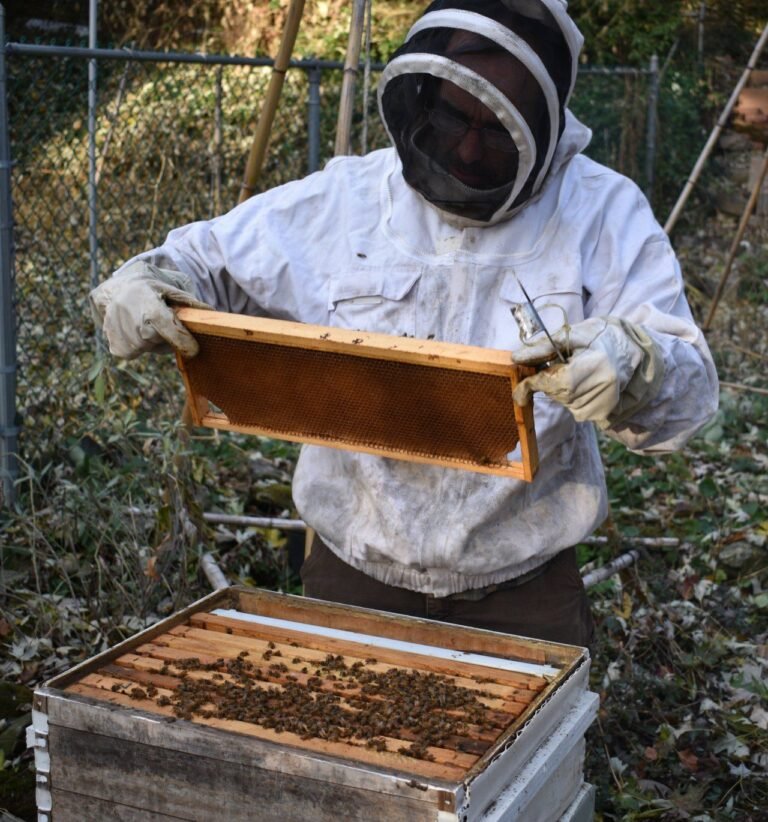
Honey bees build wax comb, not paper, and a colony in a wall does not die off in winter. Iowa State University’s Yard and Garden team says most calls about “bees” in the ground or a wall turn out to be yellowjackets:
“Recent experience suggests that approximately 90% of the inquiries we receive about “bees” in the ground or in a house wall are not honey bees, but rather are yellowjacket wasps.”
The other 10% matter. Iowa State notes that honey bee nests can last for years and store honey that can ruin walls and ceilings if left behind. University of Georgia guidance adds that once a colony dies, its combs are no longer ventilated by fanning bees and may melt and stain interior walls, so the whole nest must come out. See what to do about bees in a wall or attic and what live beehive removal costs.
Wasp Nest vs Hornet Nest: What Actually Differs
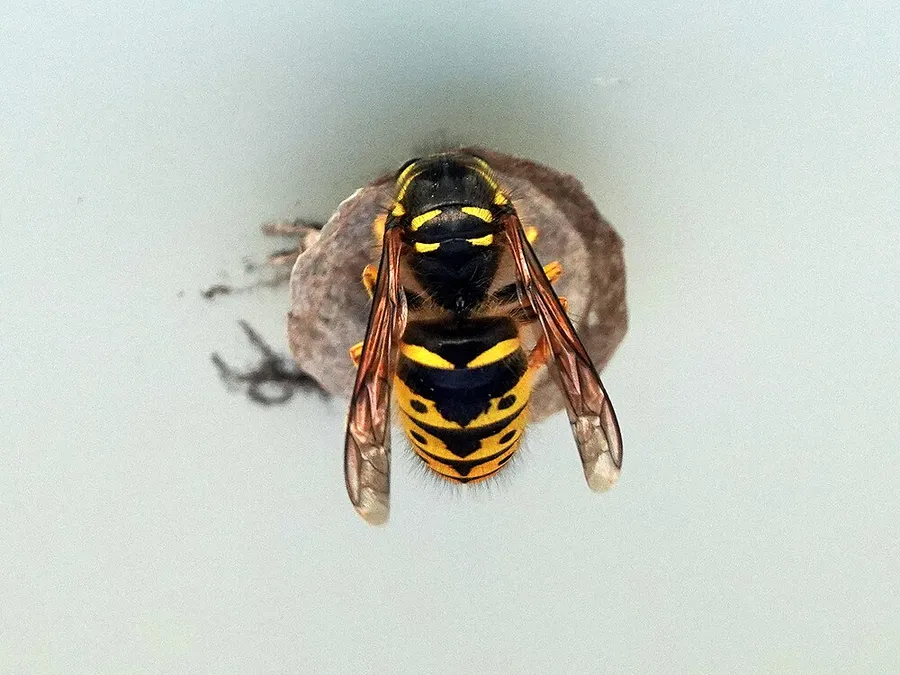
The quickest test is whether you can see the comb. A paper wasp nest shows open cells from below; a hornet or aerial yellowjacket nest wraps its combs in gray paper with one main entrance near the bottom. UC IPM says paper wasp nests rarely exceed an outstretched hand, while enclosed nests keep growing through late summer.
Most “hornet nests” in the U.S. are built by bald-faced hornets. To tell the insects apart, see our bee, wasp and hornet identification guide. If you suspect the invasive yellow-legged hornet, leave the nest alone; that guide explains why a sighting should be reported.
Leave It, Treat It, or Call a Pro?
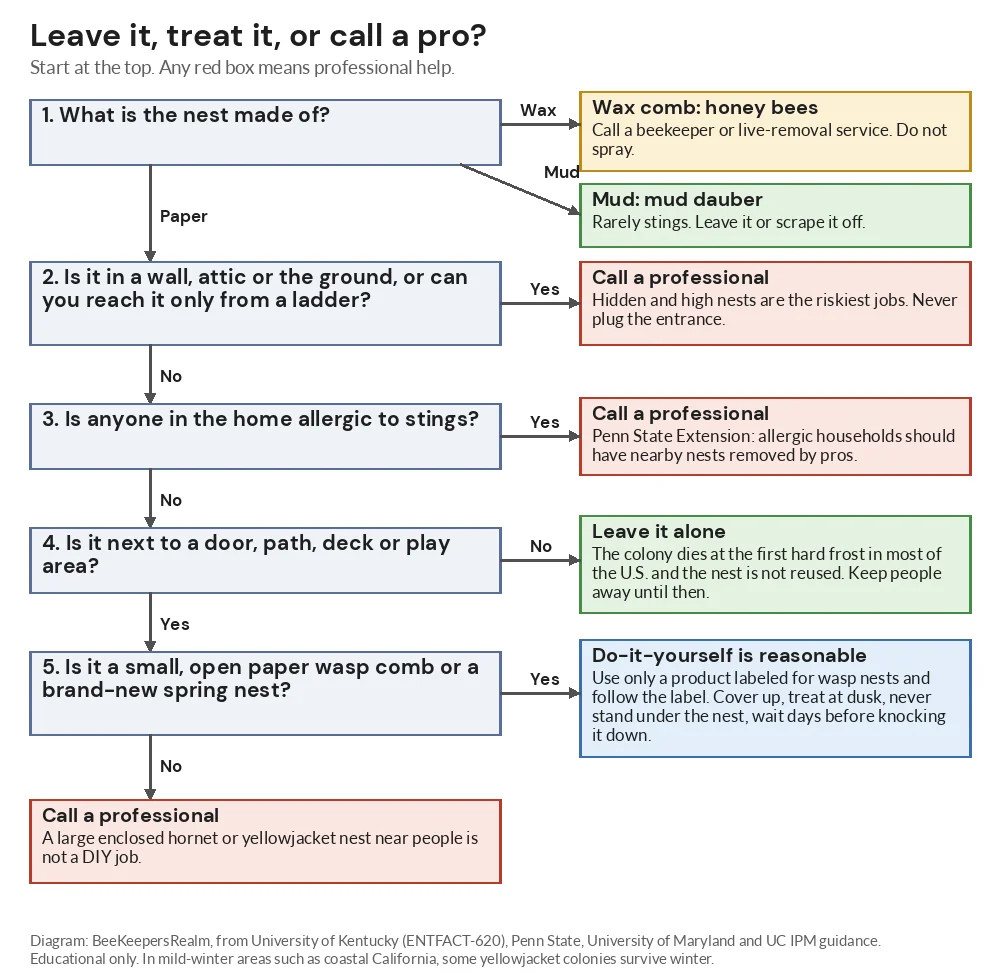
The extension guides we read weigh the same factors: where the nest is, who lives in the house, how big the colony is, and how much of the season is left. The flowchart pulls them together.
When leaving it is the safer choice
UMD Extension says social wasp colonies last one year and die off each winter; old nests are not reused, and only a few mated queens survive elsewhere. If people can avoid a nest until a killing frost, it may not need removing. Potter notes the same for Kentucky and other cold-winter states. Colonies are largest and most defensive in late summer and early fall, so a nest first noticed then is at its most dangerous and near the end of its life.
One regional catch: UC IPM reports that in very mild winters, and in coastal California south of San Francisco, some yellowjacket colonies survive for several years and grow very large.
When to call a professional
- Someone in the home is allergic. Penn State Extension advises that people with known sting sensitivities have all nests close to the home removed by professionals. Potter puts the share of Americans hypersensitive to the venom at about 1%. See how sting allergies are tested and treated.
- The nest is in a wall, attic or the ground. Penn State recommends professional treatment for nests in walls or attics.
- You need a ladder. Potter says a professional is usually the prudent call when reaching a yellowjacket nest takes a ladder.
- It is a large nest near people. UC IPM calls professional help the easiest and safest option; some California vector control districts remove nests.
Treating a Small, Exposed Nest Yourself
Extension guides that describe do-it-yourself treatment aim it at people without sting allergies and at nests they can reach without a ladder. Early spring is easiest: University of Georgia entomologist Nancy Hinkle advises knocking a new nest down with a broom while the founding queen is out foraging, and UC IPM says that usually sends her elsewhere.
For an established nest:
- Use only a product labeled for wasp or hornet nests, and follow the product label for amount, distance and timing.
- Cover up. UC IPM advises clothing over the whole body, a veil, gloves and eye protection; for hornets, Potter strongly recommends a full wasp suit sealed at wrists, ankles and collar. A bee suit or jacket is built for this.
- Pick your time and position. Most guides favor dusk or night, when most wasps are home. Potter says paper wasps can be treated by day if you do not stand under the nest, since sprayed wasps drop instantly. Never shine a flashlight at the entrance; set it on the ground, aimed to the side.
- Leave, then wait. Potter advises a few days for paper wasps and at least 3 to 4 days for hornets before knocking the nest down, and re-treating if wasps are still active.
Darkness is not a guarantee:
“Wasps are most likely to be in the nest at night, but even after dark and using formulations that shoot an insecticide stream up to 20 feet, stinging incidents are likely.”
UC IPM adds that agitated wasps may be met some distance from the nest the next day, so keep children and pets away.
Nests in the Ground or Inside a Wall
Hidden nests are where do-it-yourself attempts fail most. UC IPM explains that the nest can sit well back from the entrance, beyond the reach of a spray. Potter notes that insecticide dusts penetrate farther, and that professionals often apply them with long-pole dusters. He is blunt about the risk:
“When contemplating extermination of a yellowjacket nest, householders should realize they are entering a ‘DANGER ZONE’ — there is no pest control scenario more frightening than a ‘botched’ treatment.”
The key wall-void rule is to leave the entrance open. Penn State Extension says plugging it can make yellowjackets chew through interior sheetrock into the home, and Kentucky, Illinois, Maine and Utah State guides say the same. An open entrance also lets returning wasps carry the treatment inside. Seal the gap only after the colony is dead. Beekeepers can also read how to protect beehives from yellow jackets.
What Not to Do
- No gasoline, fire, flooding or garden hose. Potter says these folk remedies seldom work and can lead to multiple stings; UMD Extension warns that flooding a burrow or setting a nest on fire raises the sting risk. That includes the “spray can and a lighter” trick from online forums.
- Don’t stand under a nest you are spraying or break a hornet nest’s paper envelope; Potter says the wasps will scatter.
- Don’t mow under or beside a nest, hit a tree or wall that holds one, or shine a light at the entrance, all on UMD’s list.
- Don’t spray honey bees in a wall. UC Riverside’s honey bee site notes that insecticide makes the honey inedible and dangerous to other bees.
What Wasp Nest Removal Costs
We found no government or university price survey, so these figures come from one published guide, Lawn Love’s wasp nest removal cost guide (updated October 9, 2026; checked October 24, 2026). It puts the national average at $385 and the typical range at $212 to $875. Lawn Love says it may get referral fees from contractors, and local quotes vary.
| Job | Published average or range |
|---|---|
| Mud dauber nest | $315 |
| Paper wasp nest | $385 |
| Hornet nest | $450 |
| Bald-faced hornet nest | $625 |
| Yellowjacket nest | $725 |
| Nest in an attic | $325 to $450 |
| Nest in a wall | $350 to $875, repairs extra |
| DIY spray, killer and bee suit | $57 to $227 total |
Price follows risk: hidden, high or large nests cost more.
After the Nest Is Gone
- Clear wall remnants. UMD Extension advises removing dead nest material from walls so dead larvae do not attract flesh flies and rodents. A nest in a tree can stay.
- Seal entry points once the colony is dead. Utah State recommends caving in old rodent burrows and sealing exterior cracks and wall voids.
- Check again in spring. The University of Georgia article quoting Hinkle advises knocking down new nests early and checking vents, screens and gaps around window and door frames.
Frequently Asked Questions
Should I remove a wasp nest or leave it?
Leave it if it is away from doors, paths and play areas and nobody in the home is allergic; in most of the U.S. the colony dies at the first hard frost.
Is it safe to remove a wasp nest at night?
Safer, not safe. Most wasps are home after dark, but UC IPM says stings are still likely, and European hornets fly at night.
How can you tell if a wasp nest is still active?
Watch the entrance from a distance on a warm afternoon. Wasps flying in and out mean it is active.
Will wasps come back if you destroy their nest?
Foragers that were away during treatment return, so guides advise waiting several days before knocking a nest down. The old nest is not reused next year.
Can you remove a wasp nest in winter?
Yes, in cold-winter areas, where UMD notes freezing weather ends nest activity. In mild areas, check for activity first.
Should I use WD-40 or a lighter on a wasp nest?
No. A lighter turns a spray can into a flame, the “setting a nest on fire” remedy UMD Extension warns against. Use a product labeled for wasp nests, or call a professional.
Can you remove a wasp nest without killing the wasps?
Rarely. The non-lethal options are waiting for frost or knocking down a brand-new spring nest. A beekeeper can often remove honey bees alive.
Next Steps
Still unsure what built the nest? Check our stinging insect comparison chart before anyone goes near it.