Reviewed by Thomas B. · Last Updated October 24, 2026 · How we review
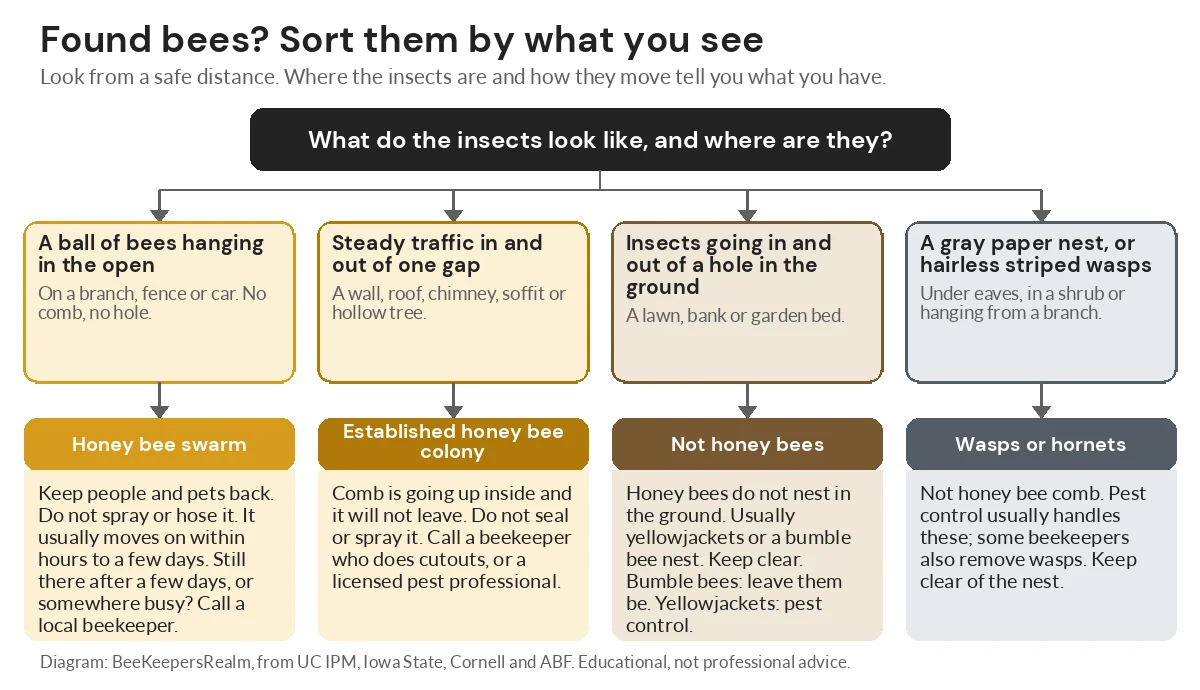
If bees hang in a ball on a branch, fence or car, it is a honey bee swarm: keep people back and call a local beekeeper if it is still there after a few days or sits somewhere busy. If bees fly in and out of one gap in a wall, roof, chimney or hollow tree, it is an established colony that will not leave on its own, so call a beekeeper who does cutouts or a licensed pest professional. Wasps and bumble bees are handled differently.
Key Takeaways
- A cluster in the open with no comb is a temporary swarm. Sources put its stay at 12 to 36 hours (University of Minnesota) up to “a few days” (Iowa State, Cornell).
- Steady traffic through one gap means comb inside. A well-established colony can hold up to 100 pounds of honey (UC IPM) and will not move out.
- Swarms go to a beekeeper, not an exterminator, and are often collected free. Walls cost money.
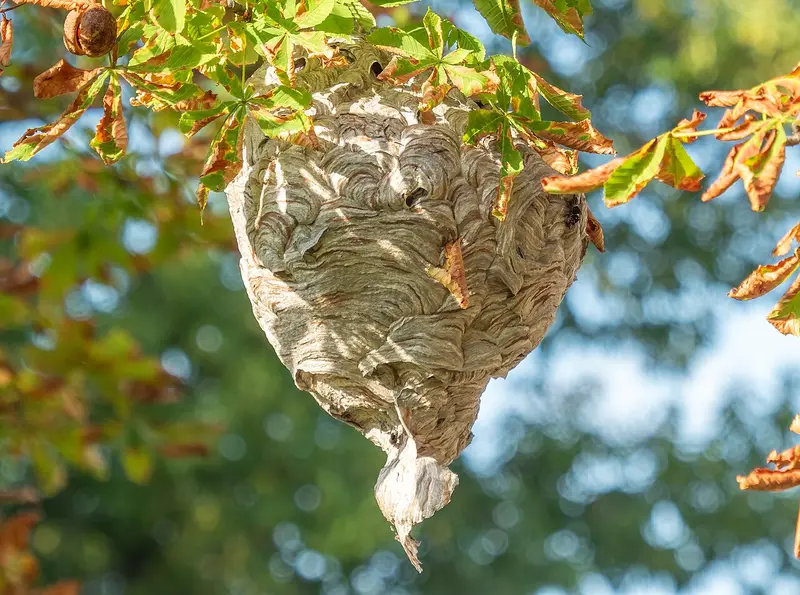
- Honey bees do not nest in the ground or build gray paper nests; wasps, hornets and bumble bees do.
- State agencies and extension services publish removal lists, checked 24 October 2026 below.
Table of Contents
- Swarm or Colony? A Decision Guide
- Honey Bee, Bumble Bee or Wasp: Quick ID
- A Cluster in the Open
- Bees Going In and Out of a Wall, Attic or Tree
- Insects Going In and Out of the Ground
- Who to Call: Checked Removal Lists
- When Swarm Season Happens
- What Not to Do
- Frequently Asked Questions
Swarm or Colony? A Decision Guide
Start with where the bees are and what they are doing. A swarm rests in the open; a colony is a nest, so bees keep coming and going from one spot.
Honey Bee, Bumble Bee or Wasp: Quick ID
| Honey bee | Bumble bee | Wasp, yellowjacket, hornet | |
|---|---|---|---|
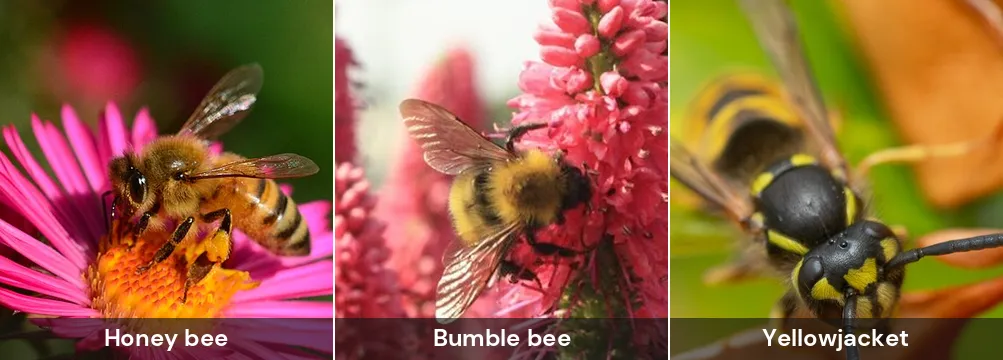
| Look | Fuzzy, amber and brown, not bright yellow (ABF) | Fuzzy, mostly yellow and black (Cornell) | Almost hairless; yellow, white or orange with black (Cornell) |
| Nest | Wax comb in an enclosed cavity, never the ground | Small colony in the ground or a siding void (Cornell, UMN) | Gray paper, mud, or a hole in the ground |
| Who to call | Beekeeper | Usually no one; see our bumble bee nest guide | Pest control; some beekeepers take wasps (ABF) |
For the stings, see bee sting vs wasp sting.
A Cluster in the Open
A swarm is a colony splitting: the old queen and about half the workers cluster while scouts seek a cavity, says UC IPM. They carry honey and guard no nest, so they rarely sting unless provoked.
“Swarms are temporary and the bees will move on if you patiently ignore them.”
Sources disagree on how long a cluster stays, so plan for hours to a few days.
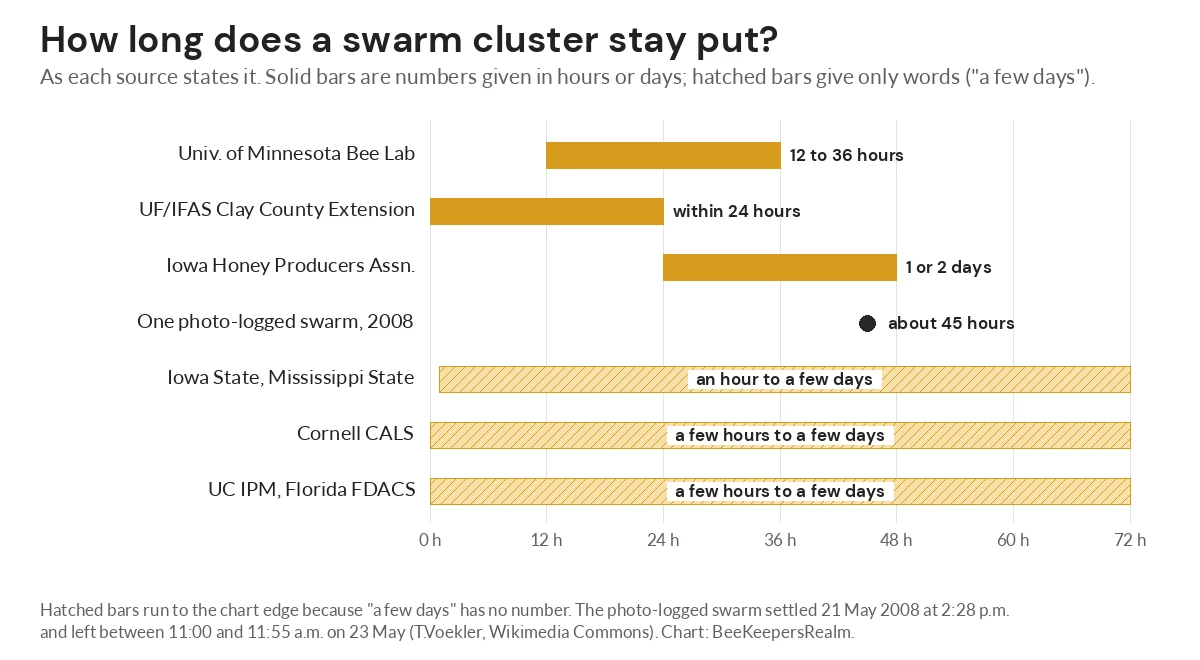
Call a beekeeper if it stays past a few days, hangs near a door or play area, or you want it gone sooner. Have ready where it is, how high, how big, how long it has been there and, if safe, a photo (Cornell, Pollinator Partnership). For trees, see bee swarm in a tree; beekeepers can read catching a swarm safely.
Bees Going In and Out of a Wall, Attic or Tree
“A well-established colony may have up to 100 pounds of honey, many pounds of adult and developing bees, and many beeswax combs.”
A cluster that shrinks without flying off is probably moving in, UC IPM adds, and removal gets harder each week.
Do not seal the hole. Sealed-in bees die over a week or two and some find their way into living space; a colony killed in place leaves honey that can ferment and leak through walls. Ask a beekeeper who does live cutouts, and see how a safe removal works and what it costs.
Pest control is legitimate when the nest cannot be reached safely.
“Although honey bees are an important agricultural resource, it is NOT illegal for a licensed pest control company to eradicate a nuisance honey bee colony.”
Treat it as urgent if bees are entering the house or anyone there is allergic. Where Africanized honey bees are established, such as all of Southern California per UC IPM, keep well back; see identifying Africanized bees.
Insects Going In and Out of the Ground
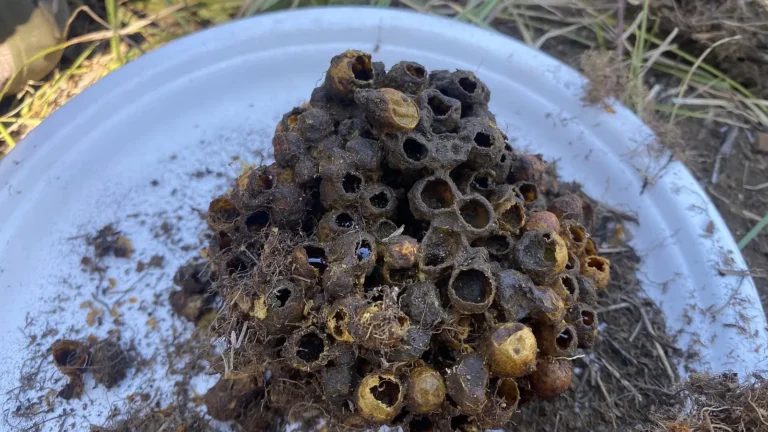
Honey bees do not live in the ground, Cornell notes. A lawn hole with traffic is usually yellowjackets or a bumble bee nest. Keep clear and pour nothing in. Bumble bee colonies are annual, and the University of Minnesota says its wasps are dead after two hard frosts. Gray paper nests in trees or eaves are wasps or hornets.
Who to Call: Checked Removal Lists
Most agencies do not remove bees themselves. These lists name beekeepers; the agencies do not endorse or license them. Ask about cost, insurance and what happens to the comb. Checked 24 October 2026.
| List | Run by | Worth knowing |
|---|---|---|
| Swarm Rescue & Removal | American Beekeeping Federation | Links to most state lists; ABF does not manage them |
| Bee Rescuers | Pollinator Partnership | County lists for several states; fee expectations |
| New York: swarm catcher list (PDF), Cornell page | NY Agriculture and Markets; Cornell | State staff cannot remove bees for private owners |
| Delaware: 2026 swarm removal list (PDF) | Delaware Department of Agriculture | Registered beekeepers, by county |
| Florida: removal or eradication list | FDACS | Registered beekeepers and licensed pest control operators |
| Texas: bee removal list | Texas Apiary Inspection Service | Registered beekeepers, by county |
| Louisiana: swarm collection list | LSU AgCenter | Regional lists; LSU only maintains them |
| Midwest: Michigan, Iowa, Minnesota | Beekeeper associations; UMN Bee Lab | Michigan has separate swarm and cutout lists |
Pollinator Partnership says there is no set fee: many beekeepers remove a swarm free or cheaply, but bees inside walls usually cost money. No list for your state? Ask your county extension office, as Iowa State suggests.
When Swarm Season Happens
Extension sources agree on spring but rarely give dates, so none are invented here.
| Source | What it says |
|---|---|
| Iowa State | Late spring and early summer, starting in the warmer hours |
| Cornell (New York) | Most often late spring and early summer |
| UC IPM (California) | Usually spring, sometimes other times when conditions allow |
| UF/IFAS (Florida) | Calls arrive with the warm Florida spring |
The reporting service Swarmed publishes its own data, not peer reviewed: 2026 reports peaked the week of 11 May, and three in four September and October reports (2024 and 2025) were established colonies, so an autumn “swarm” is often a nest.
What Not to Do
- Don’t hose, stone or knock down a cluster. UC IPM says sticks, stones or a hose provoke a swarm.
- Don’t spray or plug an active nest. Dead bees and honey stay inside the wall.
- Don’t open the wall yourself. Cutouts need gear and repairs.
If someone is stung, remove the stinger fast. A 1996 Lancet study found venom dose rose with every second, with no difference between scraping and pinching after 2 seconds. Call 911 for trouble breathing or facial swelling; see how to treat a sting.
If it is not honey bees, read if it turns out to be a wasp nest.
Frequently Asked Questions
What should I do if I find a bee swarm?
Stay back, keep children and pets away and do not spray it. Call a local beekeeper if it is still there after a few days.
How long will a swarm stay in one place?
About 12 hours to a few days, depending on source and weather. One that never leaves may be a colony.
Is a swarm of bees dangerous?
Not under most circumstances, says Iowa State, though bees sting if provoked.
Who removes a bee swarm, and is it free?
A local beekeeper, not an exterminator, often free or cheap. Use the lists above.
Can I get a hive removed from my wall for free?
Rarely. UC IPM says removing established colonies is seldom worth a beekeeper’s while without payment.
What is the difference between a swarm and a nest?
A swarm hangs in the open with no comb and leaves within days. A nest hides in a cavity, with traffic through one gap.
What time of year do bees swarm?
Mostly spring and early summer.
The Bottom Line
Identify first, then call: a beekeeper for swarms and wall colonies, pest control for wasps. This guide is educational information, not professional advice.
Image credits: Featured photo: “Bee swarm day2” by T.Voekler, licensed CC BY-SA 3.0, via Wikimedia Commons. Other photos credited in their captions.