Reviewed by Michael R. · How we review
A bumble bee nest in the ground is a small, one-season colony, usually in an abandoned rodent burrow, that holds a few hundred bees and ends on its own before winter. If it is away from foot traffic, Iowa State Extension and the Pollinator Partnership both advise leaving it alone, keeping people and mowers back, and waiting. The one thing to settle first is whether you really have bumble bees. A ground nest of yellowjackets is larger, more aggressive and calls for a professional.
This guide covers the homeowner’s version of the question: how to identify what is in the hole, how long it will last, when leaving it is the right call, and who to ask when it is not. For the species themselves, see our complete guide to bumblebees.
Safety note: this is educational information, not professional pest-control or medical advice. If anyone has trouble breathing, swelling of the tongue or throat, or faints after a sting, call 911; see the NIH MedlinePlus page on anaphylaxis.
Key Takeaways
- Bumble bee colonies last one season. A lone queen starts the nest in spring; the workers and males die before winter and only new queens survive (Iowa State Extension, U.S. Fish and Wildlife Service).
- A typical colony is a few hundred bees, started by a first brood of 5 to 20 workers. Healthy colonies of some species can pass 1,000 workers.
- Tell them apart at the entrance: fuzzy, stout bees at one hole are bumble bees; smooth, narrow-waisted, bright yellow-and-black insects swarming at one hole are yellowjackets; a single bee per hole, with several holes and soil mounds, is a solitary ground bee.
- If you can avoid the spot, leave it. Iowa State says live-trapping for relocation is not practical and covering the entrance usually does not solve anything.
- Only females sting, and they can sting more than once. Males cannot sting at all.
- Extension sources disagree about insecticides. We do not recommend DIY chemicals: identify first, then ask your county extension office or a licensed pest professional.
Table of Contents
- Is It Really Bumble Bees?
- What a Bumble Bee Ground Nest Looks Like
- How Long a Nest Lasts: A Colony Calendar
- Should You Leave It Alone?
- Living With a Nest Until It Ends
- Why Moving a Nest Rarely Works
- Nests in a Wall, Under a Deck or in a Shed
- When Removal Is Justified, and Who to Call
- Do Bumble Bees Sting?
- Frequently Asked Questions
- The Bottom Line
Is It Really Bumble Bees?
Three kinds of insects get mixed up at a hole in the ground: bumble bees, yellowjacket wasps, and solitary ground-nesting bees such as mining, digger and sweat bees. The clearest clue is traffic. The Connecticut Agricultural Experiment Station puts it plainly: many individuals enter and exit a single entrance at a yellowjacket nest, while a solitary ground bee uses her own entrance alone. The key below follows that logic and then checks the insect itself.
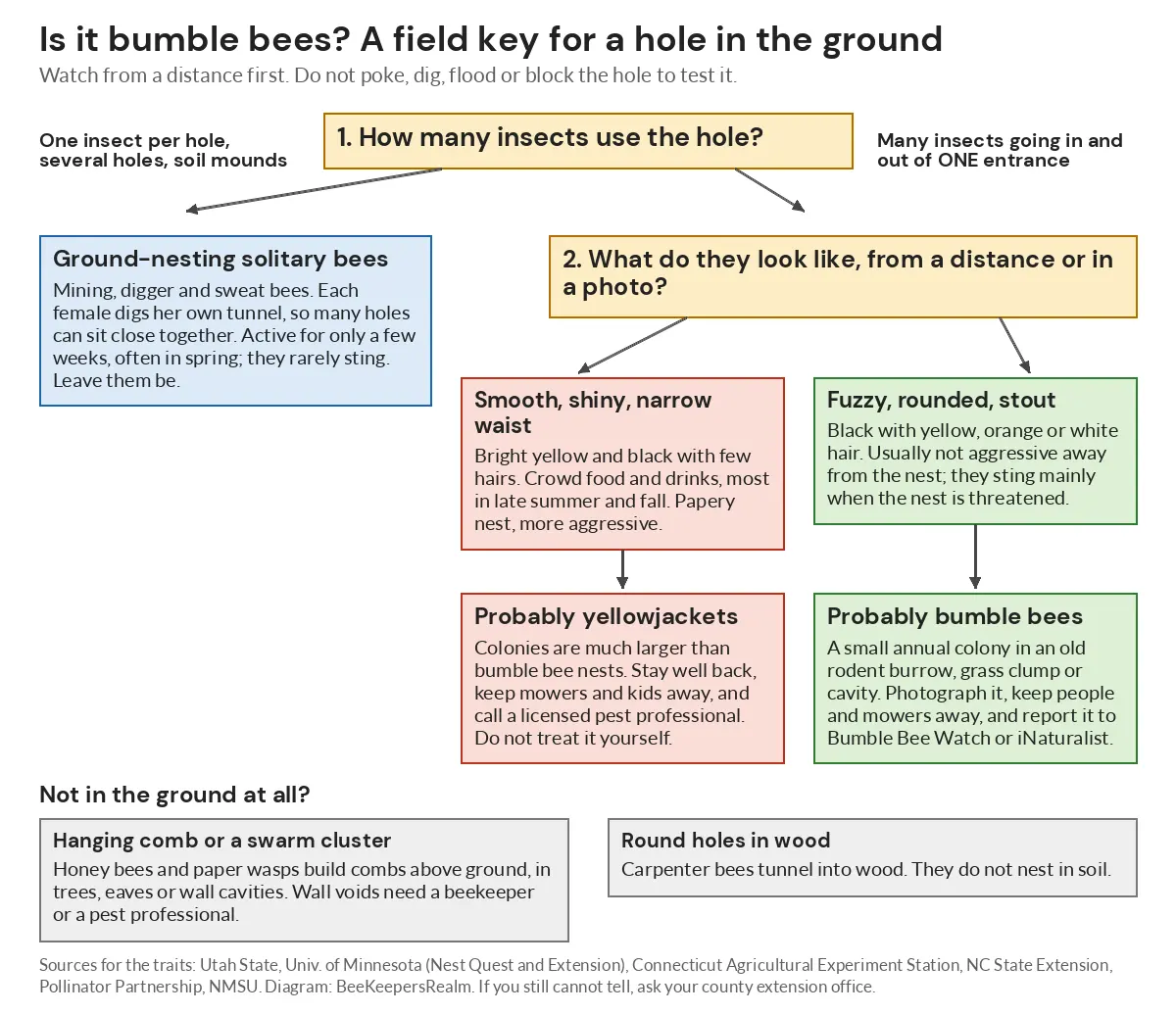
| Clue | Bumble bees | Yellowjackets | Solitary ground bees |
|---|---|---|---|
| Body | Stout and hairy; black with yellow, orange or white hair | Smooth, few hairs, bright yellow and black with a narrow waist | Mostly small and fuzzy; NC State says ground bees are usually smaller than a dime |
| Entrance | Steady traffic at one hole; the hole can be as small as a penny or as large as a cantaloupe | Many insects in and out of one hole; colonies are much larger than bumble bee nests | Typically one bee per hole, often many holes close together, each with a small mound of loose soil |
| Inside | Clumps of wax pots holding brood, pollen and nectar | Papery combs in stacked tiers | A narrow tunnel with cells at the end; mostly solitary (some sweat bees are social) |
| Season | Spring to fall, most visible when the colony peaks (mid-July to August in Minnesota) | Peak in late summer and fall, when workers scavenge food and drinks | A few weeks, often in spring |
| Temperament | Usually not aggressive away from the nest; may sting if the nest is threatened | More aggressive; can sting repeatedly | Rarely sting; they withdraw unless stepped on or cornered |
| Best response | Observe from a distance; leave it | Stay back; call a pest professional | Wait it out; it is over in weeks |
The table draws on the University of Minnesota’s Bumble Bee Nest Quest, the Connecticut Agricultural Experiment Station fact sheet, Illinois, NC State, Utah State and New Mexico State extension material, and the Pollinator Partnership.
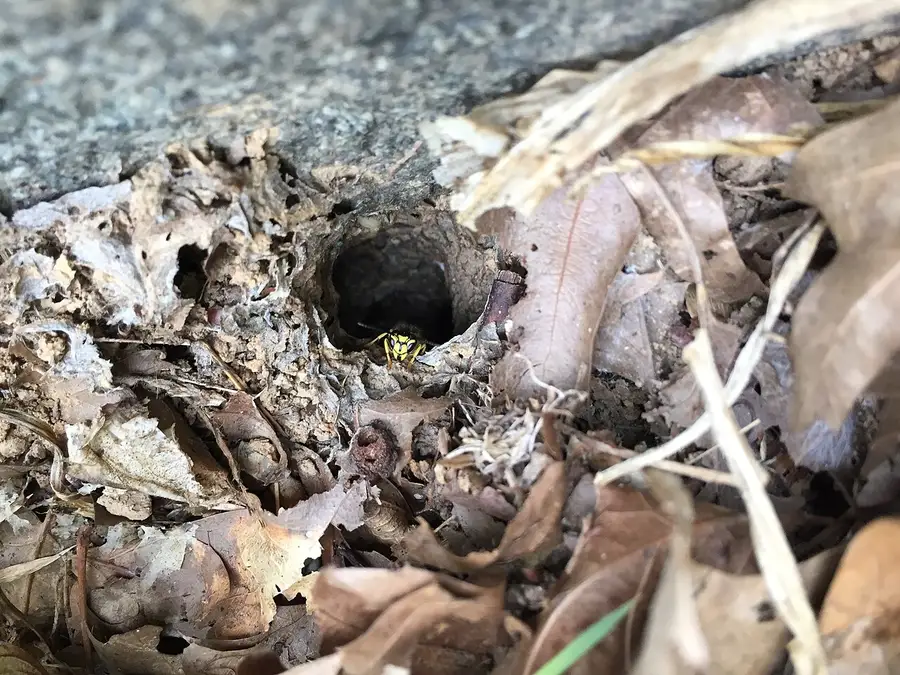
Two other mix-ups are worth knowing. In fall, male bumble bees flit low over the ground looking for mates, which the Nest Quest FAQ says is easily mistaken for nesting behavior. And bees that tunnel into wood are carpenter bees, not ground nesters; see how carpenter bees differ from bumblebees. For solitary ground bees, our guides to mining bees and digger bees show what they look like, and our bees, wasps and hornets comparison covers the rest of the stinging family.
Still unsure? The Pollinator Partnership suggests submitting clear photos to a community science project such as Bumble Bee Watch or iNaturalist, where reviewers can confirm the species; our guide to pollinator citizen science programs explains how they work.
What a Bumble Bee Ground Nest Looks Like
Bumble bees rarely dig their own homes. The University of Minnesota describes them moving into abandoned rodent dens, which rodents have already filled with insulating grass, plant stems and fur, and Iowa State says a deserted mouse or bird nest is typical. Minnesota’s Nest Quest team calls it a bumble bee moving into a vacant apartment, and notes that where rodents choose to nest is generally where bumble bees will too. That is why a nest can turn up in a bare lawn with no flowers nearby: bumble bees fly over half a mile to forage. From outside, a nest is a small hole in the ground, or a clump of grass with bees going in and out in succession.
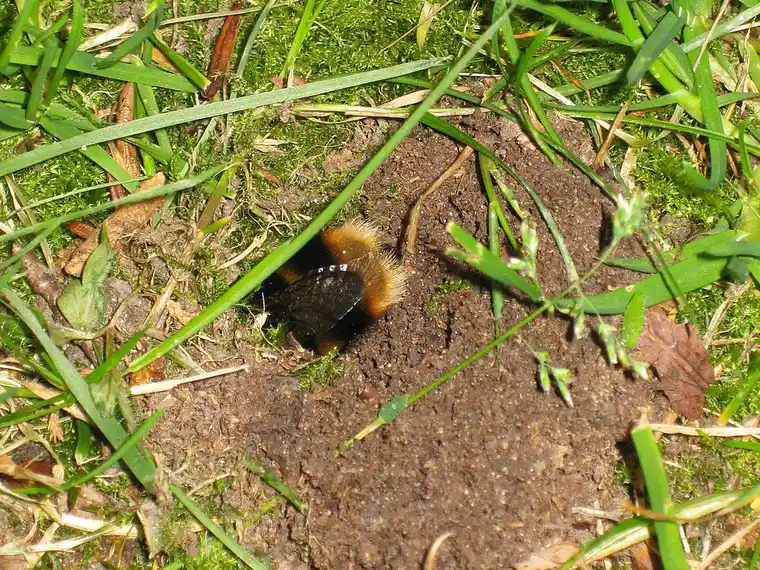
Not every “ground” nest is underground. Nest Quest says bumble bee nests are either on the surface or below the ground, and only rarely in trees. The Pollinator Partnership’s list of sites includes compost, rock piles, hollow logs, flower pots and piles of leaves or branches, as well as underground cavities and building foundations. Surface nests are often built from grass strung together by rodents.
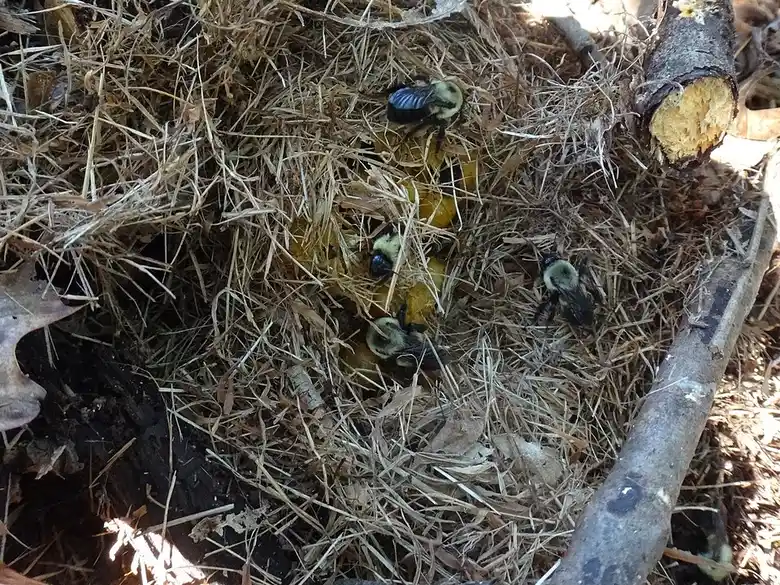
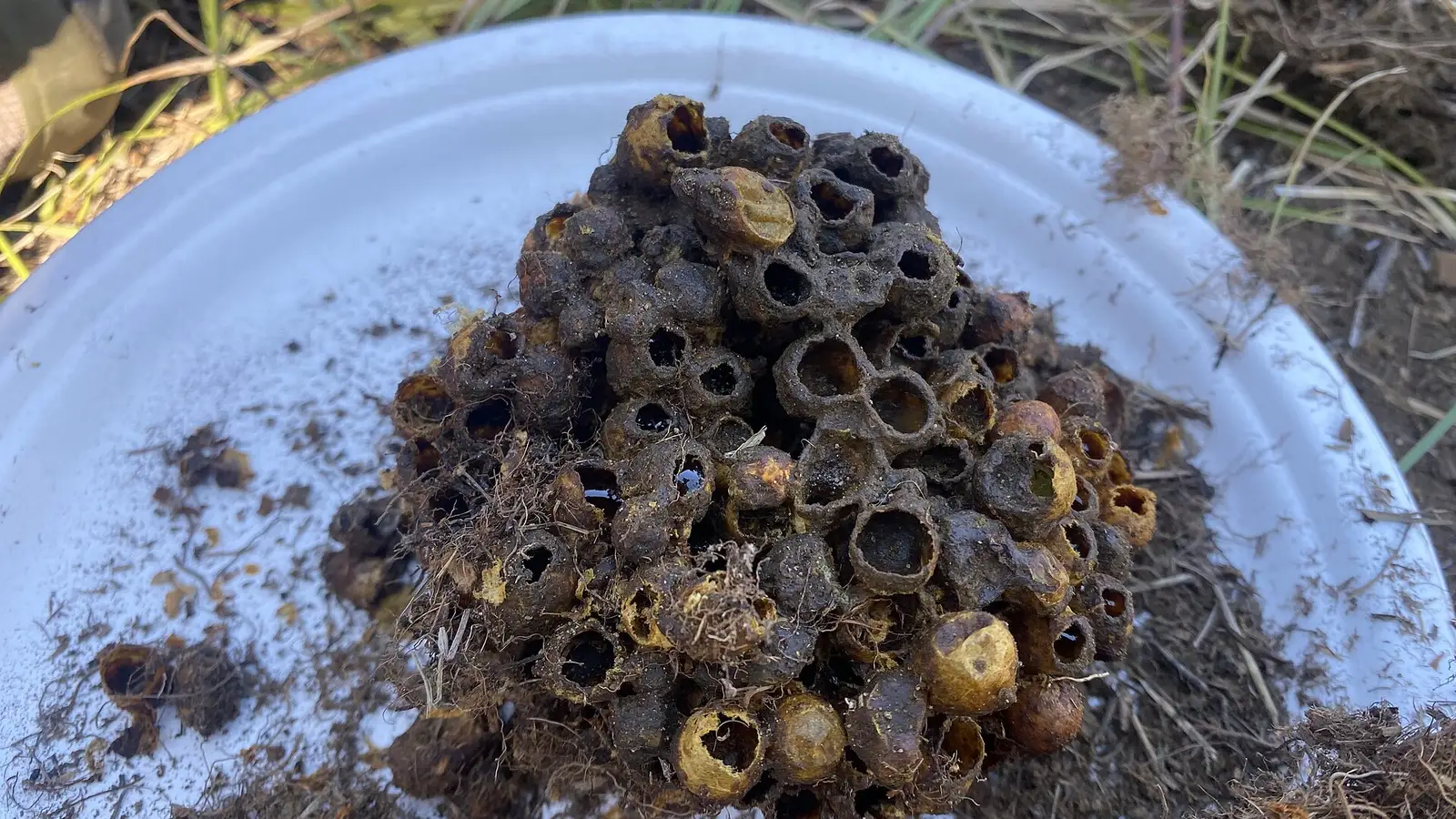
Depth varies. The U.S. Fish and Wildlife Service reports that rusty patched bumble bee nests are typically 1 to 4 feet underground in abandoned rodent nests or other mammal burrows, and that 95% of the 43 nest records it cites were underground. Inside, bumble bee comb looks nothing like a honey bee’s neat hexagons. Nest Quest describes it as a clump of pots or bowls, and the University of Minnesota notes that wax cells hold brood alongside pollen and nectar. The featured photo at the top of this page shows what such cells look like in an abandoned nest.
Most people find a nest late. More workers means more traffic, so a nest is easy to notice only at its peak, and the Pollinator Partnership adds that by the time you find it, it may be almost finished.
How Long a Nest Lasts: A Colony Calendar
The nest is one season long. In spring, a single large queen picks a site, lays eggs and gathers nectar and pollen. Iowa State says her first brood of 5 to 20 offspring are all workers, who then take over the foraging, feeding and nest enlargement while she keeps laying. By late summer the colony produces males and new queens, which mate away from the nest. Then the old colony ends.
“Before winter, the foundress queen, workers and males all die. Only the new queens, referred to as gynes, overwinter to initiate new colonies in the spring.”
Timing depends on species and latitude. The chart below uses the Fish and Wildlife Service’s published dates for one species, the rusty patched bumble bee, and Nest Quest’s Minnesota observations. Treat it as an example, not a schedule for your yard.
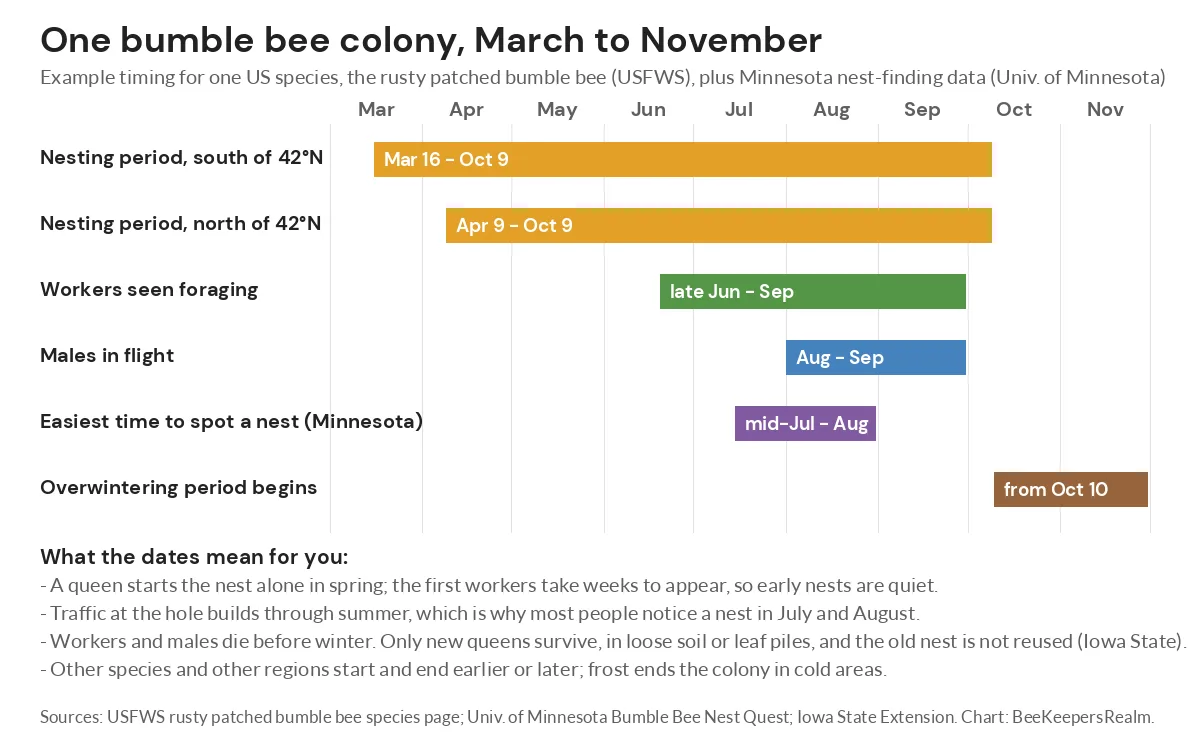
Two practical points follow from the dates. First, an active nest in early October is normal, so “they should be gone by September” is not a safe assumption; the Fish and Wildlife Service’s nesting window for the rusty patched runs to October 9, and Iowa State says workers and males die with frost or the first hard freeze. Second, the queens that survive do not return to the old nest. Iowa State says bumble bees may reappear in the same area from one year to the next but do not reuse an old nest. The new queens dig into loose soil or hide in leaf or branch piles, a habit Oregon State Extension turns into advice: leave fallen leaves and some debris where it can lie undisturbed for a season. Our guide to where bees go in winter covers that hibernation in more detail.
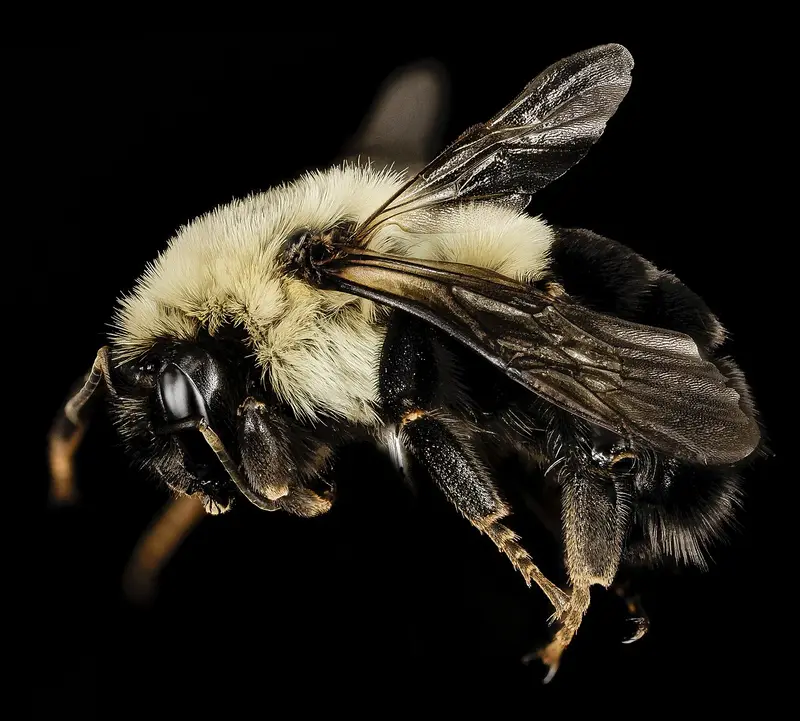
Colony size is the other thing people ask about, and sources vary because species vary:
| Source | Colony size |
|---|---|
| Iowa State Extension | “A few hundred individuals” per nest, small compared with honey bees |
| Pollinator Partnership | Over 2 to 3 months, up to several hundred or a thousand worker bees |
| U.S. Fish and Wildlife Service (rusty patched) | Healthy colonies may include more than one thousand workers |
| Bumblebee Conservation Trust (UK) | Up to about 400 bees; some species around 50 workers |
Should You Leave It Alone?
If the nest is somewhere you can avoid, yes. Iowa State Extension states the conclusion in one line:
“If the vicinity of a bumble bee nest can be avoided, then leave them alone and wait for them to die in the fall”
There are three reasons beyond convenience. The risk is lower than most people expect: Iowa State says bumble bees are not as aggressive as ground-nesting wasps, and Utah State’s pest guide lists nests as a minimal health risk to humans. The bees are also working for you; Iowa State calls them very important pollinators, with some plants better served by their long tongues. And several species are in trouble.
The rusty patched bumble bee, one of about 21 bumble bee species in the eastern United States, was listed as federally endangered in 2017. The Fish and Wildlife Service says it once occurred broadly across the eastern United States and the upper Midwest and has declined across its range since about 2007. Under the Endangered Species Act it is unlawful to “take” an endangered species (16 U.S.C. 1538), and the Act’s definition of “take” includes harming or killing it (16 U.S.C. 1532). A nest in that range is a reason for extra care. The service has also proposed, in January 2026, a nationwide agreement for conserving at-risk bumble bees on energy and transportation lands. The history of one species that did not make it is in our article on Franklin’s bumblebee.
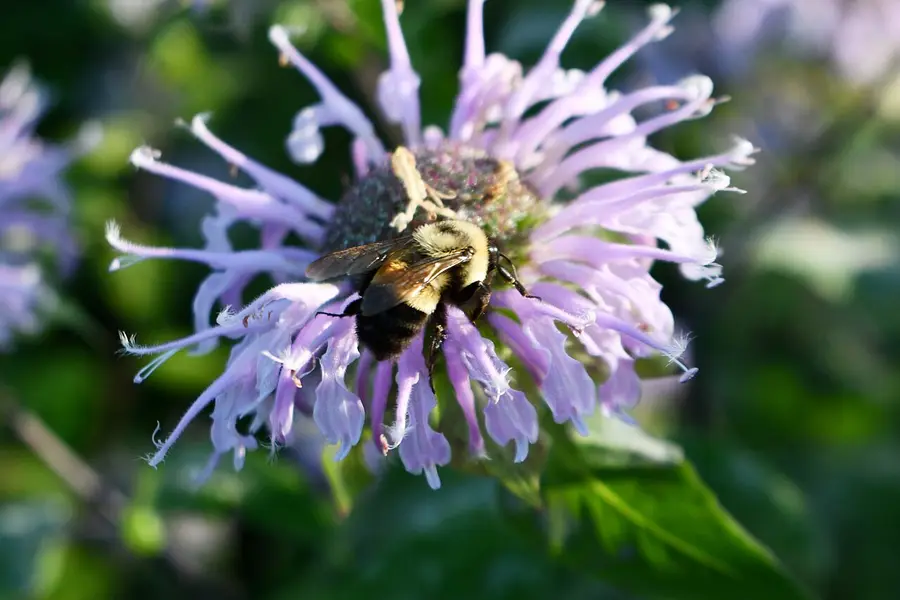
You cannot reliably tell a rusty patched nest from another bumble bee nest at a glance. If you live in the eastern or upper Midwest range, photograph the bees from a distance and ask for help before anyone disturbs the soil.
Living With a Nest Until It Ends
The nest is temporary, so the goal is to keep people and bees out of each other’s way for a few weeks to a few months. The Bumblebee Conservation Trust, a UK charity whose advice carries over, suggests small adjustments:
- Fence the entrance. Use temporary fencing or barriers to keep pets and small children away; an upturned wire hanging basket gives the bees room to come and go.
- Move what you use. Relocate play equipment or garden seating away from the entrance, and avoid noise and vibration right beside it.
- Mow elsewhere. The Trust names vibration from a lawnmower as a typical trigger for a defensive sting, so leave a generous unmown buffer and skip that patch until the colony is gone.
- Net the windows. If the entrance is near a bedroom window, fine netting over the opening stops bees that take a wrong turn indoors.
- Do not dig, flood or block. The Pollinator Partnership says not to disturb the soil or other features if possible, and Iowa State says covering the entrance usually does not solve the problem.
- Record it. Observe from a safe distance and share photos with Bumble Bee Watch or iNaturalist. Researchers know little about where bumble bees nest, so a photo of yours is useful data.
Popular how-to pages offer other fixes: flooding the soil, ground cinnamon, vinegar sprays, citronella candles, planting marigolds or peppermint. We found no university extension source that tests or recommends any of them against a bumble bee nest, and the Connecticut Agricultural Experiment Station’s guidance is to deter ground nesters by changing site conditions, not by chemical treatment.
After the colony is gone, you can make the spot less appealing next year. Because bumble bees move into rodent burrows, Utah State’s advice is to cave in old rodent burrows and seal exterior cracks and crevices. For bare patches that attract solitary ground bees, the Connecticut sheet recommends building up turf density or adding mulch or pea gravel on paths. Do this only after the colony has finished, and leave leaf litter elsewhere in the yard for hibernating queens. If you would like to host bumble bees on purpose, the research on whether bumblebee nest boxes work is less encouraging than the product pages suggest, and our guide to wild bee habitats covers better options.
Why Moving a Nest Rarely Works
The Pollinator Partnership’s nest guidance is direct:
“Do not try to move or relocate the nest, but let it run its course, if possible.”
Iowa State agrees that live-trapping bumble bees for relocation is not practical. The Partnership adds a narrow exception: if a nest truly must be moved for safety or other reasons, first work out which species it is and then contact local bumble bee experts for advice. That is a different skill from removing a honey bee swarm or a colony from a wall, so ask any beekeeper or removal company whether they have handled bumble bee nests before agreeing to anything.
Nests in a Wall, Under a Deck or in a Shed
Bumble bees will use any sheltered cavity. Iowa State lists wall cavities and even a clothes dryer vent; Nest Quest adds the space under a building’s foundation, a bird house and the cushions of patio furniture. An entrance under a deck, patio stone or shed floor is the same situation as one in the lawn: a small colony that ends in fall.
The difference is that a structure can hold honey and wax long after the bees are gone. Utah State’s IPM sheet warns never to plug the entrance hole of a nest in a structural void, and says that because of the honey pots, nests in structures should be removed and the void filled or sealed afterward to prevent reinfestation or other pests. So the sequence is: leave the entrance open while the colony is active, wait for it to end, then have the cavity cleaned out and closed. The Bumblebee Conservation Trust adds that nests do not cause structural damage.
First make sure the occupants are bumble bees. Honey bees also use wall voids, and a colony there is far larger than a bumble bee nest, which is a job for a specialist. Our guide to finding bees in a wall, attic or yard sorts out swarms from established colonies, and the safe way to remove bees from a building explains how removal works.
When Removal Is Justified, and Who to Call
Sometimes leaving it is not realistic. Iowa State says nests in yards, flower beds, woodpiles, walls and other high-traffic areas may create an unacceptable threat of being stung and justify treatment. A household member with a known insect-sting allergy is another good reason to act.
What “treatment” means is where U.S. extension sources part ways. This is the guidance we found, with dates, so you can see how much it varies:
| Source | Date | What it says about a nest in the ground |
|---|---|---|
| Iowa State Extension, Yard and Garden | Reviewed April 2024 | Leave it if you can avoid it; live-trapping is impractical; high-traffic nests may justify treatment. No method given. |
| Iowa State Extension, 1993 article by Donald Lewis (still online) | Published 1993 | Describes insecticide dust applied through the entrance at night, in protective clothing, without plugging the hole until activity stops. |
| Utah State University IPM | Undated web page | Minimal health risk; wear a bee suit; apply a non-repellent insecticidal dust at night; seal structural voids afterward. |
| New Mexico State University, Sutherland | October 2006 | Yellowjackets and bumble bees cannot be tolerated in high-traffic areas; appropriately labeled insecticides directed at the nests work best. |
| Connecticut Agricultural Experiment Station | Undated; accessibility update 2026 | “Pesticides should not be used to control ground-nesting bees”; most can be safely ignored. |
| Pollinator Partnership | Undated PDF | Do not disturb the soil; do not move the nest; if you must, consult local bumble bee experts. |
We do not give application instructions, and we recommend against DIY pesticides for four reasons. Misidentification is the obvious risk, because yellowjackets and bumble bees need different handling. A nest in the rusty patched range is protected by federal law. Treating a nest means working next to defensive bees, which is why even the older sources insist on night work and protective clothing. And an insecticide’s label is the law for how it may be used, which a how-to video does not replace.
So start with identification and local advice, and hire a licensed professional if a nest has to go:
| Your situation | Who to call or use |
|---|---|
| Not sure what it is | Photos to Bumble Bee Watch or iNaturalist; your county extension office (search for your state’s land-grant university extension service) |
| Looks like yellowjackets or another wasp | A licensed pest-control company; do not approach the entrance |
| Honey bees in a wall or ceiling | A beekeeper or bee-removal specialist; see our breakdown of what hive removal costs |
| Bumble bees in a high-traffic spot, or an allergic household member | A licensed pest professional, after extension has confirmed the species. Ask what non-chemical options and timing they offer, and tell them if you live in rusty patched range |
| Someone is stung and reacts badly | 911 and epinephrine if available; see the sting section below |
Do Bumble Bees Sting?
Yes, but not readily. Only females sting, which means queens and workers. The Pollinator Partnership notes that the queen and female workers can sting if cornered while males cannot. Utah State lists bumble bees as able to sting multiple times, and calls the sting painful. The University of Illinois’ BeeSpotter program explains why: a honey bee’s stinger is barbed and stays in the skin, while a bumble bee’s is smooth and allows repeated stings.
The question is how likely it is. University of Minnesota Extension says bumble bees are usually not aggressive when visiting flowers and are more likely to sting when their nest is threatened. That fits the triggers the sources name, such as vibration from a lawnmower and getting too close to the nest. They do not agree on how fierce a defense can get: Iowa State rates bumble bees less aggressive than ground-nesting wasps, while New Mexico State says they readily defend their colonies and can sting intruders in large numbers.
If you are stung, our guide to the difference between bee and wasp stings covers first aid, and the Schmidt sting pain index shows how the pain compares. A small number of people have a serious allergic reaction. MedlinePlus lists stinging insects among the most common causes of anaphylaxis and says symptoms can include hives, swelling of the lips or tongue, trouble swallowing, shortness of breath, wheezing, a weak pulse, vomiting, dizziness or fainting. If someone shows these signs, call 911 and give an epinephrine auto-injector right away if one is available. If you or someone in the house is allergic, read our guide on bee sting allergies and epinephrine and treat any nest within reach of that person as a case for professional help.
Frequently Asked Questions
How do I get rid of a bumble bee nest in the ground?
Usually you do not need to: the colony dies by itself before winter. Mark off the area and wait. If the nest is in a high-traffic spot, confirm the species with extension, then ask a licensed professional; we do not recommend DIY chemicals.
How long do bumble bees stay in an underground nest?
One season. A queen starts the nest in spring and the workers and males die with the first hard frost. The UK’s Bumblebee Conservation Trust puts nest life at 2 to 6 months; US dates vary by species and latitude.
Should you get rid of a bumble bee nest?
Only if you cannot avoid it, such as beside a doorway or play area, or if someone is allergic. Several species are declining, and one is federally endangered.
Is it rare to find a bumble bee nest?
Not rare, but rarely noticed. The Pollinator Partnership says most people never see bumble bee nests because they are usually hidden.
Will bumble bees come back to the same nest next year?
Not to the same nest. Iowa State says bumble bees may reappear in the same area but do not reuse an old nest.
Do bumble bees make honey?
They store nectar and pollen in wax “honey pots” to feed the colony, as New Mexico State describes. A colony is small and lasts one season, so it is not a honey crop.
Can bumble bees nest in a wall or under a deck?
Yes. Do not plug the entrance while the colony is active; seal the cavity after the bees are gone.
Are bumble bee nests dangerous?
Mostly not. Utah State rates the health risk to humans as minimal. Yellowjacket nests are the bigger concern, which is why identification comes first.
The Bottom Line
Identify what is in the hole, keep people and mowers away from it, and let a bumble bee colony finish its season. If a nest has to go, ask extension and hire a licensed professional rather than treating it yourself. For more on the bees themselves, see our native bee identification chart.
Image credits: Featured image, an abandoned Western bumble bee nest excavated in Oregon’s Cascade Range: U.S. Fish and Wildlife Service Pacific, public domain, via Wikimedia Commons (File:Western bumblebee nest (52426513787).jpg), cropped and resized. Other photo credits and licenses appear under each photo.