When most people picture a pollinator, they picture a honeybee. But across North America, bumblebees quietly do work that honeybees genuinely cannot: pollinating tomatoes, blueberries, and cranberries through a mechanical trick called buzz pollination, foraging in cold and rainy weather that grounds honeybee colonies, and pollinating native wildflowers that co-evolved with them specifically rather than with an introduced species. This guide covers what bumblebees actually are, how they differ biologically and behaviorally from honeybees, why commercial greenhouse growers pay to have bumblebee colonies shipped to them, and why one species in particular is now federally listed as endangered.
Table of Contents
- What Bumblebees Actually Are
- Bumblebees vs. Honeybees: Key Differences
- Colony Lifecycle: Why It Restarts Every Year
- Buzz Pollination: The Trick Honeybees Can’t Do
- Are Bumblebees Endangered?
- Common Mistakes
- Identifying Common North American Bumblebee Species
- How to Help Bumblebees in Your Own Yard
- The Commercial Bumblebee Pollination Industry
- Frequently Asked Questions
What Bumblebees Actually Are
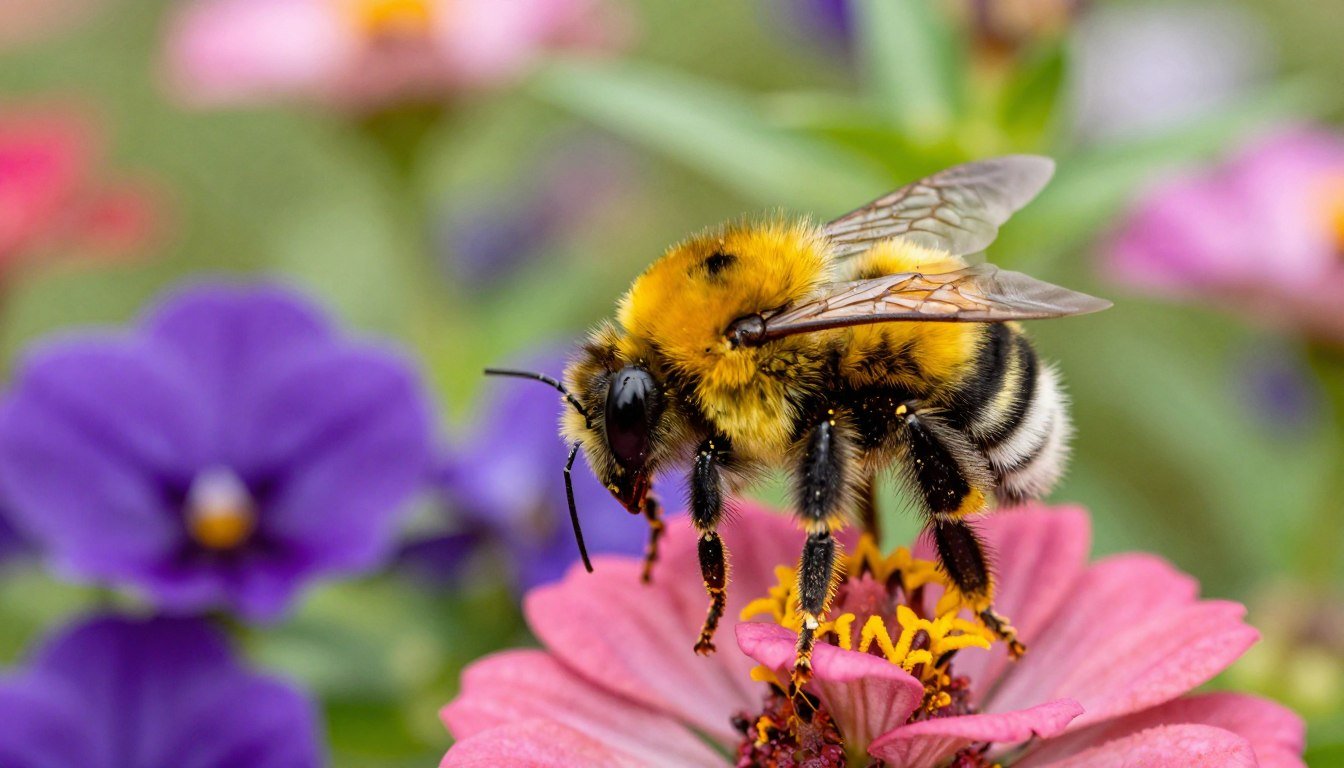
Bumblebees belong to the genus Bombus, a group of roughly 250 species worldwide, about 46 of which are found in North America. Unlike honeybees (Apis mellifera), which were introduced to North America by European colonists in the 1600s, most bumblebee species native to the continent evolved alongside North American wildflowers for millions of years. They’re immediately recognizable by their large, round, densely furry bodies, typically black with bands of yellow, orange, or occasionally white, and they’re considerably bigger and stockier than a honeybee, generally 1.5 to 2.5 cm long compared to a honeybee’s roughly 1.2 to 1.5 cm.
Like honeybees, bumblebees are social insects that live in colonies with a queen, workers, and (seasonally) males and new queens. That’s roughly where the similarity in social structure ends, because almost everything else about how a bumblebee colony operates, from its size to its lifespan to how it makes its nest, is fundamentally different from a honeybee hive.
Bumblebees vs. Honeybees: Key Differences
The differences aren’t cosmetic. They shape how each species pollinates, where it can survive, and what role it can realistically play in an ecosystem or a farm operation.
Colony size: A honeybee colony can hold 20,000 to 60,000 bees at peak season. A bumblebee colony is dramatically smaller, typically 50 to 400 individuals, with some species topping out under 100 and only a few exceptional colonies reaching into the low thousands.
Nesting: Honeybees build hanging wax comb, either in a hollow tree cavity in the wild or a man-made hive box. Bumblebees nest in small, loose, often disorganized clusters of wax pots, usually underground in an abandoned rodent burrow, under a clump of grass, or occasionally in a wall cavity or compost pile. There’s no comb in the honeybee sense at all.
Honey storage: Honeybees store enough honey to survive an entire winter as a colony, which is the entire reason humans keep them. Bumblebees store only a few days’ worth of nectar in small wax pots at any given time. They are not meaningful honey producers, and a bumblebee colony could not survive on stored reserves through a northern winter even if it tried.
Cold tolerance: This is one of the most practically important differences. Bumblebees can generate body heat by shivering their flight muscles and are covered in dense insulating hair, which lets them forage in temperatures as low as 41°F (5°C) and in light rain or overcast conditions that keep honeybees grounded in the hive. This is a major reason greenhouse growers and early-spring fruit growers specifically want bumblebees on site.
Stinging behavior: Bumblebees can sting multiple times, since their stinger isn’t barbed the way a honeybee’s is, but they are markedly less defensive and far less likely to sting unless directly handled or their nest is disturbed.
Colony Lifecycle: Why It Restarts Every Year
A honeybee colony is, in principle, perennial. Given a healthy queen and adequate stores, the same colony can persist for years. A bumblebee colony cannot. Every single bumblebee colony in North America is annual, and understanding why explains a lot about how these bees behave.
In late summer, a bumblebee colony raises a final generation of new queens and males. These mate, and the newly mated queens then leave the colony entirely and burrow into the soil alone to overwinter in a state of dormancy called diapause. Every other bee in the colony, including the original queen who founded it, dies as the season ends. Come spring, each surviving hibernated queen emerges alone, finds a nest site, and single-handedly starts an entirely new colony from scratch, foraging for herself, laying eggs, and raising the first batch of workers completely alone until there are enough workers to take over foraging and brood care. This is a fundamentally more fragile life cycle than a honeybee colony’s, since the loss of a single overwintering queen in early spring means an entire potential colony never exists at all.
Buzz Pollination: The Trick Honeybees Can’t Do
This is the single biggest practical reason bumblebees matter economically. Many plants, including tomatoes, peppers, blueberries, cranberries, and eggplant, hold their pollen tightly inside tube-like anthers that don’t release pollen through normal contact the way an open flower does. These flowers need to be vibrated at a specific frequency to shake the pollen loose, a technique called buzz pollination or sonication.
Bumblebees can do this and honeybees physically cannot. A bumblebee grips the flower and rapidly contracts its flight muscles without moving its wings, producing a distinctive audible buzz at roughly middle-C frequency that shakes pollen loose from the anther in a way honeybee mouthparts and flight muscles simply aren’t built to replicate. This is precisely why commercial greenhouse tomato growers worldwide, an industry worth billions of dollars, rely almost exclusively on purchased bumblebee colonies rather than honeybees for pollination, and why wild bumblebee populations are considered essential, not optional, for commercial blueberry and cranberry yields in North America.
Squash and pumpkin flowers don’t need buzz pollination, but they have their own specialist: the squash bee forages almost exclusively on cucurbit flowers and is often finished for the day before bumblebees or honeybees even start.
Are Bumblebees Endangered?
Not all bumblebee species, but the picture for several North American species is genuinely alarming, and one has already crossed into formal endangered status. In January 2017, the rusty patched bumble bee (Bombus affinis) became the first bumblebee species ever listed as endangered under the U.S. Endangered Species Act. The numbers behind that listing are stark: the species has declined by roughly 87% in abundance, and it has disappeared from an estimated 88% of the populations where it was documented before 2000. Once common across 28 states from Connecticut to South Dakota, it’s now confirmed present in less than 1% of its historical range.
Researchers point to a combination of factors working together rather than any single cause: habitat loss and fragmentation, exposure to pesticides (particularly certain insecticides and fungicides), and, notably, a pathogen believed to have spread from commercially managed bumblebee colonies into wild populations, compounded by the genetic vulnerability of small, isolated remaining populations. Several other North American bumblebee species, including the American bumble bee and the yellow-banded bumble bee, are under review for similar protections as their populations show comparable multi-decade declines.
For home gardeners and beekeepers, the practical takeaway is that supporting bumblebee populations is a genuinely distinct conservation goal from supporting honeybees, since planting a diverse range of native flowering plants, leaving some undisturbed ground or brush piles as potential nest sites, and avoiding pesticide application during bloom periods benefits bumblebees directly in ways that keeping honeybee hives does not.
Identifying Common North American Bumblebee Species
With 46 species native to North America, precise identification can genuinely require an expert, but a handful of species account for the vast majority of bumblebee sightings in most backyards. The common eastern bumblebee (Bombus impatiens) is by far the most frequently encountered species east of the Rockies, recognizable by a single yellow band near the head and a mostly black abdomen; it’s also the primary species raised commercially for greenhouse pollination. The two-spotted bumblebee (Bombus bimaculatus) is another common eastern species with a distinctive yellow patch pattern on its abdomen. West of the Rockies, the yellow-faced bumblebee (Bombus vosnesenskii) is one of the most commonly seen species, identifiable by its yellow face and black-and-yellow banded body. For a broader overview of how bumblebees fit alongside other native bee species found across the country, see this site’s guide to native bee species in the United States.
How to Help Bumblebees in Your Own Yard
Because bumblebees have different needs than managed honeybee colonies, supporting them takes a somewhat different approach than typical beekeeping-focused pollinator gardening advice. Leaving small patches of bare or lightly mulched ground undisturbed gives queens realistic nesting options, since most species nest underground or under leaf litter rather than above ground. Delaying fall cleanup and leaving some perennial stems and leaf piles in place through winter protects overwintering queens, which often shelter in exactly the kind of debris a tidy fall cleanup removes. Planting native, pesticide-free flowers that bloom continuously from early spring through late fall matters more for bumblebees than for honeybees, since a bumblebee colony has no substantial food reserves to fall back on during a gap in bloom. Readers building out a broader pollinator-friendly planting plan can find detailed species suggestions in this site’s guide to building a pollinator meadow.
The Commercial Bumblebee Pollination Industry
Commercial bumblebee rearing is a genuinely significant, if lesser-known, agricultural industry in its own right. Companies raise the common eastern bumblebee and a small number of other species year-round in climate-controlled facilities, shipping small cardboard nest boxes containing an established colony directly to greenhouse operations, where the colony pollinates an entire crop cycle before being retired. This industry exists specifically because greenhouse tomato production, worth billions of dollars globally, depends on buzz pollination that honeybees cannot perform and that hand-pollination with vibrating wands is far too labor-intensive to do at commercial scale. The trade-off, and part of why the rusty patched bumble bee’s endangered listing matters so much to researchers, is that commercially reared colonies shipped in large volumes are considered a plausible pathway for pathogens to spread from managed populations into wild bumblebee populations, an ongoing area of active agricultural and conservation research.
Common Mistakes
People frequently assume any large, fuzzy black-and-yellow bee is a “bumblebee,” lumping in carpenter bees, which are a completely different, mostly solitary species often confused with bumblebees due to similar size and coloring but distinguished by a shiny, hairless abdomen. Another common mistake is assuming a bumblebee nest found in a yard needs to be destroyed for safety; because bumblebee colonies are annual, small, and far less defensive than honeybees or wasps, the more useful response in most residential situations is simply to give the nest a wide berth for the few remaining weeks of the season and let it die out naturally.
Bumblebees can sense a flower's electric field through their body hairs; see how bumblebees sense flower electric fields.
Sources
For further reading, see the Xerces Society’s Pollinator Conservation Program.
Frequently Asked Questions
Do bumblebees make honey I can harvest?
No. Bumblebees only store a few days’ worth of nectar at a time in small wax pots, nowhere near enough to be harvestable, and their colonies don’t survive winter regardless.
Are bumblebees more or less aggressive than honeybees?
Generally less. Bumblebees are not naturally aggressive and typically only sting when directly handled, stepped on, or when their nest is physically disturbed.
Can I keep bumblebees like honeybees in a hive?
Not in the traditional beekeeping sense. Commercial bumblebee colonies are raised specifically for short-term greenhouse or field pollination contracts and are not managed as a perennial apiary the way honeybee hives are.
Do bumblebees pollinate better than honeybees for every crop?
No. For crops that don’t require buzz pollination, like most orchard fruit or field crops with open, accessible flowers, honeybees remain more practical at scale simply because a single honeybee hive can field tens of thousands of foragers, far more than any bumblebee colony. Bumblebees pull ahead specifically for buzz-pollinated crops and in cold, wet, or low-light conditions where honeybees won’t fly at all. Beekeepers who also want to support bumblebees on the same property should treat the two goals as complementary rather than identical, since a thriving honeybee apiary says nothing about whether the surrounding land actually offers bumblebee queens a place to nest or a season-long supply of bloom, and the two efforts genuinely reinforce each other when planned together thoughtfully.