
Reviewed by Daniel M. · Last Updated October 13, 2026 · How we review
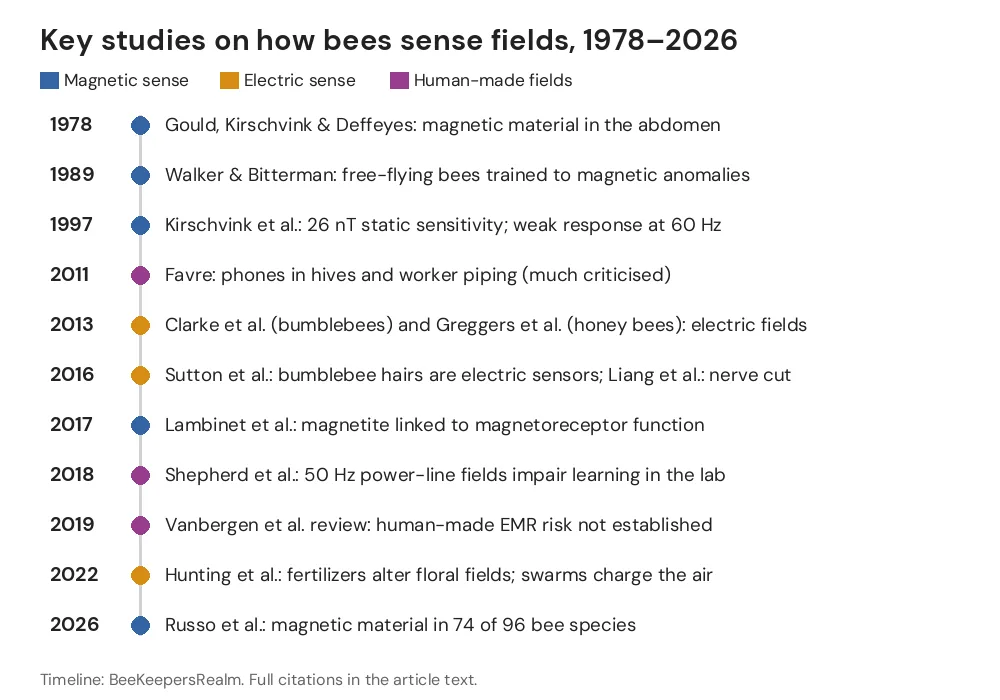
Bees detect electromagnetic fields with two separate senses. They feel weak electric fields, such as the one around a flower, through body hairs and antennae that are pushed by electric forces, and honey bees sense Earth’s magnetic field, most likely through magnetite in the abdomen. Whether radio signals from phones, Wi-Fi or 5G harm bees is a third question, and the evidence there is weak and mostly low quality.
This guide keeps those three questions apart, because most confusion online comes from mixing them. For how electric charge moves pollen, see our companion piece on static electricity and pollination.
Key Takeaways
- “Electromagnetic field” covers three different things for a bee: static or slowly changing electric fields, magnetic fields, and radio-frequency radiation. Bees have evidence-backed senses for the first two only, plus vision for light.
- In a 2016 study, bumblebee body hairs moved in electric fields as weak as 0.77 volts per metre and fired nerve signals. Antennae moved too but showed no nerve response.
- Honey bees detect electric fields with their antennae, and dancing bees give off electric fields that other bees can learn.
- Honey bees can be trained to magnetic changes as small as 26 nanotesla. A 2017 study tied this sense to magnetite in the abdomen; the receptor cells have still not been found.
- Lab studies show 50 Hz power-line fields can impair honey bee learning. For phones and 5G, reviews find no reliable evidence of harm to bees in the field.
Table of Contents
- Electric, Magnetic or Radio: Three Separate Questions
- Why a Flying Bee Carries an Electric Charge
- How Bumblebees Feel a Flower’s Electric Field
- Honey Bees Sense Fields With Their Antennae
- How Honey Bees Sense Earth’s Magnetic Field
- Power Lines: Lab Effects at Real-World Levels
- Phones, Wi-Fi and 5G: What Is and Isn’t Known
- Chemicals and Swarms That Change the Electric Landscape
- What Scientists Still Don’t Know
- Frequently Asked Questions
- The Bottom Line
Electric, Magnetic or Radio: Three Separate Questions
An electric field surrounds any charged object, like a rubbed balloon. A magnetic field surrounds a magnet or a current-carrying wire, and Earth has one. Electromagnetic radiation is the two traveling together as a wave: light, radio and phone signals. Each needs its own kind of sensor.
Bees do detect one form of electromagnetic radiation very well: light. They see ultraviolet, blue and green, as covered in our page on what light bees can and can’t see. The rest of this guide is about fields, not vision.
| Field type | Can bees sense it? | Likely sensor | How solid is the evidence? |
|---|---|---|---|
| Weak electric fields (flowers, other bees) | Yes: bumblebees and honey bees | Body hairs (bumblebee); antennae and Johnston’s organ (honey bee) | Strong in the lab (2013 to 2016 studies); how much bees rely on it outdoors is open |
| Earth’s magnetic field | Yes: honey bees | Probably magnetite in the abdomen | Repeated behavioral evidence since the 1980s; receptor cells not yet identified |
| Power-line fields (50 or 60 Hz) | Detection needs strong fields; effects seen in the lab | Not known | A few controlled lab studies; no field studies of colonies |
| Radio frequencies (phones, Wi-Fi, 5G) | No evidence bees use them as a cue | None known | Mixed, mostly low quality; no established harm at real-world levels |
| Light (UV to green) | Yes | Compound eyes and ocelli | Established |
Why a Flying Bee Carries an Electric Charge
The air is electrified even in fair weather. Near the ground, voltage rises by about 100 volts for every metre of height, a value given in the 2017 review by Dominic Clarke, Erica Morley and Daniel Robert of the University of Bristol. A plant rooted in the ground is connected to Earth, so its flowers end up slightly negative compared with the air around them.
Bees end up positive. Friction with air and with surfaces is thought to strip electrons from the cuticle, the same effect that charges a balloon, although the exact mechanism is not fully worked out. The Bristol review puts a bee’s net charge at roughly +30 to +50 picocoulombs, depending on the study and the kind of bee, which for something so small means a surface voltage of the order of hundreds of volts. In a separate project, Bristol researchers report that bumblebees have charged positive against every material they have tested.
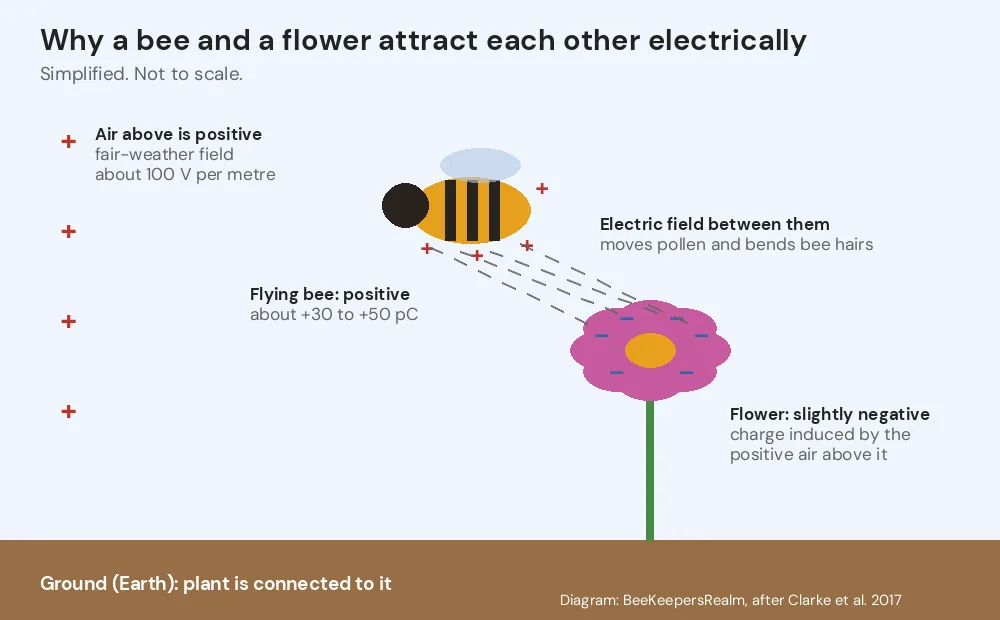
Opposite charges attract, so pollen can jump the last millimetres onto a bee. The question here is different: can the bee feel the field?
In this four-minute 2020 explainer, Andy Benson, an education officer with the UK’s Bumblebee Conservation Trust, starts with atoms and charged particles and explains what an electric field is. From about the two-minute mark he applies it to bumblebees and flowers, whose opposite charges help pollen move.
How Bumblebees Feel a Flower’s Electric Field
The 2013 artificial-flower experiments
The first proof came from Clarke, Heather Whitney, Gregory Sutton and Robert, published in Science in 2013. They built artificial flowers and gave some an electric charge. Buff-tailed bumblebees (Bombus terrestris) learned to visit the charged flowers that held sugar water and avoid uncharged ones with a bitter solution. When the charge was switched off, the bees could no longer tell them apart.
As Ed Yong reported for National Geographic, the bees chose the charged reward flowers with 81 percent accuracy and could even tell an evenly charged flower from one with a bullseye-shaped field. Adding an electric cue also sped up a hard color task: bees reached 80 percent accuracy in 24 visits instead of 35. The team found that the electric potential in a petunia stem shifted by about 25 millivolts when a bee landed, and the change lasted just under two minutes.
“Because floral electric fields can change within seconds, this sensory modality may facilitate rapid and dynamic communication between flowers and their pollinators.”
That last finding is why the field may work as an “already visited” sign. But the study showed only that a visit changes the field, not that wild bees use the change to skip emptied flowers. Treat it as a hypothesis.

Hairs, not antennae: the 2016 measurements
How a bee registers the field was answered three years later. Sutton, Clarke, Morley and Robert placed a metal disc 1 centimetre from a bumblebee and swept it with an alternating voltage of 400 volts peak to peak, from 10 Hz to 10 kHz. A laser vibrometer measured how far single hairs and the antennae moved, and fine electrodes recorded the nerve at the base of a hair.
Both moved, but the hairs moved faster and farther, and only the hairs produced nerve activity. The paper, “Mechanosensory hairs in bumblebees detect weak electric fields” in PNAS, concludes that sensory hairs are a site of electroreception. Hairs resonated near 3.8 kHz and antennae near 1.1 kHz. At resonance, a charged hair moved in a field of just 0.77 volts per metre, far weaker than the 100 volts per metre of ordinary fair-weather air.
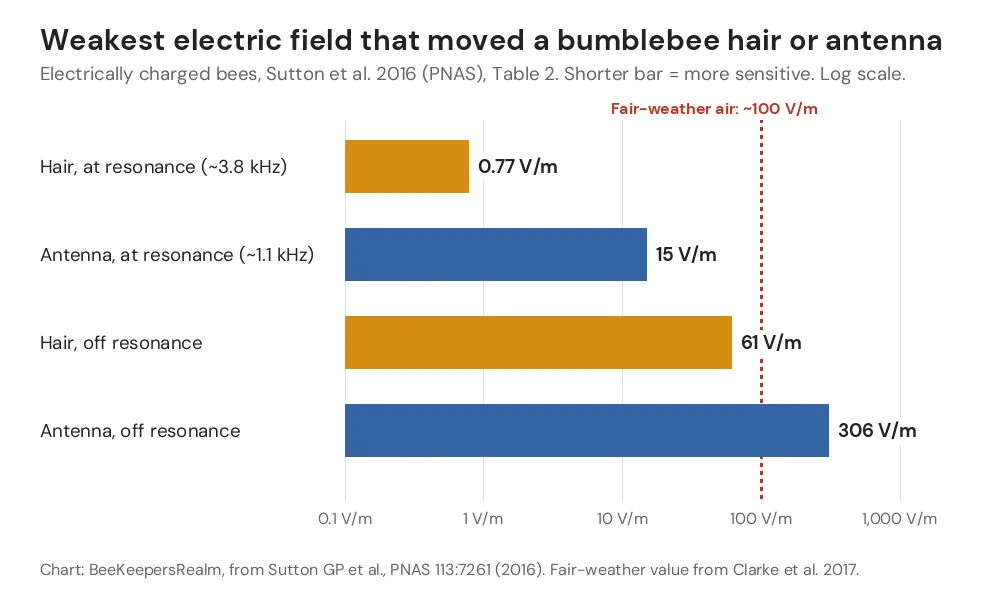
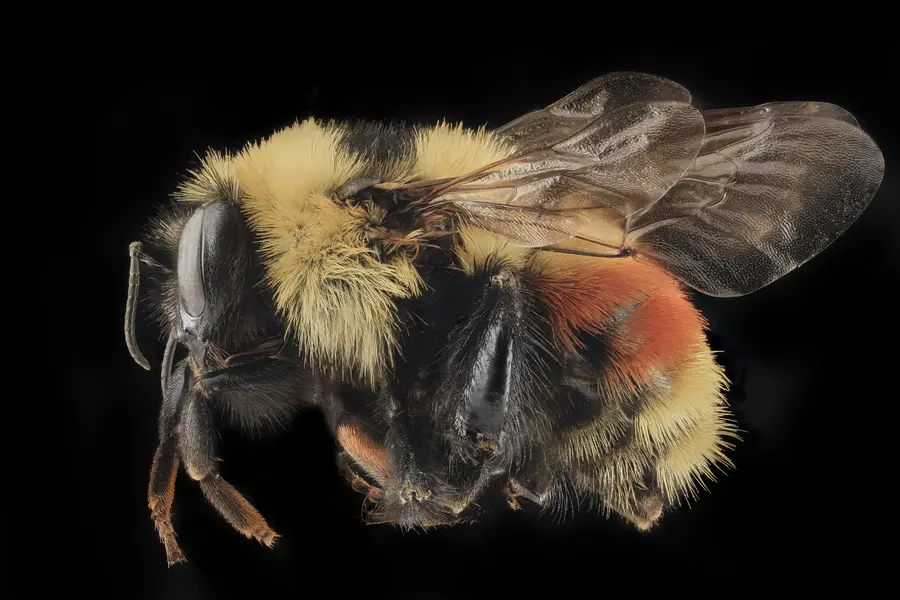
Charge matters. Hairs on charged bees moved much more than on uncharged ones, even though the test bees carried only about 4 picocoulombs, against 32 in flight. A bumblebee’s dense coat is therefore an array of tiny electric sensors as well as insulation and a pollen trap; see our guide to North American bumblebees for the rest of their biology.
How far away a bee can sense a flower
Using computer models of the field, the 2016 team calculated that a charged hair could respond to a 30-volt disc from 7.1 to 55 centimetres away, depending on frequency. Antennae responded only from 2.6 to 13 centimetres. Sutton told NPR that about 10 centimetres, around 4 inches, is more likely for a real flower. In practice this is a close-range sense used in the last moments before landing, not a way to find flowers across a field.
The same hairs also sense moving air. A 2020 model by Koh and Robert found that a 300 volt-per-metre field moves a hair about as much as the air stirred by a nearby insect’s wingbeats, so outdoors the two inputs can blur.
Honey Bees Sense Fields With Their Antennae
Honey bees showed the same ability in a different setting. In 2013, Uwe Greggers, Randolf Menzel and colleagues at the Free University of Berlin published in Proceedings of the Royal Society B that honey bees give off constant and changing electric fields when flying, landing, walking and during the waggle dance. A dancer’s body waggles at about 16.5 beats per second, and the field it gives off carries low- and high-frequency parts.
Those fields moved the antennae of nearby stationary bees without any touch. In conditioning tests, bees learned to extend their tongues to an electric field paired with sugar, including a field pulsing at 60 Hz from a probe 3 millimetres away. The team traced detection to mechanoreceptors in both antennal joints and recorded responses from the nerve of Johnston’s organ, a vibration sensor in the second segment of the antenna. Our page on sensory receptors in bee antennae explains how that organ works.
The authors suggest these fields may play a role in communication inside the dark hive, alongside the sound and air jets dancers produce. That is a proposal, not settled fact. Karl von Frisch decoded the dance itself decades earlier; see Karl von Frisch and the discovery of the waggle dance, and for the brain side, how bees process dance signals.
How Honey Bees Sense Earth’s Magnetic Field
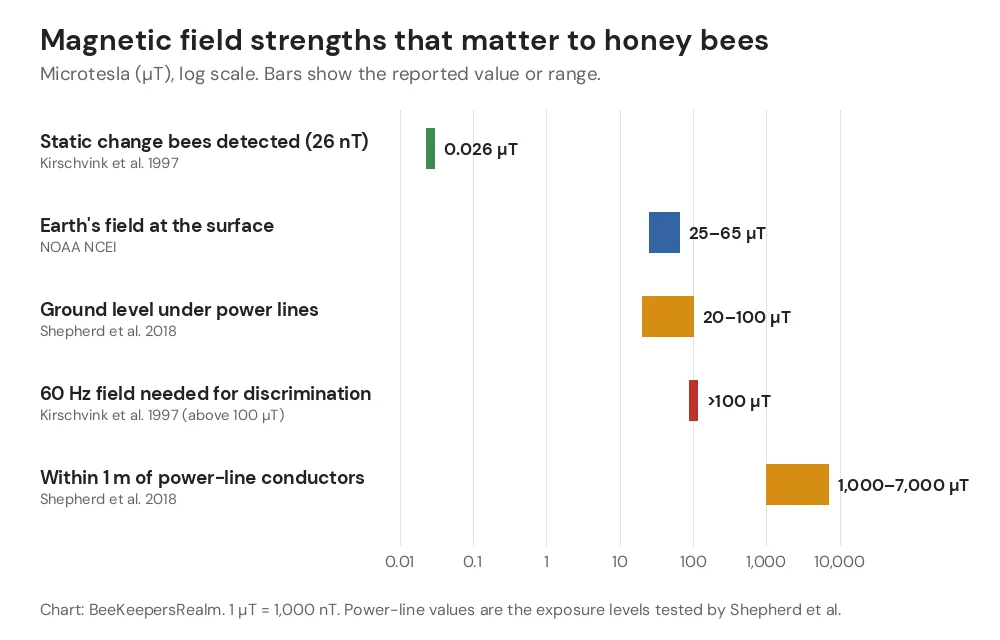
Magnetic sensing is a separate sense with separate evidence. Earth’s field at the surface ranges from about 25,000 to 65,000 nanotesla, or 25 to 65 microtesla, according to NOAA’s National Centers for Environmental Information. It is steady, not a wave.
Magnetite in the abdomen
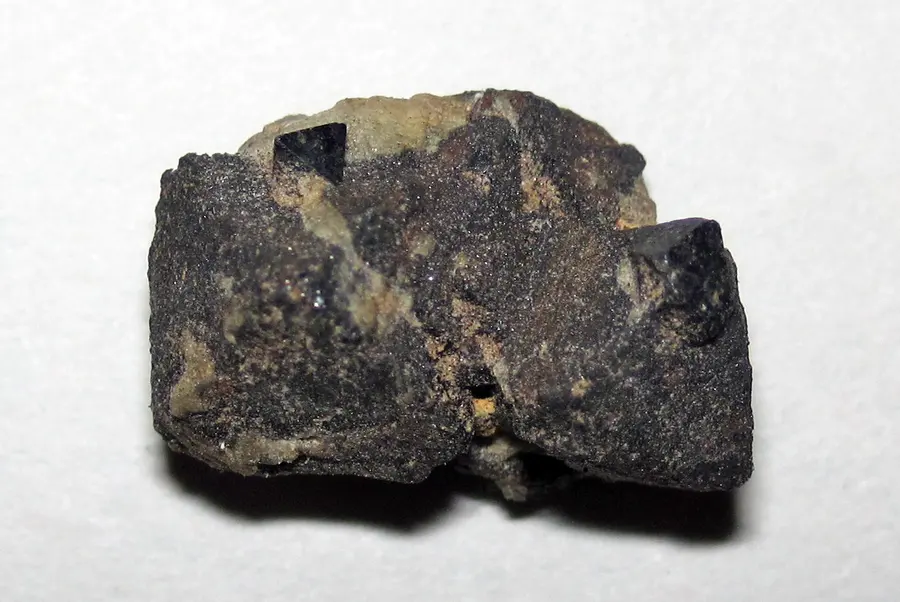
In 1978, James Gould, Joseph Kirschvink and Kenneth Deffeyes reported in Science that honey bees carry magnetic material across the front of the abdomen, which apparently develops during the pupal stage. Magnetite is an iron oxide, the same mineral as lodestone. In bees it occurs as microscopic particles, not visible crystals.
Training bees to a magnet
Michael Walker and M. E. Bitterman trained free-flying honey bees to tell whether a small, local magnetic anomaly was present or absent. Their 1989 paper in Bioelectromagnetics concluded that bees seemed to need to be moving to respond, and that the results fit a magnetite-based sensor in the front and upper part of the abdomen. Summarizing those experiments in 1997, Kirschvink’s group wrote that free-flying bees detect static changes as small as 26 nanotesla, roughly one two-thousandth of Earth’s field. Their sensitivity fell quickly for alternating fields: at 60 Hz, they needed more than 100 microtesla.
In 2016, Liang and colleagues at National Taiwan University trained harnessed bees to extend their tongues to a magnetic stimulus for a sugar reward. When the nerve cord between abdomen and thorax was cut, the bees stopped responding to the magnet but still learned an odor task, and the cord carried nerve signals when the field changed.
The strongest link so far
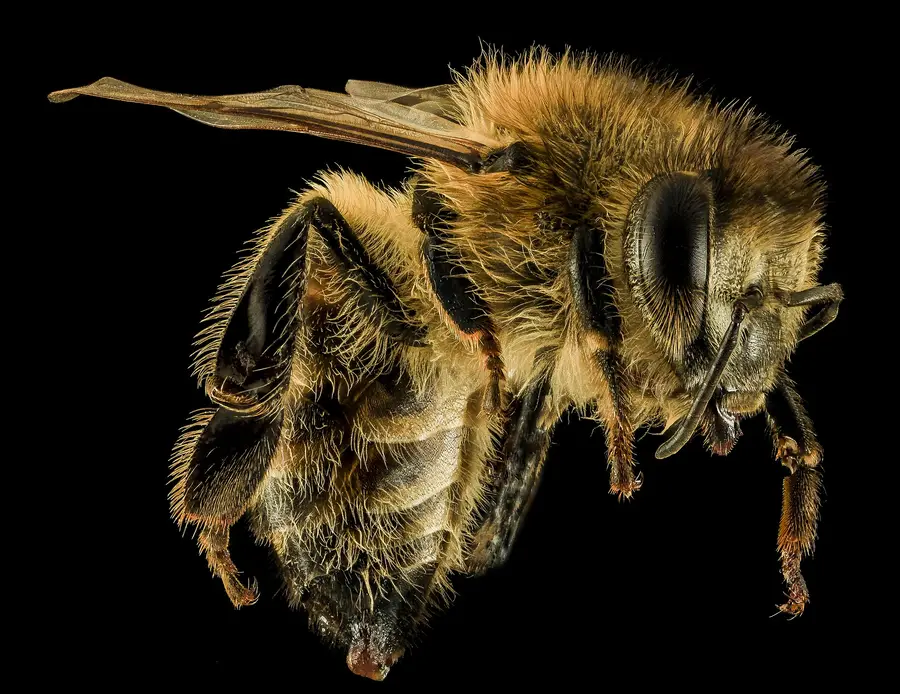
Lambinet and colleagues at Simon Fraser University in British Columbia closed the loop in 2017. Only the abdomen, not the head or thorax, showed the magnetic signature of ferromagnetic material. Bees briefly exposed to a strong magnet, which re-magnetizes magnetite, then failed to find a magnetic anomaly they had learned, while untreated bees found it.
“Our data support the conclusion that honey bees possess a magnetite-based magnetoreceptor located in the abdomen.”
Not only honey bees
A 2026 study in Science Advances led by Laura Russo measured ground-up specimens and found ferromagnetic material in 74 of 96 bee species tested, social and solitary alike, and in some wasps, beetles and flies. Signal strength rose with body size and social behavior. The authors call this “putative” magnetoreception: magnetic material shows a bee could have the sense, not that it uses it.
What the magnetic sense is for
Nobody knows exactly. Bees are known to navigate by the sun, polarized light and landmarks, so magnetism is at most one input among several. Kirschvink, Michael Winklhofer and Walker wrote in 2010 that progress on animal magnetic senses has been held back by too few behavioral methods and difficulty reproducing results, so single studies deserve caution. For how far foragers fly, see bee foraging distances.
Power Lines: Lab Effects at Real-World Levels
Power lines give off extremely low frequency (ELF) fields, 50 Hz in Europe and 60 Hz in the United States. A team at the University of Southampton exposed honey bees to 50 Hz fields at 20 to 100 microtesla, the level they cite for ground level under power lines, and up to 1,000 to 7,000 microtesla, found within a metre of the conductors. In Shepherd et al. 2018, exposure reduced learning, changed flight, lowered the success of foraging flights and reduced feeding.
A follow-up in PLOS ONE in 2019 exposed bees for 17 hours to 100 or 1,000 microtesla. Learning to avoid a punishment fell by more than 20 percent at both levels, and at 100 microtesla the bees scored 60 percent higher for aggression toward intruders from other hives.
These were short lab exposures at 50 Hz. No study has followed whole colonies living under lines, and US lines run at 60 Hz, where Kirschvink’s work found bees less sensitive. Power-line fields are a plausible stressor, not a proven cause of colony losses.
The practical step is simple. Field strength drops sharply with distance from the conductors, so if you have a choice of sites, don’t put hives directly beneath a high-voltage line. Our beehive placement guide covers the factors that matter more day to day.
Phones, Wi-Fi and 5G: What Is and Isn’t Known
The phone-in-the-hive studies
The most quoted study is Daniel Favre’s 2011 paper in Apidologie. He placed mobile phone handsets inside or right beside honey bee hives and recorded the sounds the bees made. According to Phys.org’s report on the study, bees began “worker piping,” a high-pitched signal, after the phones had been on for about 20 to 40 minutes, did not swarm even after 20 hours, and calmed within two minutes of the phones being switched off.
Critics raised two problems. Phones are not normally inside hives, and British bee scientist Norman Carreck noted that knocking or hitting a hive produces the same response. A 2011 study by Kumar and colleagues at Panjab University in India placed phones in “talk mode” near worker bees and reported reduced activity, then mass movement toward the phone, and biochemical changes. Both put phones in or right next to the colony, a far closer exposure than bees meet in the open.
What the reviews conclude
Vanbergen and colleagues reviewed the evidence on human-made electromagnetic radiation and pollinators in 2019. Lab work gave “some, albeit variable, evidence” that honey bees can detect it, but no evidence that it changes insect behavior in real ecosystems, and only one robust field study on pollinator numbers, with mixed positive and negative results.
“A lack of high quality scientific studies means that knowledge of the risk to pollinators from anthropogenic EMR is either inconclusive, unresolved, or only partly established.”
Later work agrees. A 2023 workshop report led by Germany’s Federal Office for Radiation Protection said that above 100 MHz the only established way radio waves act on living things is by heating, and that no proven harm to animals or plants under realistic outdoor conditions had been found. A 2023 systematic map by Karipidis and colleagues covered 334 studies on animals and plants, mostly lab experiments, and found that the vast majority used poor-quality methods.
Why 5G gets special attention
5G can use higher frequencies than older networks. A 2018 modelling study by Thielens and colleagues found insects absorb more radio energy above 6 GHz; shifting 10 percent of the power there could raise absorbed power by 3 to 370 percent. That is a calculation, not a measured effect on bee health.
Lab studies keep finding biological responses, such as stress markers in bees exposed to a 900 MHz field in a 2023 study from Wroclaw, Poland, so the question is not closed. But none of the reviews above found that phone or 5G signals cause colony losses in real apiaries. For what is known to drive losses, see our pages on colony collapse and varroa mite control.
Chemicals and Swarms That Change the Electric Landscape
Fertilizers and a neonicotinoid alter floral fields
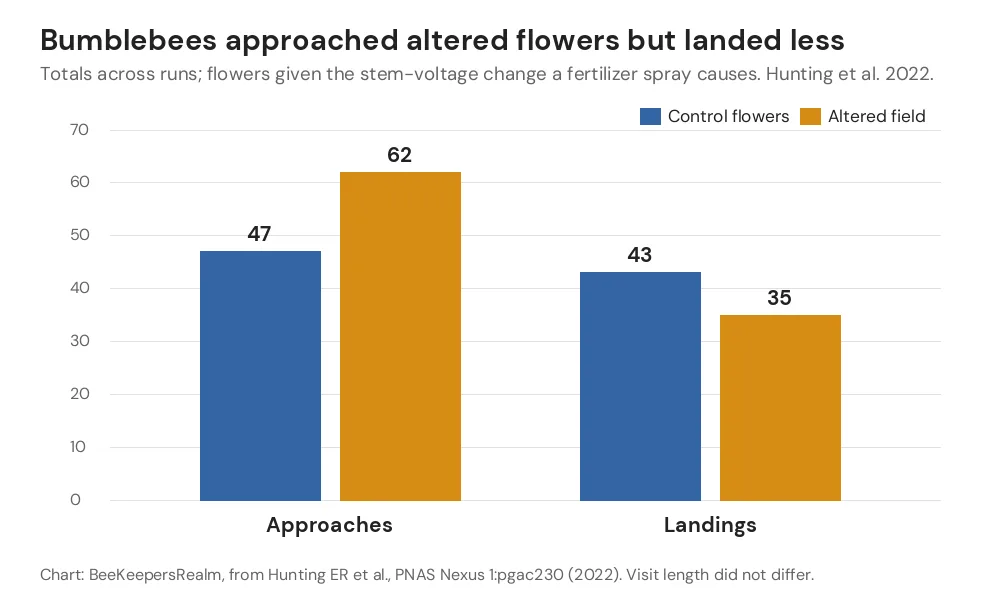
Because bees read floral electric fields, anything that changes those fields could matter. A 2022 Bristol study by Hunting and colleagues in PNAS Nexus found that common synthetic fertilizers change the size and timing of a flower’s electric field, and that a spray of the neonicotinoid imidacloprid changed stem voltage for up to 25 minutes.
When the team gave flowers the voltage change a fertilizer spray causes, bumblebees approached those flowers more often but landed on them less, as the chart shows. Once landed, they stayed just as long. The authors read this as bees noticing a disturbed electric cue on approach. For the chemical side of pesticide risk, see how pesticides affect honey bees.
Plants may react to bee charge too, but weakly: in a 2021 Bristol study, petunias released slightly more of one scent compound after bumblebee visits, while a charge typical of a flying bee alone had no effect.
A swarm charges the air
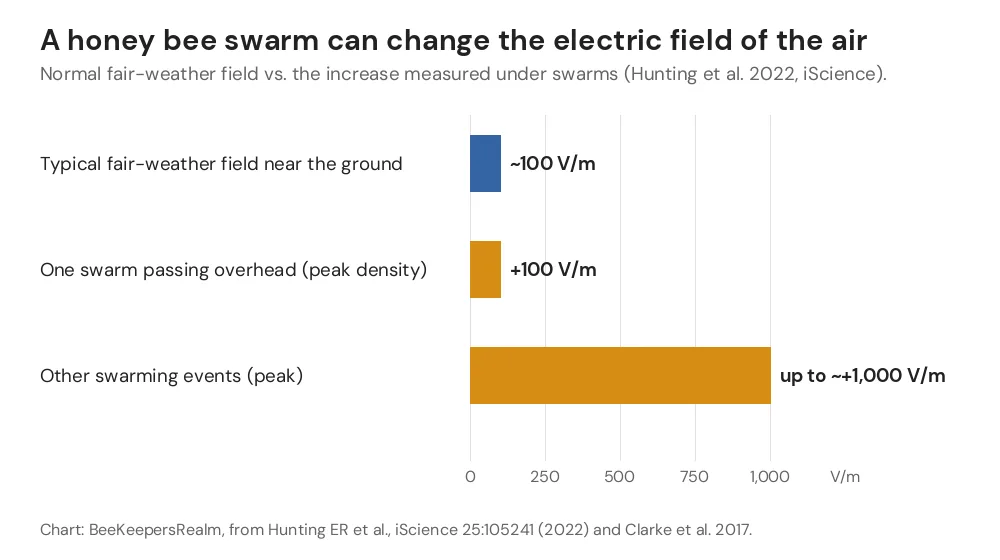
Bee charge adds up. In 2022, Hunting and colleagues reported in iScience that a honey bee swarm passing over a field monitor raised the local electric field by 100 volts per metre at peak density, and other swarms by up to about 1,000. Dense locust swarms, they calculate, can exceed the charge density of storm clouds.
What Scientists Still Don’t Know
- How much bees use the electric sense outdoors. Robert Gegear of Worcester Polytechnic Institute asked NPR “What is the functional relevance?”, given how strongly bees rely on color and scent.
- Where the magnetic receptor cells are. Magnetite is in the abdomen, but the cells that turn it into a nerve signal have not been identified.
- What realistic, long-term exposure does. Almost all ELF and radio studies are short lab exposures; well-controlled field studies on colonies are missing.
- Whether other animals share the electric sense. Sutton told NPR it may turn up in more insects, because similar hairs are common; spiders, for example, launch into the air in response to electric fields like the atmosphere’s (Morley and Robert, 2018).
Frequently Asked Questions
Can bees sense electric fields?
Yes. Bumblebees feel weak electric fields through body hairs, and honey bees through their antennae. Bumblebees learned to use flower fields to find rewards in 2013 experiments.
Can bees sense magnetic fields?
Honey bees can. They have been trained to magnetic changes as small as 26 nanotesla, and the sense most likely depends on magnetite in the abdomen.
Is 5G harmful to bees?
There is no reliable evidence that 5G harms bees outdoors. Insects absorb more energy at higher frequencies, and reviews say better studies are needed.
Do cell phones kill bees or cause colony collapse?
No study shows that. The phone studies put active handsets in or beside hives, and reviews found no evidence of effects in real apiaries.
Is it safe to keep beehives under power lines?
Lab studies found 50 Hz fields at levels under power lines impaired learning, but no colony study exists. Avoid siting hives directly beneath high-voltage lines if you can.
What frequency do bees give off?
A waggle-dancing honey bee waggles at about 16.5 Hz, and the electric field it gives off has both low- and high-frequency parts, according to Greggers et al. 2013.
What other animals can sense electric fields?
Sharks and the platypus detect electric fields in water. In air, bumblebees, honey bees and some spiders are known to respond to them.
The Bottom Line
Bees have a real electric sense and a real magnetic sense, both better proven than most people expect. Fears about phones and 5G rest on much weaker evidence. For sight, smell, taste and touch, see our overview of honeybee sensory organs.


.jpg)
_2.jpg)
.jpg)