Quickly learn safe, simple screens you can run in a kitchen and when to seek lab confirmation. Real honey is mostly sugars with modest moisture—about 76–80% sugars and 17–20% water—which shapes how it behaves in basic checks.
This short guide explains practical DIY screens: dissolution in water, the thumb/drop feel, flame and heat checks, a mild vinegar mix, plus sensory cues like aroma and crystallization. These approaches flag obvious dilution or high moisture but cannot confirm sophisticated adulteration.
For definitive answers, the industry uses lab methods such as NMR spectroscopy, isotope analysis, HMF and moisture limits, conductivity, and pollen microscopy. Codex limits are useful benchmarks; for example, HMF is commonly cited with limits near ≤40 mg/kg for many regions.
Read more on grading and lab standards in this grading standards review that complements these home checks.
Key Takeaways
- DIY screens can reveal obvious dilution or excess moisture but are not definitive.
- Expect real product composition near 76–80% sugars and 17–20% water.
- Use simple checks: dissolution, thumb/drop, flame, vinegar, and smell.
- Lab tests (NMR, isotope, HMF, pollen) provide confirmation when needed.
- Industry limits and labels help U.S. buyers read quality signals.
Understanding Honey Purity Today: What U.S. Shoppers Need to Know
Supply chains and scaling mean appearance no longer guarantees authenticity. Many jars that look right have been blended with corn, beet, or rice syrups or have added water and excessive heat exposure that raises HMF levels.
Visual checks are limited. Color and flow can be mimicked. That makes a mix of simple screens and lab confirmation the smart approach for shoppers who care about health and real value.
Look for transparent brands that publish batch results, moisture and HMF figures, or pollen verification. Labels such as raw, single-origin, and unfiltered can help, but they are not guarantees without supporting data.
- Purity matters: adulteration dilutes enzymes and antioxidants and can introduce residues.
- Season and harvest time affect moisture, which changes texture and quick screening outcomes.
- Combine at-home checks with lab indicators like moisture ≤20% and low HMF for higher confidence.
Want to know honey quality before you buy? Rely on clear sourcing, recognized certifications, and documented batch testing rather than marketing claims alone. Read more on batch verification in this is my honey the real deal.
What Pure Honey Means and Why It Matters for Health
Pure honey has a simple, predictable makeup that explains its flavor and value. It is mostly fructose and glucose with modest water content. Those ratios shape texture and shelf behavior.
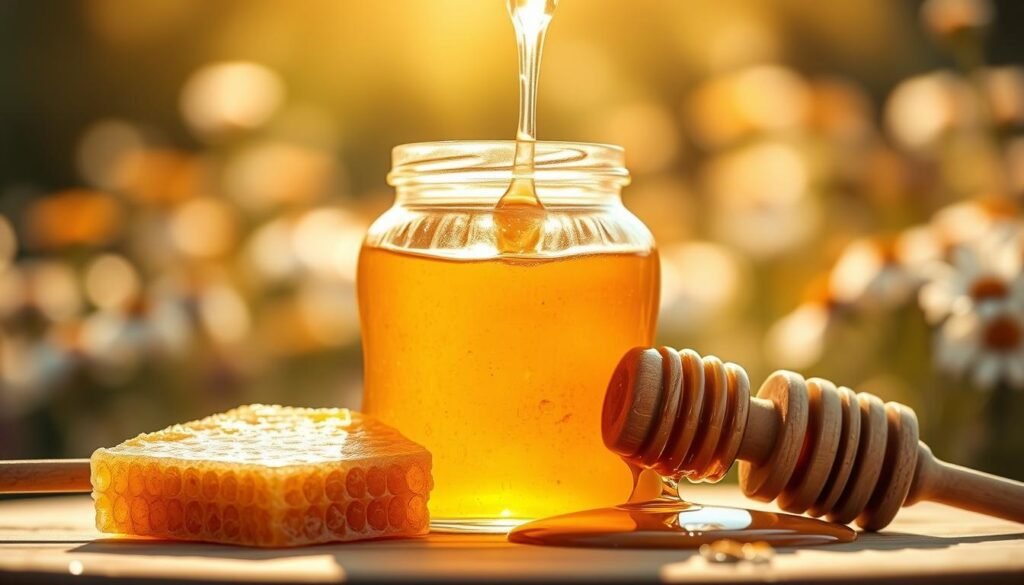
Natural composition: sugars, water, pollen, enzymes, and antioxidants
Pure honey is roughly 76–80% total sugar and about 17–20% water. It also contains tiny amounts of pollen, native enzymes, antioxidants, and trace minerals.
Why checking composition protects benefits
Native enzymes and antioxidants give many perceived health advantages. Excessive heating, heavy filtration, or dilution with syrups lowers those compounds and reduces value.
- Simple composition explains crystallization: glucose causes grain or set without meaning spoilage.
- Testing helps detect added sugar syrups or extra water that dilute nutrients and enzymes.
- Floral origin affects color and aroma but not the fact that the product is nature-derived and wholesome.
17. how to test honey purity at home USA
Use safe, simple checks with common items to screen for obvious problems before you trust a label. These small exams work fast and help spot excess water, added syrup, or heavy processing.
Water test in a clear glass
Fill a clear glass with room‑temperature water and gently slide in a spoonful. Pure samples usually clump and sink toward the bottom as one mass. Rapid dispersion often signals dilution.
Thumb or drop check
Place a tiny drop on a dry thumb. If the drop stays domed and moves slowly, moisture is low. A fast spread suggests added water or thin syrup.
Flame and heat checks
Light a matchstick or cotton bud after coating the tip with product; easy ignition can mean low moisture. Warm a teaspoon over low heat — caramelization with little foaming is typical of pure honey, while bubbling or soapy residue points to additives.
Vinegar mix and senses
Stir a little into water and add a few drops of vinegar; persistent fizzing can reveal alkaline adulterants. Use aroma and taste: layered floral notes and normal crystallization favour pure honey over one‑note syrup.
| Check | Pure result | Warning sign |
|---|---|---|
| Water | Clumps and sinks to bottom | Disperses quickly |
| Thumb/drop | Stays domed, slow spread | Runs or spreads fast |
| Flame/heat | Lights, caramelizes, no foam | Won’t light, foams, leaves residue |
| Vinegar/smell | No fizz; floral aroma | Fizzing; flat, sugary scent |
Interpreting Home Test Results Without Getting Misled
A single home screen rarely proves anything; patterns across methods tell a clearer story. Use each clue as part of a bigger picture rather than a final verdict on purity.
Common false positives and negatives
Unripe but genuine jars can disperse faster in water or fail a flame check because of higher moisture. Conversely, thick adulterants may sink and mimic authentic behavior.
Moisture, temperature, and time matters
Room conditions change outcomes. Cold increases viscosity and can make drops hold form. Warmth or recent heating makes even real product spread faster.
Crystallization nuance
Crystals form when glucose content favors grain. Fast crystallization is normal for many floral types. Lack of crystals does not automatically imply fake or overly processed product.
- Treat each result as a clue, not a verdict.
- Compare multiple checks rather than relying on one sign.
- Keep a short note of room temp and time since opening for fair comparisons.
- If several anomalies repeat—persistent foaming, strong fizz with vinegar, or a watery feel—seek professional testing.
Final note: at‑kitchen exams help prioritize jars for lab work. Good records and repeated tests make escalation decisions clearer and protect value for buyers in the United States.
Advanced Lab Methods to Confirm Purity When It Really Counts
Advanced analytical methods reveal the subtle adulteration and handling issues invisible to casual inspection. Labs combine targeted techniques to produce robust, legally useful results when product claims matter or DIY checks remain ambiguous.
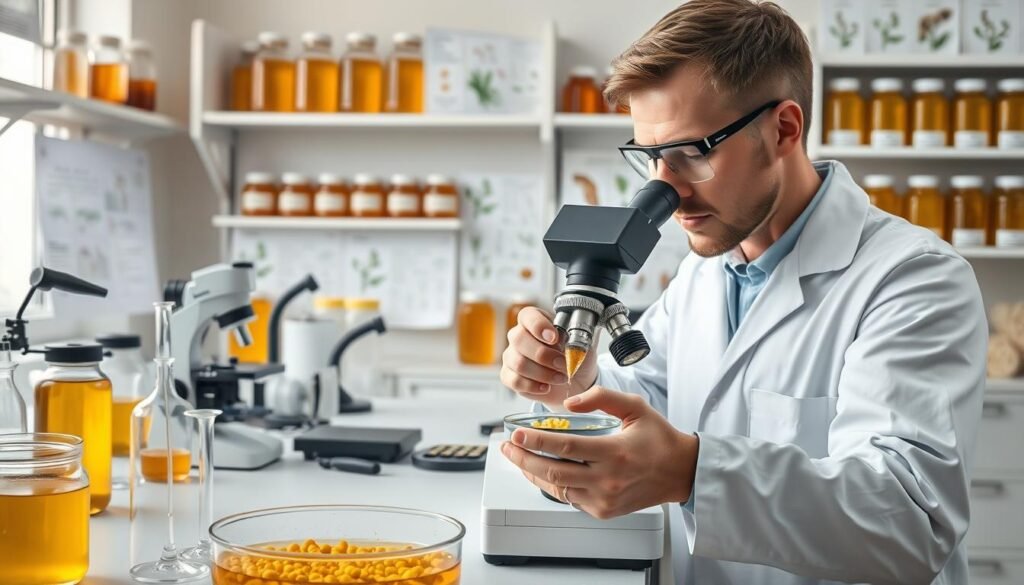
Pollen analysis (melissopalynology)
Melissopalynology inspects pollen spectra to verify floral origin and support single‑origin claims. Matching observed pollen against expected profiles strengthens authenticity narratives for premium jars.
HMF, moisture and conductivity
HMF levels act as a heat and age marker; common limits are ≤40 mg/kg and up to ≤80 mg/kg for tropical lots. Moisture at or below ~20% and expected electrical conductivity ranges help classify blossom versus honeydew types.
NMR and isotope profiling
NMR gives a molecular fingerprint that flags complex syrups and compositional anomalies that evade simple screens. LC‑IRMS isotope analysis distinguishes C3 and C4 sugar adulteration by comparing carbon ratios against natural baselines.
Labs integrate these methods to resolve unclear kitchen findings. For U.S. buyers, asking brands for batch-level certificates that list moisture, HMF levels, and any NMR or isotope results is a practical step toward certainty.
| Method | What it shows | Typical benchmark |
|---|---|---|
| Melissopalynology | Floral origin and region | Pollen spectra match expected profiles |
| HMF analysis | Heat / age indicator | ≤40 mg/kg (≤80 mg/kg tropics) |
| Moisture & Conductivity | Ripeness and type (blossom vs honeydew) | Moisture ≤20%; conductivity range per type |
| NMR spectroscopy | Molecular fingerprint; detects foreign syrups | Profiles consistent with pure honey signature |
| LC‑IRMS isotope | Detects C3/C4 sugar adulteration | Carbon isotope ratios within natural honey bounds |
Buying Pure and Raw Honey in the United States with Confidence
A reliable jar starts with traceable harvest dates, visible origin statements, and accessible lab summaries. Look past generic praise and focus on concrete signals that back product claims.
Reading labels: raw, unfiltered, single‑origin, and credible certifications
Prioritize labels that explicitly state raw honey and unfiltered handling along with a clear floral or regional origin. Certifications such as USDA Organic add a layer of oversight when present.
Brand transparency: batch testing, sourcing details, and lab reports
Favor brands that publish batch identifiers and short lab results showing moisture ≤20% and low HMF. Request NMR or isotope summaries for premium or medical‑grade jars when available.
Price, aroma, and packaging clues: glass jars, natural scent, and value
Glass jars often preserve aroma and reduce packaging risk. A bright floral scent supports authenticity, while a flat, single‑note sugar smell is a caution.
- Compare price versus declared testing; unusually low cost often signals heavy processing.
- Build a short list of U.S. brands that publish sourcing and repeat purchases across several types.
- Ask sellers for moisture, HMF, or other testing documents before buying large or high‑value jars.
“Traceability and open lab data are the best defenses against misleading labels.”
Red Flags of Adulterated Honey and Common Market Practices
A savvy buyer learns the common tricks producers use to improve shelf appeal at the expense of authenticity.
Common shortcuts include blending with corn, beet, rice or glucose syrups and adding water to stretch volume. Such additions create jars that look uniform but contain diluted sugar and fewer natural compounds.
Added syrups, excess water, overheating, and over‑filtration
Overheating is often used to improve flow. But excessive heat raises HMF and flattens aroma, which harms real composition.
Heavy filtration removes pollen and obscures origin. That makes traceability hard and reduces confidence in declared origin.
- Thin, overly fluid texture or an ultra‑uniform look can mean syrup or extra water rather than natural variance.
- Consistent foaming when gently warmed at low temperature suggests dilution or impurities affecting normal behavior.
- Flavor additives that mimic floral notes are a red flag; authentic complexity comes from nectar, not lab flavoring.
- Vague labels, no batch data, or evasive origin statements often accompany process shortcuts that trade away quality.
Practical step: combine label checks with simple kitchen screens. If several signals align, favor a better‑documented jar and consult a detailed purity test guide or a production and labeling guide before you buy.
“Transparency in sourcing and handling is the clearest defense against diluted product.”
Safety, Storage, and the Limits of At‑Home Testing
Simple ignition checks carry real risks — a controlled approach keeps you safe and the sample intact. Safety matters before you try any open‑flame or heated checks. Keep a sink or extinguisher nearby and remove flammable items from the workspace.
Fire and heat precautions for flame and stovetop tests
Use a tiny matchstick trial. Strike a match, dip its tip briefly into a spoonful of sample, and watch for quick ignition. Keep tests brief and done over a non‑flammable surface.
Have water on hand and avoid drafts. Stop immediately if flames behave oddly or if anything smokes more than expected.
Proper storage, moisture risks, and why “honey may not spoil” has caveats
Store product in a tightly sealed jar at room temperature, away from direct sunlight. Refrigeration speeds crystallization and is unnecessary for shelf stability.
Moisture above ~20% raises fermentation risk. If a sample smells off, shows visible mold, or bubbles once opened, discard it. Gentle reheating to reliquefy should be low and brief to avoid raising HMF and harming quality.
- Keep tests controlled: clear surface, water ready, and no loose papers.
- Heat checks should be short; look for caramelization without foaming.
- Understand limits: ambient temperature, recent handling, and floral source can change outcomes.
- Ask for lab data when purity claims matter; at‑kitchen screens are a first pass only.
| Practice | Why it matters | Action |
|---|---|---|
| Matchstick or small flame | Shows low moisture and volatile residues | One brief trial; extinguisher nearby |
| Low heat reliquefy | Preserves enzymes and prevents HMF rise | Warm in a water bath; avoid boiling |
| Sealed jar storage | Keeps moisture out and flavor stable | Room temp, dark shelf |
For detailed guidance on proper storage and long‑term care, see these storage best practices. Prioritize safety and documented data when product value or health considerations are at stake.
“Use at‑kitchen checks as a quick screen; rely on lab proof for final verification.”
Conclusion
Close by treating kitchen checks as triage: simple screens—water test, a tiny drop on the thumb, brief heat trials, a vinegar reaction and aroma—flag suspect jars while documentation and lab work confirm issues that matter.
Keep records of moisture, visible crystallization and any odd foaming. For higher confidence, look for declared levels like ≤20% moisture, HMF figures, pollen analysis, isotope work or NMR summaries from the seller.
Choose well‑documented raw options, clear origin statements and a solid glass jar to protect aroma and quality. If labels or results suggest additives or syrups, ask for batch reports before you buy higher‑value product.
DIY home tests are a practical first line, but lab methods give final answers. Aim for consistent signs across checks and sources when judging purity and value.
FAQ
What simple water check indicates genuine honey?
Place a spoonful in a clear glass of room-temperature water. Pure product usually sinks as a single mass and doesn’t dissolve immediately. If it disperses or dissolves quickly, that suggests added water or thin syrups.
Can a flame or heat check reveal adulteration?
A small flame test can offer clues: a sticky drop that ignites briefly or caramelizes cleanly often points to low moisture and little added sugar. If the sample smokes, foams, or produces excessive residue, it may contain additives or high moisture. Never hold open flames near jars—use caution.
How reliable is the thumb or drop viscosity check?
Press a tiny amount on your thumb: authentic raw product stays cohesive and slowly spreads, while thinned syrup runs. This is a quick tactile cue but not definitive; temperature and crystallization affect feel.
What does a vinegar test tell me?
Mix a teaspoon with diluted vinegar. Intense fizzing or foaming can indicate fermentation or certain additives. Lack of reaction isn’t proof of purity; this check helps flag possible issues for further testing.
Are aroma, taste, and crystallization useful indicators?
Yes. Natural varieties show floral or earthy aromas and complex sweetness. Crystallization is normal for many types—granulation speed varies by floral source. Rapid, uniform crystal formation or an unusually flat flavor may signal blended or heated goods.
What common false positives should I watch for with DIY tests?
Temperature, ambient moisture, and recent heating can skew results. Some pure honeys dissolve faster in warm water or remain liquid longer. Conversely, some syrups mimic viscosity. Treat home checks as preliminary, not conclusive.
When should I consider lab testing instead of home checks?
Use laboratory methods if you need proof for labeling, commercial resale, or health concerns. Tests like NMR spectroscopy, HMF measurement, pollen analysis, moisture, and isotope (LC‑IRMS) testing detect complex adulteration and provide certified results.
What lab markers indicate overheating or aging?
Hydroxymethylfurfural (HMF) increases with heat and storage; elevated HMF suggests overheating or old stock. Labs report HMF levels against accepted limits, helping confirm freshness and processing history.
How does pollen analysis help verify floral origin?
Melissopalynology examines pollen grains to match honey to specific floral sources and regions. It’s useful for single‑origin claims and detecting blends that hide cheaper syrups.
Can moisture and electrical conductivity tests determine quality?
Yes. High moisture raises fermentation risk and signals dilution. Electrical conductivity helps distinguish blossom honey from honeydew and supports authenticity when combined with other metrics.
What do NMR and isotope tests detect that home methods miss?
Nuclear magnetic resonance (NMR) profiles complex molecular fingerprints, revealing undisclosed syrups and processing. Carbon isotope ratio (LC‑IRMS) detects C3/C4 sugar substitution. These methods find adulterants invisible to DIY checks.
How can I spot trustworthy labels and brands when buying?
Look for transparent sourcing, batch lab reports, and certifications like True Source or state-level honey boards. Terms such as “raw,” “unfiltered,” and “single-origin” are useful when backed by documentation. Reputable brands often publish third‑party test results.
Are price and packaging reliable quality clues?
Extremely low prices can indicate dilution or bulk syrup blends. Glass jars and minimal processing often accompany higher-quality offerings, but packaging alone isn’t definitive—verify supplier transparency.
What safety steps should I take for flame or stovetop checks?
Avoid open flames near plastic or jars. Use small samples, keep a fire extinguisher nearby, and perform tests in a well‑ventilated area. If unsure, skip flame checks and rely on nonflammable methods or lab testing.
Does honey truly never spoil, and do home tests cover shelf‑life concerns?
Honey has low water activity and natural antimicrobials, so it resists spoilage. High moisture, contamination, or improper storage can cause fermentation. Home checks can flag moisture or fermentation signs but won’t replace lab analysis for safety issues.
What should I do if a home test raises doubts about a purchase?
Request batch lab reports from the seller or seek third‑party testing. Report suspected fraud to consumer protection agencies or local honey boards. For health concerns, discard the product and consult a professional.