
Reviewed by Michael R. · Last Updated October 6, 2026 · How we review
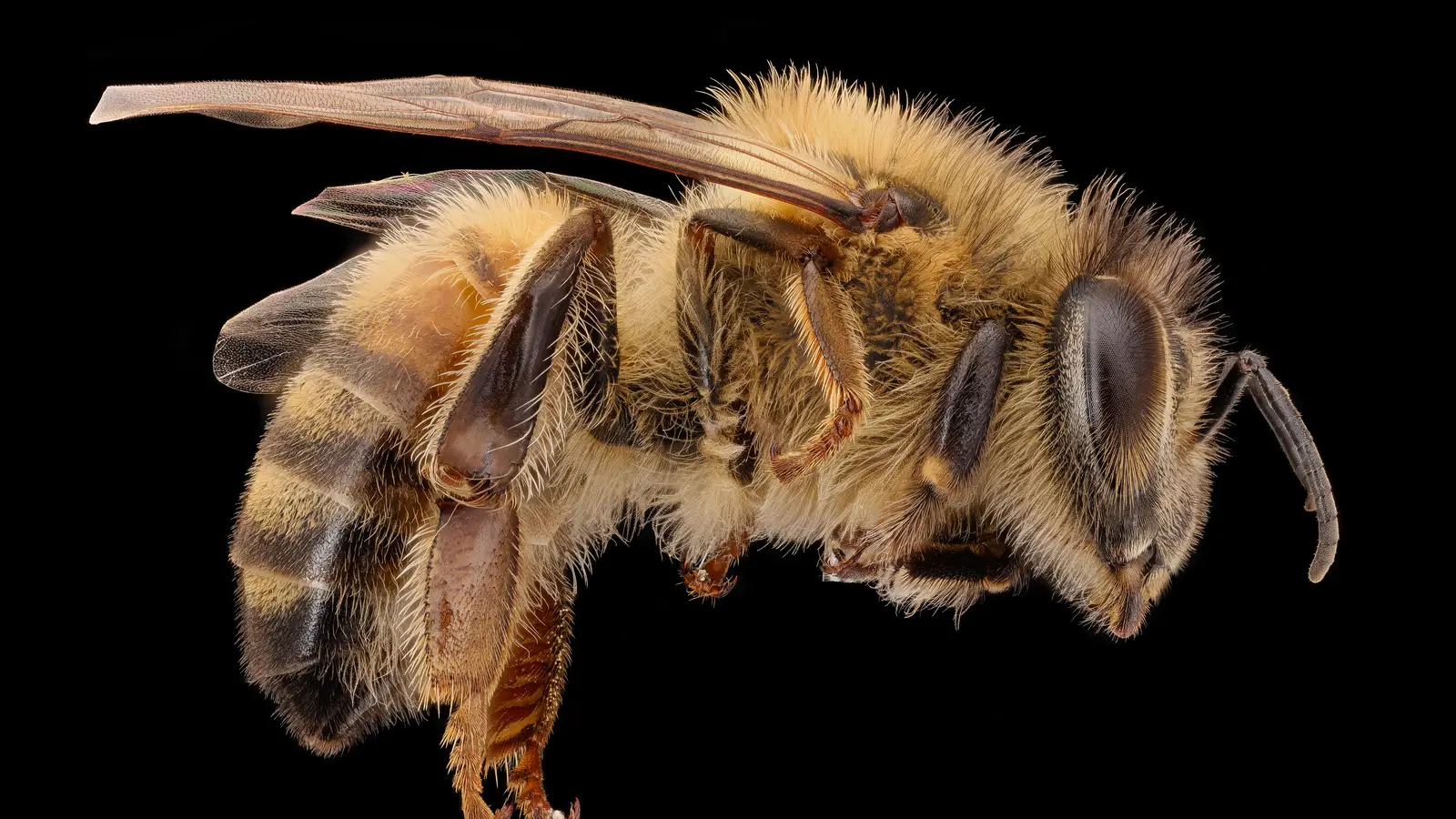
Honeybee anatomy follows the basic insect plan: a hard exoskeleton divided into a head, a thorax and an abdomen, with two antennae, five eyes, six legs and four wings. The head senses and feeds, the thorax powers flight and walking, and the abdomen holds the digestive and reproductive organs, the wax glands and the sting. Workers, queens and drones share that plan, but each caste is built differently for its job, and those differences are visible if you know where to look.
This guide walks through the body from front to back using public-domain drawings from the USDA’s 1910 study of the honey bee and labeled photos from the U.S. Geological Survey’s bee lab. It also covers something most anatomy pages skip: where the major honey bee pests and diseases actually attack the body, and why that matters at inspection time.
Key Takeaways
- A honey bee has three body regions, five eyes (two compound eyes and three ocelli), two antennae, three pairs of legs and two pairs of wings that hook together in flight.
- Drones have 13 antenna segments and females have 12. A drone’s compound eye carries about 9,990 facets, nearly twice a worker’s 5,375, in a 2013 count.
- Only workers have a pollen basket and wax glands. The queen’s sting is longer than a worker’s, with fewer and smaller barbs; drones have no sting.
- Bees breathe through ten pairs of spiracles and a network of air tubes. Their blood, called hemolymph, moves nutrients but does not carry oxygen.
- Varroa mites feed mainly on the fat body inside the abdomen, tracheal mites live in the thoracic breathing tubes and Nosema infects the midgut, so knowing the anatomy helps make sense of the damage.
Table of Contents
- Honeybee Anatomy at a Glance
- The Exoskeleton and Body Plan
- The Head: Eyes, Antennae, Mouthparts and Brain
- The Thorax: Wings, Flight Muscles and Legs
- The Abdomen: Wax Glands, Sting and Reproductive Organs
- Inside the Bee: Digestion, Breathing, Blood and Nerves
- Worker, Queen and Drone Anatomy Compared
- Where Pests and Diseases Attack the Body
- Frequently Asked Questions
Honeybee Anatomy at a Glance
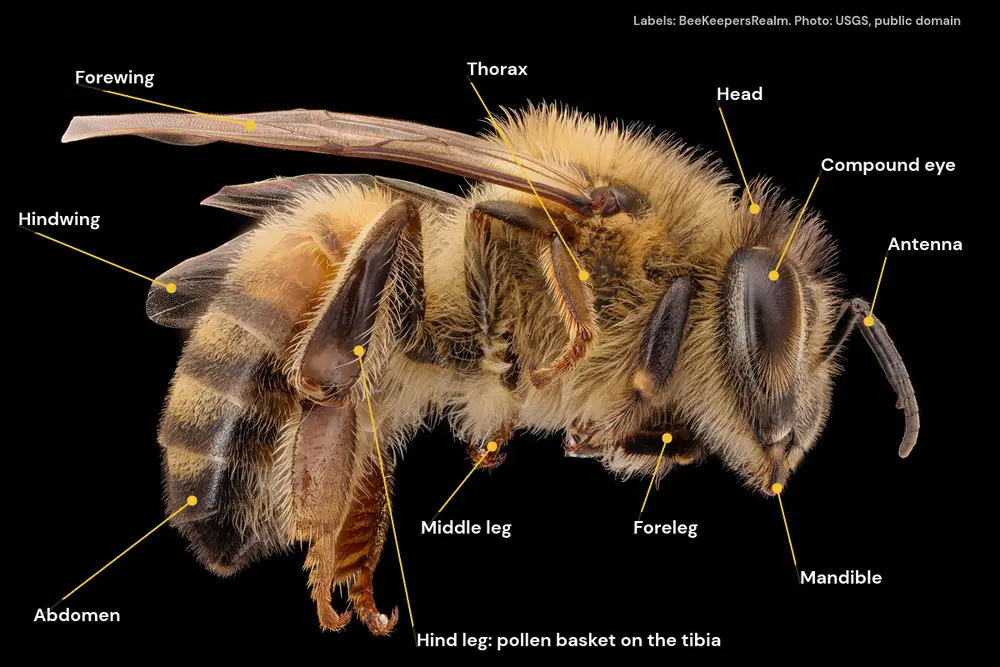
Every structure on a honey bee belongs to one of three body regions. The table below is a quick map of what sits where and what it does; each region gets its own section further down.
| Body region | Main external parts | Main internal parts | Main jobs |
|---|---|---|---|
| Head | 2 compound eyes, 3 ocelli, 2 antennae, mandibles, proboscis | Brain, hypopharyngeal, salivary and mandibular glands | Sensing, feeding, comb work, brood food |
| Thorax | 4 wings, 6 legs, 2 pairs of spiracles | Flight muscles, esophagus, aorta, nerve ganglia, air sacs | Flight, walking, warming the cluster, carrying pollen |
| Abdomen | Segmented plates, wax plates (workers), sting (females), 8 pairs of spiracles counting the first segment | Honey stomach, midgut, Malpighian tubules, rectum, heart, fat body, reproductive organs, venom sac | Carrying nectar, digestion, wax, reproduction, defense |
Sources: Snodgrass, The Anatomy of the Honey Bee (USDA, 1910); Arizona State University’s Ask A Biologist.
In this recorded talk from the Royal Society of Biology’s North Western branch, Janet Preece MRSB of the Lancashire Beekeepers Association walks through the external anatomy of the honey bee and the adaptations behind each part.
The talk was given on Zoom in October 2021 and is long, but its chapter markers let you jump straight to a body region: anatomy of the head starts at 13:39, feeding mechanisms at 25:39, the thorax with its wings and legs at 31:16, and the abdomen and stinging at 41:47. The opening chapters cover classification, the life cycle and the three castes.
The Exoskeleton and Body Plan
A honey bee has no internal skeleton. Its body wall is a hard, jointed exoskeleton of hardened plates linked by flexible membranes, and muscles attach to its inner surface. The plates also anchor the dense branched hairs that cover the body, which trap pollen and help hold in heat.
One detail surprises most beekeepers. The narrow “waist” of a bee is not where the thorax ends. In bees, wasps and ants, the first abdominal segment, called the propodeum, is fused onto the back of the thorax, and the waist is a constriction between the first and second abdominal segments. Counting that fused segment, a worker or queen has seven abdominal segments and a drone nine, according to Snodgrass. That is why a few “abdominal” parts, such as one pair of spiracles and the looped front end of the heart, sit in what looks like the thorax.
R. E. Snodgrass, whose 1910 USDA study supplies several of the drawings on this page, put the case for learning this anatomy in one line:
“In turn, a knowledge of bee activity must rest largely on a knowledge of the structure of the adult bee.”
The Head: Eyes, Antennae, Mouthparts and Brain
The head is the bee’s sensing and feeding center. It carries the eyes, the antennae and the mouthparts on the outside, and the brain and several large glands inside.
Five eyes: compound eyes and ocelli
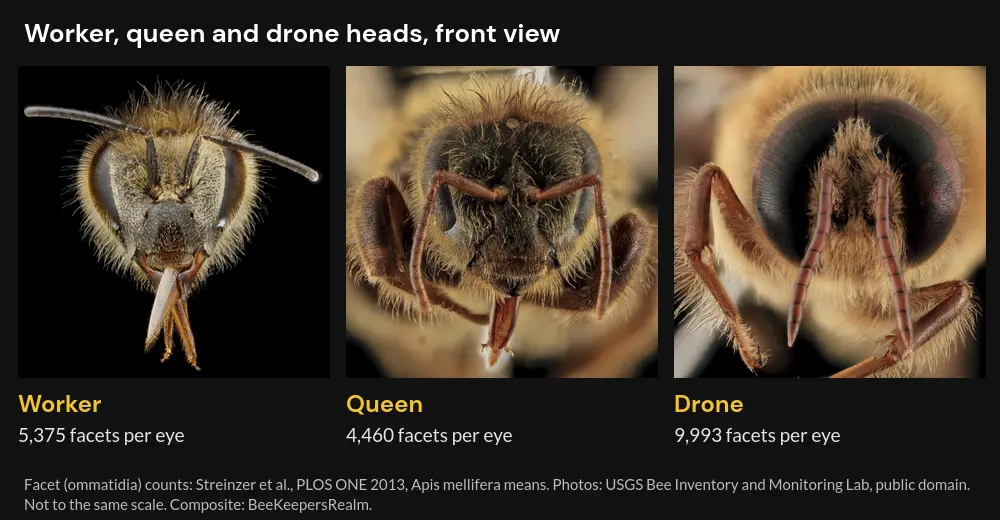
A honey bee has five eyes. The two large compound eyes on the sides of the head are each built from thousands of separate units called ommatidia, each with its own facet lens. They are good at detecting motion, color and patterns of polarized light, and unlike human eyes they see into the ultraviolet. Three small simple eyes, the ocelli, sit in a triangle on top of the head and respond mainly to light intensity, which helps with flight stability and orientation.
A 2013 study in PLOS ONE counted the facets on honey bee eyes caste by caste. Workers averaged 5,375 ommatidia per eye, queens 4,460 and drones 9,993, and the drone’s eye surface was nearly four times a worker’s (Streinzer et al., 2013). Drones need that extra eye to spot a queen in flight. Snodgrass noted that their eyes are so large they meet on top of the head, pushing the ocelli down toward the antennae. The honey bee’s compound eyes are also covered in fine hairs.
Antennae: the bee’s nose, fingers and ears
Each antenna has three parts: a long base segment (the scape), a short pivot segment (the pedicel) and a flexible, segmented whip (the flagellum). Snodgrass counted 13 segments in the drone’s antenna and 12 in the female’s, which is one of the easiest ways to sex a specimen under magnification. The flagellum is covered in thousands of tiny sensory structures for smell, touch, taste, humidity and carbon dioxide, and an organ in the pedicel picks up vibration, the closest thing a bee has to hearing.
Smell dominates. When the honey bee genome was sequenced, researchers annotated 170 odorant receptor genes but only 10 gustatory (taste) receptor genes, a lopsided ratio that reflects how much of a bee’s world is chemical (Robertson and Wanner, 2006). Our guides to how bee antennae sense the world and to the full set of honeybee sensory organs go into the receptor types in detail.
Mouthparts: mandibles and proboscis
Honey bees have both chewing and sucking mouthparts. The paired mandibles are the jaws used to knead wax, chew cappings, carry debris out of the hive, groom nestmates and grip enemies. Snodgrass found clear caste differences: the worker’s mandible has a smooth cutting edge suited to shaping wax, while the queen’s and drone’s are notched, the queen’s are proportionally the largest, and the drone’s are very small.
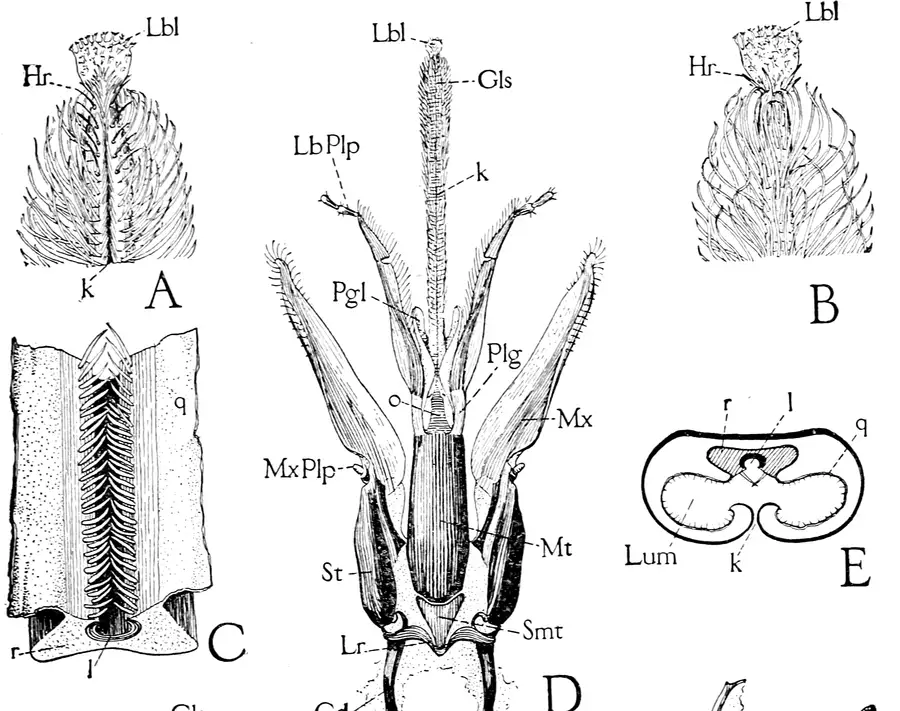
The proboscis is not a single tube. It is a bundle of parts, the paired maxillae on the outside and the labium in the middle, ending in a hairy, flexible tongue called the glossa. When feeding, the parts close around the glossa to form a temporary tube, and the glossa laps nectar, water or honey up into it. When not in use, the whole assembly folds back under the head. Snodgrass also observed that the proboscis is much longer in workers than in queens or drones, which depend on workers for food.
Brain and head glands
The honey bee brain holds roughly one million neurons, according to a 2025 study of the bee brain in Nature Communications, yet it supports navigation, the waggle dance and associative learning. Paired structures called mushroom bodies are central to learning and memory; see our summary of what honeybee cognition research has found. The esophagus runs between the brain and the ganglion just below it on its way back to the thorax.
The head also contains the glands that make a worker useful in the nest. The hypopharyngeal glands, which are well developed in young nurse bees, produce much of the protein in the food fed to larvae and the queen, and the salivary glands contribute to that food and to processing sugar. The mandibular glands open at the base of the mandibles; in queens they make the queen mandibular pheromone that helps hold the colony together.
The Thorax: Wings, Flight Muscles and Legs
The thorax is the locomotion center. Two pairs of wings attach on top, three pairs of legs below, and almost all of the space inside is taken up by flight muscle.
Four wings that work as two
Each forewing is larger than the hindwing behind it. In flight, a row of tiny hooks called hamuli along the front edge of the hindwing catches a fold on the back edge of the forewing, so each side flies as one surface. High-speed filming has shown that hovering honey bees beat their wings about 230 times per second through a short arc of roughly 90 degrees, an unusual combination among insects (Altshuler et al., PNAS, 2005). Our guide to honeybee wing structure covers wing veins, the hamuli and what wing wear says about a bee’s age.
Flight muscles that also make heat
Honey bee wings are not driven directly. Two sets of large indirect flight muscles deform the box-like thorax, and the wings flick up and down with it. The same muscles can be run with the wings disengaged, which lets bees shiver to warm brood and keep the winter cluster alive. One thing they do not do is buzz pollination: despite having similar flight muscles, honey bees cannot sonicate flowers the way bumblebees do (see why honeybees can’t buzz pollinate).
Six legs, each with a tool kit
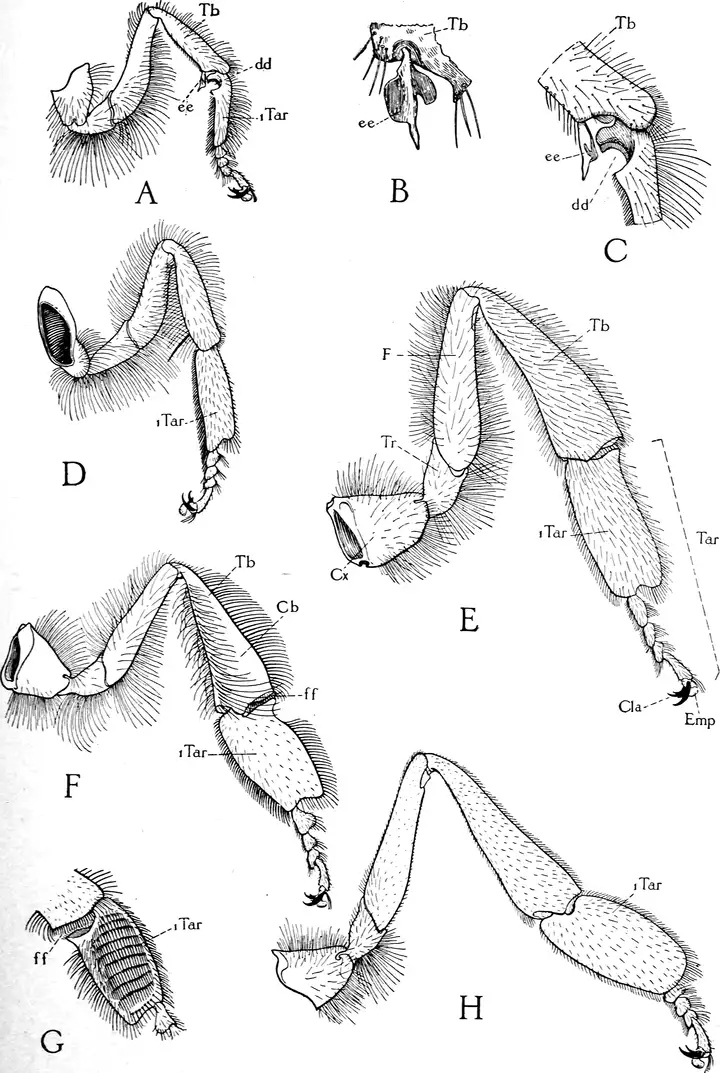
Each leg has the same basic segments: coxa, trochanter, femur, tibia and a five-part tarsus ending in claws and a sticky pad for smooth surfaces. The tips of the legs also carry taste receptors, which is how a bee can taste with her feet. On top of that shared design:
- Forelegs carry the antenna cleaner, a semicircular notch lined with stiff hairs at the base of the tarsus, with a small spine on the tibia that closes over it. The bee draws each antenna through the notch to clean it.
- Middle legs help with walking, grooming and moving pollen toward the hind legs.
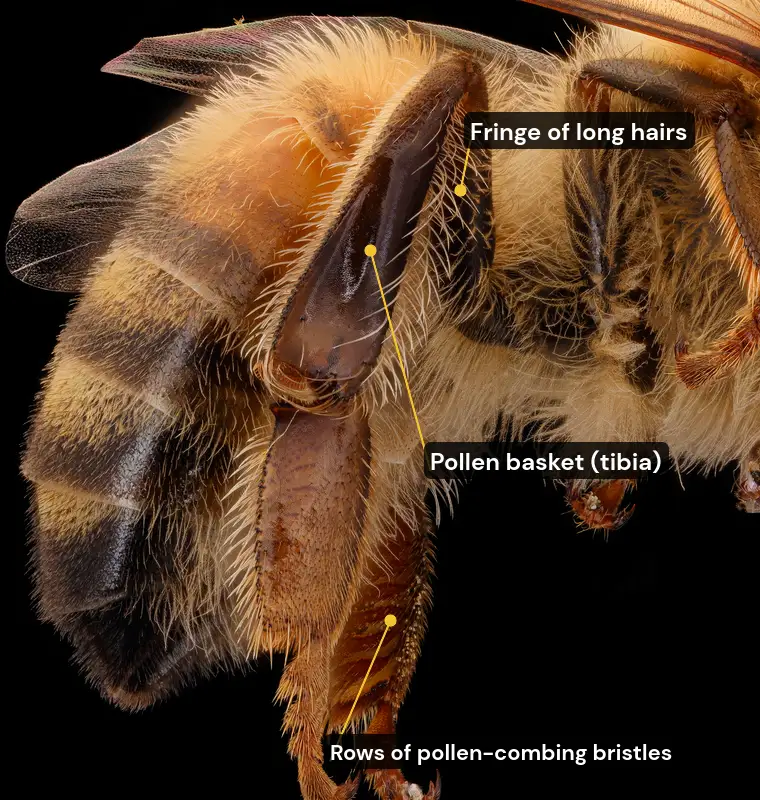
- Hind legs of workers carry the pollen-handling tools: the pollen basket, or corbicula, on the outer face of the tibia; rows of stiff bristles on the inner face of the first tarsal segment that comb pollen off the body; and a press between the two segments that pushes pollen up into the basket.
Snodgrass drew the legs of all three castes side by side, and the comparison shows that only the worker’s hind leg is built to carry pollen. Our step-by-step guide to how honey bees collect and carry pollen shows the tools in use.
The Abdomen: Wax Glands, Sting and Reproductive Organs
The abdomen is a series of overlapping plates, a hard upper plate (tergite) and a lower plate (sternite) on each segment, joined by membranes that let it stretch when the honey stomach is full and bend to sting. Most of the internal organs live here, along with the fat body, a tissue that lines the inside of the abdomen and works much like a liver.
Wax glands
Only workers make wax. Snodgrass found that it is formed only on the last four visible segments of the underside, where each sternite has a pair of smooth “mirrors” with a layer of gland cells above them, for four pairs in all. Liquid wax seeps out through tiny pores and hardens into thin scales in pockets between the plates. The bee pulls the scales out with spines on her legs and passes them forward to her mandibles for shaping. The glands are most active in young workers of roughly 12 to 17 days old, as our guide to how worker bees make beeswax explains.
The sting
The sting is a modified egg-laying tube, so only females have one. It is a shaft of two barbed lancets that slide along a guide called the stylet, connected at its base to a venom sac and glands and driven by muscles in the tip of the abdomen. In a worker the barbs catch in elastic skin, so the sting, venom sac and muscles tear away and keep pumping venom after the bee is gone. The queen’s sting is different: Snodgrass described it as much longer than the worker’s, with fewer and smaller barbs, and she uses it mainly against rival queens. Drones have no sting at all. For how stinging fits into colony defense, see how honeybees defend the colony, and for how much it hurts, the Schmidt sting pain index.
Near the tip of the abdomen, workers also have the Nasonov gland, which they expose while fanning to release the scent that guides nestmates to the hive entrance or a swarm cluster.
Reproductive organs
The queen’s abdomen is dominated by two large ovaries, each made of 150 to 200 egg tubes called ovarioles, according to a 2026 study of honey bee fertility in PNAS (Cardoso-Júnior and colleagues). Workers have the same organs in reduced form, with roughly ten times fewer ovarioles, and normally do not lay. Between the queen’s oviducts sits the spermatheca, a small round sac where she stores sperm from her mating flights and draws on it for the rest of her life; a 2025 study in Toxics notes that a newly mated queen can store up to about ten million sperm there. Drones have paired testes and an internal copulatory organ, the endophallus, which is everted and torn off during mating, killing the drone.
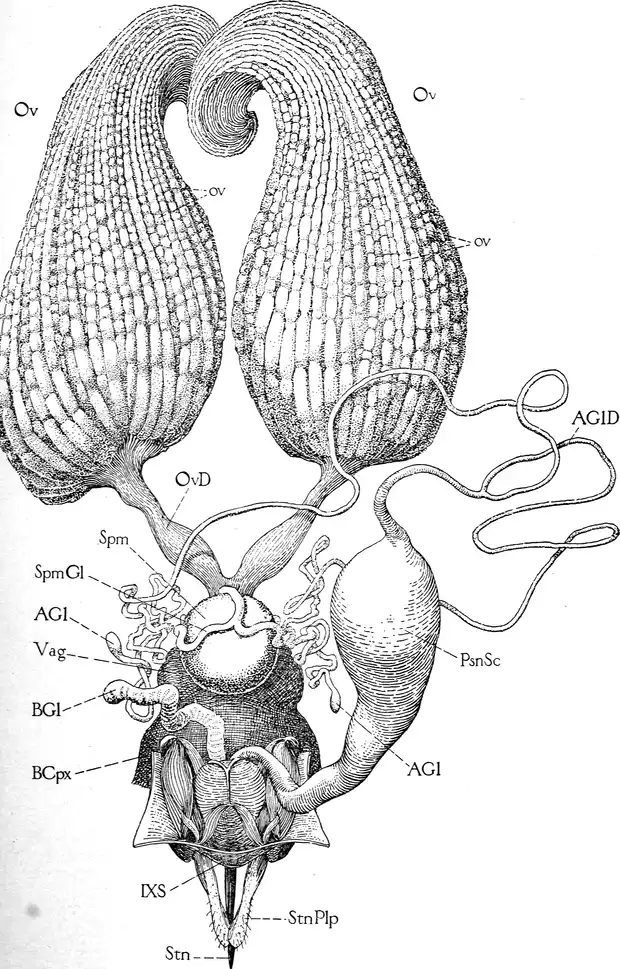
For how the queen’s anatomy supports colony life, see why the queen matters to the hive; for the drone side, see the drone bee’s function in the colony. If you are waiting on a new queen, our guide to how soon a new queen starts laying gives the usual timelines.
Inside the Bee: Digestion, Breathing, Blood and Nerves
Digestive system
The digestive tract runs the length of the body in three parts. The foregut (mouth, esophagus and the honey stomach, or crop) and the hindgut (ileum and rectum) are lined with cuticle like the outside of the body, so they absorb very little, as the University of Florida’s Jamie Ellis explained in the American Bee Journal in 2015. Digestion and absorption happen in between, in the midgut.
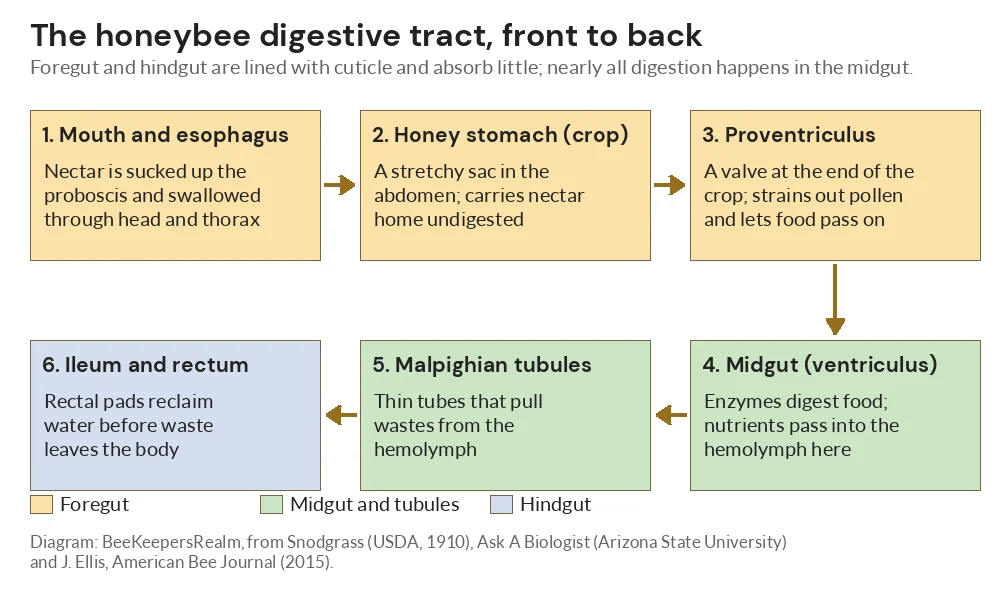
The honey stomach is the key to honey. It is a stretchy storage sac in front of the true gut, where a forager holds nectar for the flight home. At its back end the proventriculus works as a valve: it strains pollen out of the crop and controls what passes on into the midgut, so a forager can carry nectar home without digesting it. Back at the hive she passes it mouth to mouth to house bees. That is why honey is not, strictly speaking, vomit; see is honey really bee vomit.
Behind the midgut, many thin Malpighian tubules filter wastes from the blood, and pads in the rectum reclaim water before the waste leaves the body. The hindgut is also home to most of the bee’s gut bacteria, covered in our guide to the honeybee microbiome.
Respiratory system
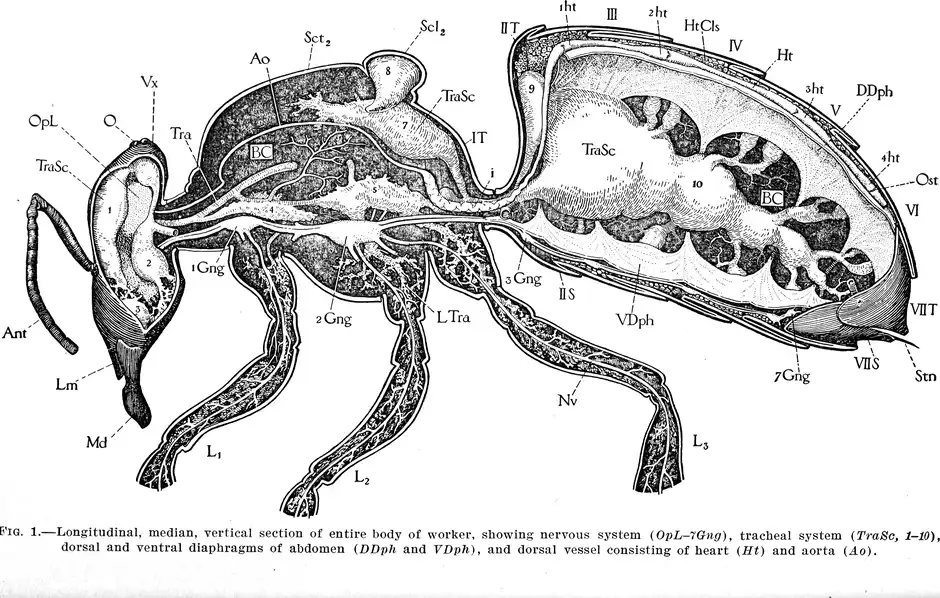
Bees have no lungs. Air enters through spiracles, small openings along the sides of the body; Snodgrass counted ten pairs, two on the thorax and eight on the abdomen counting the propodeum. Each spiracle has a closing valve. From there, branching tubes called tracheae carry air directly to the tissues, and large thin-walled air sacs in the abdomen and thorax act as bellows. When you see a bee’s abdomen pumping in and out, that is breathing.
Circulatory system
Honey bees have an open circulatory system. A single tube runs along the back: the heart in the abdomen, with paired valved slits called ostia that draw blood in. Snodgrass found that its front end coils into a tight loop where it passes through the waist, a feature he described as peculiar to the honey bee, before continuing as the narrow aorta through the thorax into the head. From there the blood, or hemolymph, seeps back through the body cavity, bathing the organs. Hemolymph carries nutrients, hormones, wastes and immune cells, but not oxygen, which the tracheae deliver. Our guide to bee immune system pathways covers the cells and defenses in the hemolymph, and the fat body guide explains the tissue that stores energy and makes the protein vitellogenin.
Nervous system
Below the gut runs the ventral nerve cord, a chain of ganglia, or nerve centers, that relays signals between the brain and the legs, wings and abdomen. In Snodgrass’s cross-section above it runs along the floor of the thorax and abdomen.
Worker, Queen and Drone Anatomy Compared
Most anatomy guides describe the worker and mention the other castes in passing. Side by side, with the numbers each source actually measured, the differences are sharper than most diagrams suggest.
| Feature | Worker | Queen | Drone |
|---|---|---|---|
| Antenna segments | 12 | 12 | 13 |
| Facets per compound eye | About 5,375 | About 4,460 | About 9,993 |
| Eye surface area | About 2.5 mm² | About 2.2 mm² | About 9.4 mm² |
| Mandibles | Smooth edge, for wax work | Notched, proportionally largest | Notched, very small |
| Proboscis | Long | Much shorter | Much shorter |
| Pollen basket | Yes | No | No |
| Wax glands | 4 pairs | No | No |
| Sting | Barbed; usually lost after stinging mammals | Longer, with fewer and smaller barbs | None |
| Ovarioles per ovary | Roughly ten times fewer than a queen’s | 150 to 200 | None (testes instead) |
| Spermatheca | No working one | Yes, stores sperm for life | No |
Sources: Snodgrass, USDA 1910 (antennae, mandibles, proboscis, pollen basket, wax glands, sting); Streinzer et al., PLOS ONE 2013 (eyes); Cardoso-Júnior et al., PNAS 2026 (ovarioles).
Two practical takeaways for the hive. A queen’s wings look short only because her abdomen, packed with ovaries, is so long. And the drone’s huge eyes and extra antenna segment are mating equipment: he is built to find a queen in the air, not to work in the nest. For how a worker’s glands and jobs change as she ages, see worker bee roles by age.
Where Pests and Diseases Attack the Body
This is where anatomy turns into beekeeping. Several of the most important honey bee problems target a specific organ, and knowing which one explains both the damage and how each is diagnosed.
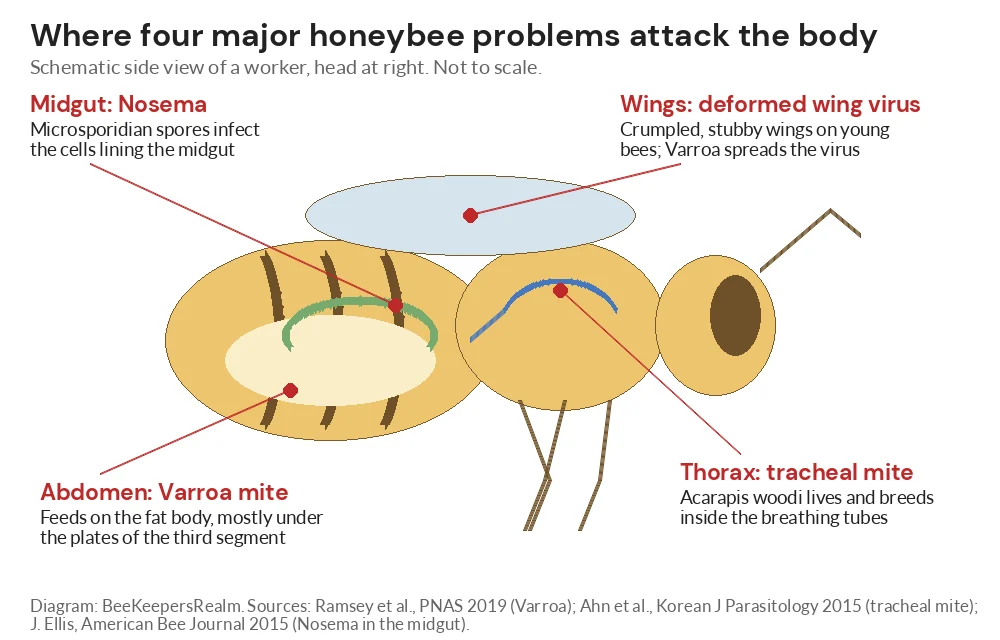
The biggest revision came in 2019. For decades, Varroa mites were assumed to drink hemolymph. A University of Maryland and USDA team stained bee tissues with fluorescent dyes, let mites feed, and traced which dye ended up in the mites’ guts:
“Our work shows that this parasite is not consuming hemolymph, as has been the accepted view, but damages host bees by consuming fat body, a tissue roughly analogous to the mammalian liver.”
The same study pinned down where mites ride on adult bees. On 104 parasitized workers, 88.5% of mites on the abdomen were tucked under the plates of the third abdominal segment, and 74.8% were on the bee’s left side, feeding through the soft membrane between plates. That hiding place is one reason mites are easy to miss on adult bees, and why an alcohol wash or sugar roll that dislodges them gives a better count than looking.
| Body part | Problem | What the anatomy explains |
|---|---|---|
| Fat body, under the abdominal plates | Varroa destructor | Mites feed on the tissue that stores energy and supports immunity; see testing and treating Varroa |
| Wings of developing bees | Deformed wing virus, spread by Varroa | Bees infected as pupae can emerge with crumpled, useless wings; see deformed wing virus signs |
| Thoracic tracheae | Tracheal mite (Acarapis woodi) | Mites live inside the breathing tubes; heavy infestations block the thoracic tracheae and cut oxygen to the flight muscles and brain (Ahn et al., 2015). Diagnosis means dissecting the thorax under magnification. |
| Midgut | Nosema (N. apis and N. ceranae) | The midgut is not lined with cuticle, which makes it the entry point for these spores (Ellis, 2015); a microscope check confirms it, as in our guide to testing for Nosema at home |
An early microscope study of the bee, the 1625 Apiarium, carried the Barberini crest; see the Barberini bees in St. Peter's.
Frequently Asked Questions
How many eyes does a honey bee have?
Five: two large compound eyes on the sides of the head and three small ocelli on top. The “twelve eyes” figure that circulates online is wrong.
How many hearts does a honey bee have?
One. It is a long tube along the back of the abdomen with paired openings that draw blood in, continuing forward as the aorta into the head.
Do bees have lungs?
No. They breathe through ten pairs of spiracles along the body, which open into a network of air tubes and air sacs that carry oxygen straight to the tissues.
What part of a bee’s body does honey come out of?
The mouth. A forager carries nectar in her honey stomach, a storage sac in front of the true gut, then passes it mouth to mouth to house bees, who process it into honey in the comb.
Do bees have blood?
They have hemolymph, a clear to pale fluid that fills the body cavity and carries nutrients, hormones and immune cells. Unlike human blood, it does not carry oxygen.
Do all honey bees have stingers?
No. Workers and queens have stings because the sting is a modified egg-laying organ. Drones are male and have none.
Do bees have teeth?
No. They have mandibles, a pair of hard jaws used to shape wax, chew cappings, carry debris and groom other bees.
How do honey bees mate?
In flight, away from the hive. A drone transfers sperm through his everted endophallus, which tears away and kills him, and the queen stores sperm from several drones in her spermatheca for the rest of her life.
Where to Go Next
This page is the overview. For depth on any single system, start with the wing, antenna and sensory guides linked above, or with the full 1910 Snodgrass study, which is free to read and still the reference that most modern bee anatomy diagrams trace back to.

.jpg)
_(18190887462).jpg)
.jpg)
_(18008327779).jpg)
_(18190998122).jpg)
_(17573861723).jpg)