On entomologist Justin O. Schmidt’s 4-point sting pain scale — built from decades of the researcher deliberately letting stinging insects sting him and rating the result — an ordinary honeybee sting lands at a 2, squarely in the middle of the range and nowhere near the top. The Schmidt Sting Pain Index has become the default reference point for comparing insect stings precisely because it isn’t just a number: every rating comes with Schmidt’s own vivid, specific description of what the pain actually feels like, and the honeybee’s entry is one of the more quoted of the bunch.
Key Takeaways
- The Schmidt Sting Pain Index was developed by entomologist Justin O. Schmidt, who worked for years at the USDA’s Carl Hayden Bee Research Center in Tucson, Arizona, starting with a 1983 paper and expanding it through a 1990 study covering 78 species.
- The scale runs from 1 (mild) to 4 (severe); the Western honey bee’s sting is rated a 2, the same tier as a typical yellowjacket or paper wasp sting.
- Only the bullet ant and the tarantula hawk wasp were originally rated a full 4 — the most severe category on the scale.
- Each rating comes with a specific, often vivid written description from Schmidt rather than just a number, which is a large part of why the index is so widely quoted outside entomology circles.
- Schmidt continued refining and expanding the scale for decades, publishing a full book on the subject, The Sting of the Wild, in 2016.
Table of Contents
- The Scale, With Schmidt’s Own Descriptions
- Where the Honeybee Actually Ranks
- How Schmidt Built the Scale
- Why a Pain Scale Needs Descriptions, Not Just Numbers
- Frequently Asked Questions
The Scale, With Schmidt’s Own Descriptions
| Level | Insect | Schmidt’s description |
|---|---|---|
| 1 | Sweat bee (Lasioglossum spp.) | “Light and ephemeral, almost fruity. A tiny spark has singed a single hair on your arm.” |
| 1.2 | Fire ant (Solenopsis invicta) | “Sharp, sudden, mildly alarming. Like walking across a shag carpet and reaching for the light switch.” |
| 2 | Western honey bee (Apis mellifera) | “Burning, corrosive, but you can handle it. A flaming match head lands on your arm and is quenched first with lye and then sulfuric acid.” |
| 2 | Yellowjacket (Vespula spp.) | “Hot and smoky, almost irreverent. Imagine W. C. Fields extinguishing a cigar on your tongue.” |
| 2 | Paper wasp (Polistes spp.) | “Burning, throbbing, and lonely. A single drop of superheated frying oil landed on your arm.” |
| 3 | Red paper wasp (Polistes canadensis) | “Caustic and burning, with a distinctly bitter aftertaste. Like spilling a beaker of hydrochloric acid on a paper cut.” |
| 4 | Bullet ant (Paraponera clavata) | “Pure, intense, brilliant pain. Like walking over flaming charcoal with a 3-inch nail embedded in your heel.” |
| 4 | Tarantula hawk (Pepsis spp.) | “Blinding, fierce, shockingly electric. A running hair dryer has just been dropped into your bubble bath.” |
Where the Honeybee Actually Ranks
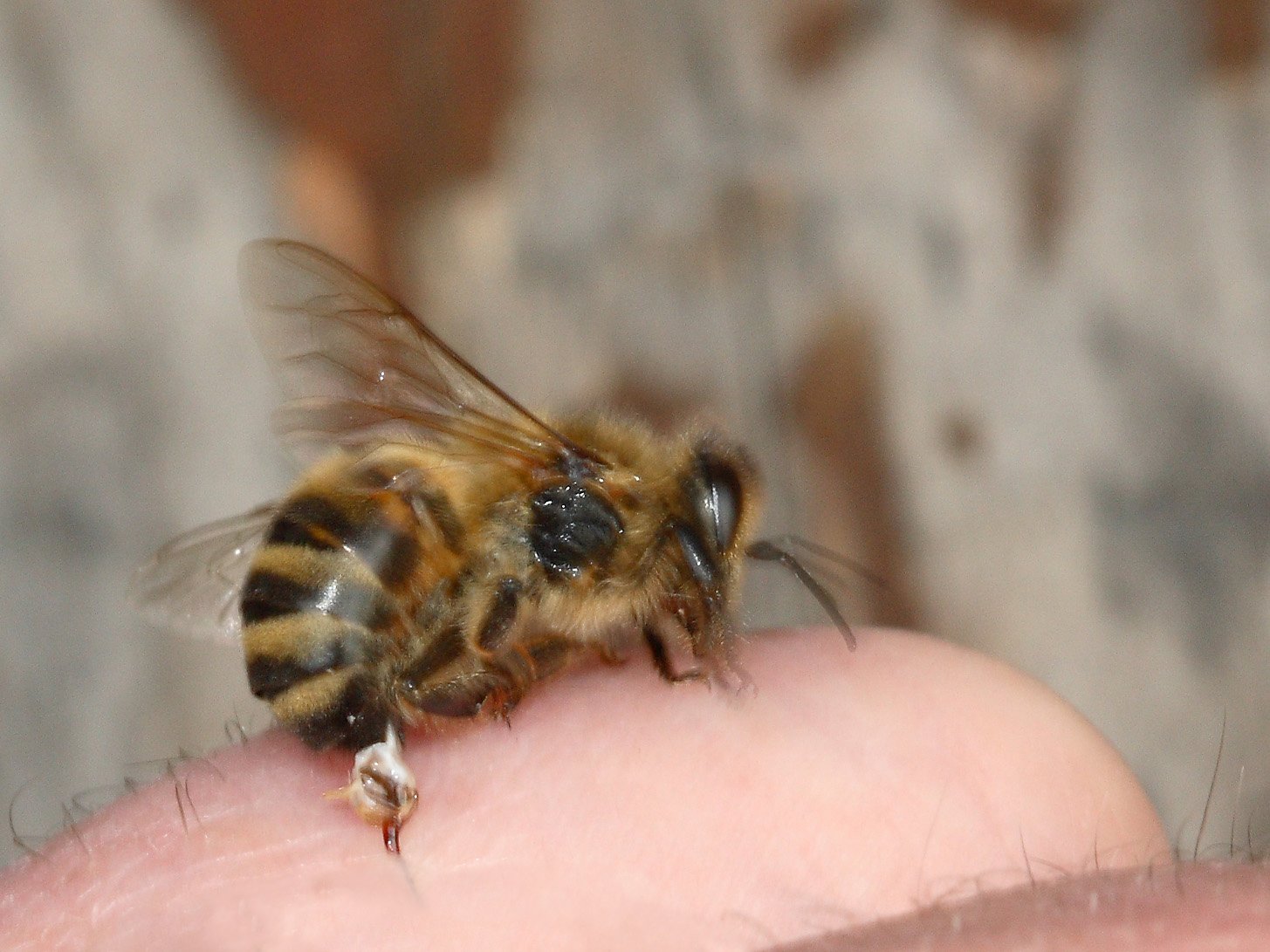
“Burning, corrosive, but you can handle it. A flaming match head lands on your arm and is quenched first with lye and then sulfuric acid.” — Justin O. Schmidt, on the Western honey bee sting.
A honeybee sting’s rating of 2 puts it in genuinely unremarkable company — the same tier as a yellowjacket or a paper wasp, both insects most people already treat as an everyday, if unpleasant, backyard hazard rather than something to fear seriously. That’s a useful data point precisely because the honeybee sting functions as most people’s mental reference point for “normal sting pain” — it’s what a huge share of Schmidt’s readers have personally experienced, which makes it the natural anchor for understanding every other rating on the scale relative to something concrete.
It’s also worth separating pain from danger. Schmidt’s scale measures the intensity of the pain response in a person without a venom allergy, not medical risk — a honeybee sting rated a 2 for pain can still be genuinely dangerous, even fatal, for the small percentage of people with a severe bee venom allergy, a distinction the pain index was never designed to capture.
How Schmidt Built the Scale
Justin O. Schmidt, an entomologist who spent years working at the USDA’s Carl Hayden Bee Research Center in Tucson, Arizona, first published a version of the pain index in 1983 as a way to systematically compare the properties of different insect venoms rather than simply as a novelty ranking. He expanded it substantially in a 1990 paper classifying stings from 78 species across 41 genera of Hymenoptera, refining both the numeric ratings and his written descriptions as he accumulated more direct experience — largely by allowing himself to be stung by the insects he was studying, a research method that became a defining, somewhat notorious part of his professional reputation. He continued developing the work for decades, culminating in a full book, The Sting of the Wild, published in 2016.
Why a Pain Scale Needs Descriptions, Not Just Numbers
A purely numeric scale — this sting is a 2, that one’s a 4 — would tell you relative intensity but nothing about what the pain actually feels like, and Schmidt’s decision to pair every rating with a specific, often strikingly written description is exactly what turned a niche entomological measurement tool into something quoted in outlets well outside science journalism. “A flaming match head lands on your arm and is quenched first with lye and then sulfuric acid” communicates something a bare number 2 simply can’t: not just how bad it is, but the specific character and duration of the sensation, in a way that lets two very different stings both rated a “2” still read as recognizably distinct experiences.
That combination of scientific rigor and genuinely memorable writing is the real reason the Schmidt Sting Pain Index has outlived plenty of more rigorously statistical pain-measurement attempts — it’s useful to researchers and quotable enough that ordinary readers, well outside entomology, still repeat it decades later.
Frequently Asked Questions
What is the highest rating on the Schmidt Sting Pain Index?
The scale runs from 1 to 4; in Schmidt’s original published work, only the bullet ant was given a full rating of 4, with the tarantula hawk wasp later added at the same top level.
Does a lower Schmidt Index rating mean a sting is safer?
Not necessarily. The index measures how much a sting hurts, not how medically dangerous it is — a low-rated sting from an insect like a honeybee can still be dangerous or fatal for someone with a genuine venom allergy, regardless of its pain ranking.
Who is Justin Schmidt?
Justin O. Schmidt is an American entomologist, born in 1947, who worked at the USDA’s Carl Hayden Bee Research Center and is best known for developing and refining the sting pain index that carries his name, culminating in his 2016 book The Sting of the Wild.
How did Schmidt determine the ratings?
Largely through direct personal experience — Schmidt was stung, often deliberately, by dozens of species of bees, wasps, and ants over the course of his research, using his own reactions to compare and calibrate the relative pain of each species’ sting.