
Reviewed by Daniel M. · Last Updated October 8, 2026 · How we review
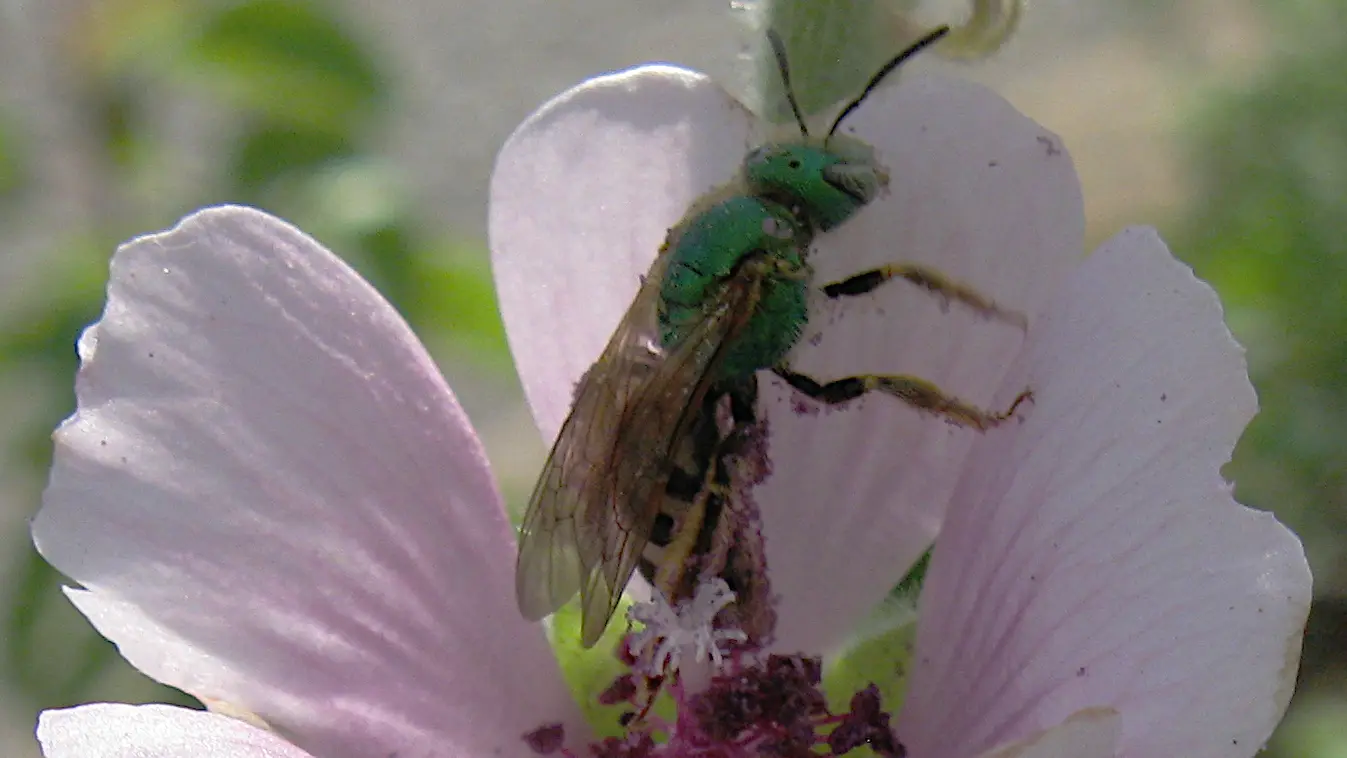
Sweat bees are small native bees in the family Halictidae, named for their habit of landing on people to lap up the salt in sweat. Most North American species are 0.1 to 0.4 inch (about 2.5 to 10 mm) long and dull black or brown, though a few are a vivid metallic green. Females can sting, but only when pressed or trapped against skin, and the sting rates 1 on a 4-point pain scale, half a honey bee’s 2.
Educational information only, not medical advice. If you have a known sting allergy, follow your doctor and the American College of Allergy, Asthma and Immunology’s insect sting guidance.
Key Takeaways
- Sweat bees are a whole family, Halictidae, with nearly 4,500 species worldwide and about 500 in North America. Most are tiny, dark Lasioglossum bees that people mistake for flies or gnats.
- They drink sweat for its salt. In a 2022 experiment, flowers with sodium added to their nectar drew nearly twice as many pollinator visits, and sweat bees were among the most common visitors.
- Only females sting, usually when squeezed. Justin Schmidt’s published ratings put Lasioglossum sweat bees at 1 of 4 and a giant sweat bee at 0.5; honey bees and yellowjackets rate 2.
- The fastest checks: four wings and long antennae mean a bee, not a hover fly; a strongly curved vein near the base of the wing marks the sweat bee family.
- Most species nest in bare, sunny ground and pollinate crops such as stone fruits, apples, alfalfa and sunflowers. A few small nest holes in thin turf are worth leaving alone.
Table of Contents
- What Is a Sweat Bee?
- How to Identify a Sweat Bee
- Sweat Bee or Something Else?
- Why Sweat Bees Land on You
- Do Sweat Bees Sting, and How Much Does It Hurt?
- Where Sweat Bees Nest
- Solitary, Social and Everything Between
- Are Sweat Bees Beneficial?
- How to Deal With Sweat Bees Without Harming Them
- Frequently Asked Questions
What Is a Sweat Bee?
“Sweat bee” is a common name for members of Halictidae, one of six bee families, according to the University of Florida’s Featured Creatures profile of the group. Washington State University’s HortSense fact sheet calls it the second-largest bee family, with about 500 species in North America; Wikipedia’s entry puts the world total at nearly 4,500. The University of Florida lists more than 50 species in Florida alone.
Most sweat bees you will meet in the United States belong to a handful of genera:
- Lasioglossum, the largest bee genus on Earth, with over 1,800 species. Most are small, dark and easy to overlook.
- Halictus, dark bees with pale bands across the abdomen.
- Agapostemon, Augochlora, Augochlorella and Augochloropsis, the bright metallic green bees most people picture when they hear the name.
- Sphecodes, red-and-black “blood bees” that lay eggs in other bees’ nests instead of building their own. See our guide to cuckoo bees.
The family also includes the alkali bee (Nomia melanderi), which WSU calls an important pollinator of alfalfa. For where sweat bees sit among the other groups, see our overview of native bee species in the United States.
How to Identify a Sweat Bee
Start with size. WSU gives 0.1 to 0.4 inch for the common sweat bee genera, and Georgia Gwinnett College’s Bees of Georgia guide measures Lasioglossum at 3.5 to 8 mm, against about 13 mm for an average honey bee. The Missouri Department of Conservation gives 1/4 to 3/4 inch, a range that covers the whole family, including its larger members.
Be careful with quick summaries that pair “1/4 to 3/4 inch” with “3 to 10 mm.” A quarter inch is already about 6 mm, so the two ranges do not match. A sweat bee you can barely see is normal; many are smaller than a grain of rice.
Tiny and dark: Lasioglossum
The commonest sweat bees are also the least obvious. Most Lasioglossum are black or brown with, at most, a faint blue-green tint on the head and thorax. Bees of Georgia notes that their flight is so fast it can be nearly invisible, and that they are often mistaken for flies.
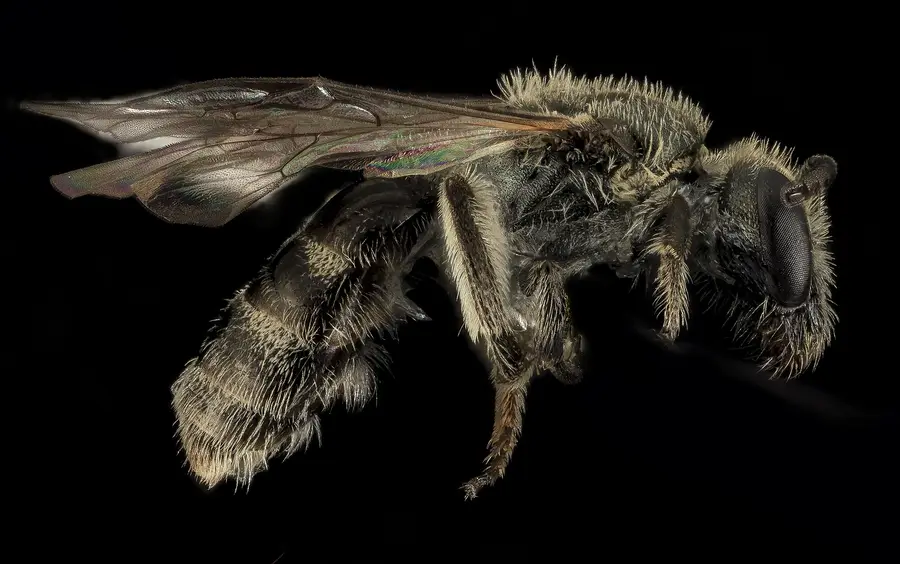
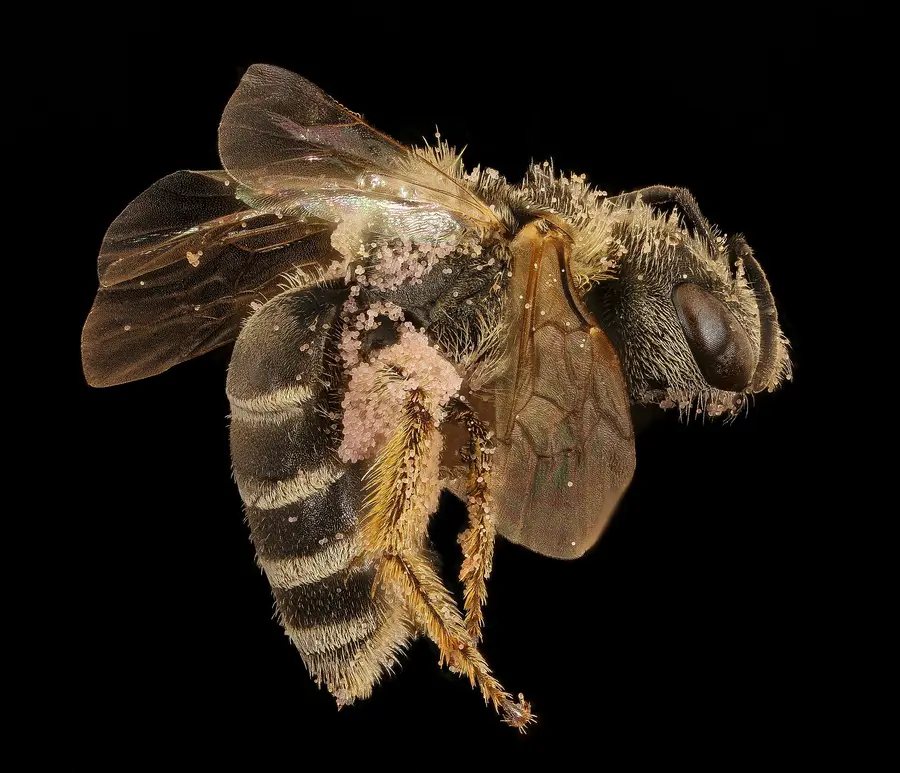
Banded and dark: Halictus
Halictus bees are a little larger and look like slim, dark honey bees, with pale hair bands across the abdomen. Halictus ligatus is one of the most widespread; USGS Bee Lab notes describe it as occurring almost everywhere and staying common in urban and disturbed sites.
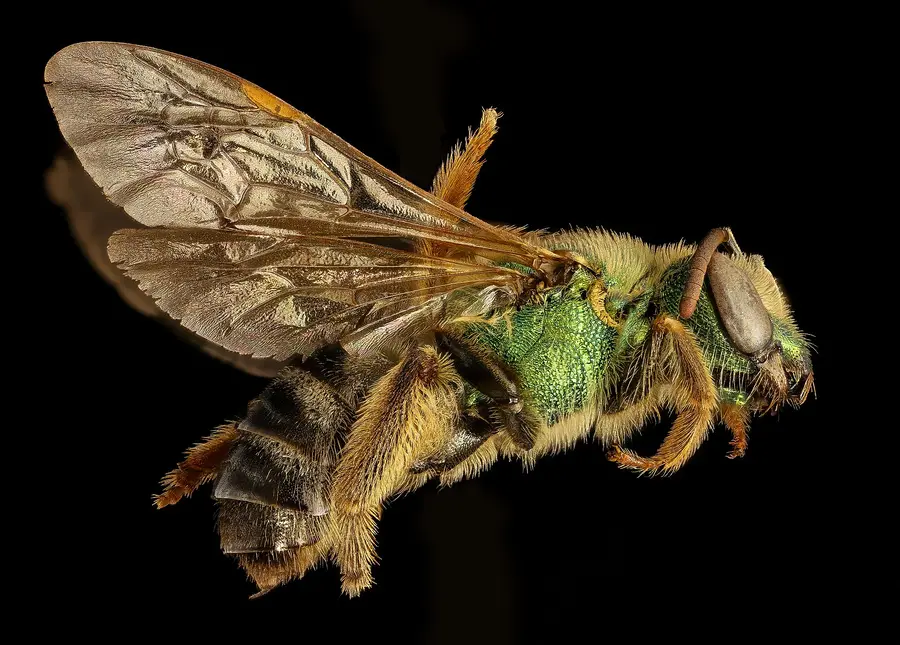
Metallic green: Agapostemon and the augochlorines
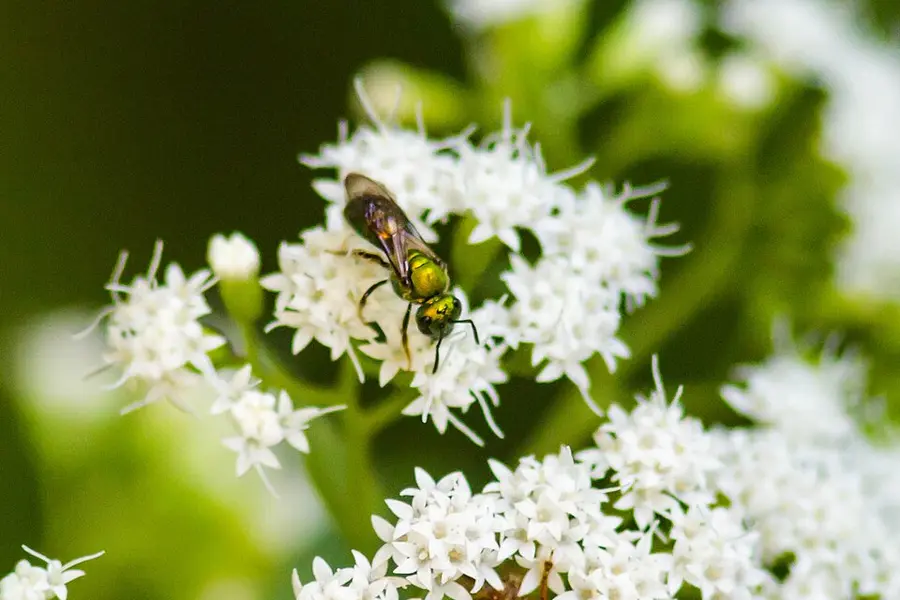
The green species are the ones people notice. WSU describes most Agapostemon as bright metallic green on the head and thorax with a black and yellow striped abdomen. Females vary: USGS Bee Lab notes say the female Agapostemon virescens has a black abdomen, while the other eastern Agapostemon females are bright green all over. Augochlora, Augochlorella and Augochloropsis are mostly green or blue-green from head to tail.
For a certain family-level ID, entomologists look at the wing.
“Halictidae can be separated from other families of bees by a strongly curved basal vein in the wing.”
That vein sits near the base of the forewing and needs a hand lens or a sharp macro photo. Our native bee identification chart lists the other groups you might confuse with it.
Sweat Bee or Something Else?
Three insects cause most of the mix-ups: hover flies, cuckoo wasps and, at a glance, honey bees.
| Sweat bee | Hover fly | Cuckoo wasp | Honey bee worker | |
|---|---|---|---|---|
| Wings | Four | Two | Four | Four |
| Typical look | Dull black or brown; some metallic green or blue | Yellow and black bands; wiggles its abdomen when it lands | Metallic blue-green, pitted “pebbly” body | Amber to brown with dark bands |
| Size | About 2.5 to 10 mm (0.1 to 0.4 in) | Often similar to sweat bees | Small | About 13 mm |
| Can it sting? | Females, mildly, when pressed | No; it has no stinger and cannot bite | Females cannot sting; they roll into a ball | Yes; the barbed stinger usually stays in skin |
Sources: Purdue Extension and the Forest Preserve District of Will County (hover flies); Missouri Department of Conservation (cuckoo wasps); WSU HortSense and Bees of Georgia, GGC (sizes).
Hover flies are the classic decoy, because they also come to people.
“Hover flies often swarm around people and even land on them, presumably looking for moisture and salts on our skin.”
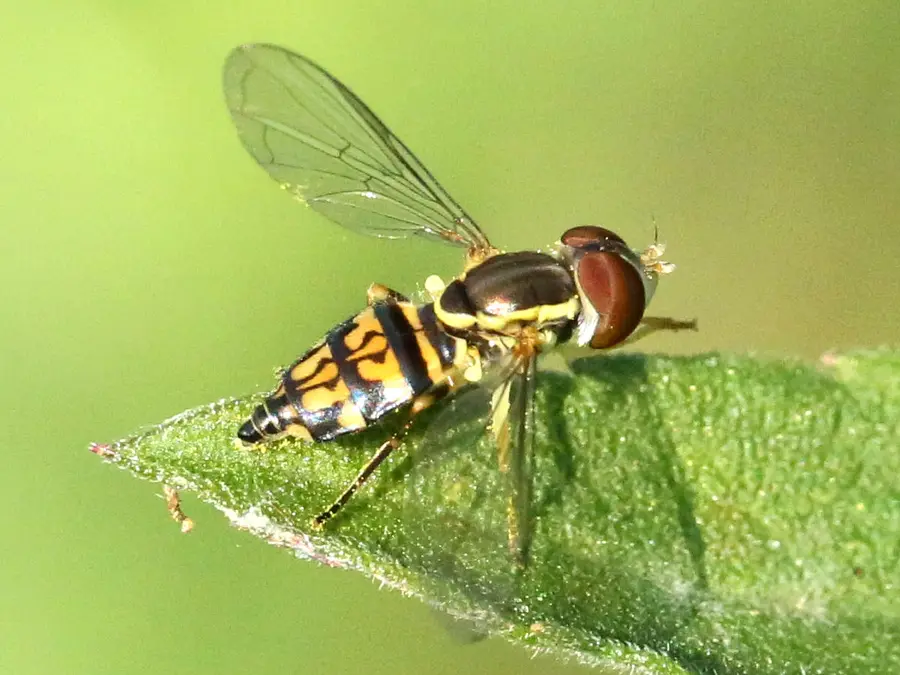
Gibb’s reminder is the old adage “two wings fun, four wings run.” More on the fly side in our guide to hover flies, and for wasps in general see the bee vs. wasp identification guide.
Why Sweat Bees Land on You
They are after salt and water. The Missouri Department of Conservation says perspiration offers them “precious moisture and salts,” and WSU says Halictus and Lasioglossum drink human sweat for its salt content. Adults feed on nectar and pollen, and their larvae eat stored balls of pollen and nectar, so sweat is a supplement, not a meal.
Why salt matters to a bee is a real research question. In a 2022 study in Biology Letters, Carrie Finkelstein and colleagues added sodium to the nectar of five plant species and counted visitors. Across 1,929 recorded visits, plants with salted nectar averaged 44.9 visitors against 24.1 on control plants, nearly twice as many, and drew about twice as many pollinator species. Halictid bees, mostly Augochlora, were among the most common visitors. The authors list sweat bees licking humans and cattle among the known ways insects hunt for sodium (Finkelstein et al., 2022).
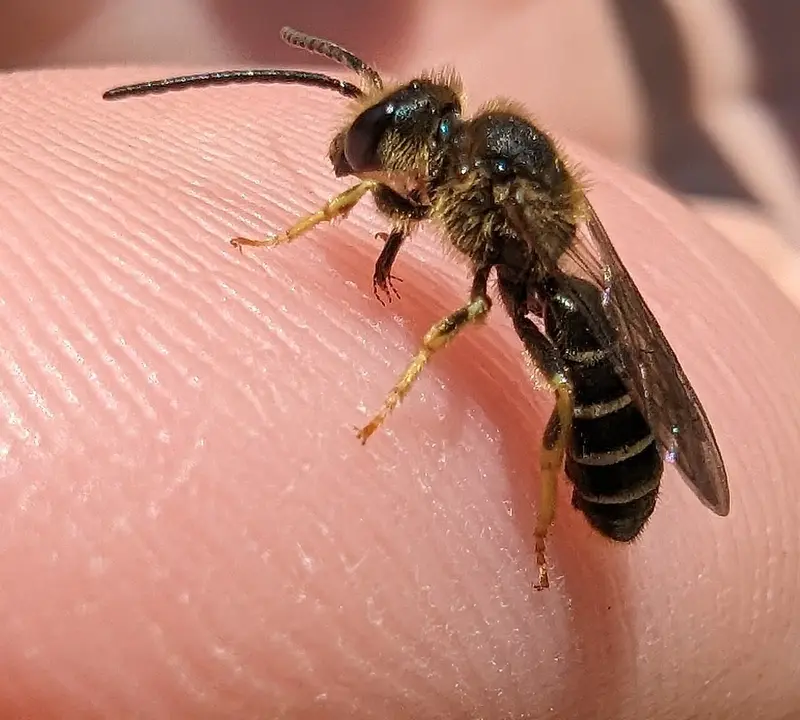
Visits come when you are sweating: on hot days, while gardening or exercising, and especially near patches of bare soil where the bees nest.
Do Sweat Bees Sting, and How Much Does It Hurt?
Yes, but rarely. Only females have a stinger, and the usual trigger is a bee being pressed against skin: under a watch strap, in a shirt collar or under a palm that swats it.
“A gentle scrape will usually persuade a visiting sweat bee to move on, but pressing on a female sweat bee may prompt her to respond with a mild sting.”
Where the sting ranks
The late entomologist Justin Schmidt rated the stings of 96 species on a scale he defines as running from 1, minor pain, to 4, extreme, debilitating pain. His 2019 table in the journal Toxins gives Lasioglossum sweat bees a 1 and the giant sweat bee Dieunomia heteropoda a 0.5, tied for the lowest score of any bee in the table (Schmidt, 2019, Table 1).
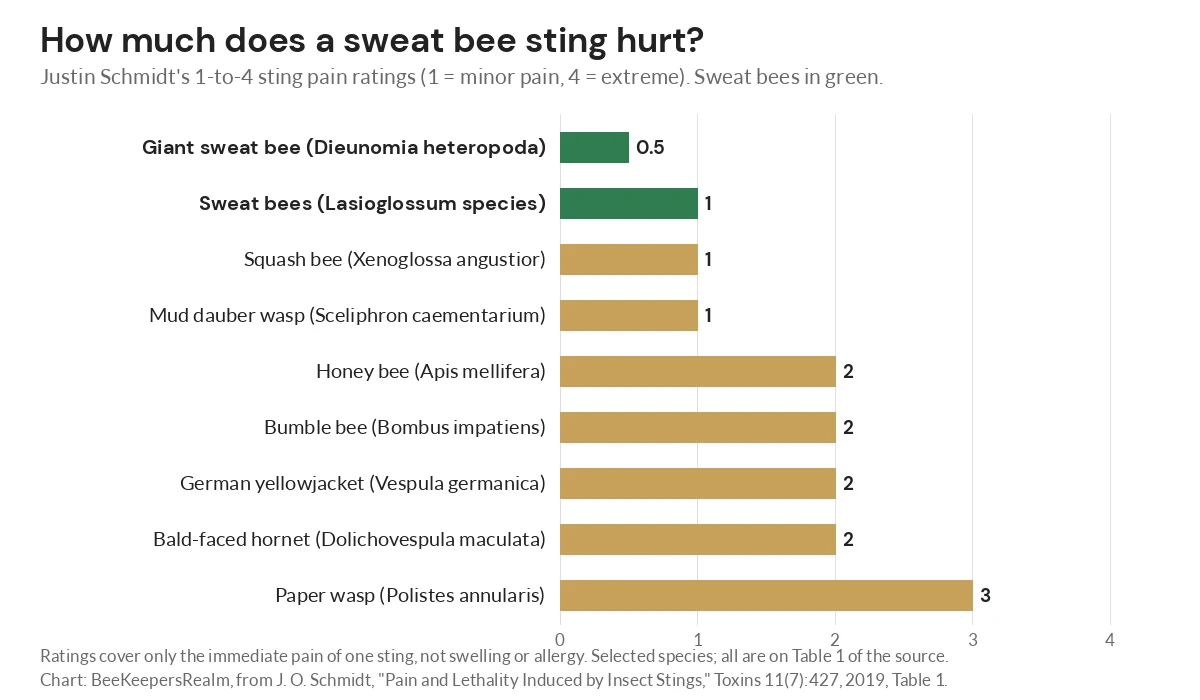
The scale measures only the first burst of pain. It says nothing about itching, swelling or allergy. For how the scale was built, see our Schmidt sting pain index guide.
Does a sweat bee die after stinging?
No. Losing the stinger is a honey bee trait: a worker’s barbed stinger lodges in skin and tears free. The Forest Preserve District of Will County, Illinois, notes that other stinging bees, such as bumble bees and carpenter bees, have smooth stingers they can pull back out. So there is usually no stinger left in the skin to scrape out. Our bee sting vs. wasp sting guide explains the barb in detail.
When a sting is more than a nuisance
For most people a sweat bee sting fades quickly. Anyone allergic to insect venom should treat any sting seriously: trouble breathing, throat swelling, hives away from the sting, dizziness or fainting call for epinephrine, if prescribed, and a 911 call. Allergists test bee and wasp venoms separately; see how venom allergy testing works.
Where Sweat Bees Nest
Most sweat bees dig their nests in the ground. The University of Florida says halictids typically nest in bare soil in a sunny spot, and WSU adds that sweat bees prefer loose, sandy soil. A nest looks like a tiny hole, often with a small mound of excavated soil around it, and several nests may share the same patch of ground.

Inside, each female builds small cells, lines them with a waxy secretion, packs each with a ball of pollen and nectar, lays one egg and seals it. Not every species digs. UF notes that some halictids nest aboveground in rotting wood, and its sources include a study of three wood-dwelling Augochlora species.
Spring yard visitors can be harder to sort out. Mining bees also nest in lawns but fly for only a few weeks in early spring, while sweat bees stay active into fall. Squash bees nest under cucurbit plants, and leafcutter bees use cavities rather than open ground.
Solitary, Social and Everything Between
Sweat bees are the textbook case for how bee societies evolve. The University of Florida profile says halictids show the widest range of social behavior of any bee family: solitary, communal, semi-social and primitively eusocial species, plus cleptoparasites. Some species switch between solitary and social nesting depending on time of year, location and altitude. The word “eusocial” itself was coined by the entomologist Suzanne Batra for this group of bees.
In social species the colony usually lasts one season. The Missouri Department of Conservation describes nests begun in April that other overwintered females may join. By summer one egg-layer remains. Some of her daughters work as foragers; others mate and spend the winter underground to start nests the next spring. Even then, MDC notes, the nests of the abundant green Augochlorella rarely hold more than a few bees.
Solitary species overwinter as prepupae or adults in their cells, according to UF, and most produce one generation a year. For the general pattern, see our guide to the solitary bee life cycle.
Are Sweat Bees Beneficial?
Very. UF calls sweat bees very important pollinators for many wildflowers and crops, naming stone fruits, pome fruits such as apples, alfalfa and sunflower. Most species are generalists that visit many plant species. The Missouri Department of Conservation adds that halictids are among the smallest bees that can buzz-pollinate, gripping a flower’s anther and vibrating to shake pollen loose, something honey bees do not do.
They are also everywhere: Bees of Georgia rates Lasioglossum as extremely common and often present in high numbers in orchards and farms. Supporting them takes the same few steps that help other wild bees: flowers from spring to fall, some bare and undisturbed ground, and fewer insecticides. Our guide to wild bee habitats covers each step.
How to Deal With Sweat Bees Without Harming Them
- On your skin: do not slap. Brush the bee off gently or wait; it is drinking, not attacking.
- Fewer visits: wipe sweat from exposed skin and keep collars and cuffs closed while gardening, so bees cannot get trapped against skin.
- Nests in the lawn: leave them if you can. Nesting is seasonal and the holes are tiny.
- Nests where children play: these bees choose bare, sunny soil, so covering that patch with mulch, sod or dense ground cover before next spring removes what they look for.
- Skip the spray: UF notes that minimal tillage and insecticide use help ground-nesting bees, so a lawn treatment aimed at sweat bees mainly harms pollinators.
If someone in the household has a diagnosed venom allergy, ask the allergist whether nests near doors need moving, and keep prescribed epinephrine on hand outdoors.
Frequently Asked Questions
Do sweat bees sting or bite you?
Females can sting, but only when pressed or trapped against skin. Males cannot sting at all.
What is mistaken for sweat bees?
Mostly hover flies, which have two wings instead of four, and small metallic cuckoo wasps, which have pitted bodies and cannot sting.
Do sweat bees die after they sting?
No. Only honey bee workers have a barbed stinger that tears free in skin.
How do you get rid of sweat bees?
Brush them off rather than swatting. If nests are in a busy spot, cover the bare soil with mulch or plants; pesticides are rarely warranted.
Do sweat bees make honey?
No. Females pack pollen and nectar into sealed cells for their larvae instead of storing honey in comb.
Are sweat bees dangerous?
Not to most people. Their sting rates 1 or lower on Schmidt’s 1-to-4 scale, but anyone with venom allergy should treat any sting seriously.
Do sweat bees have a purpose?
Yes. They pollinate wildflowers and crops such as apples, stone fruits, alfalfa and sunflowers, and some species buzz-pollinate.
The Bottom Line
A tiny bee lapping at your arm on a hot day is most likely a sweat bee after salt. Let it drink or brush it away, and leave its ground nest alone if you can.




.jpg)
.jpg)


.jpg)