A solitary bee’s life cycle has no queen, no colony, and no honey: one female builds a nest alone, packs each cell with a ball of pollen and nectar, lays a single egg on top, and seals it before ever meeting her own offspring. Nearly all of that offspring’s life — egg, larva, and the long dormant stage called diapause — happens hidden inside the nest, and humans only ever see the adult, which is active for just three to eight weeks before the whole cycle starts over. This guide walks through each stage in order, explains why males almost always emerge first, and compares the process directly against the honeybee colony life cycle already covered on this site, since the two could hardly work more differently.
Key Takeaways
- A solitary bee’s full life cycle runs about a year, but the visible adult stage lasts only three to eight weeks — the rest is spent as an egg, larva, and dormant prepupa or adult inside a sealed nest cell.
- There is no queen, no workers, and no shared brood care: a single female provisions and seals every cell in her nest alone, then dies before her offspring ever emerge.
- Most temperate solitary bees overwinter in diapause, a suspended-development state — some as a prepupa, others (including mason bees) as a fully formed adult still inside the cocoon.
- Males typically emerge before females, a pattern called protandry, because mothers place male eggs closer to the nest entrance so sons can leave without disturbing their still-developing sisters.
- According to the Xerces Society, more than 90% of the roughly 3,600 native bee species in North America live this solitary life — the honeybee’s colony-based life cycle is the exception, not the rule.
Table of Contents
- The Four Stages at a Glance
- Egg Stage: One Female, One Nest, No Help
- Larval Stage: Eating a Pollen Loaf Alone in the Dark
- Pupal Stage and Diapause: Why Most of the Year Is a Wait
- Adult Stage: Three to Eight Weeks to Do Everything
- Protandry: Why the Males Always Show Up First
- Ground-Nesting vs. Cavity-Nesting: Same Stages, Different Homes
- One Generation or More: Univoltine vs. Multivoltine Species
- A Mason Bee’s Year: The Life Cycle in a Familiar Species
- How This Differs From a Honeybee Colony’s Life Cycle
- Why This Timing Matters If You Keep a Bee Hotel
- Frequently Asked Questions
The Four Stages at a Glance
Like almost all bees, a solitary bee develops through complete metamorphosis: egg, larva, pupa, and adult. What makes the solitary life cycle distinct isn’t the number of stages — honeybees go through the same four — it’s who’s doing the work at each one. In a honeybee colony, nurse workers feed larvae continuously and a queen does nothing but lay eggs. In a solitary nest, one female does every job herself: digging or finding the nest site, foraging for pollen and nectar, mixing it into a “bee bread” loaf, laying the egg, and sealing the cell, all before moving on to build the next cell over. She typically completes this whole sequence a dozen or so times across her adult life, then dies without ever seeing an offspring reach adulthood.
Egg Stage: One Female, One Nest, No Help
Once a female has found or excavated a suitable nest site — a hollow stem, an abandoned beetle tunnel, or a burrow she digs herself in bare soil — she begins provisioning the first cell with collected pollen and nectar, kneaded into a dense loaf. She lays a single egg directly on top of that food supply, then seals the cell with mud, chewed leaf paste, resin, or packed soil, depending on the species. That cell is now finished: nothing more will be added to it, and the larva that hatches inside will eat only what its mother left before she moved on. She repeats this process cell after cell, working backward through a tunnel or outward through a burrow, until she runs out of time, resources, or life.
Larval Stage: Eating a Pollen Loaf Alone in the Dark
The egg hatches into a legless larva that does essentially one thing: eat. With no nurse bees to feed it and no way to leave the sealed cell, it consumes the entire pollen-and-nectar loaf its mother provisioned, growing and molting through several instars over roughly one to a few weeks depending on species, temperature, and food quality. By the time the food is gone, the larva has usually grown to fill most of the cell. It then stops feeding, voids its gut waste to the side so it doesn’t foul its own space, and spins a cocoon or thins into a pupal cell wall — the transition into the next stage.
Pupal Stage and Diapause: Why Most of the Year Is a Wait
This is where a solitary bee’s calendar diverges sharply from a honeybee’s. In a honeybee colony, pupation takes roughly two weeks and the hive keeps the brood nest at a steady, climate-controlled temperature year-round. A solitary bee has no colony to regulate its environment, so most species time their development to survive winter through diapause — a hormonally controlled state of arrested development, not simple cold-induced sluggishness. Research on Osmia species has found the resting insect actually undergoes real physiological changes during diapause, including shifts in its gut microbial community that may help it survive the months of dormancy.
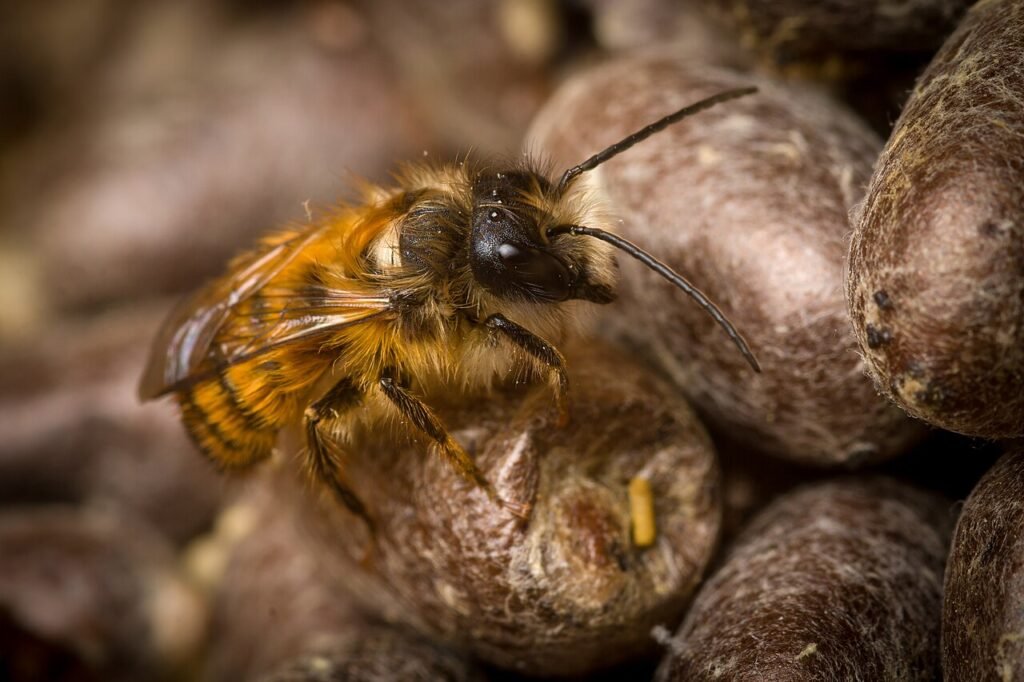
Exactly which stage overwinters varies by species. Many solitary bees, including several leafcutter bee species, spend the winter arrested as a prepupa — a resting stage reached just after the larva finishes feeding, before it fully transforms — and only complete pupation and adult development the following spring once temperatures warm up. Mason bees (genus Osmia) take a different route: they complete the full transformation to adult by autumn, then overwinter as fully formed adults, still curled up inside their cocoons, waiting for spring temperatures to trigger diapause termination and emergence. Either way, the insect spends far more of its one-year life cycle dormant than active.
Adult Stage: Three to Eight Weeks to Do Everything
When a solitary bee finally emerges as an adult, its entire reproductive life happens fast. Most species are only active for three to eight weeks, and during that window an adult female has to mate, locate or build a nest site, forage for pollen and nectar on every trip herself (no division of labor to lean on), and lay as many eggs as her body and the season allow before she dies. There’s no overlap between generations and no worker caste to extend the window — when her adult weeks are up, so is her contribution to the next generation, which is already sealed inside the cells she leaves behind.
Protandry: Why the Males Always Show Up First
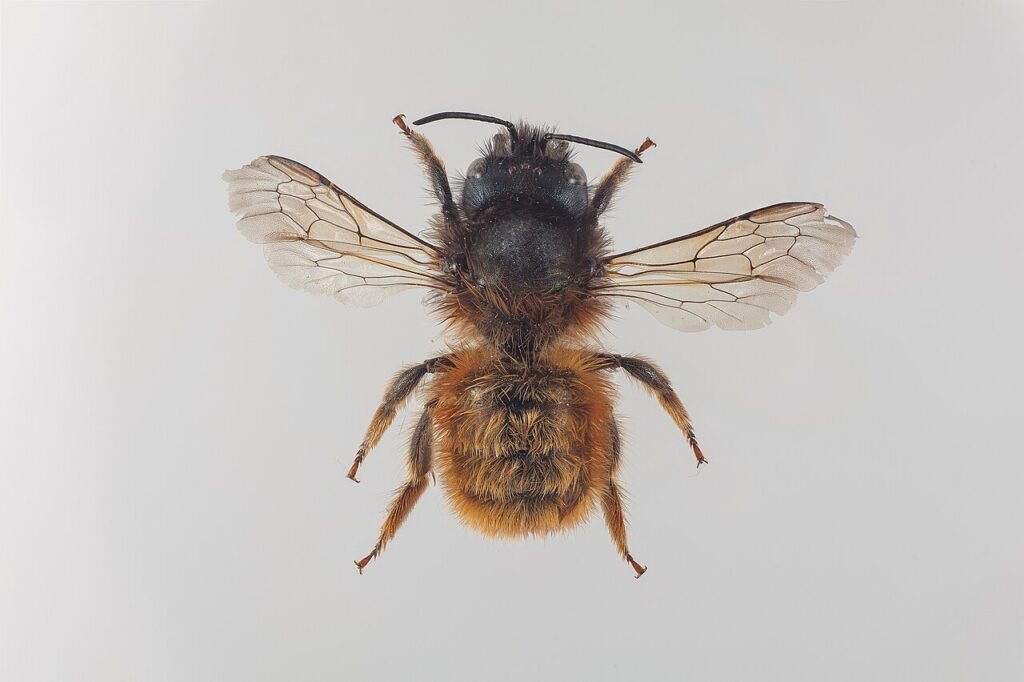
One detail that rarely makes it into general overviews of bee biology: in most solitary bee species, males emerge before females, a pattern entomologists call protandry. It isn’t random timing — mothers actively engineer it. Because males typically develop faster and need less food, and because a female provisions her nest cells in sequence, she tends to place male eggs in the cells nearer the tunnel entrance and female eggs deeper inside. Since bees can only exit a linear tunnel nest in the order they’re positioned, this placement means sons reliably emerge and leave before their sisters do, without disturbing the still-developing females behind them. The advantage for the males is straightforward: being out and waiting near the nest site first gives them more chances to mate with the females that emerge over the following days. (There are exceptions — in wool carder bees, for instance, females tend to emerge first instead — but protandry is the pattern in the large majority of solitary species, including the mason and leafcutter bees already covered on this site.)
Ground-Nesting vs. Cavity-Nesting: Same Stages, Different Homes
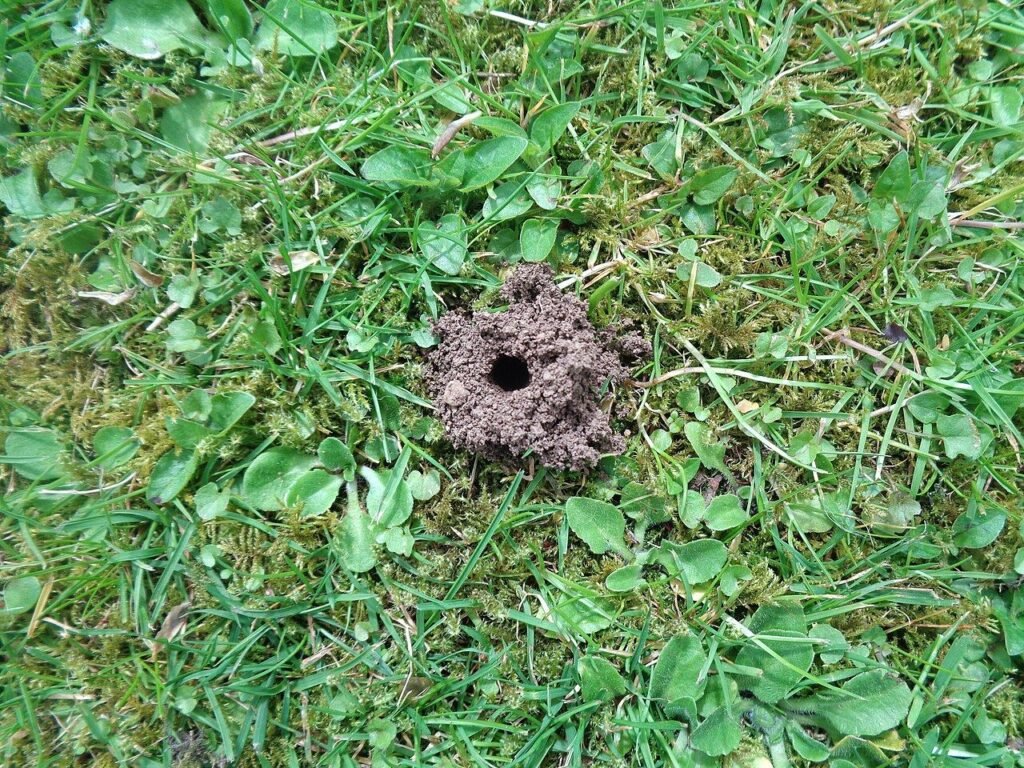
The four life-cycle stages are consistent across solitary bees, but where those stages physically happen splits the group roughly in two. Globally, around 70% of solitary bee species nest underground, digging tunnels a few inches to several feet deep in bare or sparsely vegetated soil — mining bees (genus Andrena) are a common example, often nesting in loose aggregations of dozens or even thousands of individual, unconnected burrows in the same patch of ground. The remaining roughly 30% are cavity- or stem-nesters, using hollow plant stems, abandoned beetle tunnels in dead wood, or reed-like gaps rather than digging their own space — mason and leafcutter bees fall into this group, which is exactly the category a well-built bee house is designed to support. For a fuller breakdown of which species nest where and how to tell them apart, see this site’s native bee identification chart, organized specifically by nesting behavior.
One Generation or More: Univoltine vs. Multivoltine Species
Most solitary bees in temperate climates are univoltine — one generation per year, with adults active for a single short window (often timed to a specific bloom period) and every subsequent stage compressed into the months around it. A smaller number of species, generally in warmer regions or with access to a longer growing season, are bivoltine or multivoltine, completing two or more generations in a single year rather than one. This is part of why “how long is a solitary bee’s life cycle” doesn’t have one universal answer: the roughly one-year figure describes the typical univoltine pattern, not every species on every landscape.
A Mason Bee’s Year: The Life Cycle in a Familiar Species
It helps to see the abstract stages mapped onto a real species’ calendar. Using the blue orchard mason bee (Osmia lignaria), already covered in detail in this site’s mason bees guide: adults emerge in early spring, timed closely to fruit tree bloom. Males emerge first (protandry, as above) and wait near nesting sites. Females mate, then spend their three-to-six-week adult lives provisioning cells in hollow stems or nesting-block tunnels, each sealed with a distinctive mud plug — the “masonry” that gives the species its name. Eggs hatch within days, larvae feed for several weeks through early summer, and by late summer each has completed metamorphosis into an adult, still sealed inside its cocoon. Rather than emerging that same year, the adult mason bee stays in the cocoon through fall and winter in diapause, only breaking dormancy and chewing its way out the following spring when temperatures rise again — closing the loop into a new generation.
How This Differs From a Honeybee Colony’s Life Cycle
Because this site covers managed honeybees in depth elsewhere, including a full breakdown of the honeybee’s own egg-to-adult development, it’s worth being explicit about how differently the two processes actually work rather than assuming “bee life cycle” means one thing.
| Aspect | Solitary bee (e.g. mason, leafcutter) | Honeybee colony |
|---|---|---|
| Who raises the brood | One female, alone, per nest | A caste of nurse workers, feeding continuously |
| Colony structure | None — no queen, no workers, no drones as a caste | Queen, workers, and drones with distinct roles |
| Food for larvae | A single sealed pollen/nectar loaf, provisioned once | Ongoing feeding by nurse bees throughout development |
| Approx. egg-to-adult time | Weeks to develop, but often a year including dormancy | About 16 days (queen) to 24 days (drone) |
| Overwintering | Individual, as a dormant prepupa or adult in a sealed cell | As a living cluster of thousands, actively thermoregulating |
| Honey production | None — no colony, no surplus to store | Yes, stored communally as a food reserve |
| Generations overlapping | No — mother is gone before offspring emerge | Yes — queen, workers of many ages coexist continuously |
The honeybee’s colony structure lets it survive winter as a coordinated group, actively generating heat; a solitary bee instead survives winter the way most solitary insects do, by shutting development down almost entirely inside a sealed, individual cell. Neither strategy is “better” in general — they’re different solutions produced by very different social structures, and it’s a genuine oversimplification to describe wild solitary bees using honeybee vocabulary like “hive” or “colony,” since neither actually applies.
Why This Timing Matters If You Keep a Bee Hotel
Understanding diapause and emergence timing isn’t just biology trivia if you maintain nesting habitat at home. Disturbing or moving filled nesting tubes too early can interrupt diapause before the insect inside is physiologically ready, and opening or harvesting cocoons at the wrong point in the cycle is a documented way well-meaning bee-hotel owners accidentally harm the population they’re trying to help. If you’re setting up or maintaining cavity-nesting habitat, this site’s dedicated guide to building and maintaining a mason bee house covers the correct harvesting and winter-storage timing in detail; more broadly, see this site’s guide to supporting wild bee habitat in a yard that includes both ground-nesting and cavity-nesting species.
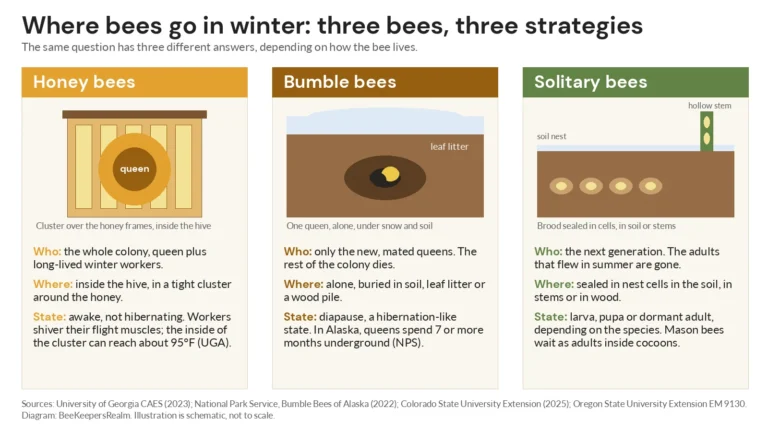
Other bees handle winter differently; see where each kind of bee spends winter.
Meet the other types of bees found in the US.
Frequently Asked Questions
How long does a solitary bee live?
An adult solitary bee is typically active for only three to eight weeks, but the full life cycle from egg to the next generation’s emergence takes about a year, since most of that time is spent as an egg, larva, or a dormant prepupa or adult sealed inside a nest cell.
Do solitary bees make honey?
No. Solitary bees have no colony, no worker caste, and no shared food storage, so there is no surplus honey production — each female provisions only enough pollen and nectar for her own offspring’s individual cells.
Why do male solitary bees emerge before females?
This pattern, called protandry, happens because mothers place male eggs in the nest cells closer to the tunnel entrance and female eggs deeper inside; since bees exit a linear nest in the order they are positioned, sons emerge first without disturbing their still-developing sisters.
What is the difference between univoltine and multivoltine solitary bees?
Univoltine species complete one generation per year, with adults active for a single short window timed to a bloom period. Bivoltine or multivoltine species, usually in warmer regions or with a longer growing season, complete two or more generations in a single year.
Is it safe to open bee hotel tubes to check on cocoons?
Not casually. Disturbing or moving filled nesting tubes too early can interrupt diapause before the insect inside is physiologically ready, which is a documented way well-meaning bee-hotel owners accidentally harm the population they are trying to help.
Last updated: September 11, 2026.
Sources
- Xerces Society, Wild Bee Conservation and Nesting in Darkness: Solitary Ground Nesting Bees
- National Wildlife Federation, The Life of a Solitary Bee
- Bug of the Week (University of Maryland), Why Are Males First to Emerge for Mason Bees?
- Peer-reviewed research on Osmia diapause physiology, National Center for Biotechnology Information: Symbiotic bacteria and fungi proliferate in diapause and may enhance overwintering survival in a solitary bee
Related Reading
- Mason Bees: The Native Orchard Pollinator That Outperforms Honeybees
- How to Build and Maintain a Mason Bee House
- Native Bee Identification Chart
- Honey Bee Life Cycle Explained Simply
- Pesticide-Free Lawn Care: How to Protect Bees and Keep a Lawn
- Does Backyard Beekeeping Hurt Wild Bees? What the Research Shows
Image credits: Photo: Arnstein Staverløkk / Norsk institutt for naturforskning (NINA), via Wikimedia Commons, CC BY 3.0.