
Last Updated September 15, 2026
If small mounds of excavated soil with a neat entrance hole have ever appeared in your lawn during the first warm weeks of spring, accompanied by low-flying bees that vanish again within a few weeks, you’ve likely hosted mining bees without realizing it. Genus Andrena represents one of the single largest groups of native bees found anywhere in North America, with roughly 400 species on the continent, and despite being genuinely common in most residential lawns and gardens, mining bees remain one of the least recognized and most consistently overlooked native pollinators covered anywhere on this site. This guide covers what mining bees actually are, their unusually compressed early-spring lifecycle, how to reliably identify their distinctive lawn nests, and why leaving them alone is almost always the correct, and easiest, response.
Key Takeaways
- Mining bees (genus Andrena, family Andrenidae) include roughly 400 North American species, making it one of the continent’s largest native bee genera.
- Adults are active for only a few weeks each spring; the rest of the year is spent underground as eggs, larvae, and dormant adults.
- About 70% of native bee species nest in the ground, and mining bees are among the most commonly encountered of that group in residential lawns (NC State Extension).
- Mining bees are non-aggressive, rarely sting, and almost never require any control response — the aggregation disappears on its own within a few weeks.
- Some species, like Andrena erigeniae, are pollen specialists tied to a single wildflower (spring beauty), timing their entire adult season to that plant’s bloom.
Table of Contents
- What Mining Bees Actually Are
- A Compressed Lifecycle: Weeks, Not Months
- Identifying a Mining Bee Nest in Your Lawn
- Why They Matter for Early-Blooming Fruit Trees
- Genuinely Docile: Why Removal Is Rarely Necessary
- Pollen Specialists Tied to a Single Plant
- A Natural Threat: Parasitic Cuckoo Bees
- Mining Bees vs. Other Lawn-Dwelling Native Bees
- Common Mistakes
- Frequently Asked Questions
What Mining Bees Actually Are
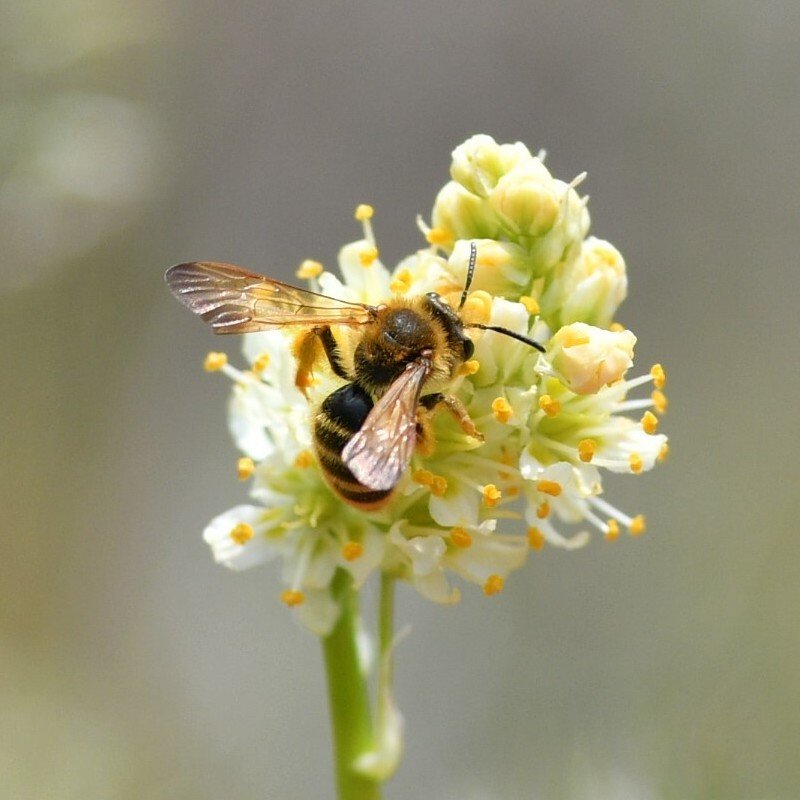
Mining bees belong to the family Andrenidae, and the genus Andrena alone contains roughly 400 species across North America, making it one of the continent’s largest and most diverse native bee genera, alongside the equally vast Lasioglossum sweat bee genus covered elsewhere on this site. They’re generally slender, modest-sized bees, roughly 5 to 15 mm long, and while coloring varies considerably by species, from dull brown to more distinctly banded patterns, one identification detail holds fairly consistently across the genus: females often show a subtle line of pale hairs along the inner edge of each eye, sometimes described informally as “eyebrows,” a small but genuinely useful field mark for anyone trying to confirm an Andrena identification. A few of the larger, more robustly furred species can superficially resemble a small honeybee at a quick glance, particularly in flight, though the eyebrow-like facial hair line, overall body shape, and solitary rather than hive-based behavior reliably separate them once someone knows what to look for.
A Compressed Lifecycle: Weeks, Not Months
Mining bees have one of the shortest adult active periods of any native bee covered on this site. Most Andrena species complete a single generation per year, with adults emerging from underground in early spring, often as early as March in warmer regions, and remaining active for only a few weeks before dying off, having mated, dug and provisioned individual nest cells, and laid eggs, all within that single brief window. The offspring then develop underground through spring, summer, fall, and winter as eggs, larvae, and eventually dormant adults, waiting inside their nest cells for the following spring’s emergence cue. Because the adult stage genuinely is that brief, once mating and nest provisioning are complete, adults simply die off, and the vast majority of any individual mining bee’s actual total lifespan — eleven-plus months — is spent completely hidden underground, rather than as a visible flying adult buzzing around a lawn in spring.
Identifying a Mining Bee Nest in Your Lawn
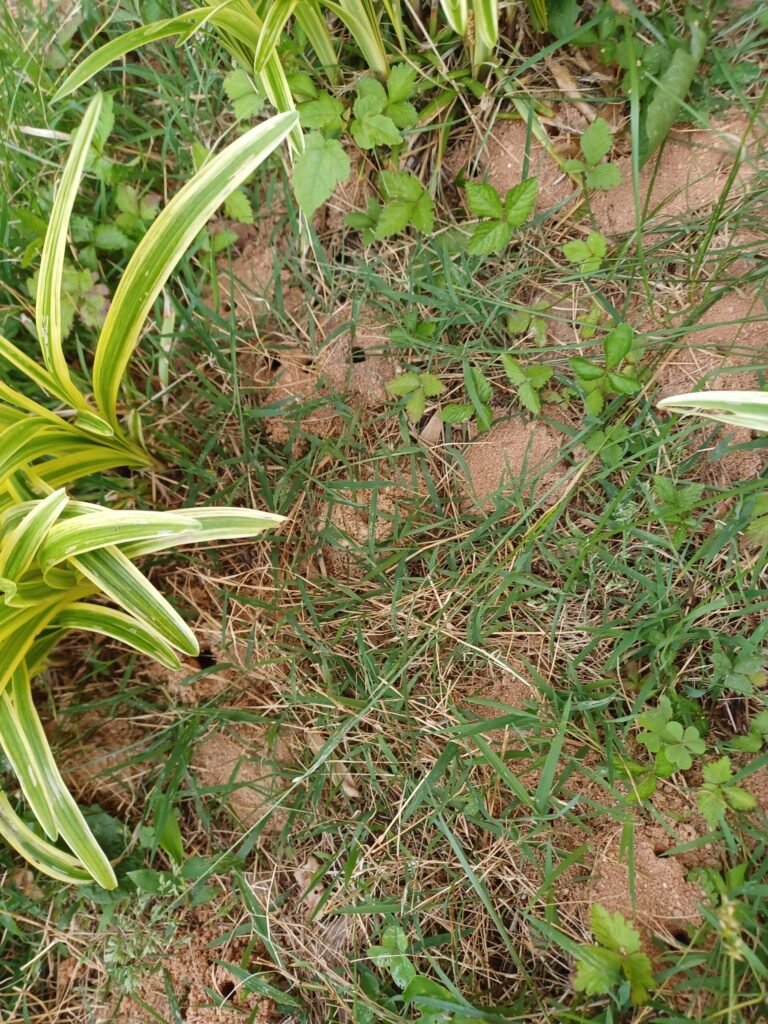
A mining bee nest is genuinely distinctive once recognized: a small, volcano-shaped mound of loose excavated soil — sometimes called a tumulus — typically an inch or two across, with a single round entrance hole at the center, often appearing in numbers across a patch of thin or sparse lawn during the first warm days of spring. Because many females are attracted to the same favorable patch of soil, sometimes sun-exposed, well-drained, and lightly vegetated turf, these nests frequently appear in loose aggregations, dozens or even hundreds of individual mounds scattered across a lawn, which can understandably alarm homeowners who mistake the scene for a single large, coordinated colony rather than many entirely independent, solitary nests sharing convenient real estate. Each mound belongs to one independent female with no shared structure, but a favorable nesting site can attract returning or new females year after year, so a lawn patch that hosted mining bees one spring often continues doing so in subsequent years simply because the underlying soil conditions — texture, drainage, sun exposure, and vegetation density — remain appealing, not because of any deliberate encouragement.
Why They Matter for Early-Blooming Fruit Trees
Mining bees are genuinely important pollinators specifically because their brief active window lines up so precisely with early spring bloom, covering fruit trees like apple, cherry, and plum, along with blueberries, brambles, and a wide range of early wildflowers, precisely at a time when honeybee colonies are often still recovering and building strength after winter and may not yet be operating at full foraging capacity. Research on early-blooming fruit crops suggests wild solitary bees like mining bees complement rather than substitute for honeybee pollination, a synergistic pattern similar to what’s documented for mason bees working alongside honeybees in orchards. Beyond orchard crops, mining bees pollinate a broad range of native spring wildflowers, and because so many species are specialists tied to particular native plants, their presence in an area is often a genuinely meaningful indicator of a functioning, diverse local ecosystem rather than a purely agricultural asset. Roughly 70% of North America’s native bee species nest in the ground rather than in cavities or wood, and mining bees are among the most visible members of that group in an ordinary residential lawn.
“Out of the more than 20,000 bee species in the world, approximately 70% build their nests underground.”
Genuinely Docile: Why Removal Is Rarely Necessary
Like most solitary bees discussed across this site, mining bees are non-aggressive, have no hive or shared food stores to defend, and rarely sting unless directly and firmly handled; females can sting but very rarely do, and males, as with every bee species, cannot sting at all. This is very low risk for children or pets on the lawn — mining bees show no interest in defending their nest area the way a social wasp colony would. Given that an active mining bee lawn population typically disappears entirely within a few weeks as the brief adult season ends, most homeowners find that simply waiting out the short active period, rather than attempting any kind of pest control response, is both the easiest and most appropriate approach, particularly given the genuine pollination value the bees provide during that same window.
Pollen Specialists Tied to a Single Plant
Some of the more scientifically interesting Andrena species are true pollen specialists, oligoleges, meaning they collect pollen from essentially one plant genus or family and largely ignore everything else, a specialization also seen in the squash bees covered elsewhere on this site. Andrena erigeniae, the spring beauty mining bee, is closely tied to spring beauty (Claytonia virginica), a common early spring woodland wildflower found from Minnesota to New York and south to North Carolina and Georgia — females return to the nest visibly dusted pink, having collected almost nothing but spring beauty’s distinctive pink pollen, and pack it into brood cells for their larvae. This kind of tight, evolved timing between a specific mining bee species and a specific spring ephemeral wildflower, active from roughly early April through May, is a genuinely elegant example of coevolution, and it’s part of why preserving diverse native early-spring plantings, not just fruit trees, matters for supporting the full range of mining bee diversity in a given region.
A Natural Threat: Parasitic Cuckoo Bees
Mining bee nests face a specific natural threat worth mentioning: cuckoo bees, a group of native bees that build no nest of their own and instead sneak their eggs into an unguarded mining bee nest cell, letting the host mining bee’s provisions feed the cuckoo bee’s own offspring instead. This kleptoparasitic relationship is a genuinely fascinating and fairly common feature of mining bee natural history, covered in more detail in this site’s dedicated guide to cuckoo bees, and represents a completely natural population-limiting pressure entirely separate from anything a homeowner needs to manage.
Mining Bees vs. Other Lawn-Dwelling Native Bees
Mining bees share the ground-nesting habit with a couple of other native bee species covered on this site, though each fills a different ecological niche. Timing, more than appearance, is usually the fastest way to tell them apart.
| Bee | Active season | Diet | Nest style |
|---|---|---|---|
| Mining bee (Andrena) | A few weeks in early spring only | Wide range of hosts; some species are strict specialists | Solitary ground nests, often in loose lawn aggregations |
| Sweat bees (Lasioglossum and others) | Spring through fall, much longer window | Generalist across many species | Ground-nesting; some species are semi-social |
| Squash bees | Summer, timed to squash/cucurbit bloom | Cucurbit specialist | Solitary ground nests, often directly beneath squash plants |
Where mining bees stand apart is their unusually compressed adult season, active for only a few weeks each spring compared to the longer seasonal presence of sweat bees or the summer-timed activity of squash bees, making correct spring identification, rather than summer or fall vigilance, the key to actually noticing this particular native bee.
Common Mistakes
The most common mistake is treating a mining bee lawn aggregation as a dangerous infestation requiring pesticide treatment, when the bees are solitary, non-aggressive, and gone within a matter of weeks regardless of any intervention. Another mistake is confusing mining bee mounds with ant hills or other lawn pest damage; the neat, single-entrance, volcano-shaped mound with visible bee traffic during warm daylight hours is a fairly reliable way to distinguish mining bee activity from other lawn insects. People sometimes also apply broad lawn treatments in early spring specifically hoping to prevent mining bees from returning the following year, when a naturally thin, dry, sparsely vegetated lawn area is simply attractive nesting habitat that will likely draw new mining bees back regardless, unless the underlying turf density itself changes.
Frequently Asked Questions
Why do mining bees seem to disappear so completely after just a few weeks?
Because the adult stage genuinely is that brief; once mating and nest provisioning are complete, adults simply die off, and the next generation spends the following eleven-plus months developing entirely underground as eggs, larvae, and dormant adults, only re-emerging the following spring when temperature and day-length cues signal it’s time.
Can mining bees be confused with sweat bees, given both are ground-nesting and easily overlooked?
Yes, the two are genuinely easy to confuse at a glance, though timing is the most useful practical clue: mining bee activity is concentrated tightly into a few early-spring weeks, while sweat bee activity, particularly in socially organized species, extends across a much longer stretch of spring through fall.
Are mining bees dangerous to children or pets playing on the lawn?
Very low risk. They’re non-aggressive, rarely sting even when directly handled, and show no interest in defending their nest area the way a social wasp colony would.
Will mining bees damage my lawn?
No meaningful damage. The small excavated mounds are cosmetic and temporary, and the brief nesting season means any visible soil disturbance resolves on its own within a few weeks without any lasting effect on turf health.
Is there a best time of day to actually see mining bees active in a lawn?
Warm, sunny mid-morning through early afternoon hours during their brief spring window tend to offer the best chance of observing genuine activity, since mining bees, like most solitary bees, are considerably less active during cool mornings, overcast conditions, or the cooler hours near dusk — and their docile nature makes them unusually safe to observe up close.
Do mining bees compete with honeybees for the same spring forage?
To some extent, but their specialist tendencies and much shorter foraging window mean direct competition is generally limited; research on early-blooming fruit crops suggests wild solitary bees like mining bees complement rather than substitute for honeybee pollination.
Can I attract more mining bees to help pollinate my garden?
To some extent, yes; leaving some areas of lawn thin, sun-exposed, and pesticide-free, along with planting early-blooming native flowers and fruit trees, can make a yard more attractive to wild mining bee populations already present in the surrounding area.
Sources
- NC State Extension, “Ground Nesting Bees: What to Look for and What Species to Expect”
- Florida Wildflower Foundation, “Know Your Native Pollinators: Mining Bees”
- University of Illinois Extension, “Native Bees”
Last reviewed September 15, 2026.


