A moon garden is a planting designed specifically for nighttime pollinators — moths above all — using pale or white, strongly fragrant, tubular flowers that open or intensify their scent after dusk. It’s a genuinely different design brief than a standard bee-and-butterfly pollinator garden, because the pollinators you’re targeting can’t see color the way daytime insects do and rely on scent and pale reflectivity to find flowers in the dark.
Key Takeaways
- Moths are not a minor backup pollinator: a 2022 Biology Letters study using time-lapse cameras in the Swiss Alps found moths (mainly the large yellow underwing, Noctua pronuba) accounted for 34% of flower visits to red clover, versus 61% from bumblebees — and flowers with moth or bumblebee visits set 11.6% more seed than unvisited ones.
- A separate three-year University of Arkansas study on apple trees found nocturnal moths were just as effective at pollinating as daytime honey bees, naming Mythimna unipuncta and Peridroma saucia as key nighttime visitors.
- Yucca and yucca moths (Tegeticula species) share one of the most tightly co-evolved pollination partnerships in nature — each plant is pollinated almost exclusively by one moth genus that could not reproduce without it.
- Moths locate flowers primarily by scent, not sight, so fragrance intensity after dusk matters more than flower size or bright color.
- Ordinary white or blue-toned outdoor lighting placed near a moon garden can disorient moths and pull them away from the flowers you planted for them — warm-toned, shielded, motion-triggered lighting protects the display without wasting the planting.
Table of Contents
- Why Build a Garden for Night Pollinators
- What Actually Makes a Flower Moth-Friendly
- Best Plants for a Moon Garden, Compared
- A Closer Look at the Key Plants
- Designing and Placing the Garden
- Mistakes That Undercut a Moon Garden
- Frequently Asked Questions
Why Build a Garden for Night Pollinators
Almost every pollinator garden guide on the internet is written for what’s active during the day — honey bees, bumblebees, butterflies. That leaves out an entire shift of pollinators that starts working right as the daytime crew clocks out. Moths make up a genuinely large share of that night shift, and recent research shows they’re not just filling gaps bees leave behind — they’re doing real, measurable pollination work of their own.
A 2022 study published in Biology Letters put time-lapse cameras on 36 red clover flower heads across roughly 300 square meters in the Swiss Alps and recorded pollinator visits around the clock from June through August. The result was the first documented evidence of moth pollination in red clover (Trifolium pratense) after roughly a century of research on the plant that focused almost entirely on bees. Moths — mostly the large yellow underwing, Noctua pronuba — accounted for 34% of all flower visits captured, compared to 61% from bumblebees. Flower heads that received moth or bumblebee visits produced 11.6% more seed than those with no visits at all; bumblebee visits alone, without moths, showed no significant relationship to seed set in the study.
Separately, a three-year study by University of Arkansas entomology researcher Stephen Robertson monitored pollination in apple orchards and found that nocturnal moths — including the armyworm moth (Mythimna unipuncta) and variegated cutworm moth (Peridroma saucia) — were just as capable of pollinating apple blossoms at night as honey bees are during the day. Robertson’s conclusion, based on the sheer diversity and numbers of moths active after dark, was that moths as a group may be undervalued as pollinators generally, simply because almost nobody is watching for them.
None of this means a moon garden replaces a daytime pollinator planting. It means the two are complementary, and a yard that only supports daytime pollinators is doing half the job a yard could do with the same square footage.
What Actually Makes a Flower Moth-Friendly
Moths and daytime pollinators are looking for different signals, because they’re solving a different problem: finding a flower with almost no light to see by. A genuinely moth-friendly flower tends to share several traits:
- Pale or white coloring. White, cream, and pale pink or lavender petals reflect what little moonlight or ambient light is available, making them far easier for a moth to spot in the dark than a flower in deep red or purple.
- Strong fragrance that peaks after dusk. Since sight is nearly useless at night, scent does most of the work. Moon-garden staples like moonflower and evening primrose are only lightly scented (or barely open at all) during the day and become noticeably more fragrant as evening approaches.
- Tubular or trumpet-shaped blooms. Many moths, especially the larger sphinx and hawk moths, feed with a long proboscis while hovering rather than landing, so deep tubular flowers suit their feeding style better than flat, open blooms do.
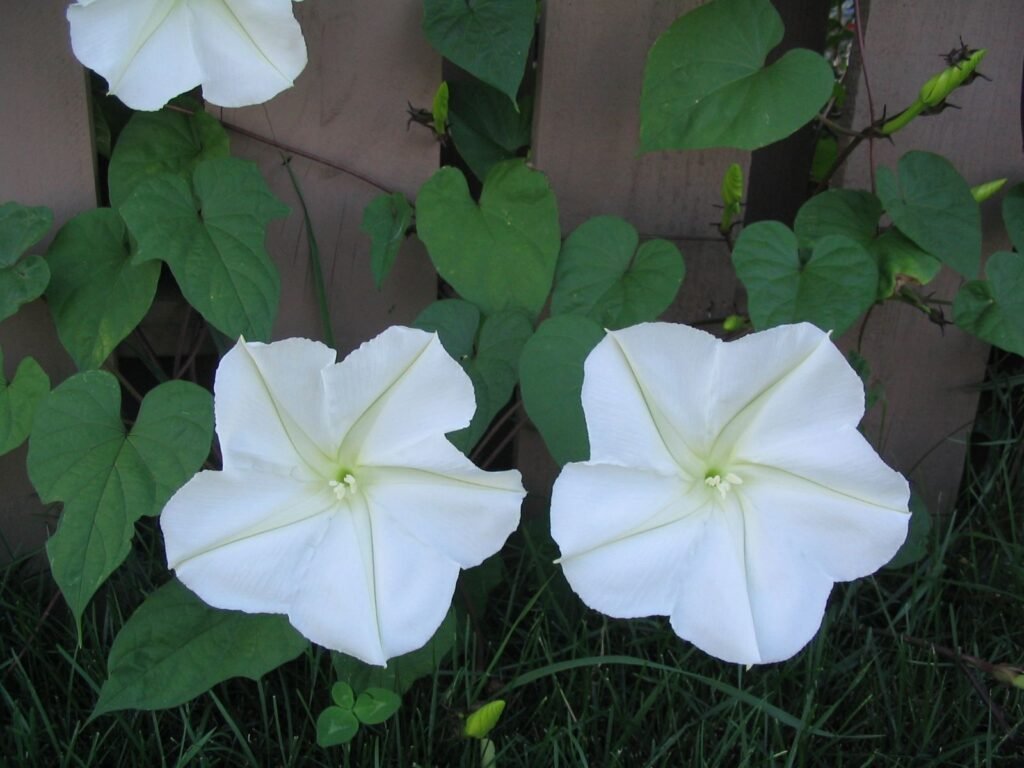
- Night-specific opening or intensification. Some flowers, like moonflower (Ipomoea alba), physically unfurl at dusk and close again by mid-morning — the entire bloom cycle is built around a nighttime pollinator, not a daytime one.
The most extreme version of this relationship isn’t a garden plant at all, but it’s worth knowing because it shows exactly how tight a moth-flower partnership can get: yucca plants and yucca moths (genus Tegeticula) are obligate mutualists. A female yucca moth actively gathers pollen into a ball, carries it to another yucca flower, and deliberately packs it onto the stigma — then lays her eggs in the developing seed pod, and her larvae eat a portion (not all) of the resulting seeds. Neither species reproduces successfully without the other; it’s one of the most frequently cited examples of coevolution in botany, and it’s the reason yucca is on nearly every serious moon-garden plant list.
Best Plants for a Moon Garden, Compared
These species were chosen specifically because they combine genuine documented moth value (not just “looks pale and blooms late”) with realistic availability for home gardeners across most of the US.
| Plant | USDA zones | Bloom timing | Color/fragrance | Moth connection |
|---|---|---|---|---|
| Moonflower (Ipomoea alba) | 10–11 (annual vine elsewhere) | Opens at dusk, closes by mid-morning | Large white trumpet; sweet fragrance strongest at night | Classic sphinx moth (Sphingidae) nectar source; the signature moon-garden vine |
| Evening primrose (Oenothera biennis/speciosa) | 3–9 | Opens at dusk | Pale yellow or pink; lemony scent that peaks in evening | Documented host and nectar plant for several sphinx moth species |
| Sacred datura/moonflower (Datura wrightii) | 8–11 | Opens at dusk | Large white trumpet; heavy sweet fragrance | Primary nectar source for the Carolina sphinx (Manduca sexta) and five-spotted hawk moth (Manduca quinquemaculata) |
| Yucca (Yucca filamentosa and related species) | 4–10 | Early to midsummer | Cream-white bell clusters, mild fragrance | Obligate mutualist relationship with yucca moths (Tegeticula spp.) — neither reproduces without the other |
| Four o’clocks (Mirabilis jalapa) | 9–11 (annual elsewhere) | Opens mid-afternoon into night | White, pink, yellow, or bicolor; sweet evening fragrance | Long floral tube favors long-tongued hawk moths |
| Night phlox (Zaluzianskya capensis) | Annual in most zones | Closes by day, opens and intensifies by night | White with a maroon reverse; vanilla-almond scent at night | Popular smaller-scale moth and beneficial-insect nectar plant for borders and containers |
Source: species profiles cross-referenced from Clemson Cooperative Extension’s Home & Garden Information Center nocturnal-garden guide, the U.S. Fish & Wildlife Service’s pollinator program, and USDA plant hardiness data for each species.
A Closer Look at the Key Plants
Moonflower is the plant most people picture when they hear “moon garden,” and for good reason — the six-inch white blooms genuinely do unfurl within minutes at dusk, and the fragrance is noticeable from several feet away by full dark. It’s a vigorous annual vine outside zones 10–11, so most gardeners grow it on a trellis or arbor each year from seed.
Evening primrose is a genuine two-for-one: it’s an easy, often self-seeding perennial or biennial that also happens to be a documented larval host and nectar source for several sphinx moth species, including the Kern primrose sphinx moth in parts of its native range. It tolerates poor soil better than most plants on this list.
Sacred datura (also sold as devil’s trumpet or moonflower, which causes some nursery-label confusion with Ipomoea alba) produces some of the largest flowers of any plant here and is a primary nectar source for the Carolina sphinx and five-spotted hawk moth — both large, hummingbird-sized moths that are genuinely dramatic to watch feeding at dusk. Every part of the plant is toxic if ingested, so it’s not a good choice for gardens with young children or pets that browse plants.
Yucca earns its place for the mutualism described above rather than for scent or drama — it’s a structural, low-maintenance plant that quietly supports a pollination relationship most gardeners never think about.
Four o’clocks and night phlox are the two best options for smaller gardens or containers, since both stay compact and still deliver real evening fragrance without needing a trellis or a full bed.
Designing and Placing the Garden
- Site it where people will actually be after dark. A moon garden’s payoff — fragrance and the chance to watch moths feed — is wasted on a side yard nobody visits at night. Place it near a patio, porch, or path you actually use in the evening.
- Cluster pale flowers together rather than scattering them. A concentrated block of white and pale blooms reads clearly in low light; the same flowers spread thinly through a mixed bed lose most of their visual and olfactory impact after dusk.
- Layer for height the same way you would in daylight. Vines like moonflower on a trellis or arbor at the back, yucca or four o’clocks as mid-height structure, and low, compact bloomers like night phlox at the front keep the display readable in the dark.
- Skip bright white or blue-toned outdoor lighting near the planting. Standard white LED or blue-rich lighting disorients moths and other night-flying insects and pulls them toward the fixture instead of the flowers — a documented concern in dark-sky and pollinator-conservation guidance. Warm-toned (2700K or lower), shielded, or motion-activated lighting lets people enjoy the space without working against the planting’s purpose.
- Add a pale-colored path or seating element. Light-colored gravel, pavers, or furniture reflect ambient light and moonlight the same way pale flowers do, making the whole space easier to navigate and enjoy after sunset.
Mistakes That Undercut a Moon Garden
- Planting bright, saturated colors expecting the same night effect as daytime beds. Deep reds, oranges, and purples that look striking at noon essentially disappear in low light — pale and white varieties are doing real work here, not just following a theme.
- Installing standard bright security or landscape lighting right next to the bed. This is the single most common way a moon garden fails at its actual purpose — the light competes directly with what the flowers are trying to do and can draw moths away to exhaustion at the fixture instead.
- Treating datura and moonflower vines as safe ornamentals around curious pets or kids. Several signature moon-garden plants, sacred datura especially, are toxic if chewed or eaten — worth knowing before placing them near a play area.
- Expecting an instant, dramatic moth show. Moths are genuinely more visible with intention — a UV flashlight and a plain white sheet hung near the garden on a warm, humid, low-wind night is the standard, low-cost way enthusiasts actually observe what’s visiting, rather than relying on catching one by chance.
For the moth side of the story, see the moth pollination syndrome.
Frequently Asked Questions
What is a moon garden and how is it different from a regular pollinator garden?
A moon garden is a planting designed around pale, white, and strongly fragrant flowers that open or intensify their scent after dusk, specifically to support moths and other nighttime pollinators. A standard pollinator garden is built around what daytime insects like bees and butterflies can see and smell in full light — the design logic is genuinely different because the target pollinators navigate by different senses.
Are moths actually important pollinators, or mostly a novelty?
They’re genuinely important. A 2022 Biology Letters study found moths accounted for 34% of pollinator visits to red clover in a Swiss Alps field site, and flowers visited by moths or bumblebees set significantly more seed than unvisited ones. A separate University of Arkansas apple-orchard study found nocturnal moths pollinated just as effectively as daytime honey bees.
What plants work best in a moon garden?
Moonflower, evening primrose, sacred datura, yucca, four o’clocks, and night phlox are reliable choices, each combining pale or white coloring, strong evening fragrance, and documented moth activity. Choosing species suited to your USDA hardiness zone matters more than picking every plant on a list.
Is outdoor lighting a problem for a moon garden?
Yes — standard bright white or blue-toned lighting placed near the planting can disorient moths and draw them toward the fixture instead of the flowers, working directly against the garden’s purpose. Warm-toned, shielded, or motion-activated lighting lets the space still be usable at night without undermining it.
Are any moon-garden plants dangerous to pets or children?
Sacred datura (Datura wrightii) is toxic if any part of the plant is ingested and should be sited carefully or avoided in yards with young children or pets that browse plants. Moonflower and evening primrose don’t carry the same level of toxicity concern but, as with any ornamental, shouldn’t be treated as edible.
How can I actually see what moths are visiting my garden?
The standard low-cost method enthusiasts use is “mothing”: hang a plain white sheet near the garden and shine a UV or mercury-vapor light on it on a warm, humid, calm night, then check periodically to see what’s landed. It works far better than trying to spot moths on the flowers themselves in the dark.
More detail on this is available from Xerces Society.
Related Reading
Further Reading
- Pollinator Certification Programs: Bee City USA and Bee Better Certified Explained
- Balcony and Container Pollinator Gardens: A No-Yard Guide
Image credits: Photo: Katja Schulz, CC BY 2.0, via Wikimedia Commons.