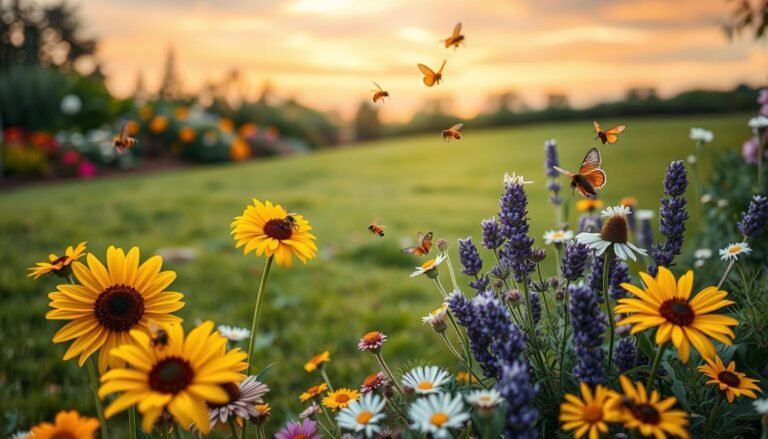
A balcony, patio, or window box can function as genuine pollinator habitat without any yard at all — the U.S. Fish and Wildlife Service specifically promotes container gardening as a real conservation action, not just a consolation prize for renters. The plants, containers, and layout that work in the ground don’t automatically transfer to pots, though, and most “pollinator garden” advice online still assumes you have soil to dig into.
Key Takeaways
- The U.S. Fish and Wildlife Service treats balcony and container gardens as real pollinator habitat, not a lesser substitute — it estimates that if every U.S. household planted just one pollinator-friendly plant, that alone would add more than 120 million plants of habitat nationwide.
- Container soil dries out far faster than ground soil, which is the single biggest reason balcony pollinator gardens fail — watering frequency, not plant choice, is usually the real problem.
- Compact, container-bred cultivars of true native and near-native plants (dwarf milkweed, ‘Munstead’ or ‘Hidcote’ lavender, compact salvia) outperform generic “butterfly mix” seed packets in a pot.
- Vertical space — railing planters, wall-mounted pockets, trellises — matters more on a balcony than it does in a yard, since floor footprint is usually the limiting factor, not overall growing area.
- Renters should check lease terms and weight limits before committing to large ceramic or concrete containers, especially on upper floors or older balconies.
Table of Contents
- Why a Balcony Garden Counts as Real Pollinator Habitat
- Choosing Your Spot: Sun, Wind, and Weight
- Picking the Right Containers
- Best Plants for Pots and Window Boxes
- Layout: Making the Most of a Small Footprint
- Container-Specific Care Differences
- What Renters Should Check First
- Common Mistakes That Undercut a Container Garden’s Value
- Frequently Asked Questions
Why a Balcony Garden Counts as Real Pollinator Habitat
It’s easy to assume a few pots on a third-floor balcony can’t meaningfully help bees and butterflies compared to a real backyard garden, but that assumption doesn’t hold up against how foraging pollinators actually behave. Most native bees forage within a few hundred feet to a couple of miles of their nest, and honeybees routinely work flowers on rooftops and balconies in dense urban cores where a container garden may be the only nectar source on the block. The U.S. Fish and Wildlife Service’s own guidance on this exact topic makes the point directly: a balcony garden isn’t a scaled-down imitation of a real pollinator garden, it’s a legitimate instance of one, sized to whatever space is actually available.
The agency also frames the cumulative impact in a way that’s easy to overlook when you’re staring at one empty balcony railing: if every household in the U.S. planted just a single pollinator-friendly plant, that alone would add more than 120 million new plants of habitat nationwide. A four-pot balcony garden is a small thing in isolation, but it’s the same unit of impact multiplied across millions of apartments, condos, and townhomes that otherwise contribute nothing to the pollinator corridor a neighborhood depends on.
Choosing Your Spot: Sun, Wind, and Weight
Before choosing a single plant, the physical realities of the space need an honest assessment. Most reliable pollinator plants — lavender, salvia, coneflower, lantana, milkweed — need close to full sun, meaning at least six hours of direct light. A north-facing balcony or one shaded by an upper floor for most of the day will struggle to support the plants that actually draw pollinators reliably, no matter how good the soil or containers are; in that situation, it’s more honest to plan around shade-tolerant foliage and accept a lower-traffic pollinator space than to fight the site.
Wind exposure matters more on an elevated balcony than it ever does at ground level. Upper-floor balconies see stronger, more constant wind, which dries out container soil faster, can snap tall flower stems, and makes anything taller than about two feet a genuine tip-over risk in a lightweight pot. Weight is the other structural consideration that ground gardens never require thinking about: a large ceramic or concrete planter filled with wet soil can weigh well over 50 pounds per container, and stacking several of those along a railing edge concentrates real load on a structure that wasn’t necessarily engineered with a garden in mind. Checking a building’s balcony weight guidance, or simply distributing weight across smaller pots rather than a few large ones, is a practical safety step that has nothing to do with plant selection but determines whether the whole project is workable.
Picking the Right Containers
Container sizing is one of the most commonly gotten-wrong details in small-space pollinator gardening, and the mistake runs in both directions. A pot that’s too small restricts root growth and forces constant watering; a pot that’s dramatically oversized for the plant holds excess moisture the roots aren’t using, which is a leading cause of root rot in container gardening generally. The practical rule several extension and wildlife-agency sources converge on is to choose a container only about two inches larger in diameter than the plant’s root ball or nursery pot — enough room to grow into over a season, not enough to sit permanently waterlogged.
Drainage holes are non-negotiable regardless of container material. A decorative pot without drainage can still be used, but only as a cachepot holding a properly drained nursery pot inside it, never as the actual planting vessel. Material affects watering frequency more than most gardeners expect: unglazed terra cotta is porous and dries out fastest (which can be an advantage for drought-tolerant plants like lavender and salvia, and a liability for anything moisture-loving), while glazed ceramic, resin, and plastic retain moisture longer and need less frequent watering. Self-watering containers with a built-in reservoir are worth the extra cost specifically for a balcony that dries out fast in full sun, since inconsistent watering — not plant choice — is the single most common reason a container pollinator garden fails.
Best Plants for Pots and Window Boxes
The plants that dominate general “best plants for bees” lists aren’t all container-appropriate — a plant that spreads by rhizome or grows six feet tall in the ground can outgrow a pot within a season or need dividing constantly. The table below focuses specifically on compact, container-proven options with real pollinator value, not just plants that happen to tolerate a pot.
| Plant | Container fit | Sun needs | Who it attracts | Note |
|---|---|---|---|---|
| Lavender (compact cultivars ‘Munstead,’ ‘Hidcote’) | Excellent — bred for compact habit | Full sun | Honeybees, bumblebees | Prefers drier soil; pairs well with unglazed terra cotta |
| Lantana | Excellent — naturally dense and compact | Full sun | Honeybees, butterflies | Long, continuous bloom through summer heat; treat as an annual outside warm climates |
| Dwarf milkweed (Asclepias compact cultivars) | Good — needs roughly a 3-gallon pot minimum | Full sun | Monarch butterflies specifically, plus bees | The only larval host plant for monarch caterpillars, not just a nectar source |
| Salvia (compact/dwarf types) | Excellent | Full sun | Bumblebees, hummingbirds | Long spikes give strong vertical interest in a mixed pot |
| Pentas | Excellent | Full sun, heat-tolerant | Butterflies especially | Blooms nonstop through summer heat that stalls other annuals |
| Coneflower (Echinacea, compact cultivars) | Good — needs a deeper pot for taproot | Full sun | Honeybees, native bees | Long late-summer bloom window; leave seed heads standing into fall |
| Bee balm (Monarda, compact cultivars) | Fair — spreads by stolons, needs annual dividing in a pot | Full sun | Bumblebees, hummingbirds, specialist native bees | See our full bee balm growing guide for species/cultivar differences |
Wherever possible, favor plants native or near-native to the region rather than generic ornamental hybrids, since native plants tend to support a wider range of native bee species, not just honeybees and the most generalist bumblebees. Regional native plant lists searchable by ZIP code through the Pollinator Partnership’s free regional planting guides are a more reliable way to find regionally appropriate native options than a generic national “pollinator mix” seed packet, which often defaults to plants that aren’t native anywhere near the garden they’re sold for.
Layout: Making the Most of a Small Footprint
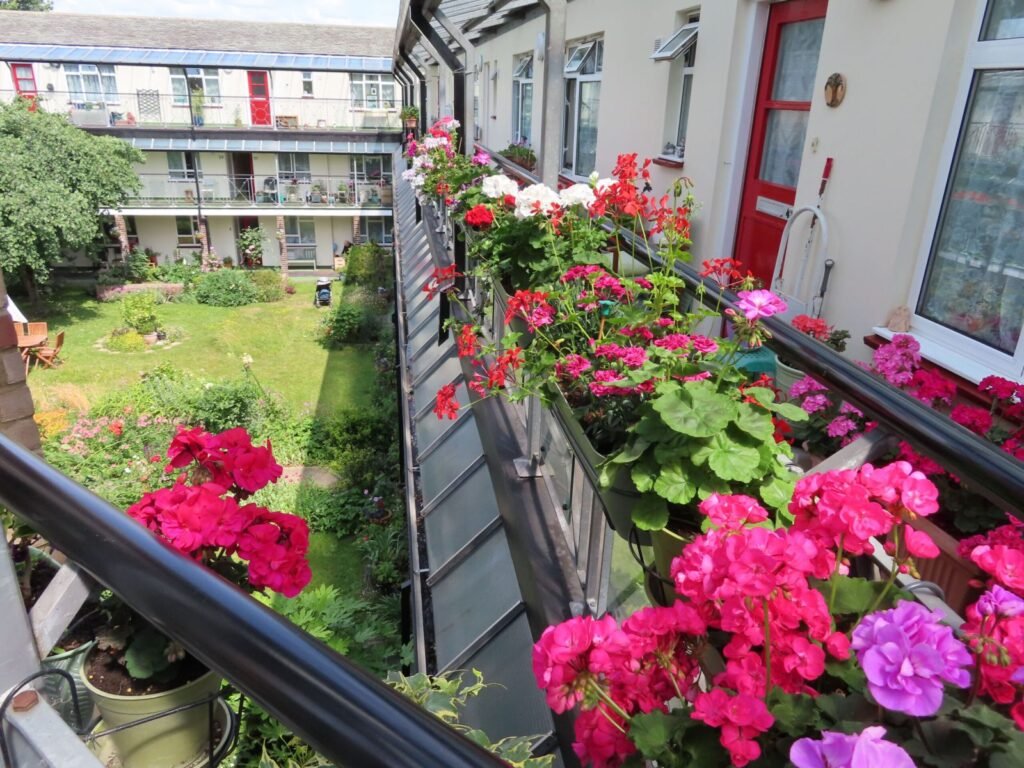
A balcony’s usable floor space is almost always its most limiting factor, which makes vertical growing far more valuable here than it would be in a yard with room to spread out. Railing planters that hook over the balcony rail add growing space without consuming any floor area at all — a real practical advantage over a yard bed, where every plant competes for the same ground footprint. Wall-mounted pocket planters and tiered plant stands accomplish the same thing along a vertical wall or corner. A trellis anchored to a single pot lets a vining plant like a compact clematis or nasturtium claim vertical space that would otherwise go completely unused.
Within any given cluster of pots, the same principle used in ground beds still applies: taller plants toward the back or center, shorter plants toward the front or edges, so nothing shades out a shorter neighbor. Staggering bloom times across a small collection of pots — an early-spring pot of something cold-tolerant, summer-blooming lavender and salvia, and a late-blooming aster or sedum for fall — keeps a small space productive for pollinators across most of the growing season instead of producing one big flush of color and then going quiet. Planning for roughly three extra inches of space around each plant when arranging several pots together prevents the kind of overcrowding that blocks airflow and invites fungal problems in tight quarters.
Container-Specific Care Differences
The single biggest practical difference between a container garden and a ground bed is how fast the soil dries out. A raised container exposed to sun and wind on all sides loses moisture far faster than the same volume of soil insulated by surrounding earth, which means a balcony garden in full summer sun can need daily watering when an equivalent ground planting would go two or three days between waterings. Checking soil moisture with a finger an inch down, rather than watering on a fixed schedule, avoids both underwatering (the most common outright killer of container plants) and overwatering into a pot with poor drainage.
Winter brings the opposite kind of extra vulnerability: a container’s roots are exposed to cold air on every side, not insulated by surrounding ground the way an in-ground root system is, so perennial roots in a pot can freeze and die at air temperatures a ground-planted version of the same species would survive without issue. Grouping pots together against a building wall, wrapping containers in burlap or bubble wrap, or mulching heavily over the soil surface all reduce this exposure; in genuinely cold climates, moving perennial pots into an unheated garage or shed for winter is often the more reliable option than trying to insulate them in place. Fertilizing also differs from ground gardening: container soil has nutrients washed out by drainage water far faster than ground soil does, so a container garden generally needs more frequent, lighter feeding through the growing season than the same plants would need in the ground.
What Renters Should Check First
Most of the plant and container advice above assumes the space is available to use freely, but a rented balcony or patio often comes with real constraints worth checking before buying anything. Lease agreements sometimes explicitly restrict what can be attached to railings, hung from ceilings, or left visible from the street or common areas — a quick read of the lease’s outdoor-space clause avoids buying planters that then have to come back down. Weight limits are a genuine structural concern on older buildings or upper floors, and a property manager can usually confirm a safe load if it isn’t otherwise documented.
Because a rented space may need to be restored to its original condition at move-out, favoring freestanding containers over anything drilled or permanently mounted keeps the entire garden portable — an underrated advantage for anyone who might move within a year or two, since the whole collection of pots, plants, and soil can simply travel to the next balcony rather than being abandoned. HOA and condo association rules can add another layer of restriction beyond an individual lease, particularly around what’s visible from outside the building; checking those rules before investing in larger or more visible containers avoids a removal notice after the fact.
Common Mistakes That Undercut a Container Garden’s Value
- Oversized pots “to be safe.” A container much larger than the plant needs holds excess unused moisture and is a leading cause of root rot — bigger is not automatically better in container gardening.
- Ignoring drainage. A beautiful pot with no drainage hole, used as the actual planting container rather than a cachepot, waterlogs roots regardless of how well everything else is done.
- Watering on a fixed schedule instead of checking the soil. Container soil’s drying rate changes constantly with heat, wind, and pot material — a rigid schedule reliably leads to either underwatering or overwatering.
- Buying generic “butterfly mix” or “bee mix” seed packets without checking regional native content. Many of these mixes are dominated by non-native ornamentals that offer far less real value to local native bee species than a regionally appropriate native plant does.
- Not accounting for weight and wind on an elevated balcony. These are structural and safety considerations a ground garden never requires thinking about, and skipping them is a real, not theoretical, risk.
Frequently Asked Questions
Can a balcony garden actually make a real difference for pollinators, or is it mostly symbolic?
It’s a real, if small, contribution — the U.S. Fish and Wildlife Service actively promotes balcony and container gardens as genuine pollinator habitat, not a token gesture, and points out that the cumulative effect of many small container gardens across a city adds up to meaningful habitat, especially in dense urban areas with little other green space.
What’s the single biggest reason container pollinator gardens fail?
Inconsistent watering, not plant selection. Container soil dries out much faster than ground soil because it’s exposed to sun, wind, and air on every side, and both underwatering and overwatering (in a pot with poor drainage) are more common failure points than picking the “wrong” plant.
Do the plants need to be native to actually help pollinators?
Native or regionally appropriate plants generally support a wider range of native bee species than generic ornamental hybrids, some of which offer little usable pollen or nectar despite showy flowers. A ZIP-code-based native plant search through a resource like pollinator.org is more reliable than a generic national “pollinator mix” seed packet.
How big a pot do I actually need?
As a general rule, a container about two inches larger in diameter than the plant’s current root ball or nursery pot gives enough room to grow without leaving excess unused soil that stays wet and encourages root rot. Larger perennials like milkweed or coneflower need a deeper pot to accommodate their root systems, generally a 3-gallon size or larger.
Will my container perennials survive winter on an exposed balcony?
Not always, and not automatically the way the same plant would survive in the ground. Container roots are exposed to cold air on all sides with no insulating ground around them, so grouping pots together, insulating them, or moving them to an unheated garage over winter meaningfully improves survival odds for perennials in cold climates.
Can I keep a container pollinator garden if my lease restricts what’s attached to the balcony?
Yes — freestanding pots and railing planters that hook on without drilling or permanent mounting keep the entire garden compliant with most lease restrictions and fully portable if you move, which is generally the safer default for a rented space regardless of what the lease specifically allows.