Bees can recognize individual human faces, rank zero as a quantity, do basic arithmetic, and reach group decisions by a form of democratic voting — all real, peer-reviewed findings, not folklore. These eight facts are backed by named researchers, published studies, and real institutions, not the same recycled trivia that shows up on every “fun bee facts” listicle.
Key Takeaways
- Bees can learn to recognize and distinguish individual human faces with over 80% accuracy despite having fewer than one million brain cells (Dyer et al., Journal of Experimental Biology, 2005).
- Honeybees are one of the few non-human animals shown to understand zero as a numerical concept below one — a 2018 RMIT/CNRS study published in Science found they rank an empty set as “less than” one, even without prior exposure to it.
- A 2019 Science Advances study found honeybees can use color as a symbol for “add” or “subtract” and solve unfamiliar arithmetic problems using it, getting the right answer 63-72% of the time.
- Stressed bumblebees show a measurable pessimism bias in their choices — a 2011 Current Biology study is one of the foundational pieces of evidence for emotion-like states in insects.
- Honeybee colonies pick a new home through a real form of collective decision-making: scout bees “vote” with waggle dances, and the swarm moves once roughly 15-20 scouts converge on the same site — documented across decades of research by Cornell biologist Thomas Seeley.
Table of Contents
- 1. Bees Can Recognize Individual Human Faces
- 2. Bees Understand the Concept of Zero
- 3. Bees Can Add and Subtract
- 4. Stressed Bees Show a Measurable Pessimism Bias
- 5. Bumblebees Don’t Just Copy — They Improve on What They’re Shown
- 6. Honeybee Swarms Choose a New Home by a Real Voting Process
- 7. Honeybees Can’t Do What Bumblebees Do to Pollinate Tomatoes
- 8. “Undertaker” Bees Detect Death by What’s Missing, Not What’s There
- Frequently Asked Questions
1. Bees Can Recognize Individual Human Faces
Researcher Adrian Dyer (then at Monash University, now at RMIT) trained honeybees to associate specific human face images with a sugar-water reward, then tested whether they could pick that same face out from similar distractor faces. Published in the Journal of Experimental Biology (2005), the study found bees discriminated the trained target face from a similar distractor face with greater than 80% accuracy, and continued recognizing it across different viewpoints. Bees have no evolutionary reason to process human faces — the finding matters because it shows this kind of “holistic” facial recognition doesn’t require a large brain; a bee’s brain has fewer than one million neurons, compared to roughly 86 billion in a human brain.
2. Bees Understand the Concept of Zero
Understanding that “nothing” is a quantity smaller than “one” seems basic, but it’s a genuinely rare cognitive ability — documented in humans, some primates, and very few other species. RMIT PhD researcher Scarlett Howard and colleagues trained individual honeybees to choose the image with the fewest visual elements for a sugar reward, then tested them with a never-before-seen image containing zero elements. Published in Science in 2018, the study found bees correctly treated the empty set as “less than” one, despite never having been trained on it directly — making honeybees among the first insects shown capable of understanding the difference between something and nothing.
3. Bees Can Add and Subtract
The same RMIT team followed up with an even more striking result: honeybees trained to treat the color blue as meaning “add one” and yellow as meaning “subtract one” could apply that rule to solve entirely new problems in a Y-maze. Published in Science Advances in February 2019, the study found bees chose the mathematically correct answer 63-72% of the time depending on the specific equation — well above chance. Given that honeybees and humans diverged over 400 million years ago evolutionarily, the researchers noted this suggests numerical reasoning may be far more accessible across the animal kingdom than previously assumed.
4. Stressed Bees Show a Measurable Pessimism Bias
Researchers led by Melissa Bateson at Newcastle University physically agitated honeybees (a mild shake, simulating a predator attack) and then tested how they responded to an ambiguous situation — a scent partway between one they’d learned meant “high reward” and one meaning “low reward.” Published in Current Biology in 2011, the study found agitated bees were significantly more likely to treat the ambiguous cue pessimistically, avoiding it as if expecting a poor outcome, compared to undisturbed bees. This is one of the foundational studies used to argue that insects can experience measurable, biologically real emotion-like states, not just fixed reflexes.
5. Bumblebees Don’t Just Copy — They Improve on What They’re Shown
Researchers at Queen Mary University of London, led by Olli Loukola, trained “demonstrator” bumblebees to roll a small ball to a target location for a reward, then let untrained bees watch. Published in Science in 2017, the study found observer bees didn’t just copy the demonstrated technique — most of the successful bees ignored the ball they’d watched get moved and instead used a different ball sitting closer to the goal, solving the task more efficiently than what they’d actually observed. That’s a real, documented example of cognitive flexibility, not simple imitation, in an insect with a brain smaller than a grain of rice.
6. Honeybee Swarms Choose a New Home by a Real Voting Process
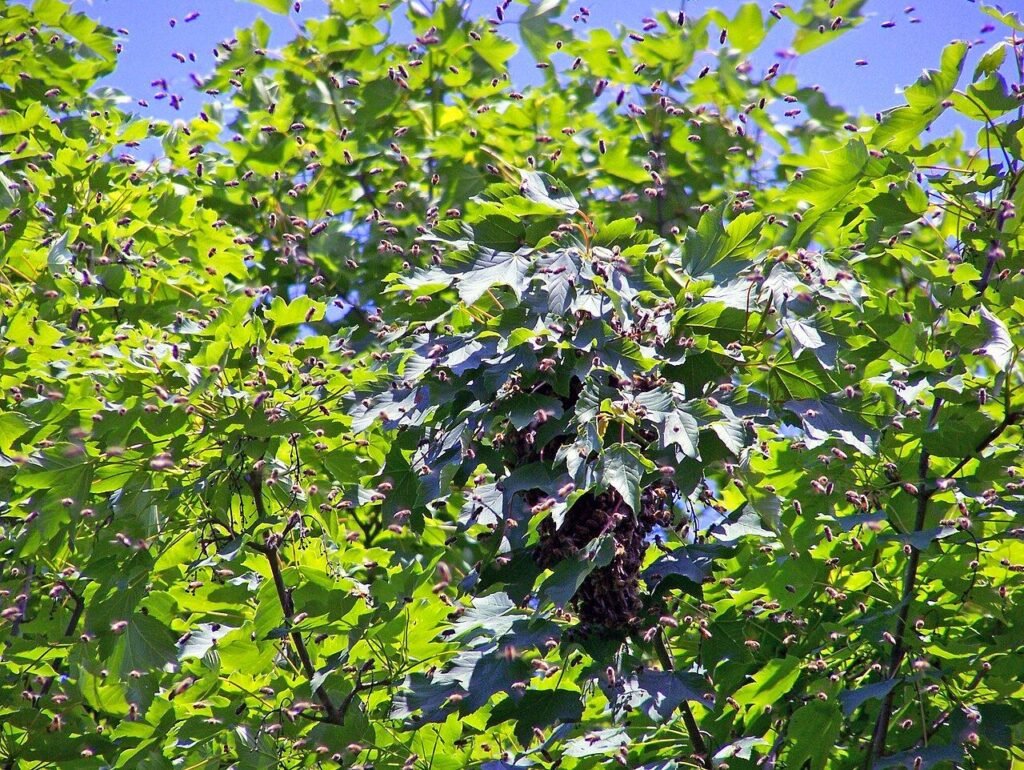
When a colony outgrows its hive, several hundred scout bees independently search for candidate new nest sites, then return and advertise what they found through waggle dances — the more promising the site, the more vigorous and sustained the dance. Cornell biologist Thomas Seeley’s decades of field research, summarized in his book Honeybee Democracy, documented that scouts don’t just pick a favorite and commit — they visit and re-evaluate other advertised sites, and the swarm only commits once roughly 15-20 scouts are simultaneously present and dancing for the same location, a real quorum threshold. Once quorum is reached, those scouts produce a distinct vibration signal (informally called “piping”) that cues the rest of the swarm to prepare for takeoff. It’s a genuinely decentralized group decision process, not a single queen or scout dictating the outcome.
7. Honeybees Can’t Do What Bumblebees Do to Pollinate Tomatoes
Some flowers, including tomato, pepper, and blueberry, hold their pollen in tube-like anthers that need to be vibrated loose rather than simply brushed — a technique called buzz pollination, or sonication, where a bee grips the flower and vibrates its flight muscles without moving its wings. Bumblebees and many native solitary bees can do this; honeybees do not. They have the same basic flight muscles other bees use to sonicate, but not the behavior, and training does not change that. That is why commercial tomato greenhouses stock managed bumblebee colonies instead of honeybees, and research on highbush blueberry has found it takes roughly four honeybee visits to move the same amount of pollen as a single bumblebee visit.
8. “Undertaker” Bees Detect Death by What’s Missing, Not What’s There
Honeybee colonies remove dead bees quickly — a behavior called necrophoresis that helps limit disease spread. The mechanism is more specific than “bees can smell death”: research has found that oleic acid, released as brood decompose, is the chemical cue that triggers worker bees to remove dead or freeze-killed brood specifically. But for dead adult bees, a separate study found the trigger works in reverse — certain cuticular hydrocarbons (heptacosane and nonacosane) that are present on living bees measurably drop within about 30 minutes of death, and it’s that drop below a living threshold, not the appearance of a new “death” chemical, that cues undertaker bees to remove the corpse. In other words, the hive doesn’t detect the smell of death so much as the sudden absence of the smell of being alive.
Frequently Asked Questions
Can bees really recognize human faces?
Yes — a 2005 study published in the Journal of Experimental Biology found honeybees trained to associate a specific human face with a reward could pick that same face out from similar faces with over 80% accuracy, despite having fewer than one million brain cells.
Is it true bees understand the number zero?
Yes, according to a 2018 study in Science by RMIT and French researchers, which found honeybees correctly ranked an empty set (zero elements) as “less than” one, even without being directly trained on that comparison — a genuinely rare cognitive ability outside of humans and a handful of other species.
Can bees actually do math?
In a limited but real sense, yes. A 2019 study in Science Advances found honeybees could learn to treat colors as symbols for “add one” or “subtract one” and apply that rule correctly to new problems 63-72% of the time — a level of numerical reasoning not previously expected in an insect brain.
Do bees actually feel emotions?
Researchers are careful to say “emotion-like states” rather than claiming bees feel exactly what humans feel, but a 2011 study in Current Biology found physically stressed bees showed a measurable pessimism bias in ambiguous situations — a real, testable proxy for an emotional response, not just a fixed reflex.
How do honeybee swarms actually decide on a new hive location?
Scout bees search independently, then advertise candidate sites to the swarm through waggle dances. Per decades of research by Cornell biologist Thomas Seeley, the swarm doesn’t commit until roughly 15-20 scouts are simultaneously dancing for the same site — a real quorum-based, decentralized decision process.
Why can’t honeybees pollinate tomatoes as well as bumblebees?
Tomato flowers require buzz pollination (sonication) — vibrating the flower to shake pollen loose from tube-like anthers. Honeybees lack the specific muscle mechanism to do this, while bumblebees and many native bees can, which is why greenhouse tomato growers use managed bumblebee colonies instead of honeybees.
This is covered in more depth by USDA Agricultural Research Service.
Related Reading
Further Reading
- Is Honey Really Bee Vomit? The Truth About How It’s Made
- National Honey Month: Its Real History and How It Started
Image credits: Photo: JJ Harrison, licensed CC BY-SA 3.0, via Wikimedia Commons.