Reviewed by Thomas B. · How we review
Honey bees handle nectar toxins mainly inside their own bodies, not in the honey. Detoxification enzymes, gut bacteria, taste, and learned avoidance do that work, while honey ripening protects stored food from microbes but does not strip out plant toxins. This guide covers both processes and where each one stops.
Honey is a supersaturated food made mainly of glucose and fructose and more than 180 minor components. The initial plant fluid starts very dilute, near 80% water, and becomes a low-water product at about 17–18% through enzymatic action and evaporation.
Key enzymes such as invertase and glucose oxidase reshape sugars and create gluconic acid and hydrogen peroxide. Catalase helps limit oxidative build-up so the colony stays safe while antimicrobial properties develop.
The crop, or honey stomach, acts as a brief holding and enzyme-dosing site. House workers finish the conversion inside the hive by transferring content, fanning to ripen, and capping cells. Flower chemistry varies, so the hive’s division of labor evens out those differences and preserves aroma and nutrients.
Key Takeaways
- Nectar can carry plant toxins (alkaloids, phenolics, diterpenes, toxic sugars) and pesticide residues; bees deal with them mainly after eating, using cytochrome P450 and other detoxification enzymes.
- Honey bees have a comparatively small set of detox genes, but specific enzymes are well documented (CYP6AS for quercetin, CYP9Q for some insecticides), and compounds in honey and pollen switch them on.
- Gut bacteria such as Gilliamella apicola can break down sugars like mannose that are toxic to bees.
- Taste and learned aversion steer foragers away from bitter or sickening nectar, but bees cannot taste some pesticides, including common neonicotinoids.
- Honey ripening (invertase, glucose oxidase, drying to about 17–18% water) protects against yeasts and bacteria. It does not remove toxins such as grayanotoxins, tutin, or pyrrolizidine alkaloids, and evaporation can concentrate them.
Why understanding nectar toxins in bees matters today
Nectar toxins matter on two levels. For the colony, plant compounds and pesticide residues in nectar affect forager survival, learning, and foraging choices. For beekeepers and consumers, some of those compounds carry through into honey. Separately, low final water content and natural acidity are the hive’s main defenses against bacteria and yeast; when drying fails, fermentation can begin and spoil stored food. It helps to keep these two kinds of risk apart, because the colony handles them in different ways.
Worker roles and hive signaling keep the colony focused on productive flowers and balanced workload. That coordination helps convert variable sucrose and other sugar mixes from different flowers into stable honey that supports colony resilience.
Human handling matters, too. Improper heating of fructose-rich syrups or poor storage can form HMF, a harmful byproduct. That risk makes chemistry-aware feeding and processing essential for safe production and consumer confidence.
“Small shifts in moisture or sugar conversion can mean the difference between shelf-stable honey and fermentation.”
- Flower variability affects sugar ratios, flavor, and crystallization behavior.
- Low moisture plus acidity curbs bacteria, protecting hive health and food quality.
- Chemistry-aware choices improve storage, purity, and overall production planning across U.S. landscapes.
For more on how floral choices shape supply, see foraging and floral sources. Informed decisions by keepers and consumers reduce spoilage, protect colonies, and preserve the unique flavors of honey.
How bees process toxins in nectar
Nectar is not just sugar water. Many plants add secondary compounds to it: alkaloids such as nicotine and caffeine, phenolics such as quercetin and p-coumaric acid, diterpenes such as the grayanotoxins in rhododendrons, and unusual sugars that bees cannot use. A review by Stevenson, Nicolson, and Wright (Functional Ecology, 2017) describes these compounds in the nectar of a wide range of plant families, usually at lower concentrations than in the plant’s leaves. Foragers also bring home pesticide residues with nectar and pollen. Honey bees deal with this chemical load in four main ways, and none of them happens inside the stored honey.
1. Detoxification enzymes in the bee’s body
Compounds that a bee actually ingests and absorbs are handled mainly by cytochrome P450 enzymes in the midgut and fat body, with help from glutathione S-transferases and carboxylesterases. These enzymes modify a compound so it is less active or easier to excrete.
When the honey bee genome was sequenced, Claudianos and colleagues (Insect Molecular Biology, 2006) found that honey bees carry roughly half as many of these detoxification genes as fruit flies or mosquitoes. The smaller toolkit is thought to reflect a diet of nectar and pollen that is relatively low in toxins, and it is one reason bees can be sensitive to some chemicals.
The enzymes they do have are well targeted. Enzymes in the CYP6AS family metabolize quercetin, a flavonoid common in nectar, pollen, and honey (Mao and colleagues, 2009). Enzymes in the CYP9Q family break down some insecticides: Manjon and colleagues (Current Biology, 2018) showed that CYP9Q3 metabolizes the neonicotinoid thiacloprid, which helps explain why honey bees tolerate it far better than imidacloprid.
Diet switches these defenses on. Mao, Schuler, and Berenbaum (PNAS, 2013) found that p-coumaric acid, a compound found in honey and pollen, up-regulates detoxification genes in worker bees. Bees eating their own honey and pollen are therefore likely better equipped than bees living only on sugar syrup.
2. Gut bacteria that handle problem sugars
Some nectars and pollens contain sugars such as mannose, arabinose, and xylose that honey bees cannot metabolize, and mannose in particular is toxic to them. Zheng and colleagues (mBio, 2016) showed that strains of the bee gut bacterium Gilliamella apicola can break these sugars down, which suggests the gut community helps limit the harm. How large that effect is inside a working colony has not yet been well measured.
3. Taste, learning, and avoidance
Bees taste bitter compounds and often reject strongly bitter nectar. They can also learn to avoid a food that made them ill: Wright and colleagues (Journal of Neuroscience, 2010) showed that honey bees form aversions to odors paired with toxins such as quinine and amygdalin, both through taste and through feeling unwell after eating.
The picture is not simple, though. At the low doses found in real nectar, some alkaloids are attractive: caffeine in citrus and coffee nectar improves foragers’ memory of a flower (Wright and colleagues, Science, 2013). Honey bees accept low nicotine levels, while higher levels deter them and reduced survival in caged bees (Köhler, Pirk, and Nicolson, Journal of Insect Physiology, 2012). And bees cannot taste everything. Kessler and colleagues (Nature, 2015) found that honey bees and bumblebees could not detect common neonicotinoids in sugar solution and even preferred the dosed food. Taste is a useful filter against plant bitterness, not a reliable one against synthetic chemicals.
4. Mixing and dilution across the colony
Because nectar from many flowers and many foragers is blended in the comb, one toxic source is usually diluted by everything else coming in, unless it dominates the landscape. Recruitment through the waggle dance also favors rewarding patches, so a patch that yields poorly draws fewer foragers over time. Neither step removes a toxin; they only reduce how much of it any one bee eats.
What honey-making does not remove
The enzyme and drying steps described later in this guide protect honey against yeasts and bacteria. They are not a detox process for plant compounds. Evaporating nectar from about 70–80% water down to about 18% concentrates any non-volatile compound it carries, which is why naturally toxic honeys exist:
- Grayanotoxins from rhododendrons and related plants survive into “mad honey,” which causes poisoning in people, most often reported from the Black Sea region of Turkey and from Nepal (Jansen and colleagues, Cardiovascular Toxicology, 2012). Read more in our piece on the Gurung honey hunters of Nepal and mad honey.
- Tutin, from the New Zealand tutu plant, reaches honey when bees collect honeydew from insects that feed on tutu. New Zealand sets a legal maximum for tutin in honey for this reason.
- Pyrrolizidine alkaloids from plants such as Echium (Paterson’s curse) have been measured in honey (Edgar and colleagues, Journal of Agricultural and Food Chemistry, 2002).
For which plants genuinely harm bees and which warnings are myths, see plants toxic to bees. The rest of this guide covers the other half of the story: how the hive turns nectar into honey that resists spoilage.
Collection and flower choice: the colony’s first filter
Forager behavior and early enzyme action set the stage for safe conversion. Worker foragers collect nectar from flowers and store the liquid briefly in the honey stomach. There, invertase begins to hydrolyze sucrose into glucose and fructose during flight and return.

Nectar collection and dilution in the honey stomach
Foragers use a proboscis to gather liquid and hold it in the crop. This short-term storage lets enzymes start sugar breakdown before any hive transfer. The crop is a storage sac, not a digestive organ: a valve called the proventriculus controls how much passes on to the midgut, so a forager absorbs only the share she lets through for her own fuel. The rest, along with any plant compounds it contains, is handed to house bees at the hive.
Flower choice, colony communication, and avoiding high-risk blooms
Waggle dances and scent cues steer foragers toward reliable floral sources. That group-level selection lowers exposure to blooms that might deliver problematic compounds and supports efficient conversion.
From nectar to honey: lowering spoilage risk through chemistry and time
Trophallaxis—mouth-to-mouth transfer—spreads the load so many workers add enzymes and adjust moisture. Repeated regurgitation and fanning drive water down from roughly 70–80% toward the target 17–20%.
- Multiple enzyme passes reduce sucrose and change sugar ratios, favoring stability.
- Lowering moisture and consistent enzyme addition cut microbial opportunity and fermentation risk.
- Steady concentration before comb deposition ensures final drying and capping lock in quality.
For an accessible overview of the conversion sequence, see how bees make honey. Our guide to how honey cures inside the hive covers the ripening steps in more detail.
Honey-ripening enzymes: protection against microbes, not plant toxins
A cascade of enzymes converts floral sugars into a stable, low-risk food while adjusting acidity and reactive compounds. This brief chemical choreography makes honey resistant to spoilage and safe for long-term storage.
Invertase: breaking sucrose into glucose and fructose for storage
Invertase, delivered from salivary glands, cleaves sucrose into glucose and fructose. That split reduces complexity and creates predictable sugar ratios for final honey content. Multiple stomach transfers ensure the enzyme dose is repeated across many brief passes.
Glucose oxidase: generating gluconic acid and hydrogen peroxide
Glucose oxidase converts glucose to gluconic acid and low levels of hydrogen peroxide. The acid lowers pH while peroxide offers antimicrobial action. Together they provide protection without additives, and they form as part of normal enzyme activity.
Catalase and pH balance: managing hydrogen peroxide and acidity
Catalase acts as a safety valve. It turns excess peroxide into water and oxygen, keeping reactive hydrogen species from building too high. This balance preserves antimicrobial benefit while protecting living workers and stored food.
Low moisture content and supersaturation: limiting bacteria and fermentation
As water falls toward ~17–18%, the solution becomes supersaturated and inhospitable to microbes. Combined with repeated enzymatic passes and adjusted acidity, sugars resist fermentation and the hive secures a shelf-stable product.
“This multi-enzyme pathway is the heart of the hive’s risk reduction and the reason honey’s properties endure.”
For a deeper review of this biochemical sequence, see the un-bee-lievable chemistry overview.
Inside the hive: step-by-step honey ripening
A rhythmic cycle of exchanges and air movement inside the colony removes water and boosts enzyme action.
Trophallaxis and reprocessing cycles: enzymatic “passes” over time
Nectar first arrives with foragers and is briefly held in the honey stomach. For about 20 minutes, house workers perform repeated trophallaxis—regurgitation and reingestion—that keeps enzymes active and spreads enzyme-rich fluid across many mouths.
This staggered handling increases surface area and allows invertase and other enzymes to keep splitting sucrose into glucose and fructose while moisture drops. Each pass refines sugar balance and reduces microbial opportunity as water activity falls.
Wing fanning, evaporation, and capping: moisture targets and stability
Workers create directed airflow with their wings to speed evaporation. Evaporation drives moisture toward the target ~17–20% low water threshold needed for stable honey.
The hive keeps zones for active drying and later ripening before comb capping seals the cells. This coordinated ventilation, enzyme exposure, and water removal produce a resilient honey matrix and limit peroxide buildup and fermentation risk.
“Sustained reprocessing and ventilation are the colony’s practical safeguards for turning variable floral input into long-term stores.”
What this means for honey safety, properties, and colony health
The safety of stored honey depends on low water activity and a small but vital oxidative defense.
Low water content near 17–18% plus acidity creates an environment that limits bacteria and yeast growth. Small amounts of hydrogen peroxide produced by glucose oxidase add antimicrobial action without harming the colony.
When moisture rises above roughly 20–25%, fermentation can begin. Alcohol and off-flavors form, and that spoils food stores and weakens colony reserves.
Practical chemistry that preserves stores
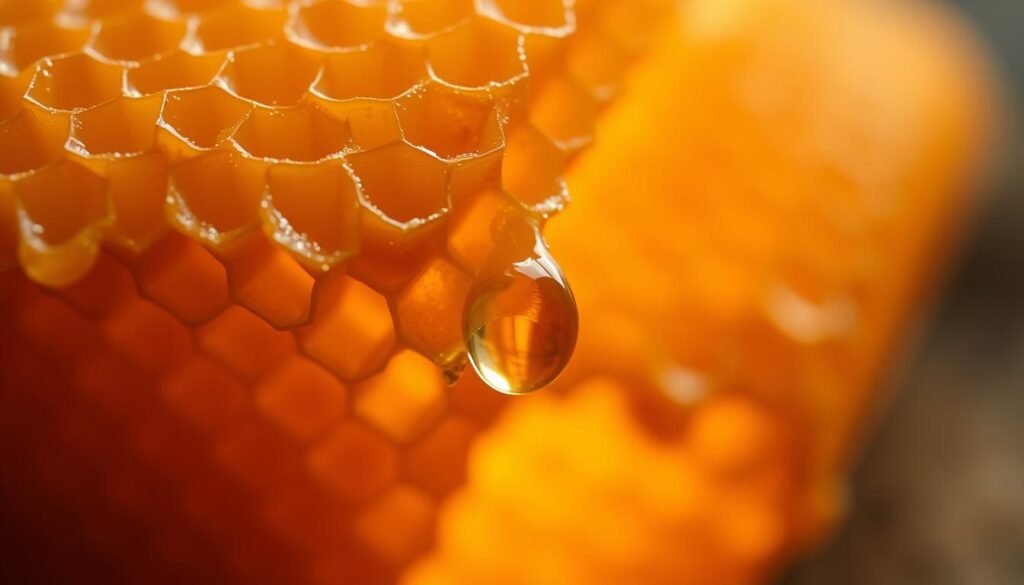
Workers cap well-dried cells with beeswax, sealing content against atmospheric moisture and prolonging shelf life.
The balance of glucose and fructose also matters. It shapes crystallization tendencies but does not reduce safety when water content stays low.
- Oxidase and enzyme actions provide controlled peroxide levels that reduce microbial load.
- Beeswax capping and low moisture together prevent fermentation and protect winter food.
- Consistent ripening practices in the United States help secure colony health and honey quality.
“Proper drying and capping turn variable floral input into a stable food reserve for the colony.”
Practical takeaways for beekeepers and informed consumers
Practical steps reduce spoilage risk and keep honey quality high from hive to jar.
Support ventilation and space. Give the colony enough super room so workers can use their wings for evaporation and bring moisture down to the target 17–20% before capping.
Use a refractometer to check water content when you make honey harvest decisions. Prioritize frames that are mostly capped to lower fermentation risk.
Avoid overheating stored honey or feeds. Fructose-rich syrups can form HMF at modest temperatures, which harms the bee and degrades the product.
- Store jars above ~50°F to slow crystallization; clean extraction reduces particulates that seed crystals.
- Position hives near diverse flowers to collect nectar with balanced sugars and manageable sucrose levels.
- Seal jars tightly and respect beeswax capping as a natural barrier to atmospheric moisture uptake.
Know your local toxin risks. Where you can, keep colonies away from fields during and just after insecticide applications, and talk with nearby growers about spray timing. If you sell honey from areas with large stands of rhododendron or mountain laurel, or from tutu country in New Zealand, learn the local testing rules and harvest guidance; in New Zealand, tutin in honey is regulated by law. Letting bees keep some of their own honey and pollen, rather than relying only on sugar syrup, may also help, since compounds in honey and pollen switch on the detoxification enzymes described above.
“Incremental control over moisture, ventilation, and gentle handling yields a stable, long-lived product.”
Conclusion
To conclude, coordinated enzyme delivery and targeted drying convert liquid harvests into shelf-stable honey.
Invertase shifts sucrose toward glucose and fructose while glucose oxidase yields gluconic acid and limited hydrogen peroxide. Those chemistry steps give the product gentle antimicrobial properties without harming the hive.
Lowering water through repeated trophallaxis and directed airflow is central. A low water, low-moisture state prevents fermentation and preserves texture and flavor from diverse flowers.
On toxins specifically, bees rely on a modest set of detoxification enzymes, helpful gut bacteria, taste and learned avoidance, and the dilution that comes from blending many nectar sources. Honey ripening protects stored food from microbes, but it does not strip out plant toxins such as grayanotoxins, tutin, or pyrrolizidine alkaloids, and concentrating nectar can raise their levels.
Practical production choices matter: respect glands-derived enzyme systems, avoid overheating, and prevent post-harvest moisture uptake to keep honey safe and long lived. Understanding these compounds and steps helps beekeepers and consumers make better decisions for colony health and superior honey.
FAQ
What enzymes are key when nectar becomes honey?
Worker bees add enzymes from their hypopharyngeal glands and the honey stomach, notably invertase and glucose oxidase. Invertase splits sucrose into glucose and fructose, which lowers osmotic stress and makes the sugars easier to store. Glucose oxidase converts glucose into gluconic acid and hydrogen peroxide, contributing to honey’s mild acidity and antimicrobial activity.
Why do foragers dilute and concentrate liquid collected from flowers?
Foragers adjust moisture by adding saliva and mixing different flower sources in the honey stomach. Mixing loads from many flowers and many foragers also means nectar from a single toxic source is usually diluted by everything else coming in, although this lowers exposure rather than removing the compound. Back at the hive, repeated trophallaxis and wing fanning evaporate water until the moisture content hits a safe, stable range below about 18%.
How does the hive manage hydrogen peroxide produced during conversion?
Hydrogen peroxide is made by glucose oxidase, an enzyme bees add from their hypopharyngeal glands. In ripe, low-water honey the enzyme is nearly inactive; it becomes active again when honey is diluted, which is why diluted honey shows more peroxide activity. Catalase, which comes mainly from nectar and pollen, breaks some of the peroxide down, so different honeys end up with very different peroxide levels.
Can nectar with natural plant compounds harm the colony after processing?
Yes. Honey ripening is aimed at microbes, not plant chemistry, and evaporating nectar concentrates any non-volatile compounds it carries. Grayanotoxins (from rhododendrons), tutin (from honeydew on New Zealand tutu), and pyrrolizidine alkaloids (from plants such as Echium) have all been found in honey. Many nectar compounds are harmless or even beneficial to bees at the low doses they normally meet, but processing should not be assumed to make a toxic source safe.
What role does moisture play in preventing fermentation or spoilage?
Low moisture is critical. Drying nectar to a water content around 17–18% creates supersaturation that inhibits yeast and bacterial growth. Wing fanning, cell capping, and the colony’s temperature control all contribute to achieving and maintaining that safe moisture level.
How do bees avoid highly toxic floral sources?
Foragers rely on learning, floral cues, and colony-level feedback. If a flower source causes illness or reduced return rates, foragers avoid it. Communication through the waggle dance and scent markers helps the colony shift foraging away from high-risk blooms. Bees do have limits: they cannot taste some pesticides, including common neonicotinoids, and in laboratory tests they preferred sugar solution containing them (Kessler and colleagues, 2015).
Does the honey stomach break down harmful compounds directly?
No. The honey stomach (crop) stores and carries nectar and adds invertase, but it is not where toxins are broken down. Detoxification happens after food passes the proventriculus into the midgut and is absorbed, mainly through cytochrome P450 enzymes in the midgut and fat body. The honey-making steps inside the hive change sugars and water content, not plant toxins.
Are microbial communities involved in nectar transformation?
Yes. Yeasts and bacteria on flowers change nectar chemistry before bees collect it, and the bee’s own gut bacteria matter after eating: strains of Gilliamella apicola can metabolize sugars such as mannose that are toxic to honey bees (Zheng and colleagues, 2016). Inside the hive, drying and acidity keep microbes from growing in stored honey.
What indicators show that honey is safe and stable after processing?
Low moisture (under ~18%), elevated gluconic acid, mild acidity, and detectable hydrogen peroxide activity are typical markers. Sensory signs such as uniform texture, lack of fizzing, and stable shelf life also indicate proper processing and lower microbial risk.
What practical steps should beekeepers take to support safe nectar transformation?
Provide diverse forage to dilute risky floral chemistries, avoid moving colonies near known toxic blooms, monitor hive humidity and ventilation, and harvest only fully capped honey. Where pesticides are a concern, coordinate with nearby growers on spray timing, and let bees keep some of their own honey and pollen rather than relying only on sugar syrup.