Reviewed by Elena P. · Last Updated November 12, 2026 · How we review
A drone bee is a male honey bee. He hatches from an unfertilized egg, has huge eyes that meet on top of his head, has no stinger, and does none of the colony’s work. His one job is to fly out on warm afternoons and mate with a young queen from another colony, and he dies the moment he succeeds. A healthy colony keeps several hundred drones from late spring through summer, then pushes them out when food runs short in the fall.
Beekeepers say drone, bee drone or male honey bee; Wikipedia files him under “Drone (bee)” to keep him apart from the flying machines.
Key Takeaways
- A drone is the male of the honey bee colony. He grows from an unfertilized egg and carries one set of 16 chromosomes, all from his mother.
- Look for eyes that touch at the top of the head, a big blocky body with a blunt rear end, and no stinger.
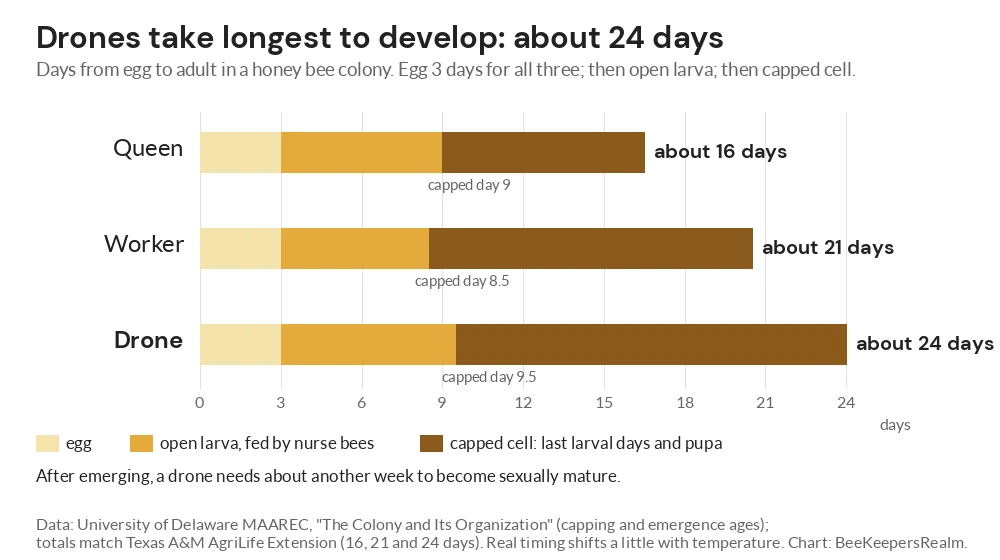
- Drones need about 24 days from egg to adult, against about 21 for workers and 16 for queens, plus about a week more to mature.
- They fly in the afternoon to drone congregation areas, where a queen mates with several drones in the air. Each successful drone dies instantly.
- Workers expel drones in the fall when nectar and pollen dry up; queenless colonies are the exception.
- Varroa mites breed better in drone brood: Penn State Extension reports a 6-fold increase in mites under drone cappings, which is why drone comb works as a mite trap.
Table of Contents
- What Is a Drone Bee?
- How to Identify a Drone Bee
- Drone Development: 24 Days From Egg to Adult
- What Do Drone Bees Do?
- Mating Flights and Drone Congregation Areas
- What Happens to a Drone After Mating?
- How Many Drone Bees Are in a Hive?
- Why Drones Are Kicked Out in the Fall
- Drone Brood and Varroa Mites
- Drone-Laying Queens and Laying Workers
- Frequently Asked Questions
- The Bottom Line
What Is a Drone Bee?
A drone bee is one of the three kinds of adult in a honey bee colony, alongside the single queen and thousands of female workers. The queen decides each bee’s sex as she lays. According to the Mid-Atlantic Apiculture Research and Extension Consortium (MAAREC), she releases stored sperm for an egg meant to become a worker or queen, but not when the egg goes into a larger drone-sized cell. Unfertilized eggs become drones.
That makes drones haploid. Texas A&M AgriLife Extension’s beekeeper training puts it in two lines: “Males are haploid (drones)” and “Females are diploid (queens and workers).” A drone has a mother but no father, though he does have a grandfather through her, and every sperm cell he makes carries the same genes. Our guide to honey bee genetics explains what that means for relatedness in the hive, and our overview of the honey bee and its three castes puts the drone in context.
How to Identify a Drone Bee
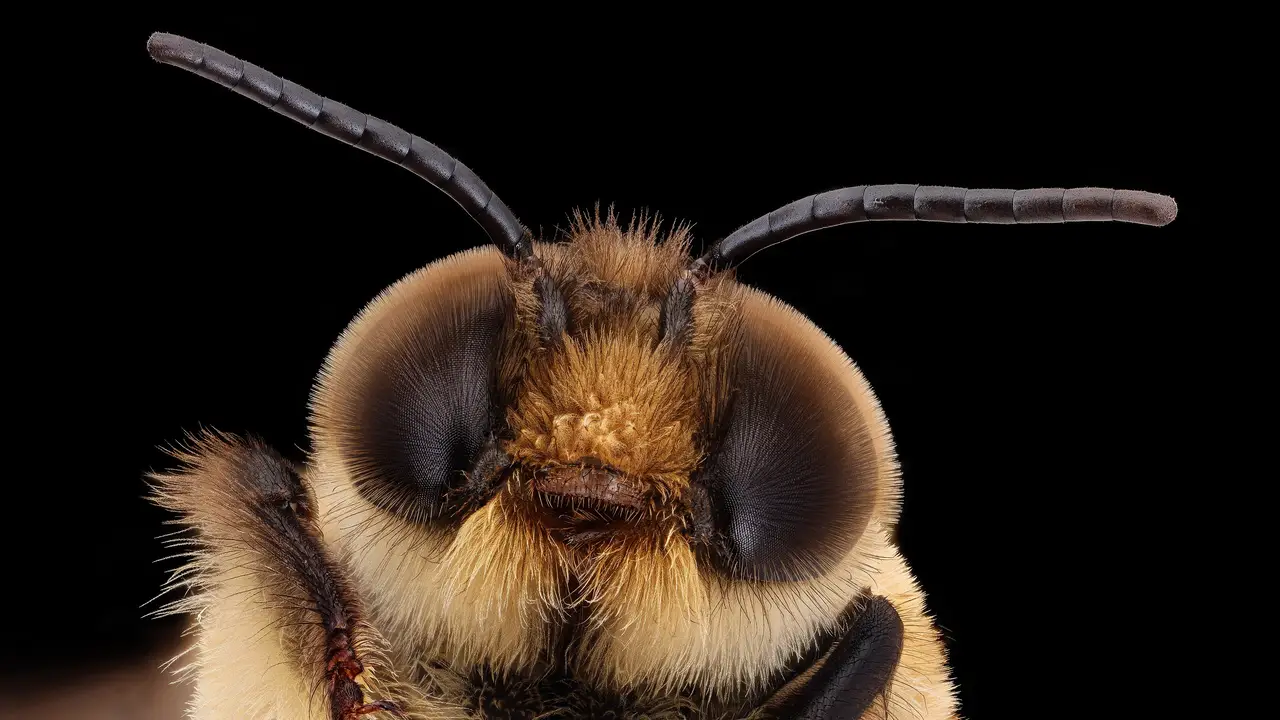
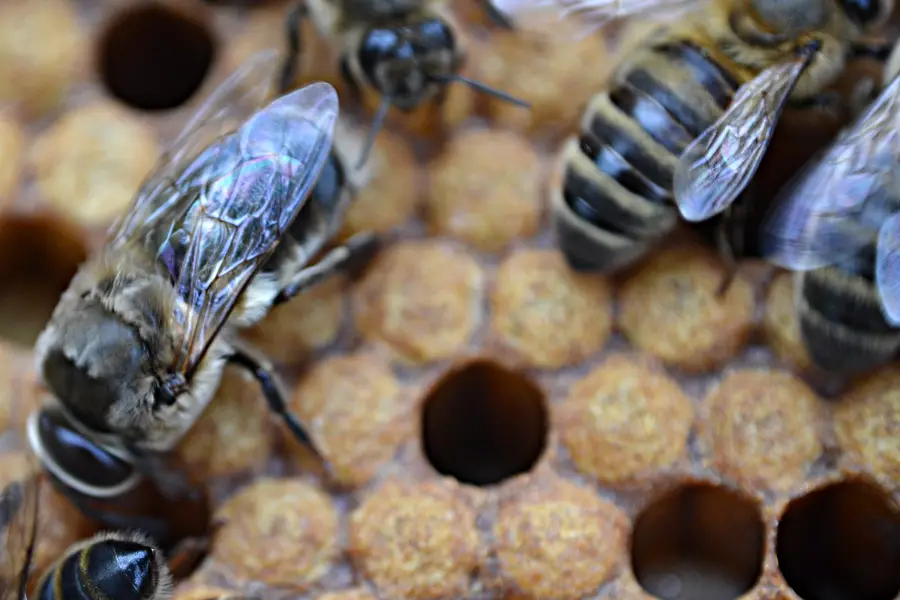
MAAREC describes drones as the largest bees in the colony, with a much larger head whose compound eyes meet at the top. Three checks settle it on a frame:
- Eyes. A drone’s eyes wrap over the top of his head and touch. A worker’s and a queen’s sit on the sides with a gap between them.
- Body shape. He is thicker and boxier than a worker, with a blunt, rounded rear end instead of a pointed one.
- No stinger, no tools. Drones have no stinger, pollen baskets or wax glands.
Drone vs. worker vs. queen at a glance
| Drone | Worker | Queen | |
|---|---|---|---|
| Sex and origin | Male, unfertilized egg | Female, fertilized egg | Female, fertilized egg fed royal jelly |
| Eyes | Very large, meet on top of the head | Smaller, on the sides | Smaller, on the sides |
| Body | Largest and bulkiest, blunt rear | Smallest | Longest abdomen |
| Stinger | None | Yes, barbed | Yes, curved, with fewer and shorter barbs |
| Egg to adult | About 24 days | About 21 days | About 16 days |
| Number per colony | Several hundred in late spring and summer | Thousands | Usually one |
| Main job | Mating with queens from other colonies | Every task in the hive and field | Laying eggs |
Development times are from Texas A&M AgriLife Extension; body features and numbers are from MAAREC. To find the one bee who lays all the eggs, see our queen bee guide.
Do drone bees sting?
No. A drone has no stinger, so he cannot sting you. If picked up, he may swing his abdomen around as if to sting, but it is a bluff.
Drone Development: 24 Days From Egg to Adult
Drones take the longest of the three castes to develop: 24 days, against 21 for workers and 16 for queens, according to Texas A&M AgriLife Extension. MAAREC gives the steps: the egg hatches after 3 days, the drone cell is capped when the larva is about 6½ days old, and the adult emerges about 14½ days after capping.
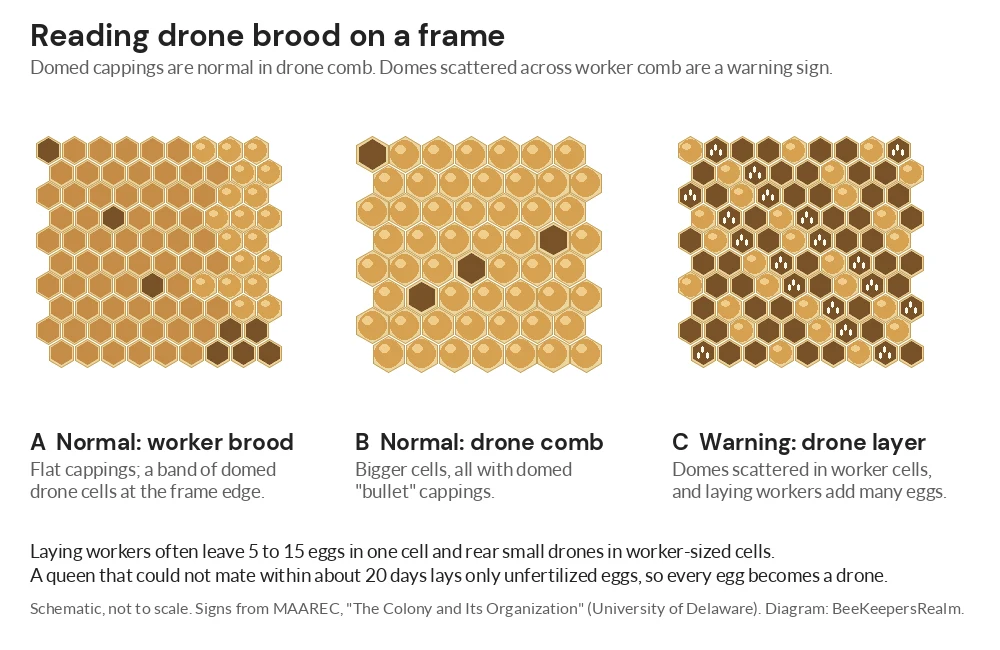
Drone cells are larger than worker cells, and their cappings bulge outward in a dome, often called bullet or popcorn cappings; worker brood is capped almost flat. Drone cells usually sit together in patches toward the bottom of a frame or at the edge of the brood nest.
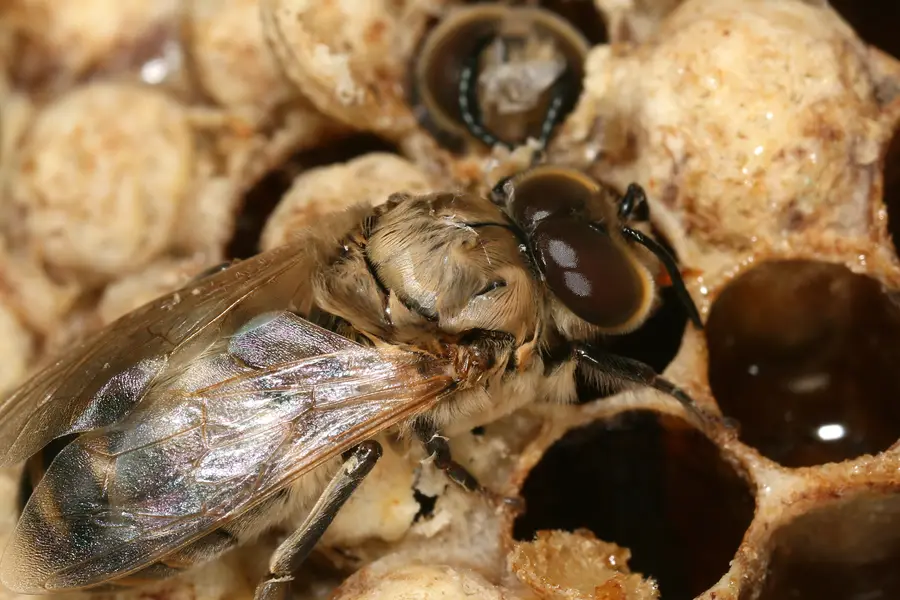
A new drone is not ready to mate. MAAREC says drones become sexually mature about a week after emerging and stay inside until about 8 days old. A 2019 Apidologie study that logged marked drones with an optical counter at the hive entrance found orientation flights at 6 to 9 days old, and 30-minute mating flights from 21 days in spring and 13 days in summer. See the honey bee life cycle, stage by stage for how this fits the brood cycle.
What Do Drone Bees Do?
Inside the hive, very little. MAAREC notes that drones perform no useful work for the hive, though their presence is believed to be important for normal colony functioning. They do not forage, build comb, nurse brood or guard the entrance, and they have never been observed taking food from flowers. Workers feed young drones; from about 4 days old a drone can also take honey from open cells. He is expensive: MAAREC estimates drones eat three times as much food as workers.
His real work is outside, in the afternoon, searching for virgin queens. Every other job falls to the females, as our guide to worker bee roles by age shows, and the colony-level picture of mating, eggs and swarming is in our guide to bee reproduction.
Do drones communicate?
Not the way workers do. Drones do not dance or recruit nestmates. Their key signal is one they receive: MAAREC explains that drones find and recognize a queen by her chemical odor, her pheromone. Workers, in turn, judge drones. A 2024 study in Behavioral Ecology and Sociobiology found that workers selectively evict small and immune-challenged drones.
Mating Flights and Drone Congregation Areas
Drones mate away from home, in fixed patches of airspace called drone congregation areas (DCAs), where males from many colonies gather and wait for queens. In the 2019 Apidologie study, most drone flights happened between 14:00 and 18:00; MAAREC gives noon to 4:00 p.m.
- Distance. A 2012 study of DCAs in Puerto Rico by Galindo-Cardona and colleagues notes that DCAs are typically 500 m to 5 km from the colony, with matings reported at 15 to 60 m above ground.
- Effort. A review by Rueppell, Fondrk and Page reports that drones make 2 to 4 flights a day on average and fly up to 7 km from their hive.
- Odds. A queen mates with seven to fifteen drones, according to MAAREC, while a colony rears thousands. Jaffé and Moritz (2009) found that drones caught at a DCA had more symmetrical wings than drones sampled at their hives, a sign that the flights weed out weaker males.
- Drifting. In the 2019 study only 50% of drones stayed with their own colony in spring and 80% in summer; the rest drifted to other hives.
“Compared to the queen or the workers, the biology of honey bee Apis mellifera L. drones is poorly known.”
Queens tend to fly farther than drones, which lowers the chance of mating with brothers. To find a DCA near your apiary, see our guide to evaluating drone congregation areas; the queen’s side is in virgin queen mating flights: timeline and weather.
What Happens to a Drone After Mating?
He dies. In MAAREC’s words, drones “die instantly upon mating.” Mating happens in flight: the drone everts his endophallus into the queen, the organ ruptures, and he falls away, leaving part of it behind. The next drone can still mate with her.
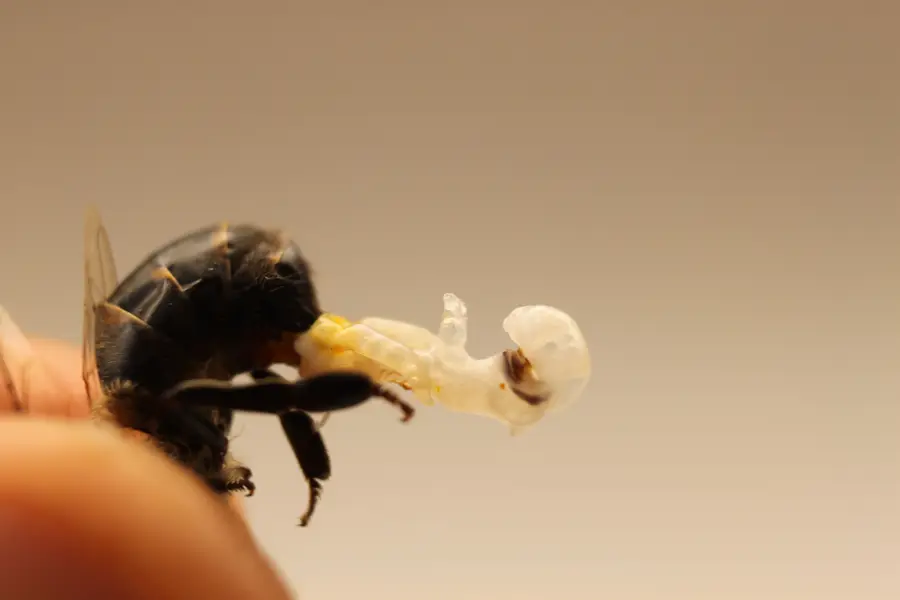
Most drones never mate. They return home to feed and fly again until age, accident or eviction ends them. The Rueppell, Fondrk and Page review says drones are believed to live at most about 60 days, with records of up to 90, and that published average lifespans range from 12 to 14 days up to 54 days.
How Many Drone Bees Are in a Hive?
MAAREC puts it at several hundred drones in a normal colony during late spring and summer, against thousands of workers and one queen. Numbers follow food: the authors of the 2024 eviction study note that drone production depends on climate but typically happens while colonies are bringing in resources.
| Season | Drones in the colony | What it means |
|---|---|---|
| Spring | Drone brood appears, then adult drones | The colony is growing and has food to spare |
| Late spring to summer | Peak: several hundred adults | Mating and swarming season |
| Fall | Falling fast as workers expel them | Forage is scarce; the colony saves its stores |
| Winter | Normally none | Drones in winter can mean the colony is queenless |
Why Drones Are Kicked Out in the Fall
Once the nectar flow ends, a drone is a mouth the colony cannot afford. Workers stop feeding drones and push them out of the entrance. Outside, a drone cannot feed himself from flowers, so he starves or dies of cold.
“When cold weather begins in the fall and pollen/nectar resources become scarce, drones usually are forced out into the cold and left to starve.”
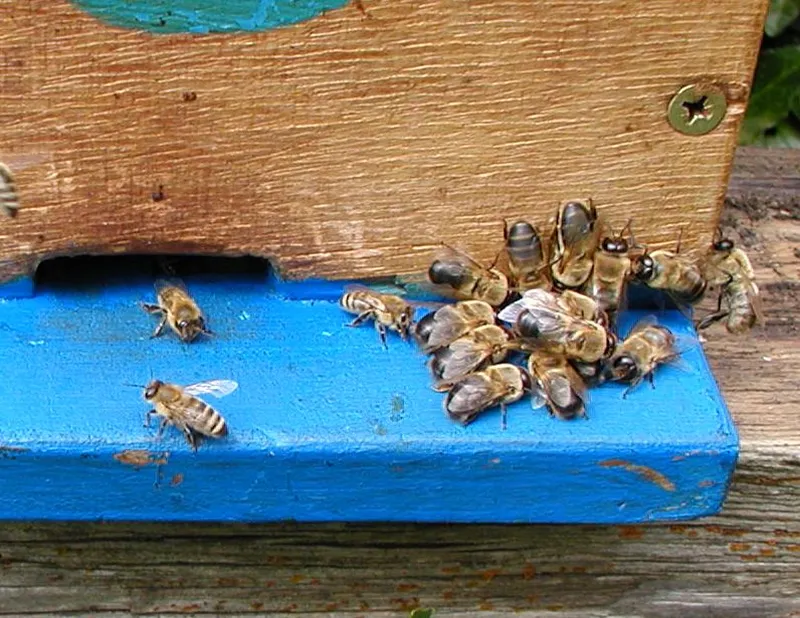
The 2024 study by Gilchrist and colleagues found workers removing small and immune-challenged drones overnight, so quality matters as well as season. The exception, per MAAREC, is a queenless colony, which lets drones stay indefinitely.
Drone Brood and Varroa Mites
Varroa mites reproduce inside capped brood cells, and they favor drone brood. Penn State Extension explains why: drone cells stay capped longer (15 days for drones versus 11 days for workers), so a mite produces 2.2 to 2.6 offspring per attempt in a drone cell but only 1.3 to 1.4 in a worker cell. Drone brood also stays attractive to mites for 40 to 50 hours, against 15 to 30 hours for worker brood.
“Together, these reproductive advantages of drone brood manifest as a 6-fold increase in mites found under the cappings of drone cells than under worker cells.”
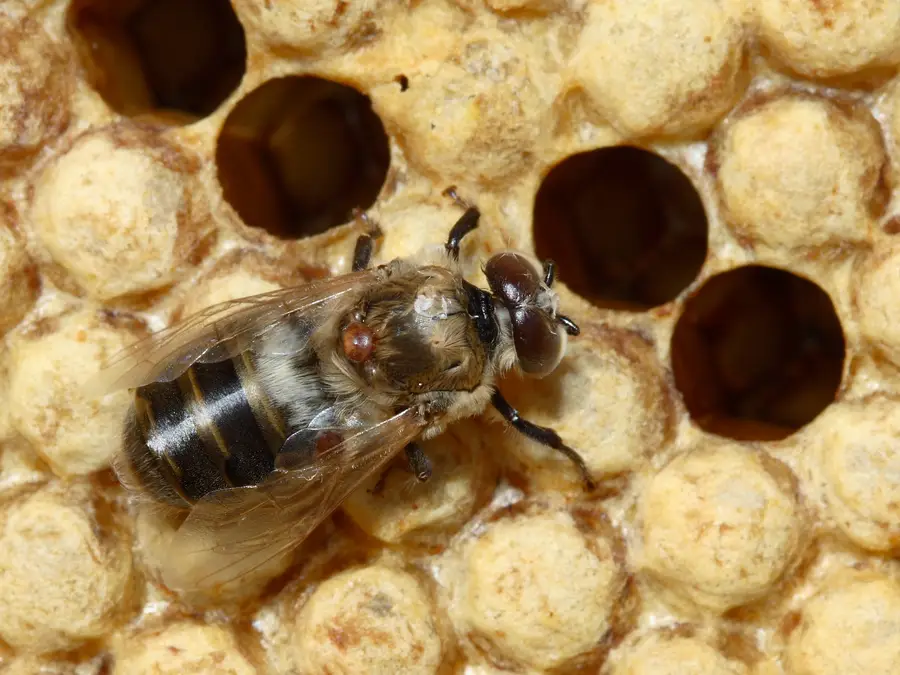
Beekeepers turn that preference into a trap: a frame of drone comb draws in mites, and removing it once capped, before the drones emerge, takes the mites with it. Penn State treats it as one mechanical control among several, so keep testing mite levels. Our guide to drone brood harvesting for mite control covers frames and timing, and the varroa mite life cycle explains what happens inside the cell.
Drone-Laying Queens and Laying Workers
A few drones are normal; a brood nest full of them is not. Two problems produce mostly drones, and both show up as domed cappings where flat worker cappings should be.
- A drone-laying queen. MAAREC notes that if bad weather delays a young queen’s mating for more than 20 days, she can only lay unfertilized eggs, all of which become drones. Our guide to what causes a queen to become drone laying covers the other causes and the fix.
- Laying workers. In a colony queenless for a week or more, some workers start laying. MAAREC lists the signs: five to fifteen eggs per cell, eggs on the cell walls instead of the base, and small drones reared in worker-sized cells. See signs of laying workers in a queenless hive.
Frequently Asked Questions
What does a drone bee do all day?
Mostly he waits. Drones spend the morning in the hive, being fed or taking honey, then fly to drone congregation areas in the afternoon, coming back to refuel between flights.
Do drone bees sting you?
No. Drones have no stinger. Only the females, workers and queen, have one.
What does it mean if you see a drone bee?
In spring or summer it usually means a colony is strong enough to raise males and that mating and swarming season has started. Drones in winter, or drone brood scattered through worker comb, point to a queen problem.
What happens to drone bees after mating?
They die instantly. The endophallus ruptures and stays in the queen, and the drone falls away.
Do drone bees sleep?
They spend most of their time resting in the hive. Carolina Honeybees, a beekeeping education site, describes drones as sleeping or resting while waiting for a warm afternoon to fly.
What is a drone bee hive?
There is no separate hive of drones; they live in ordinary colonies with the queen and workers. Beekeepers sometimes call a colony producing almost only drones a “drone layer,” which means a drone-laying queen or laying workers.
How long do drone bees live?
Usually a few weeks. Researchers believe drones live at most about 60 days, with records of up to 90, and reported averages range from about 12 to 54 days.
What do drone bees eat?
Food from the colony’s stores. Workers feed young drones, and from about 4 days old drones can take honey from open cells. They never collect nectar or pollen themselves.
The Bottom Line
Drones are not lazy workers; they are how a colony sends its genes to other colonies. A few hundred in summer is a sign of a strong hive. Use drone brood as a mite trap if it suits your management, and treat domed cappings scattered through worker comb as a prompt to check your queen.
Image credits: Featured photo: face of a drone honey bee, USGS Bee Inventory and Monitoring Lab, public domain, cropped. Development chart and brood diagram: BeeKeepersRealm.