Reviewed by Thomas B. · Last Updated October 6, 2026 · How we review
Bee reproduction works on two levels. Every bee in a honey bee colony comes from one queen, who mates in flight with a dozen or more drones in her first weeks, stores their sperm for life and decides egg by egg whether to fertilize it: fertilized eggs become females (workers or queens), unfertilized eggs become males (drones). The colony itself reproduces by swarming, when the old queen leaves with about half of the bees.
Below are both levels, with the timings that matter in a hive. For egg, larva and pupa stages in more depth, see our honey bee life cycle guide.
Key Takeaways
- Only the queen lays fertilized eggs. She mates on one to six flights over a few days, with 6 to 26 drones (12 to 14 on average), and never mates again.
- Fertilized eggs (32 chromosomes) become females; unfertilized eggs (16) become drones, so a drone has a mother but no father.
- A queen develops in about 16 days, a worker in 21 and a drone in 24.
- From the egg in a queen cell to that queen’s first adult daughters takes about seven weeks, roughly day 47 to 51 by our arithmetic.
- Only swarming (or a beekeeper’s split) multiplies colonies. Supersedure and emergency cells just replace a queen.
Table of Contents
- Who Reproduces in a Honey Bee Colony
- How Honey Bees Mate
- How a Queen Stores Sperm for Years
- How the Queen Sets Each Egg’s Sex
- Development Days by Caste
- The Reproduction Clock: Queen Cell to New Workers
- How Whole Colonies Reproduce
- Bumble Bees and Solitary Bees
- Frequently Asked Questions
Who Reproduces in a Honey Bee Colony
Only two of a colony’s three kinds of adult bee normally breed: one queen and, in late spring and summer, several hundred drones. The thousands of female workers never mate.
| Bee | Develops from | Role in reproduction |
|---|---|---|
| Queen | Fertilized egg, fed royal jelly throughout | Lays every egg; mates only in her first weeks |
| Drone | Unfertilized egg | Mates with queens from other colonies, once, and dies |
| Worker | Fertilized egg, switched to worker jelly | Rears brood; if queenless, can lay only drone eggs |
The queen. Penn State Extension says a quality queen can lay over 2,000 eggs a day at peak; the Mid-Atlantic Apiculture Research and Extension Consortium (MAAREC) gives up to 1,500. Her pheromones stop workers from developing ovaries or rearing new queens. Queens can live seven or more years, Penn State notes, but laying usually declines after the first year or two.
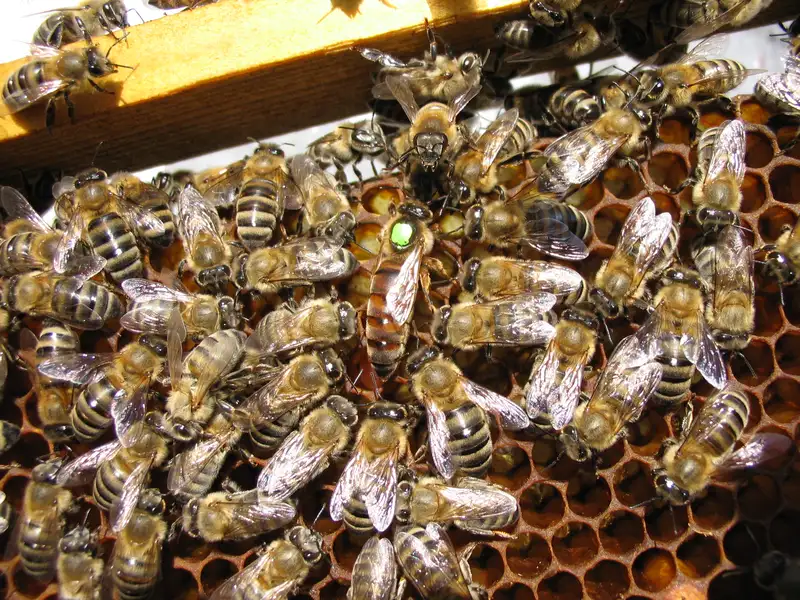
Drones. According to MAAREC’s colony guide, drones start orientation flights at about 8 days old, are sexually mature about a week after emerging, fly mostly between noon and 4 p.m., and are pushed out to starve when fall forage ends.
Workers. Their ovaries stay undeveloped while a queen and brood are present. After a week or more without a queen, some start laying, but their unfertilized eggs make only small drones, often several to a cell.
How Honey Bees Mate
Mating happens outside the hive. A new virgin queen spends five to eight days in the hive while her reproductive organs mature (Penn State), takes short orientation flights, then flies out on warm afternoons.
Drone congregation areas
Drones from many colonies gather in drone congregation areas (DCAs), patches of airspace used year after year. A 2014 review in Insects by Heidinger and colleagues cites 8,000 to 15,000 drones present at once. MAAREC says the queen mates above 20 feet after flying some distance from home, which lowers the odds of mating with her brothers.
What happens in the air
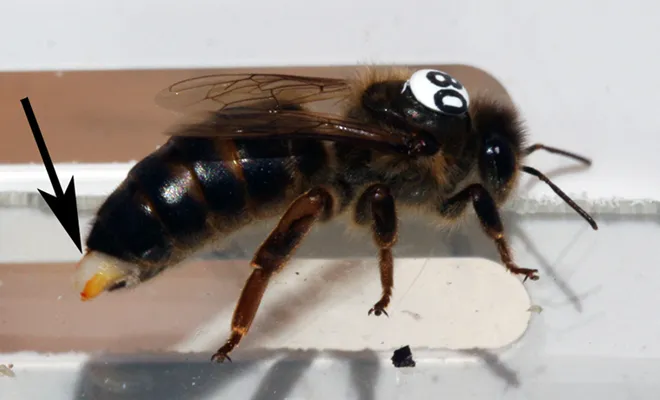
A drone mounts the queen in flight and everts his endophallus into her sting chamber. Part of it tears away and stays in her as a mating sign, and the drone dies. A queen that returns with a mating sign has mated at least once, not necessarily for the last time.
How many drones and how many flights
Several popular pages say a queen takes one mating flight. The Heidinger review summarizes earlier studies as one to six flights over a couple of days and 6 to 26 drones per queen, averaging 12 to 14. In the authors’ own RFID tracking of 64 queens in Germany, queens flew on about two days on average, 82% of flights left between 1 and 4 p.m., and flights averaged about 18 minutes.
MAAREC adds a deadline: a queen kept in by bad weather for more than 20 days can no longer mate and lays only drone eggs. Our virgin queen mating flight timeline covers weather and signs.
In this University of Florida Beekeeping Academy episode, Dr. Jamie Ellis gives an overview of honey bee mating biology.
The 16-minute video covers why mating happens away from the nest, how drones find congregation areas, the queen’s flights and the mating act, why she mates with many drones, and how she stores the sperm.
How a Queen Stores Sperm for Years
Semen from all her drones first fills the queen’s oviducts, but only a small fraction ends up in the spermatheca, a small storage sac in her abdomen. The figure usually quoted is 5 to 6 million stored sperm.
A US measurement came in lower. A North Carolina State University team bought 80 commercial queens from large California breeders and found an average of 4.37 million stored sperm, 83.7% of it viable, with an average effective paternity frequency (a genetic estimate of how many fathers the workers have) of 17.0 (Tarpy et al., Journal of Economic Entomology, 2012).
“Honey bee queens mate with multiple males, which increases the total genetic diversity within colonies and has been shown to confer numerous benefits for colony health and productivity.”
A mated queen starts laying two to four days after mating (MAAREC gives 48 hours in one guide, three to four days in another). That stock is all she will ever have; as it runs low she lays more drone eggs in worker cells.
How the Queen Sets Each Egg’s Sex
Honey bees are haplodiploid. As each egg passes down her oviduct, the queen releases a few sperm from the spermatheca or does not. Per MAAREC, she fertilizes eggs laid in worker and queen cells and not those laid in the larger drone cells. A fertilized egg has two sets of 16 chromosomes and becomes a female; diet then decides worker or queen. An unfertilized egg has one set, all from the queen, and becomes a drone.
“Thus a female bee has a mother and a father while a male bee has only a mother.”
The switch is the csd (complementary sex determiner) gene, which has more than 20 versions. Two different versions make a female, one version a male. When a queen mates with a related drone, some fertilized eggs get two identical copies and become diploid drones, which workers remove as larvae, leaving a shotgun brood pattern.
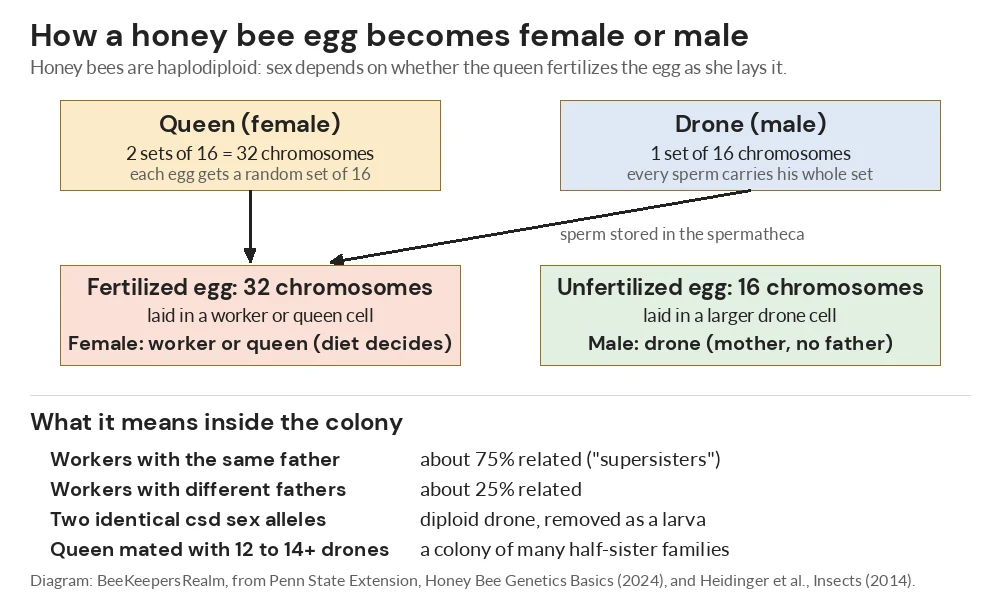
Workers with the same father share about 75% of their genes (“supersisters”); workers with different fathers share about 25%. Our bee genetics guide covers what this means for breeding.
Development Days by Caste
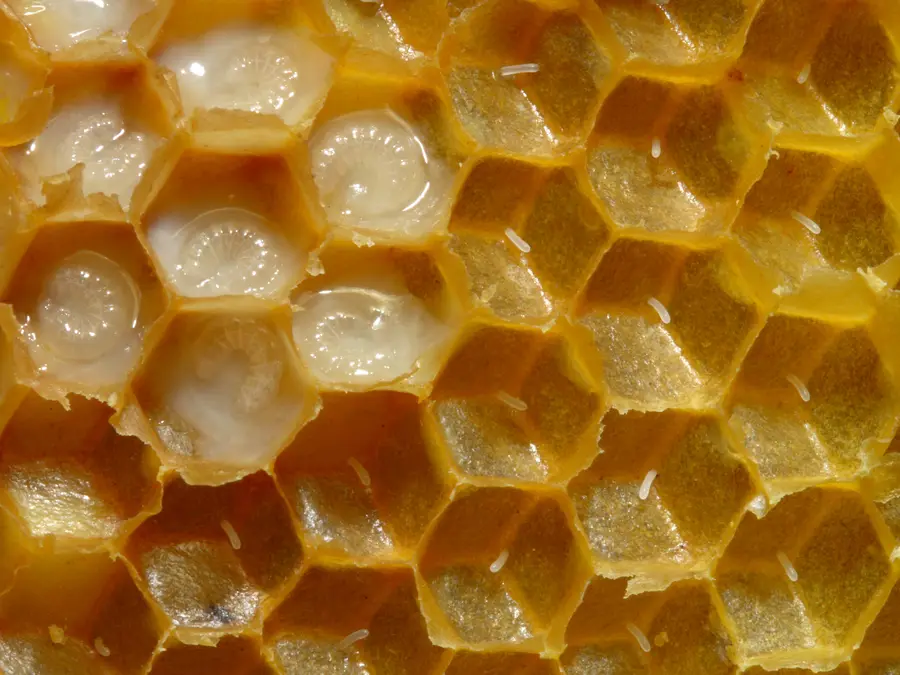
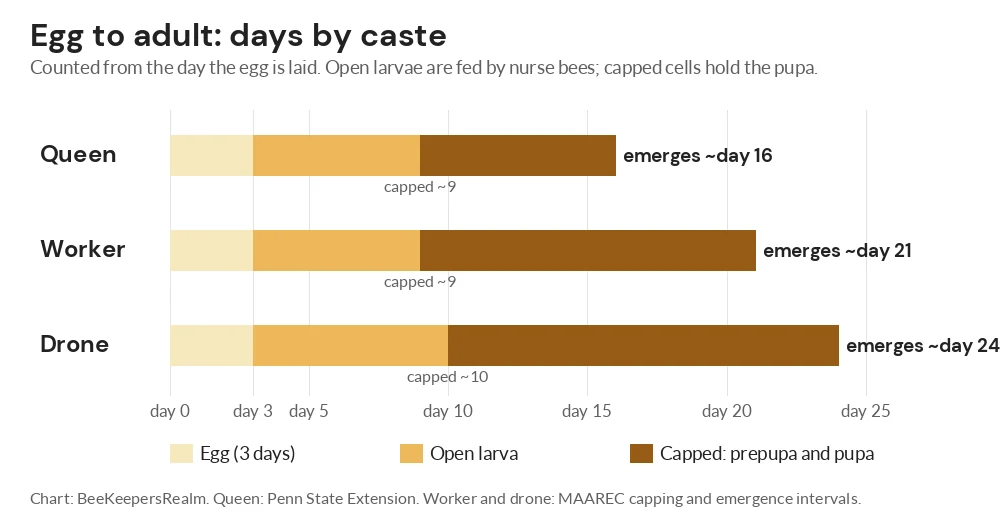
Every egg hatches after about three days. Penn State says all larvae get royal jelly for their first three days; worker larvae then switch to worker jelly, a mix of royal jelly, pollen and nectar, while queen larvae stay on royal jelly. Any female larva under three days old can still become a queen, and the best queens come from larvae under a day old.
| Caste | Egg hatches | Cell capped | Adult emerges |
|---|---|---|---|
| Queen | Day 3 | About day 9 | About day 16 |
| Worker | Day 3 | About day 9 | About day 21 |
| Drone | Day 3 | About day 10 | About day 24 |
Days count from egg laying. Sources: Penn State (queen) and MAAREC (worker, drone).
The Reproduction Clock: Queen Cell to New Workers
Chained together, these figures show how long a colony waits for new bees after starting a queen, which is why swarmed colonies and splits shrink for weeks. This is our arithmetic from the sources named, not a published figure.
| Step | Day (egg laid in queen cell = day 0) | Basis |
|---|---|---|
| Queen cell capped | About 9 | Penn State |
| Virgin queen emerges | About 16 | Penn State |
| Mating flights begin | About 21 to 24 | 5 to 8 days after emerging (Penn State) |
| First eggs | About 26 to 30 | 10 to 14 days after emerging (maturing, flights, then a 2 to 4 day laying delay) |
| First worker brood capped | About 35 to 39 | Worker capping at about day 9 |
| First daughter workers emerge | About 47 to 51 | 21-day worker development |
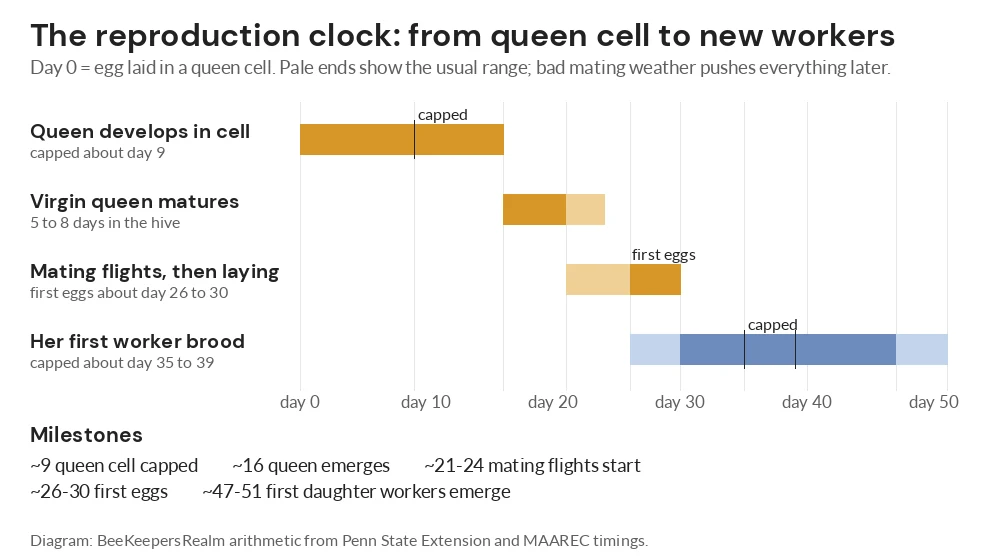
That is about seven weeks with no new workers while old ones keep dying. Our guide to splitting hives uses the same arithmetic to time splits.
How Whole Colonies Reproduce
A colony multiplies by swarming. In spring a crowded colony raises extra drones, then queen cells, usually along the bottom edges of combs. MAAREC describes what happens when the first new queen is nearly ready to emerge, before the main nectar flow:
“The old queen and about half of the bees will rush en masse out the entrance.”
The swarm clusters on a branch while scouts pick a new home. In the old nest, the first virgin queen out kills her rivals, mates about a week later, and the clock above restarts. MAAREC puts swarm season in the central, southern and western states from March to June. See why bees swarm and how to stop it.
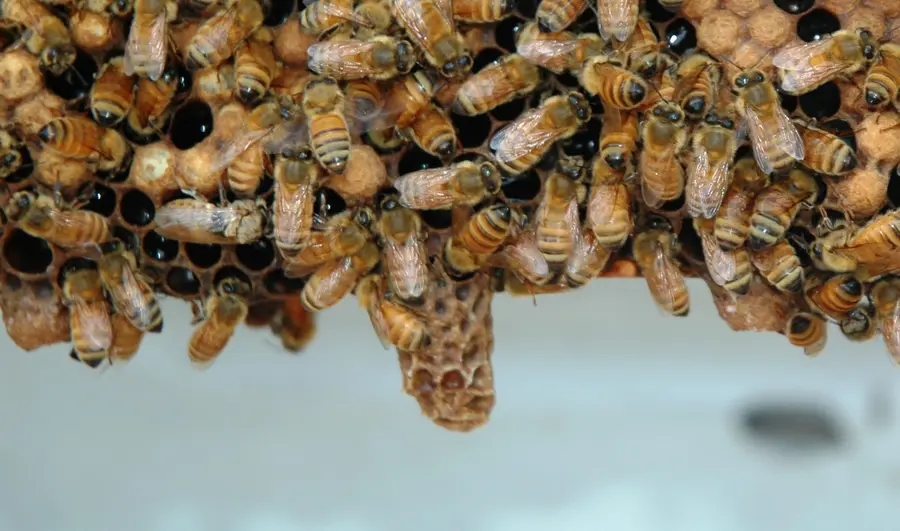
Not every queen cell means a new colony. MAAREC describes three reasons bees rear queens:
| Reason | Usual cell position | New colony? |
|---|---|---|
| Swarming | Bottom margins of combs or gaps in the brood comb | Yes |
| Supersedure (failing queen) | Comb face | No |
| Emergency (queen lost) | Worker cells on the comb face, rebuilt to hang down | No |
See swarm cells vs supersedure cells and how a hive reproduces through swarming and supersedure.
Bumble Bees and Solitary Bees
- Bumble bees have annual colonies. The University of Wisconsin–Madison’s bumble bee program describes queens founding nests alone in spring; by late summer the colony raises males and new queens, which leave and mate. Everyone else dies, and only the mated new queens overwinter.
- Solitary bees have no workers or queens. Each female mates, then builds and provisions her own nest cells; see the solitary bee life cycle.
- The Cape honey bee of South Africa is the honey bee exception: its workers can lay female eggs without mating. See our Cape honey bee profile.
Frequently Asked Questions
Do bees reproduce sexually or asexually?
Both. Females come from fertilized eggs. Drones come from unfertilized eggs, a form of asexual reproduction called parthenogenesis.
How many times does a queen bee mate?
Only in one short period early in life, but on one to six flights with about 12 to 14 drones on average. She does not mate again once she is laying.
How does a bee become a queen?
Workers raise a female larva under about three days old in a queen cell and feed her royal jelly throughout. She emerges about 16 days after the egg was laid.
Can worker bees lay eggs?
Yes, in a colony that has been queenless for a while, but the eggs are unfertilized and become drones. Only Cape honey bee workers can produce females.
How long does a queen’s stored sperm last?
Usually for her productive life, about two to three years by MAAREC’s estimate. When it runs out she lays only drone eggs.
The Bottom Line
A few days of mating flights set up a queen’s whole laying life, and every new queen costs a colony about seven weeks before her daughters emerge. Plan requeening, splits and swarm control around that clock.