Reviewed by Thomas B. · Last Updated September 22, 2026 · How we review
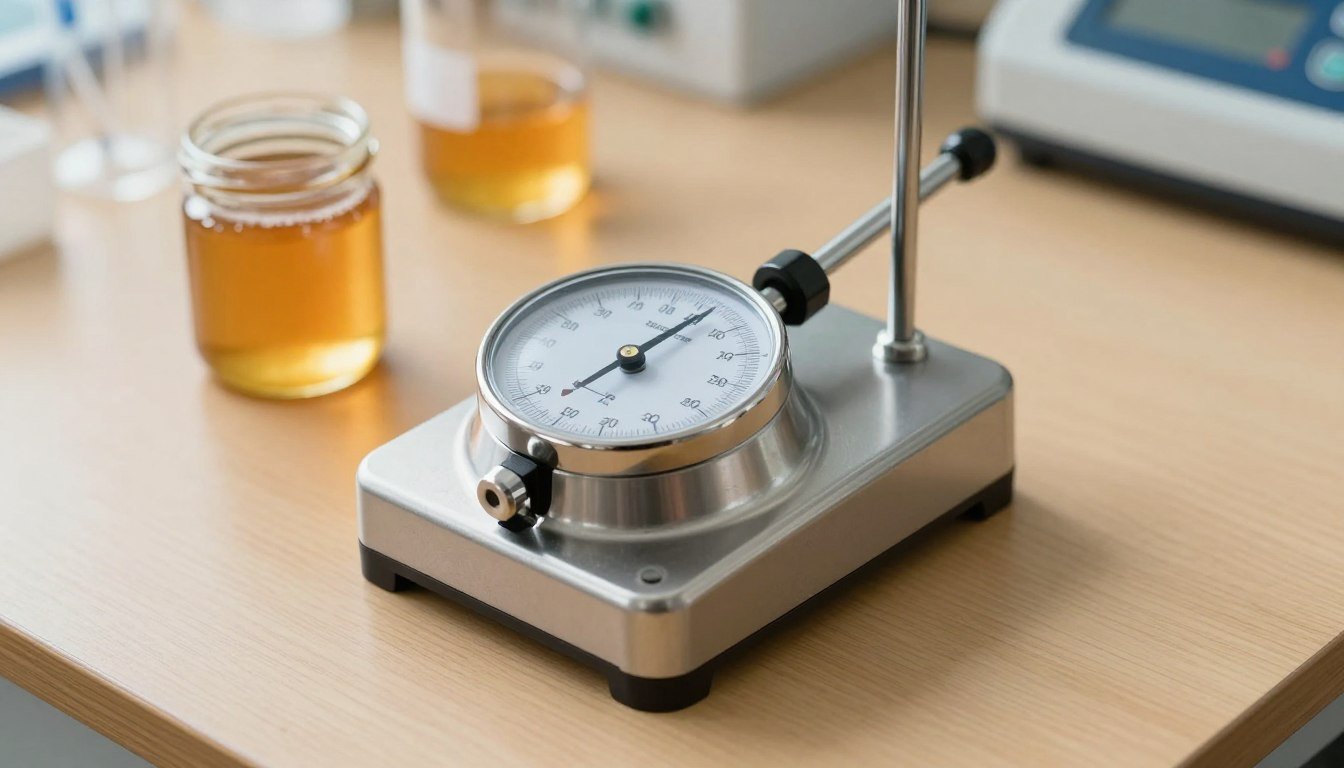
A honey refractometer measures moisture by reading how far light bends through a thin film of honey, and a result you can act on depends on three things in order: calibrating the instrument against a known standard, spreading a bubble-free sample across a clean prism, and correcting the reading back to 20 °C (68 °F) when the honey is not at that temperature. The USDA determines soluble solids in extracted honey by refractometer at 20 °C, caps U.S. Grade A and Grade B at 18.6% moisture, and allows up to 20.0% for Grade C. Below 17.1% moisture, honey will not ferment within a year no matter how many yeast spores it carries.
Key Takeaways
- Calibrate first, every session: glycerin reads just below 73 Brix, extra-virgin olive oil reads about 71.5 Brix. An uncalibrated instrument produces a confident wrong number.
- The USDA reference temperature is 20 °C (68 °F). Above it, add 0.00023 to the refractive index per °C (0.00013 per °F); below it, subtract.
- A cold sample read without correction looks drier than it is — the one direction a beekeeper cannot afford to get wrong. A warm sample errs the safe way, looking wetter.
- 18.6% moisture is the U.S. Grade A/B ceiling; 17.1% is the point below which fermentation will not occur within a year.
- On a honey refractometer’s Brix scale, moisture is roughly 100 minus the Brix figure, which is exactly how the USDA soluble-solids table is built.
Table of Contents
One-line note: a moisture reading is only ever as good as the calibration and the sample handling behind it — fermentation risk follows directly from this number, so treat an uncalibrated or badly sampled reading as no reading at all.
What a Honey Refractometer Actually Measures
The instrument does not detect water. It measures refractive index — the angle at which light is bent by the sample — and the eyepiece scale converts that angle into a percentage. Dissolved sugars raise the refractive index; water lowers it. The USDA’s standards for grades of extracted honey tabulate that relationship from 1.4817 (21.9% moisture) to 1.5044 (13.0% moisture), and require the determination be made at 20 °C. Everything below exists to get your instrument and your sample onto that table honestly. For where the figure sits in the wider workflow, see honey processing and quality standards.
Choosing a Refractometer: Scale, ATC, and Accuracy
- Scale. A honey-specific analogue unit carries a moisture scale (roughly 12–27%) beside a Brix scale. A general-purpose Brix refractometer works but needs converting; a wine or coolant refractometer does not, because the range is wrong.
- ATC. Automatic temperature compensation shifts the scale for ambient temperature, and it is the most over-trusted feature on the instrument: it works within a stated band, commonly about 10–35 °C, and it compensates for the instrument’s temperature, not for a jar carried in from a cold shed ten minutes ago.
- Resolution. Analogue honey scales are marked in about 0.2% steps; digital units resolve to 0.1%. Neither means anything once calibration has drifted.
Our comparison of the best honey refractometers for beekeepers covers the analogue-versus-digital trade-off at apiary scale.
How to Calibrate a Honey Refractometer
Betterbee’s instrument documentation is blunt about the trigger conditions: recalibrate once or twice a season, and again whenever the honey-room temperature moves more than five degrees from where it sat at the last calibration. On an analogue unit:
- Wipe the prism with a damp lint-free cloth and dry it. Residue from the last reading will bias this one.
- Apply two or three drops of reference fluid, let it spread across the whole glass, and close the cover without trapping bubbles.
- Hold the eyepiece toward a bright window and focus until the blue-white boundary is sharp.
- Turn the adjustment screw until the boundary sits on the reference value — clockwise lowers the line, counter-clockwise raises it — then re-check and clean the prism.
Two reference fluids are in common use. Glycerin at 99.5% anhydrous should put the line just below 73 Brix. Extra-virgin olive oil is the field substitute, defensible because its refractive index is defined rather than guessed.
Olive oil is defined by UN FAO to have refractive index of 1.4677 to 1.4705. That equals 71 to 72 degrees Brix. You could also calibrate using olive oil to 71.5 and be close.
Note the phrase "and be close." Olive oil spans a full degree of Brix, so 71.5 is a midpoint, not a certified standard. Use fresh oil, and if you sell graded honey verify against glycerin or a purchased standard at least once a season.
Taking a Reading You Can Trust
Most bad readings are sampling failures, not instrument failures.
- Equalise the temperature. Leave the honey and the refractometer in the same room for at least an hour. This one step removes most of the error described in the next section.
- Homogenise, then use a thin film. Water migrates toward the surface of a settling tank, so a reading skimmed off the top can run close to a point wetter than the bucket average. Stir, draw from mid-depth, and spread two or three drops across the whole prism — more honey only traps bubbles, and a bubble reads as a blurred boundary.
- Deal with crystals. The liquid fraction around crystals is wetter than the honey as a whole, so a partly granulated sample is meaningless. The USDA liquefies crystallised honey at about 54.4 °C (130 °F) and cools it to 20 °C before grading; at apiary scale see how to reliquefy crystallised honey without damage and avoiding overheating during extraction.
- Read more than once. One reading is a data point, not a lot average. For sampling frames on the hive before you pull supers, see judging ripe honey moisture on the frame.
Temperature Correction: The USDA Numbers
Refractive index falls as temperature rises, so a reading taken away from 20 °C is not on the USDA table until you move it there. The correction sits in the footnote to Table III of the grade standard.
If refractometer reading is made at temperature above 20° C (68° F) add 0.00023 to the refractive index for each degree C, or 0.00013 for each degree F. If made below 20° C (68° F), subtract correction.
Work the arithmetic through and the consequence is clear. Read a raw refractive index of 1.4890 in a 30 °C extracting room: straight off the table that is 19.0% moisture. Ten degrees above reference adds 0.0023, giving 1.4913, which the table puts at 17.9%. The honey is drier than the uncorrected reading claimed — the safe direction of error.
The dangerous case is the opposite one. Below 20 °C the correction is subtracted, so an uncorrected reading understates true moisture. Honey carried in from a 10 °C outbuilding and read immediately can look roughly a point drier than it is — enough to move a batch from "bottle it" to "this will ferment."
| Temperature when read | Correction to refractive index | Approximate moisture shift | Error if skipped |
|---|---|---|---|
| 10 °C / 50 °F | Subtract 0.0023 | About +1.0 point | Looks a point too dry — unsafe |
| 15 °C / 59 °F | Subtract 0.00115 | About +0.5 point | Looks too dry — unsafe |
| 20 °C / 68 °F | None — reference temperature | None | None |
| 25 °C / 77 °F | Add 0.00115 | About −0.5 point | Looks too wet — conservative |
| 30 °C / 86 °F | Add 0.0023 | About −1.0 point | Looks too wet — conservative |
Those shifts come from the USDA table itself: across the working range, 0.00023 of refractive index is worth roughly 0.1 percentage points of moisture, and the same magnitude applies if your scale reports moisture directly. ATC does this inside its compensation band, which is exactly why honey and instrument must be at the same temperature — it can only compensate for the temperature it senses. Room conditions also act on the honey itself, as covered in humidity effects on honey curing.
Interpreting the Number You Get
Two independent thresholds govern the reading: the USDA grade ceilings, and the moisture level at which osmophilic yeasts can grow, established in the USDA’s own honey composition research.
Honey with less than 17.1 percent water will not ferment in a year, irrespective of the yeast count.
| Corrected reading | What it means | What to do |
|---|---|---|
| Below 15.5% | Unusually dry. No fermentation risk. | Bottle, but expect faster granulation. |
| 15.5–17.0% | The comfortable window: inside every grade, below the fermentation floor. | Extract, bottle, store normally. |
| 17.1–18.0% | Safe for a year only at 1,000 yeast spores per gram or fewer. | Bottle, store cool, rotate stock rather than holding it. |
| 18.1–18.6% | Within U.S. Grade A and B (18.6% ceiling), but tolerates only about 10 spores per gram. | Dry further, or sell fast and store below about 10 °C (50 °F). |
| 18.7–20.0% | Fails Grade A and B on the analytical factor; Grade C only (20.0% ceiling). | Dry before bottling for retail. |
| Above 20.0% | Below U.S. Grade C. Expect fermentation. | Do not shelf-bottle. Dry it, or divert to mead or baking. |
If the honey is already extracted and you are deciding whether it can go into jars, our guide to refractometer readings that mean don’t bottle yet turns each band into a bottling decision and covers blending and drying a wet batch.
Granulation shifts this picture, because crystallising sugar concentrates water into the remaining liquid fraction and can push a borderline jar over the line after bottling — see why honey crystallises and how to fix it. A high reading before extraction is easy: leave the supers on, because bees dry nectar better than any dehumidifier. After extraction it takes warm, moving, dry air, and if a batch has begun to ferment, whether fermented honey can be saved covers what is recoverable. Without an instrument, the sensory screens in how to test honey moisture without an instrument flag an obviously wet batch but never give you a gradeable number.
Converting Brix to Moisture
If your instrument carries only a Brix scale, the conversion is simpler than most sources make it sound. Brix reports percent soluble solids, and the USDA table is built on exactly that quantity, so moisture is the remainder: 81.4% soluble solids is 18.6% moisture, 83.0% is 17.0%, 85.0% is 15.0%. Subtract the Brix figure from 100.
Two caveats. Brix is calibrated for sucrose while honey is mostly fructose and glucose, so a general-purpose Brix unit approximates where a honey-scaled one reads directly. And the conversion assumes the reading is already temperature-corrected; converting an uncorrected number just carries the error across.
Frequently Asked Questions
What should honey read on a refractometer?
Aim for 15.5–18.0% moisture on a corrected reading. The USDA caps U.S. Grade A and B extracted honey at 18.6% moisture and Grade C at 20.0%. Below 17.1%, honey will not ferment within a year regardless of yeast count, which makes that figure the safest working target.
How do I convert Brix to honey moisture?
Subtract the Brix reading from 100. A honey refractometer’s Brix scale reports percent soluble solids, and the USDA grade table pairs 81.4% soluble solids with 18.6% moisture on exactly that basis. Correct for temperature before converting, or the error simply carries over.
How often should I calibrate my honey refractometer?
Verify calibration at the start of every extracting session, and recalibrate whenever the honey-room temperature has moved more than about five degrees since the last adjustment. Instrument documentation typically specifies once or twice per season as a minimum, with temperature change as the trigger for anything more frequent.
Can I calibrate a honey refractometer with olive oil?
Yes, within limits. Extra-virgin olive oil has a defined refractive index of 1.4677 to 1.4705, equal to about 71 to 72 Brix, so setting the boundary line at 71.5 gets you close. Use fresh oil, and verify against glycerin or a purchased standard if you sell graded honey.
Does ATC remove the need for temperature correction?
Not entirely. Automatic temperature compensation adjusts within a stated band, commonly around 10–35 °C, and it responds to the instrument’s own temperature. If the honey and the refractometer are not equalised, ATC compensates for the wrong temperature. Give both an hour in the same room first.
Can I test honey straight from a frame?
Yes, but sample deliberately. Scrape honey from capped and uncapped areas into a clean container rather than pressing the prism against comb, and avoid wax fragments and bubbles. Uncapped cells hold noticeably more water, so a mixed scrape will read wetter than the extractable crop.
We go deeper into this topic in our post on honey ph vs acidity explained.