Reviewed by Daniel M. · Last Updated September 23, 2026 · How we review
No kitchen test can give you an exact honey moisture reading, but two methods without a refractometer are genuinely useful. The first is judging ripeness on the frame before you extract. The second is a careful density check with a kitchen scale and a jar, which can tell roughly 17% honey from roughly 20% honey. The popular pour, bubble, match and bread tests are much less reliable than they look. Use them only as rough hints.
Key Takeaways
- Aim for 18.6% water or less, the USDA limit for Grade A. By USDA’s classic fermentation table, honey under 17.1% will not ferment within a year regardless of yeast count.
- Best field check: harvest frames that are mostly capped and pass the shake test, meaning no nectar flicks out when you shake the frame sharply.
- Best jar check: compare the weight of a jar filled brim-full with honey to the same jar filled with water. Each 1% of extra water lowers specific gravity by about 0.007.
- Flow and bubble tests mostly measure temperature and floral source, not water.
- If you sell honey, a refractometer is cheap insurance. These methods are triage.
Table of Contents
What Moisture Level You Are Aiming For
Honey keeps because there is too little free water for yeasts to grow. Add a percent or two of water and that protection starts to fail. The thresholds below come from USDA’s Beekeeping in the United States (Agriculture Handbook 335) and the U.S. grade standards for extracted honey:
| Water content | Fermentation risk (USDA AH 335) | Practical meaning |
|---|---|---|
| Under 17.1% | Will not ferment within a year, regardless of yeast count | Very safe |
| 17.1 to 18% | Safe if yeast count is 1,000 per gram or less | Normal, stable honey |
| 18.1 to 18.6% | Safe only with 10 or fewer yeasts per gram | Still within U.S. Grade A, but watch it |
| 18.7 to 19% | Safe only with 10 or fewer yeasts per gram | Outside Grade A, so dry, blend or use soon |
| Over 19% | Can ferment with as little as one yeast per gram | Treat as unstable |
Our guide to target moisture for ripe honey goes further into these numbers.
No-Instrument Methods, Ranked
This is our honest ranking of the no-refractometer methods beekeepers pass around:
| Method | What it actually detects | Reliability |
|---|---|---|
| Kitchen-scale density test | Specific gravity, which is directly tied to water content | Good, about plus or minus 1% if done carefully |
| Frame shake test | Clearly unripe nectar in uncapped cells | Good at catching very wet frames, blind to borderline honey |
| Capping percentage | Whether bees consider the honey finished | Fair. Capped honey can still be wet in humid weather |
| Pour, drizzle, ribbon, thumb or bead test | Viscosity, mostly driven by temperature | Poor |
| Jar-flip bubble test | Viscosity again | Poor, often misread |
| Match, bread or paper-towel test | Nothing calibrated | Unreliable |
Before Extraction: Capping and the Shake Test
The easiest place to control moisture is before the honey leaves the hive. Bees cap cells once they judge the honey ripe. A common rule of thumb is to pull frames that are at least 80 to 90% capped.
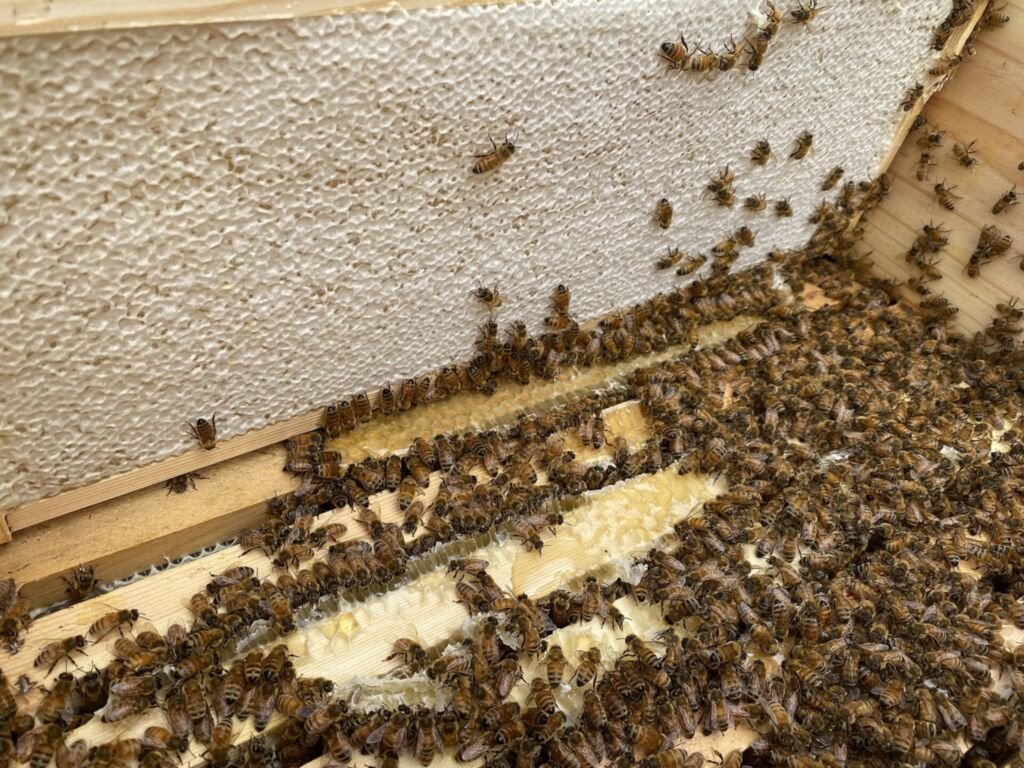
For frames with some open cells, use the shake test. Hold the frame horizontally over the open hive, cells facing down, and give it one sharp downward shake. If nectar sprinkles out, those cells are not ripe. If nothing moves, the uncapped honey is probably close to finished.
Both checks have limits. In humid weather, bees sometimes cap honey above 18.6%. Our article on why capped honey can still be high in moisture explains how. We see this in the Red River Valley during muggy late-July flows. On humid summers we lean harder on the density check below, or borrow a refractometer before bottling.
The Kitchen-Scale Density Test
This is the method most guides skip, and it is the only one here that gives you a number. Water is lighter than the sugars in honey, so wetter honey weighs less per jar. Stefan Bogdanov’s Book of Honey, chapter 4 tabulates the relationship at 20°C (68°F):
| Water content | Specific gravity at 20°C | Honey weight if the jar holds 500 g of water |
|---|---|---|
| 16% | 1.4295 | about 715 g |
| 17% | 1.4237 | about 712 g |
| 18% | 1.4171 | about 709 g |
| 19% | 1.4101 | about 705 g |
| 20% | 1.4027 | about 701 g |
Every 1% of water changes the honey weight in a 500 g-of-water jar by only about 3.5 grams, so technique matters more than equipment:
- Use settled, liquid honey. Freshly extracted honey is full of tiny air bubbles that make it read light. Let it settle for a couple of days, and skim the top. Crystallized honey will not work.
- Pick a rigid glass jar and a flat lid or glass plate that can slide across the rim to strike off the excess. Weigh the empty jar and plate together.
- Fill with water brim-full, slide the plate across so no air is trapped, dry the outside and weigh. Subtract the empty weight to get the water mass.
- Dry the jar completely, then repeat with honey. Both liquids should be at the same room temperature, ideally near 68°F.
- Divide honey mass by water mass to get specific gravity, then read the water content from the table.
For example, if the jar holds 500 g of water and 709 g of honey, specific gravity is 1.418, or about 18% water. A kitchen scale that reads to 1 gram is enough. Filling errors and leftover bubbles are the real limits, so treat results as plus or minus 1% and repeat the test once.
If the result is borderline
A density reading around 18.5 to 19.5% means the honey is not safe for long storage at room temperature, but it is not ruined. USDA Agriculture Handbook 335 notes that storage below 50°F stops fermentation for as long as the honey stays that cold, though not afterward. It also warns that granulated honey is more prone to fermentation, because the liquid left between the crystals is wetter than the original honey. In practice we put borderline buckets in the coldest storage we have, use that honey first, and blend it with drier honey before bottling.
Drying supers before extraction
If frames fail the shake test or a density check on a sample comes back high, the most effective fix is to dry the honey while it is still in the comb, where it has far more exposed surface than in a bucket. Stack the supers in a small closed room, offset or on spacers so air can move between them, run a dehumidifier and use a fan to push air across the frames. Honey only gives up water to air that is drier than it is. Bogdanov’s figures put honey at 18.3% water in balance with air at about 60% relative humidity, so the room needs to be well below that; around 40% is a common target. Leave the supers a day or more, then recheck before extracting. Keep the room sealed so robbing bees cannot reach the frames. A dry room has a side benefit: small hive beetle eggs hatch poorly at low humidity, which is one reason extension services recommend dehumidifying honey houses. Once honey is extracted into a bucket it dries only very slowly, so drying works far better before extraction than after.
Why the Popular Tests Mislead
- Pour, ribbon, thumb and bead tests measure viscosity, whether you watch honey pour, string between your fingers or hold its shape as a drop, and viscosity swings enormously with temperature. The same jar pours like syrup on a warm counter and like paste in a cold kitchen. Floral source matters too. Heather honey, for example, is gel-like until stirred, as Bogdanov notes.
- The bubble test is often misread. Bubbles rise more slowly through thicker honey, and thicker usually means drier. So slow, persistent bubbles do not mean excess water.
- Match and bread tests have no calibration behind them. A match lighting after being dipped tells you little about whether honey is 17% or 19%.
- Foam and a sour smell mean fermentation has already started, which is too late to be a moisture test. See how to identify fermented honey.
Room humidity is the hidden factor in all of this. Bogdanov’s figures show honey at 18.3% water starts absorbing moisture from air above about 60% relative humidity. Keep supers covered, extract in a dry room and seal buckets promptly. Our guide on keeping honey from absorbing moisture has more.
Frequently Asked Questions
Can you tell honey moisture by how thick it is?
Only roughly, and only when comparing honeys at the same temperature from the same floral source. Temperature changes viscosity far more than a percent or two of water does, so thickness alone is a poor guide.
Is capped honey always dry enough?
Usually, but not always. In humid weather bees can cap honey above 18.6%. Combine capping with the shake test, and check extracted honey by density or refractometer when the summer has been muggy.
How accurate is the kitchen-scale density test?
With settled, bubble-free honey, a rigid jar and both liquids at the same temperature, expect about plus or minus 1% water content. That is enough to tell safe honey from risky honey, but not enough for labeling or sale.
What should I do if I think my honey is too wet?
Do not bottle it for storage yet. Keep it cool, blend it with drier honey, or reduce moisture before extraction by holding supers in a closed room with a dehumidifier. See our guide to preventing honey fermentation.
Does the match test for honey moisture work?
Not reliably. It has no calibration and depends heavily on how much honey coats the match. It cannot separate stable honey from borderline honey.
When is a refractometer worth buying?
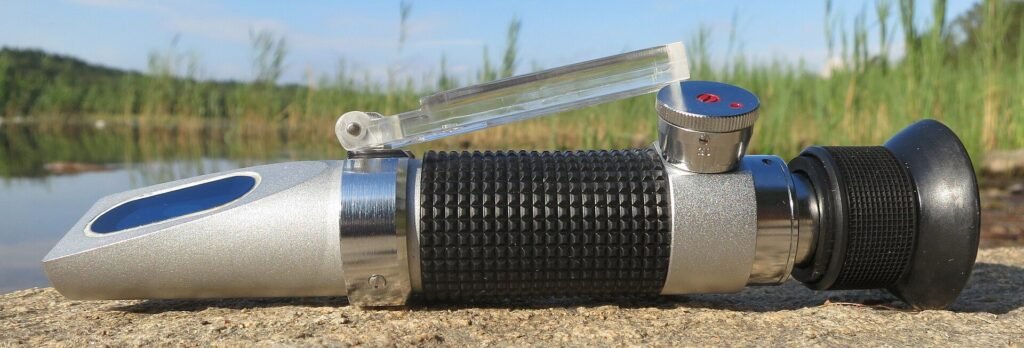
As soon as you sell honey or harvest in humid conditions. A basic honey refractometer reads to about 0.1 to 0.5% and removes the guesswork. For a disputed or borderline wholesale lot, a food testing laboratory can report moisture exactly. See our roundup of honey refractometers.
Conclusion
Without an instrument, control moisture at the frame with capping and the shake test, then check the jar with a careful density measurement. Treat pour, bubble and match tests as curiosities, not measurements. If you sell honey, a refractometer is worth it.