Reviewed by Michael R. · Last Updated October 14, 2026 · How we review
The best way to store honey long term is in a sealed glass jar or another food-grade container, kept dry and out of the heat. The National Honey Board says honey in sealed containers “can remain stable for decades,” but it slowly darkens and loses aroma, and an open jar can pull in enough water to ferment.
Each number below has a source, from USDA, Codex, the FAO and university research. It is educational information, not medical advice.
Key Takeaways
- Water is the main enemy. Honey is hygroscopic, so a loose lid or a damp spoon lets in the moisture that yeast needs.
- Glass, stainless steel and food-grade plastic are all fine. The FAO says to keep copper, iron, steel and zinc away from honey.
- For processed honey the National Honey Board suggests 64-75°F (18-24°C). Above about 77°F (25°C), quality falls faster.
- Keep moisture at or below 18.6%, the USDA limit for Grades A and B. The Codex limit is 20%.
- Crystallization is not spoilage. Warm the sealed jar gently, below about 104°F (40°C).
- Never give honey to a child under 1 year old, whatever the jar looks like.
Table of Contents
- Why Honey Keeps, and What Ruins It
- Best Containers: Glass, Plastic, Stainless and What to Avoid
- Storage Temperature and Heat Damage
- Moisture, Humidity and Fermentation
- Crystallized Honey: Why It Happens and How to Reverse It
- Honey Storage Conditions at a Glance
- Freezing and Refrigerating Honey
- Comb Honey and Bulk Buckets
- Labels, Shelf Life and Signs to Discard
- A Safety Note on Infants
- Frequently Asked Questions
- Next Step
Why Honey Keeps, and What Ruins It
Honey keeps because it is very low in water and acidic. Amina Harris of the University of California, Davis Honey and Pollination Center told Smithsonian that honey’s pH “falls between 3 and 4.5, approximately.” Few microbes survive that combination, and the jar’s seal is the final defense:
“As long as the lid stays on it and no water is added to it, honey will not go bad.”
“Does not spoil” is not the same as “does not change.” The National Honey Board’s FAQ says honey “tends to darken and lose its aroma and flavor or crystallize,” and that these changes depend on temperature. In a Brazilian study, eight raw honeys kept about 540 days at 20 ± 4°C showed shifting aroma compounds. Storage is about slowing that drift. For the spoilage question itself, see does honey expire.
Best Containers: Glass, Plastic, Stainless and What to Avoid
Use glass, stainless steel or food-grade plastic with a lid that seals. That is the FAO’s guidance in its beekeeping manual, which also gives the reason to avoid certain metals:
“No copper, iron, steel or zinc should be used as they dissolve into the honey and may affect colour and flavour, and might reach toxic levels.”
So “never metal” is too broad: stainless steel is on the FAO’s approved list, while galvanized (zinc) steel suits only brief contact, such as an extractor. The FAO also warns that honey absorbs odors quickly, so a reused bucket must be odor-free.
Glass is the easy choice for jars, and the FAO lists it as suitable. Plastic is not equal on moisture. The National Honey Board notes that low-density polyethylene containers can let moisture escape, which may contribute to crystallization. Use plastic for bulk or travel, and move honey you plan to keep for years into glass. Our container buyer’s guide compares jar and bottle styles.
Wash and fully dry the container, and fill it near the top: Southern Cross University notes that less airspace means less moisture uptake.
Storage Temperature and Heat Damage
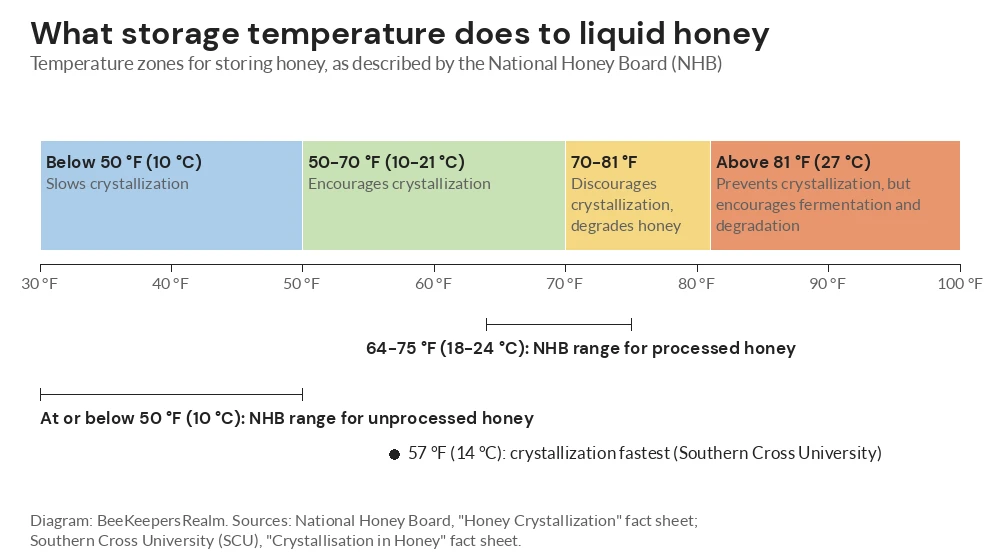
Aim for a steady room temperature near 64-75°F (18-24°C), and avoid sustained heat. The National Honey Board gives that range for processed honey and says unprocessed honey is best at or below 50°F (10°C). The FAO adds that temperatures above 77°F (25°C) are “not desirable for the quality of honey.”
Heat does visible and invisible harm. The invisible part is hydroxymethylfurfural (HMF), a compound that rises as honey ages or heats. Codex caps it at 40 mg/kg, or 80 mg/kg for tropical-origin honey. Analytica Laboratories forecasts that a honey starting at 2 mg/kg would reach the 40 mg/kg limit after about 150 days at 93°F (34°C); see its HMF technical summary. A review in the Journal of Food Science and Technology says storing honey above 27°C for several months raises HMF. Our HMF explainer covers the number.
In practice, skip the attic, the shed and the shelf above the stove; an interior cupboard is a sensible spot.
Moisture, Humidity and Fermentation
Honey that stays at or below 18% water is the least likely to ferment, and 18.6% is the U.S. Grade A and B ceiling. The USDA standard sets the limit as at least 81.4% soluble solids, which Table III converts to 18.6% moisture, and allows 80.0% (20.0% moisture) for Grade C. Codex Standard 12-1981 sets a maximum of 20% for most honey.
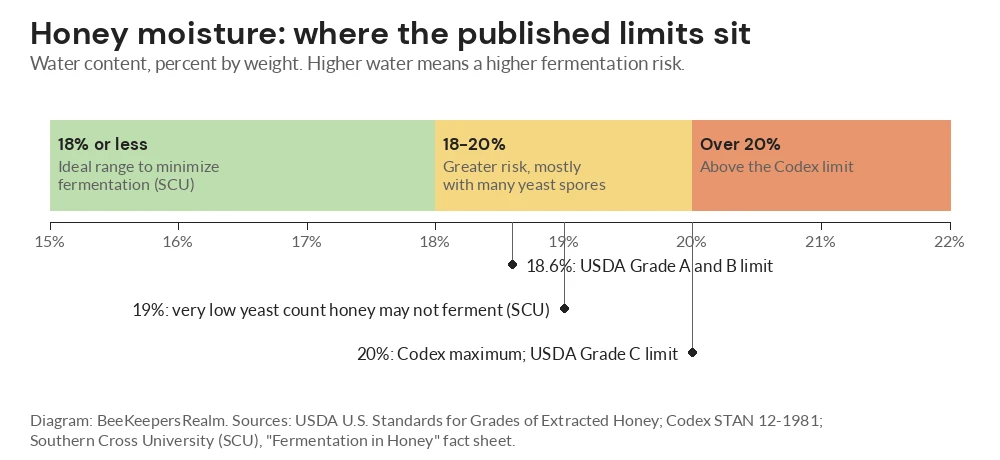
Those figures are limits, not guarantees. Southern Cross University explains that fermentation also depends on yeast: spores range from one per gram to tens of thousands, and honey with very few may not ferment at up to 19% moisture. Yeast goes dormant below about 50°F (10°C) and wakes when honey warms. High moisture usually comes from uncapped frames, wet-weather extracting or air exposure.
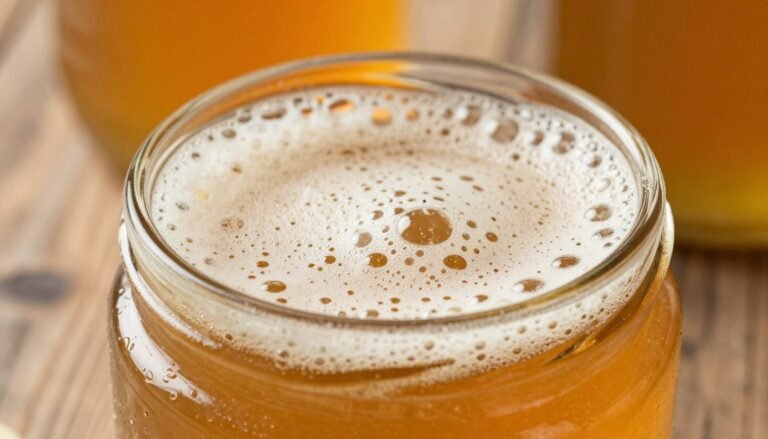
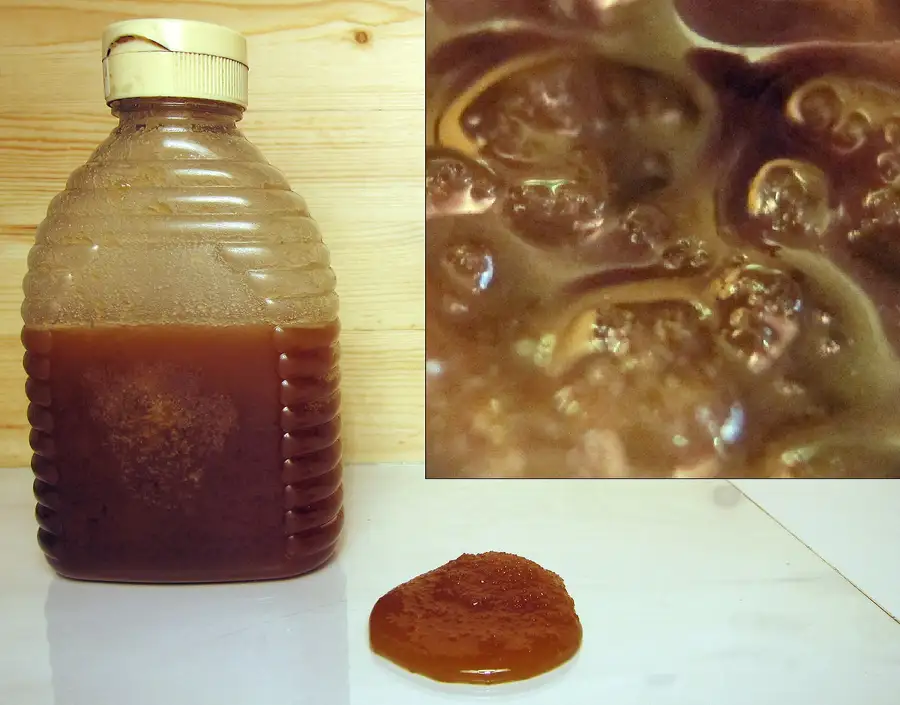
Because honey is hygroscopic, a jar can drift upward after you store it. Keep lids on, use dry spoons, and avoid damp spots such as the area above the dishwasher. If you bottle your own honey, check it first with a refractometer; our guide to ripe honey moisture covers when to pull supers. The warning signs are a sharp smell, runny texture and foam; see how to identify fermented honey.
Crystallized Honey: Why It Happens and How to Reverse It
Honey crystallizes because glucose separates from a supersaturated sugar solution; it is a texture change, not spoilage. The National Honey Board explains that honey is more than 70% sugar and often under 20% water, so glucose tends to precipitate. The FAO says honeys with a glucose-to-water ratio under 1.8, such as black locust, chestnut and tupelo, stay liquid longer. Raw honey tends to set faster because particles such as pollen and wax, and tiny air bubbles, seed crystals, according to the NHB’s filtering FAQ and Southern Cross University. See why some honeys crystallize faster.
To reverse it, warm the closed jar in a bath, stir, and keep the honey cool enough to touch.
- Stand the jar in warm water. The FAO describes commercial melting at 40-50°C (104-122°F); Southern Cross University sets a ceiling of 45°C (113°F). The lower end is gentler.
- Stir occasionally until the crystals dissolve. Do not boil or scorch it, as the National Honey Board warns.
- Let it cool and re-seal. Do not melt the same honey again and again: the FAO notes that once heated honey recrystallizes, its crystals are larger and need more heat to melt.
The FAO also reports that a single 24-hour warming at 40°C does far less damage than prolonged storage above 25°C. For more methods see how to reliquefy crystallized honey.
Honey Storage Conditions at a Glance
This table pulls the figures above into one place. Each row has its own source, and two rows rest on single studies, noted below.
| Honey form | Container | Temperature | What to expect | Source |
|---|---|---|---|---|
| Processed liquid honey | Sealed glass or food-grade container | 64-75°F (18-24°C) | Stays liquid longer; slow darkening and aroma loss | National Honey Board |
| Unprocessed liquid honey | Sealed glass or food-grade container | At or below 50°F (10°C) | Crystallization slowed; yeast dormant below 10°C but revives when warmed | NHB; SCU |
| Any liquid honey | Any | 50-70°F (10-21°C) | Crystallization encouraged; fastest near 57°F (14°C) | NHB; SCU |
| Any liquid honey | Any | Above 77°F (25°C), long term | Quality loss; HMF forecast to go from 2 to 40 mg/kg in about 150 days at 93°F (single forecast) | FAO; Analytica |
| Any liquid honey | Any | Above 81°F (27°C) | No crystals, but fermentation and degradation encouraged | NHB |
| Honey kept a year or more | Tightly covered, in the freezer | Frozen | No crystals; flavor and color retained (1987 archived bulletin) | Michigan State Extension |
| Bulk extracted honey | Well-sealed food-grade buckets, or stainless drums | Cool, dry, off the ground | Fermentation risk if air gets in; bottle early to avoid hard-set buckets | FAO; NHB; SCU |
| Comb honey | Sealed | Frozen first | Freezing kills every life stage of wax moths | Honey Bee Suite |
Freezing and Refrigerating Honey
Freezing works for long storage; refrigerating mostly just changes the texture. An archived 1987 Michigan State bulletin advises freezing honey kept a year or more to prevent crystals and retain flavor and color. That is old, single-source advice, so treat it as an option. Thaw jars sealed so condensation does not add water.
The refrigerator is different. The same bulletin says not to refrigerate honey because it will crystallize and be hard to spread, and the NHB puts crystallization risk highest between 50 and 70°F. Its zones also say below 50°F slows it for unprocessed honey, so sources are not fully consistent. Sealed honey keeps at room temperature, so refrigerate only for a firm spread.
Comb Honey and Bulk Buckets
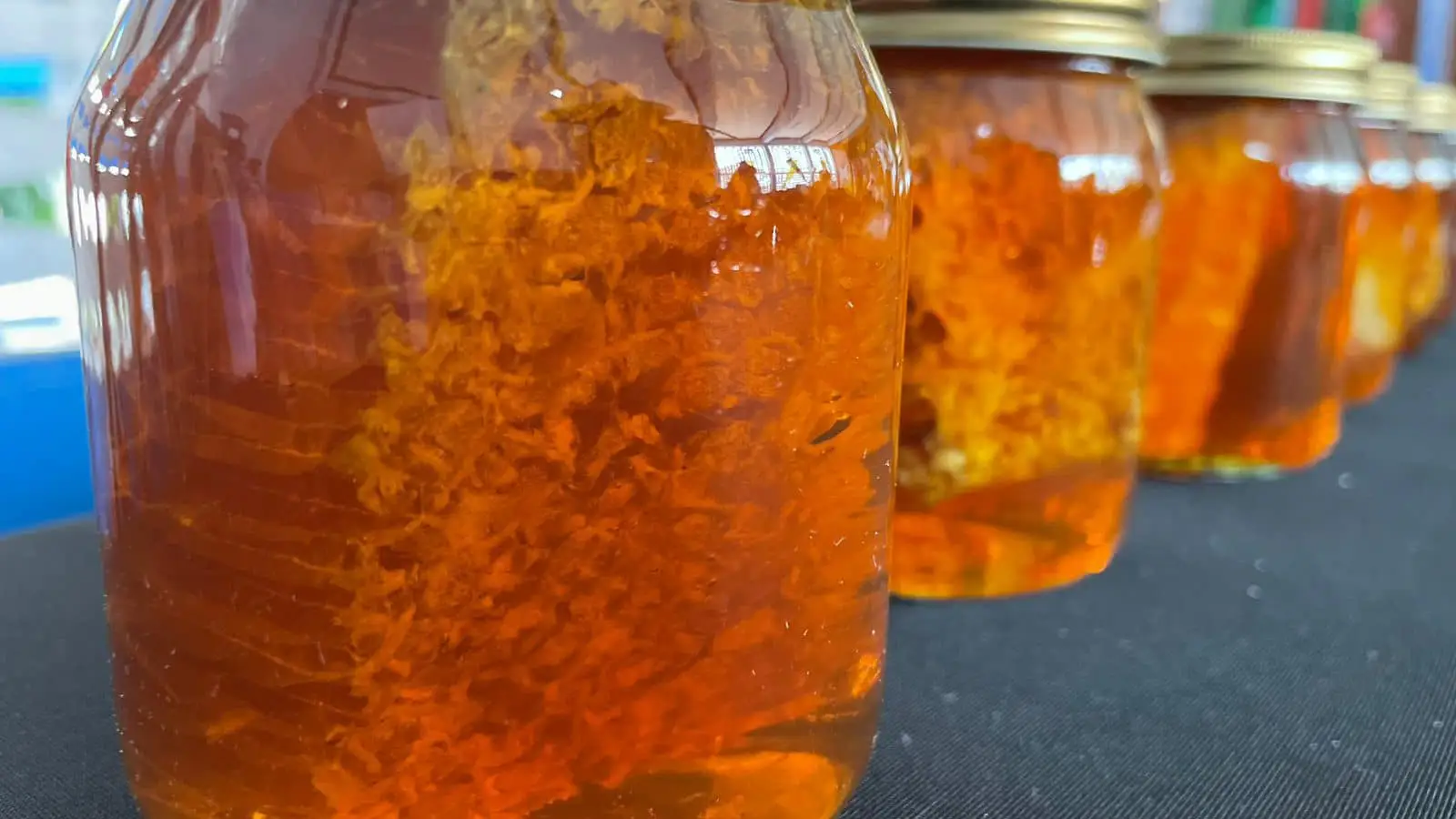
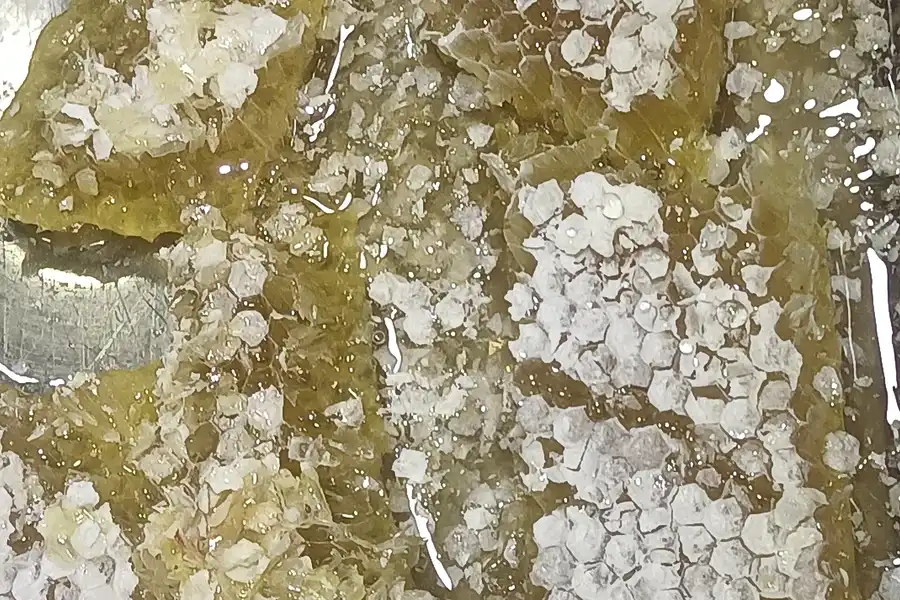
Freeze comb honey before storing it, and bottle bulk honey promptly. Comb is food for wax moths, and Honey Bee Suite notes that freezing kills all life stages. The FAO warns that chemical moth treatments leave residues in wax, so freezing is the cleaner choice for comb you plan to eat. Comb crystallizes too. See our cut comb honey guide for handling.
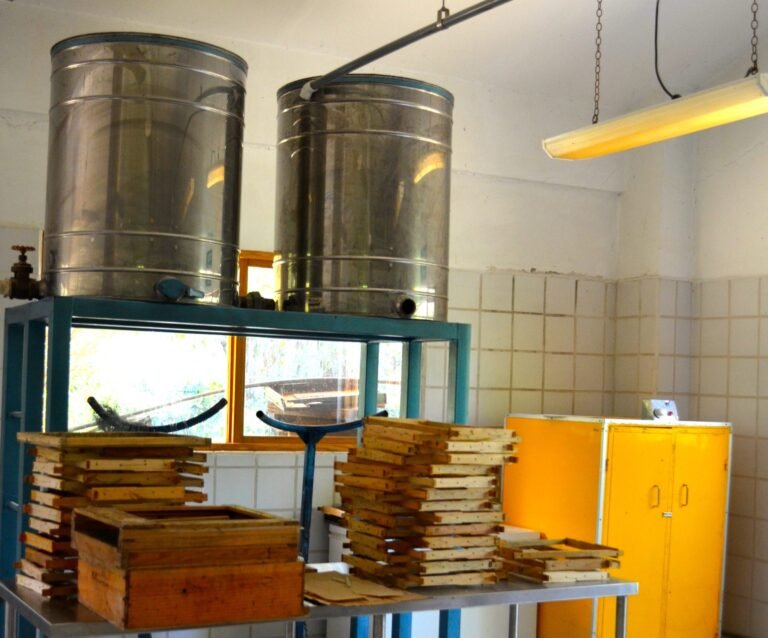
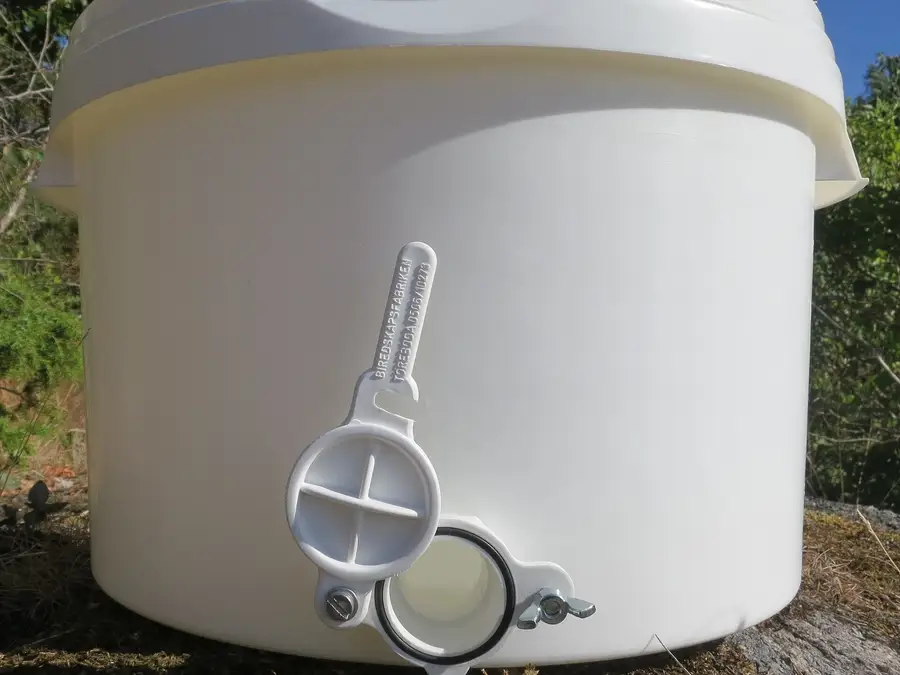
For extracted honey in bulk, the FAO calls for buckets “with well sealing lids.” Southern Cross University advises settling honey for at least 48 hours, then bottling it quickly, because honey that sets in a bucket is hard to get out. A gate valve eases jar filling; see when to use a honey gate strainer.
Labels, Shelf Life and Signs to Discard
Date every jar, and treat two years as a quality target, not an expiry. The National Honey Board says “for practical purposes, a shelf life of two years is often stated,” and that honey in sealed containers can last far longer. The jar must stay sealed and dry. If you sell your honey, honey labeling rules cover what must be on the jar, and factors affecting honey quality explains what shortens quality life.
Throw honey out if it smells sharp or sour, has turned runny, or foams. Southern Cross University says fermented honey can build gas in a sealed jar until the seal breaks or the jar bursts. The NHB’s rule is short: “If in doubt, throw it out.”
A Safety Note on Infants
The CDC says: “Do not feed honey to a child who is younger than 1 year old.” Honey can contain the bacteria that cause infant botulism, and no storage method removes the spores. This is general information; ask a pediatrician about your child. Our article on honey and babies has the details, and the CDC’s botulism prevention page is the official source.
See also what cold really does to honey.
Frequently Asked Questions
How long does honey last in a jar?
The National Honey Board says sealed honey can stay stable for decades, and commonly states two years for practical quality. Open jars last as long as you keep the lid on and water out.
Is it better to store honey in plastic or glass?
Glass for long storage. The FAO accepts food-grade plastic, but the NHB notes polyethylene can let moisture escape, and plastic takes up odors more easily than glass.
Should honey be refrigerated?
No. Sealed honey keeps at room temperature, and cold storage mainly speeds or changes crystallization. Chill a jar only if you want a firmer spread.
Can honey really last 3,000 years?
Smithsonian reports archaeologists finding honey thousands of years old, still preserved, in Egyptian tombs, and credits low water, acidity and a sealed container. Do not treat that as a promise for your pantry: the NHB says honey still darkens and loses aroma over time.
Is 20-year-old honey still good?
It may be safe if it was kept sealed and dry, but flavor and color will have changed. Check the smell and texture, and follow the NHB: “If in doubt, throw it out.”
How do I stop honey from crystallizing?
You can slow it, not stop it. Keep unprocessed honey at or below 50°F, or hold processed honey at 64-75°F, and filter out pollen and wax before bottling. All honey eventually crystallizes.
How do I keep ants out of a honey jar?
Wipe the jar clean after each use, as the Michigan State bulletin advises, and keep the lid tight.
Next Step
Put honey you plan to keep into dry glass, date it, and shelve it in a cool interior cupboard. If you harvest your own, test moisture first: refractometer readings that mean do not bottle shows the numbers to watch.