Reviewed by Thomas B. · Last Updated September 23, 2026 · How we review
Honey can sit in a settling tank for as little as 24 hours or for several weeks, but the useful window is usually 1 to 4 days: long enough for air bubbles and wax fragments to rise, short enough that the honey has not started to crystallize, absorb moisture or stratify in the tank. Beyond about a week, a settling tank stops being a clarifier and becomes a storage vessel, and it is not a very good one.
Most advice stops at “leave it 48 hours.” This guide goes further and answers the question the tank itself raises: what actually changes in the honey the longer it sits, and at what point waiting starts to cost you. If you only need the short answer on how long to let honey settle before bottling, it comes first.
Key Takeaways
- Plan on 24 to 48 hours in a warm room (around 80 to 90°F) and up to 3 or 4 days in a cooler room before drawing honey off a settling tank.
- Temperature matters more than the clock: honey is roughly three times more viscous at 69°F than at 84°F, so bubbles rise about three times more slowly.
- Honey crystallizes fastest around 57°F (14°C), which is exactly the temperature of many unheated garages and basements in autumn.
- Honey absorbs water from the air whenever relative humidity is above about 60%, and settling tank lids are rarely airtight.
- In a tank left standing for weeks, wetter honey can stratify toward the top, where it is most at risk of fermenting.
- If you must hold honey longer than a week, move it into sealed food-grade pails and bottle later rather than leaving it in the tank.
Table of Contents
- How Long to Let Honey Settle Before Bottling
- What a Settling Tank Actually Does
- What Happens Hour by Hour, Day by Day
- Why Temperature Sets the Real Timetable
- The Four Risks of Leaving Honey Too Long
- How Floral Source Changes the Window
- A Practical Settling Routine
- Frequently Asked Questions
How Long to Let Honey Settle Before Bottling
For most small-scale beekeepers the answer is 24 to 48 hours in a warm room, then a test jar drawn from the gate. Temperature sets the range:
| Settling conditions | Typical time before bottling |
|---|---|
| Warm room (80 to 90°F), strained honey, bucket or small tank | About 24 hours |
| Normal room temperature (high 60s to low 70s °F) | 48 hours or more |
| Cool garage or basement (50s °F) | 3 to 4 days, with a rising risk of crystallization; warming the room is the better fix |
| Fast-granulating honey such as canola | Bottle within about 24 hours regardless |
Three other things move the number:
- Depth. Bubbles have to rise the full depth of the container, so a shallow bucket clears sooner than a tall tank.
- Straining. Running honey through a coarse and then a medium strainer at extraction removes most of the wax before settling, leaving less scum to rise and skim.
- How much air went in. Pumped or fast-spun honey carries more fine bubbles than honey that drained by gravity, and needs the longer end of the range.
If you bottle sooner, for example straight from the extractor for a farm stand, expect a foam layer to rise in the jars over the next day or two. It is harmless and can be skimmed before labeling; see foam on honey after bottling and bottling straight from the extractor. The rest of this guide covers what happens when honey stays in the tank longer than that.
What a Settling Tank Actually Does
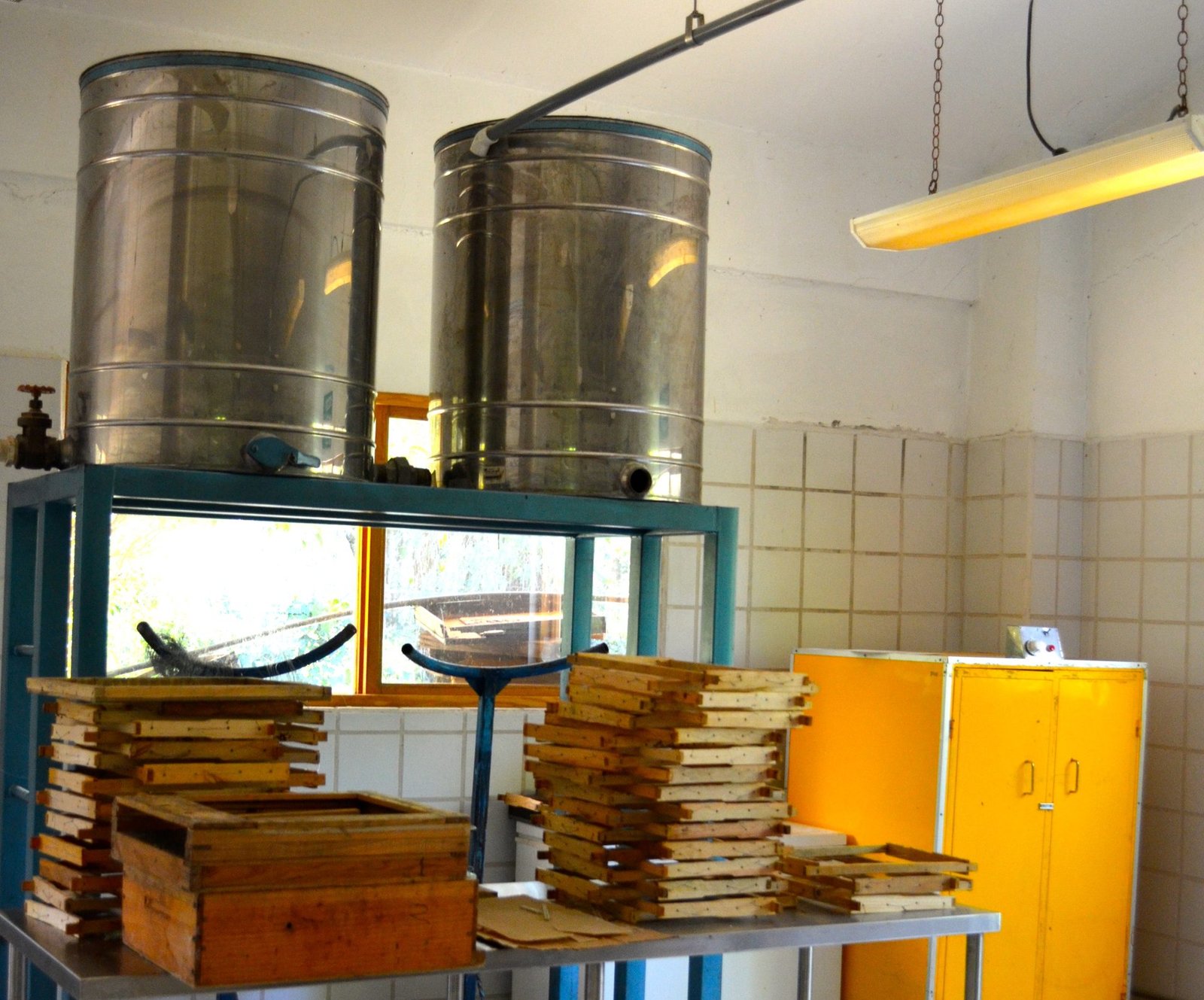
A settling tank (also called a settling vat or bottling tank) is a food-grade container, usually stainless steel or food-grade plastic, with a honey gate near the bottom. Freshly extracted honey is strained into it and then left undisturbed. Two things separate by gravity:
- Air bubbles, whipped in by the extractor and pumping, rise and form a foam layer on top.
- Fine wax particles and bits of bee that slipped through the strainer are lighter than honey, so they also float up into that surface scum.
Because the gate draws from the bottom, the cleanest honey comes out first, and the scum stays behind until you skim it or leave the last inch in the tank. For the physical side of choosing a tank, see our settling tank size guide and the comparison of stainless steel vs plastic bottling tanks.
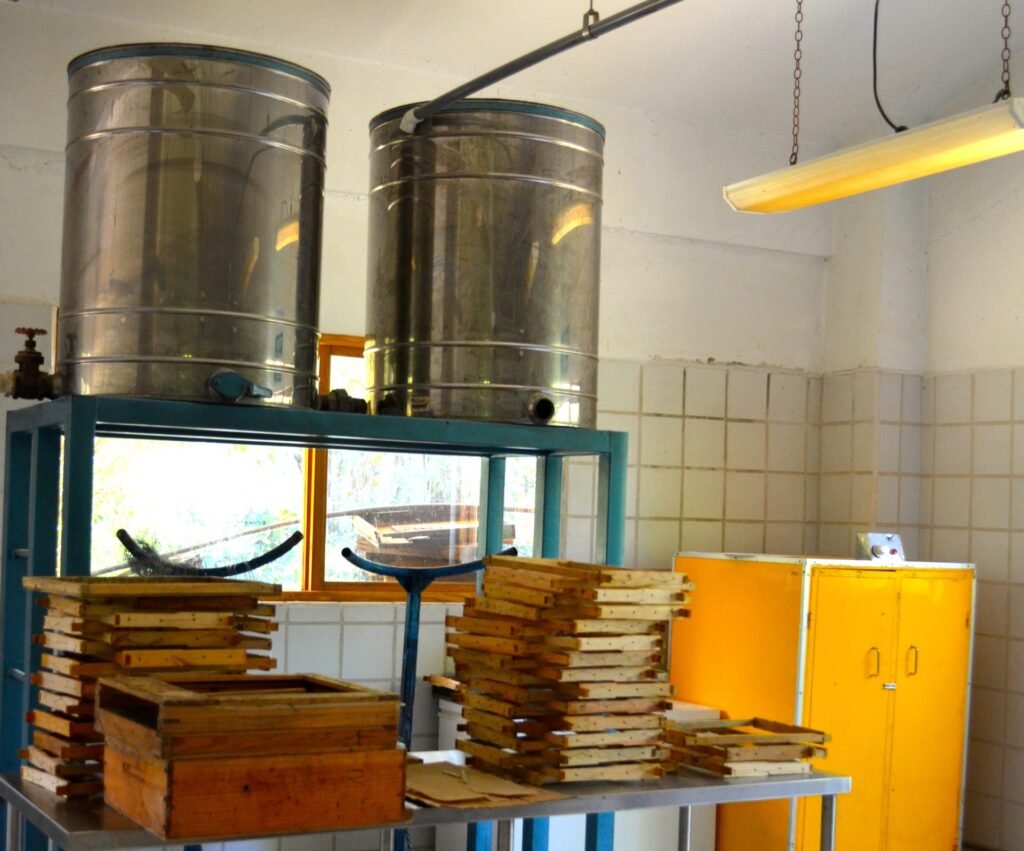
A settling tank does not dry honey, pasteurize it or remove dissolved moisture. Whatever moisture content the honey had coming out of the extractor, it still has in the tank, and if the room is humid it can go up.
What Happens Hour by Hour, Day by Day
The table below is a general timeline for a typical light, fairly dry honey (around 17 to 18% moisture) held in a covered tank. Actual timing shifts with temperature, tank depth and floral source.
| Time in tank | What is happening | What to do |
|---|---|---|
| 0 to 12 hours | Large bubbles and coarse wax rise quickly; honey still looks cloudy. | Leave it alone; avoid vibration and stirring. |
| 12 to 48 hours | Fine bubbles continue rising; a distinct foam layer forms. In a warm room the honey below is usually clear. | Draw off from the gate once a test jar looks clear. |
| 2 to 4 days | Settling is essentially complete even in a cooler room. In fast-granulating honeys, seed crystals may begin forming. | Bottle now, especially canola, sunflower or dandelion honey. |
| 1 to 3 weeks | Crystallization may be visible, starting at the walls and bottom; the surface can pick up moisture if humid. | Transfer to sealed pails or bottle promptly. |
| 1 month or more | Many honeys partly or fully set in the tank; moisture stratification and surface fermentation become possible. | Not recommended; honey will need gentle warming before it can be drawn off. |
Why Temperature Sets the Real Timetable
The “48-hour rule” hides the most important variable: how thick the honey is. A bubble rises through honey at a speed that depends on its size and the honey’s viscosity, and viscosity falls steeply as honey warms. Figures from the United Nations Food and Agriculture Organization’s technical bulletin on honey properties and processing show sweet clover honey at 16.1% moisture measuring about 600 poise at 57°F (13.7°C), 190 poise at 69°F (20.6°C) and 68 poise at 84°F (29.0°C). In other words, the same honey is nearly three times runnier at 84°F than at 69°F, and nearly nine times runnier than at 57°F.
To show what that means in a tank, we applied Stokes’ law (the standard physics for a small sphere rising through a thick liquid) to those FAO viscosity values. This is an idealised estimate, not a lab measurement, but the proportions hold:
| Room / honey temperature | Viscosity (FAO data) | How far a 0.2 mm bubble rises in 48 hours | How far a 0.1 mm bubble rises in 48 hours |
|---|---|---|---|
| 57°F (13.7°C) | 600 poise | About 3.5 inches | About 1 inch |
| 69°F (20.6°C) | 190 poise | About 11 inches | About 2.7 inches |
| 84°F (29.0°C) | 68 poise | About 30 inches | About 7.6 inches |
A full 60-pound pail holds roughly 13 to 14 inches of honey, and larger tanks are deeper still. At normal room temperature, even 0.2 mm bubbles starting near the bottom of a deep tank may not reach the surface in 48 hours; at 84°F they clear the full depth easily, and only the very finest bubbles remain. That is why beekeepers with a warm room can bottle the next day, while those settling in a cool basement see cloudy jars even after two days.
Warmth has limits. Keep the honey itself below about 95°F during settling; prolonged heat speeds formation of hydroxymethylfurfural (HMF), the compound regulators use as a marker of heat damage and ageing, and it dulls aroma. The Codex Alimentarius honey standard caps HMF at 40 mg/kg for most honey. A purpose-built honey warming cabinet or a thermostat-controlled room is the safest way to hold that range.
The Four Risks of Leaving Honey Too Long
Crystallization in the tank
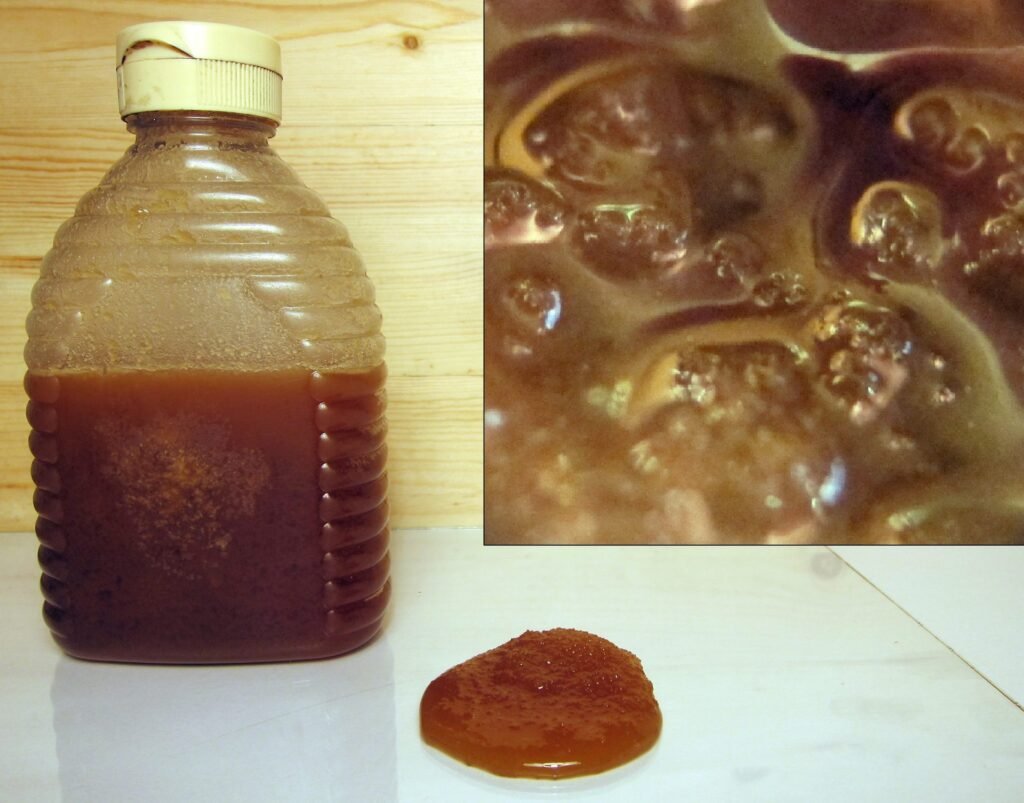
The FAO bulletin identifies about 57°F (14°C) as the optimum temperature for fast crystallization, with virtually none above 77°F (25°C) or below 41°F (5°C). In our region of eastern North Dakota and the Red River Valley, honey is typically extracted from late July through early September, and by late September an unheated garage or basement often sits right in that 50s°F zone. Honey that sits in the tank through a cool spell can set around the gate and walls, and then the whole tank has to be warmed to empty it. Our guide to reliquefying crystallized honey without damage explains how to do that gently.
Moisture absorption
Honey is hygroscopic. According to the same FAO data, honey at 18.3% moisture is in balance with air at 60% relative humidity; above that humidity it pulls water from the air. A settling tank with a loose lid in a humid processing room can gain moisture at the surface over days. The USDA grade standard for Grade A extracted honey allows no more than 18.6% moisture, so honey that went in close to the limit can drift over it. See how humidity affects extracted honey for details.
Stratification
This is the risk most settling advice misses. Wetter honey is less dense than drier honey, and the FAO notes that in large storage tanks, high-moisture honey can settle above the denser, drier honey. If you blended supers of different ripeness into one tank and left it standing for weeks, the top layer may end up noticeably wetter than your average reading. Always mix the batch thoroughly before taking a refractometer reading, and test from the top as well as the gate if the tank has stood for a while.
Fermentation
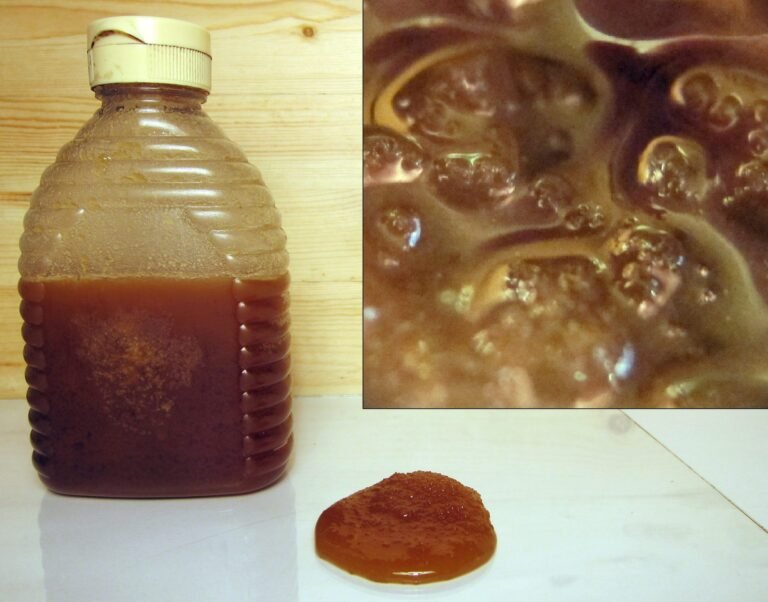
Wild yeasts are naturally present in honey. The FAO bulletin puts the safe storage threshold at below about 18% water, and crystallization makes things worse: as glucose crystals form, water is released into the remaining liquid, raising its moisture content. A tank that is partly crystallized, slightly humid at the surface and above 18% moisture is the classic setup for a sour, foamy top layer. Our fermentation risk checklist covers what to check before bottling.
Only honeys with less than 18% water can be stored with little to no risk of fermentation.”
How Floral Source Changes the Window
Honeys high in glucose relative to fructose crystallize quickly and give you less time in the tank. That matters on the Northern Plains, where canola and sunflower are major nectar sources alongside sweet clover and alfalfa.
| Honey type | Typical crystallization speed | Suggested maximum time in tank |
|---|---|---|
| Canola (rapeseed) | Very fast, sometimes days | 24 hours; extract and bottle quickly |
| Sunflower, dandelion | Fast | 1 to 2 days |
| Sweet clover, alfalfa, mixed wildflower | Moderate, weeks to months | 2 to 4 days |
| Basswood (linden) | Moderate to slow | Up to about a week if warm and sealed |
| Tupelo, black locust (acacia), sage | Very slow | A week or more is tolerable |
If you are unsure what dominated a given extraction, assume the faster column. Our explainer on why some honeys crystallize faster than others covers the glucose-to-fructose chemistry.
A Practical Settling Routine
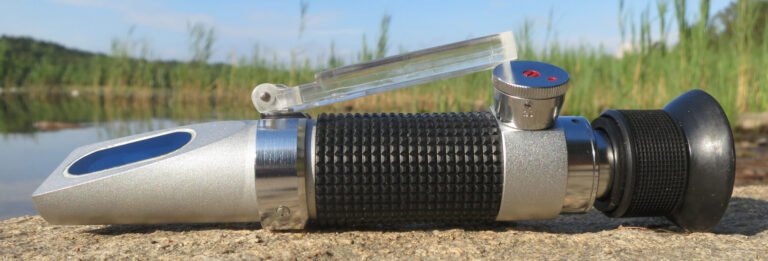
- Check moisture first. Take a refractometer reading on a mixed sample before the honey goes into the tank. If it reads above 18.6%, deal with that before settling, not after. Write the reading on the tank or in a bucket log; our lot tracking guide shows a simple format.
- Strain, then fill gently. Let honey run down the side of the tank or through a strainer resting on the surface, rather than dropping from a height, to avoid whipping in more air. Our guide to avoiding air bubbles when bottling honey has more tips.
- Keep it warm and still. Aim for a room of 80 to 90°F, with the lid on and the tank on a solid surface away from the extractor’s vibration. Put the tank or bucket at its final bottling height before you fill it: a full 5-gallon pail holds about 60 pounds of honey, and moving it stirs the bubbles back in.
- Test, do not guess. After 24 hours, draw a small jar from the gate and hold it to a light. If it is clear, bottle. If it is still hazy, give it another day.
- Skim or leave the top. Lay cling film on the surface and lift it off to remove foam, or simply stop drawing before the scum reaches the gate.
- Do not use the tank for storage. If you cannot bottle within about a week, transfer the clear honey into sealed food-grade pails and store them somewhere cool and dry, then warm and bottle later.
Frequently Asked Questions
Can I leave honey in a settling tank for a week?
You can, if the honey is dry (below about 18% moisture), the lid fits well and the room is warm enough to keep it from crystallizing. Fast-setting honeys such as canola or sunflower may start to granulate within that time, so bottle those sooner.
Is 24 hours long enough to settle honey?
In a warm room of about 80 to 90°F, 24 hours is often enough for jar-clear honey. At normal room temperature (high 60s °F), fine bubbles rise about three times more slowly, so 48 hours or more is safer.
What temperature should a settling room be?
Around 80 to 90°F (27 to 32°C) gives fast clearing without heat damage. Keep the honey itself below about 95°F, and avoid the 50s °F, where honey crystallizes fastest.
Why is my honey still cloudy after settling?
The most common causes are a cool room, a deep tank, or very fine air bubbles from high-speed extraction or pumping. Early crystallization can also cause haze. Warm the room and wait another day, and check whether fine white crystals are forming.
Can honey ferment in a settling tank?
Yes, if its moisture content is too high or it absorbs moisture from humid air. Fermentation usually starts at the surface, where honey is wettest, and shows as foam, bubbles and a sour or yeasty smell.
Should I stir honey in the settling tank?
Not during settling, because stirring mixes bubbles and wax back in. Stir or mix only before taking a moisture reading, or if a tank has stood long enough to stratify.
The Bottom Line
Treat a settling tank as a short stop, not a warehouse. With dry honey, a warm room and a good lid, 24 to 48 hours gives clear jars; up to four days is fine for most honeys; much beyond a week invites crystallization, moisture pickup and stratification. When in doubt, test a jar from the gate and let the honey, not the clock, tell you when it is ready.