Reviewed by Sofia T. · Last Updated September 24, 2026 · How we review
Honey crystallizes faster when it contains more glucose relative to water, when it holds more particles for crystals to form on, and when it is stored near 57°F (14°C). Glucose-rich honeys such as canola, alfalfa, clover and dandelion can set within weeks of extraction. Fructose-rich honeys such as tupelo, sage and black locust (sold as acacia) can stay liquid for years. Processing and storage can speed up or slow down any honey by months, but they can’t change its sugar chemistry, and the sugar chemistry is set by the flowers the bees worked.
This article explains why crystallization speeds differ. If you already have a set jar, see how to reliquefy crystallized honey without damage. If you want to control crystallization on purpose, see our seeding ratio guide for creamed honey.
Key Takeaways
- Glucose is the sugar that crystallizes. Fructose stays dissolved, so the balance between the two sets the baseline speed.
- The glucose-to-water ratio predicts speed. Honey below about 1.7 tends to stay liquid. Honey above about 2.1 crystallizes quickly.
- Drier honey sets faster. Removing water raises the glucose-to-water ratio, so very ripe honey often granulates sooner.
- Particles and air bubbles start crystals. Pollen, wax, dust and leftover crystals from old honey all act as starting points.
- 57°F (14°C) is the fastest temperature. Colder storage slows crystallization, and warmth above about 77°F (25°C) slows it too.
- Beekeepers control more than they think. Clean equipment, settling time and warm storage can add months before a jar sets.
Table of Contents
- The Four Factors That Set the Clock
- Glucose Is the Sugar That Crystallizes
- The Glucose-to-Water Ratio
- Particles and Bubbles: Where Crystals Start
- Temperature: Why 57°F Is the Worst Place for Honey
- Fast and Slow Honeys by Floral Source
- What Beekeepers Do That Changes the Timeline
- Frequently Asked Questions
The Four Factors That Set the Clock
Honey is a supersaturated sugar solution. According to the National Honey Board’s crystallization fact sheet, it holds more than 70% sugar and often less than 20% water, which is more sugar than that water can keep dissolved for good. Sooner or later, some of the glucose comes out of solution as crystals. What varies is how soon, and four factors control that.
| Factor | Speeds crystallization | Slows crystallization | Who controls it |
|---|---|---|---|
| Sugar profile | High glucose, low fructose | High fructose, glucose under about 30% | The nectar source |
| Water content | Low moisture (a high glucose-to-water ratio) | Higher moisture, though this brings fermentation risk | Ripening in the hive and harvest timing |
| Crystal starting points | Pollen, wax, dust, air bubbles, old crystals | Settling, straining, clean equipment | The beekeeper or packer |
| Storage temperature | A steady 50-59°F (10-15°C) | Above about 77°F (25°C), or frozen | Whoever stores the jar |
Glucose Is the Sugar That Crystallizes
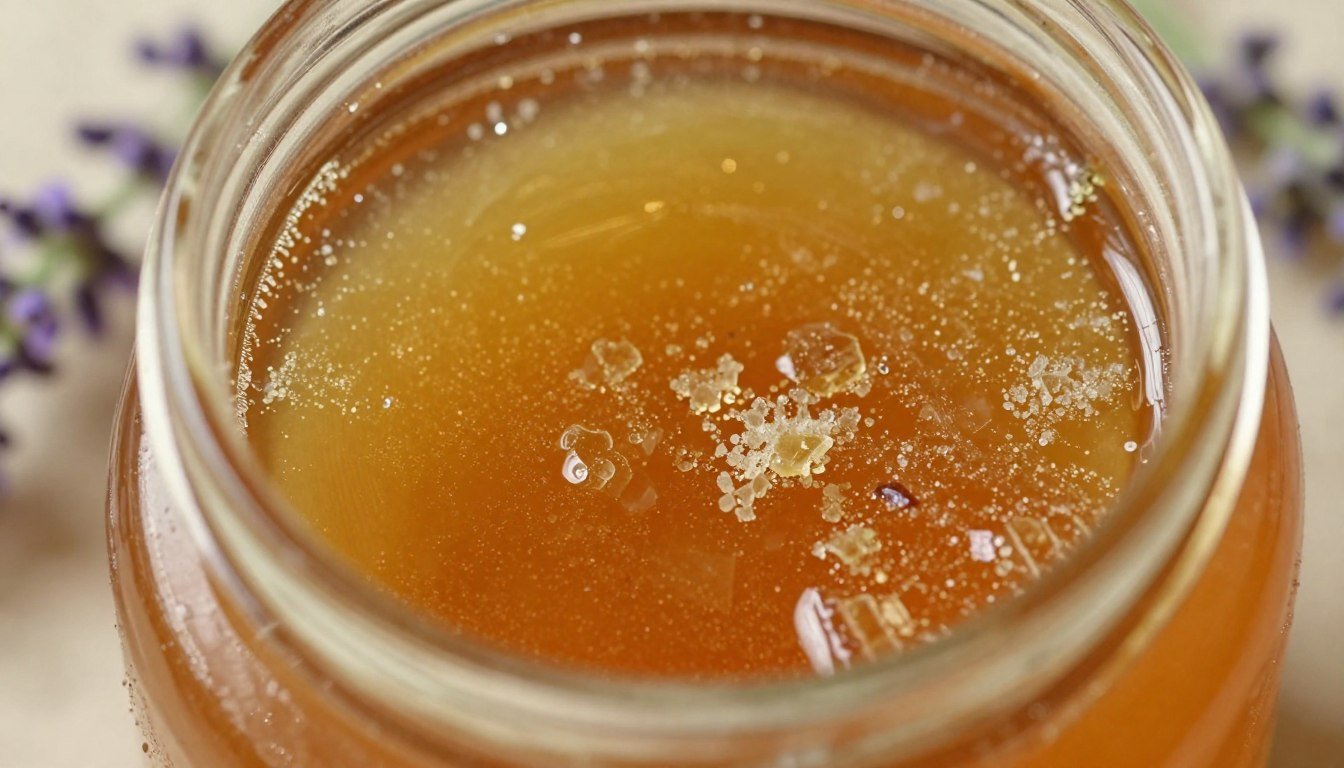
Honey’s two main sugars are fructose and glucose, which usually occur in similar amounts. Only glucose crystallizes under normal conditions. It is much less soluble in water than fructose, and when it comes out of solution it forms glucose monohydrate crystals. These crystals knit together into a network that traps the rest of the honey, which is why a jar goes from runny to solid.
That’s why the fructose-to-glucose (F/G) ratio is the first thing to check when comparing honeys. Quality Services International, a German honey-testing laboratory, gives these thresholds:
- F/G above 1.33: the honey tends not to crystallize.
- F/G below 1.11: the honey tends to crystallize rapidly.
The National Honey Board makes the same point from the glucose side: most honeys crystallize after extraction, but those with less than 30% glucose, such as tupelo and sage, resist granulation.
The Glucose-to-Water Ratio
Sugar profile alone doesn’t explain speed, because the same amount of glucose behaves differently depending on how much water it is dissolved in. The glucose-to-water (G/W) ratio combines both, and it is the most useful single predictor. QSI puts the thresholds at below 1.70 for honey that stays liquid and above 2.16 for honey that crystallizes rapidly. Honey between those values is intermediate and usually sets within some months.
“Honey with a low glucose-to-water ratio is likely to remain liquid, avoiding crystallization.”
The National Honey Board’s reference composition for U.S. honey averages 30.31% glucose and 17.2% moisture, which works out to a G/W ratio of about 1.76. That is just above the stay-liquid line, which is why an average honey usually sets within months rather than weeks. The ratio also has a counterintuitive consequence: drier honey crystallizes faster. Using that same average glucose figure, honey at 18.6% moisture (the USDA Grade A limit) has a G/W of about 1.63, below the threshold. Dried to 16% moisture, the same honey reaches about 1.89, well into the intermediate range. This is one reason very thick honey from a hot, dry late summer can set sooner than a wetter year’s crop.
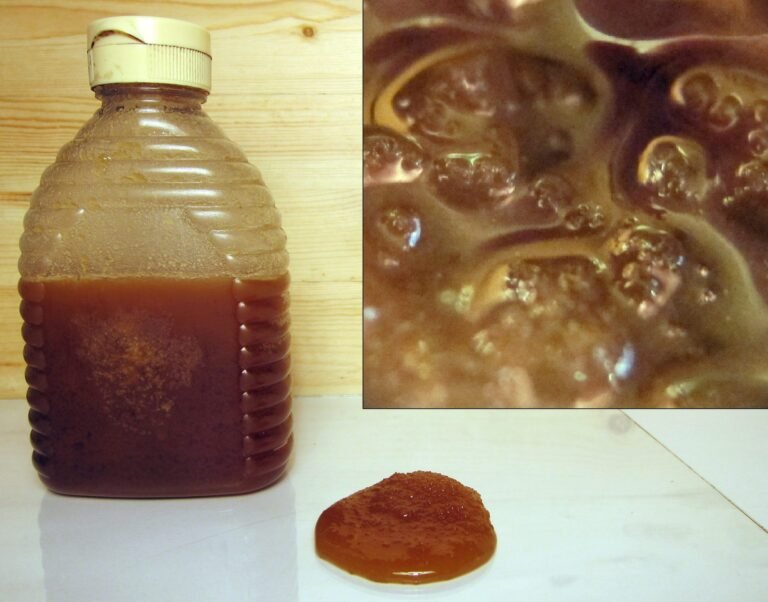
The reverse is not a solution. Honey with higher moisture tends to crystallize unevenly, with a solid layer at the bottom and a runny layer on top. The National Honey Board notes that the liquid layer holds more water than the original honey, which makes it a good place for yeast to grow. See honey granulation vs fermentation for how to tell the two apart.
Particles and Bubbles: Where Crystals Start
Glucose needs something to crystallize onto. QSI’s fact sheet lists “tiny glucose crystals, pollen grains, dust particles or air bubbles” as the starting points, or nuclei, from which crystals grow. The more of these a honey contains, the more crystals start at once, and the faster the jar sets.
This explains several common observations:
- Raw honey sets sooner than supermarket honey. Raw honey keeps its pollen and fine wax. Commercial packers heat honey to dissolve existing crystals and filter out particles, which delays setting. Our guide to raw vs processed honey explains what each step removes. For how much pollen stays in, see pollen content in unfiltered honey.
- Extracted honey sets sooner than honey left in the comb. The National Honey Board notes that honey processed with extractors and pumps is likely to crystallize faster than honey left in the comb. Extraction works air and fine particles into the honey.
- Fast-set honey is smoother. Khalil Hamdan, in his review of honey crystallization, notes that the faster honey crystallizes, the finer its texture. Many nuclei produce many small crystals. A slow set from a few nuclei produces fewer, larger, grittier crystals. Creamed honey uses this deliberately.
Crystallizing sooner does not prove that honey is raw or pure. It reflects the honey’s chemistry and handling. A pure honey that has been heated and fine-filtered can stay liquid for a long time, and a naturally slow honey like tupelo stays liquid even when completely raw.
Temperature: Why 57°F Is the Worst Place for Honey
E.J. Dyce, whose 1930s research at Cornell became the basis of commercial creamed honey, found that honey crystallizes fastest at a steady temperature of about 14°C (57°F). The physics works on both sides of that point. Colder honey becomes too thick for glucose molecules to move to growing crystals, while warmer honey holds more glucose in solution.
| Storage temperature | What happens |
|---|---|
| Below 50°F (10°C) | Honey is very thick, and crystallization slows down |
| 50-59°F (10-15°C) | Fastest crystallization; the peak is around 57°F (14°C) |
| 59-77°F (15-25°C) | Crystallization still happens, but more slowly as temperature rises |
| Above 77°F (25°C) | Crystallization is strongly delayed, and the crystals that do form are coarse |
| Around 86-104°F (30-40°C) | Existing crystals begin to dissolve |
QSI reports that liquid honey stored directly at 14°C crystallizes within five weeks. In a northern house, that means a cool basement shelf, an unheated porch or a pantry against an outside wall can turn a liquid jar solid faster than the refrigerator. Southern Cross University’s honey crystallisation fact sheet adds a detail that matters in a honey house: don’t store honey containers directly on concrete or paved floors, which can get cold and speed up crystallization.
Fast and Slow Honeys by Floral Source
Because sugar profile depends on the nectar source, honey types fall into fairly consistent speed groups. This table follows Hamdan’s review and the National Honey Board’s table, which is adapted from the USDA’s 1962 survey of American honeys.
| Speed | Typical honeys | What to expect |
|---|---|---|
| Rapid | Canola (oilseed rape), alfalfa, clover, dandelion, mustard, cotton, mesquite | Sets within weeks to a few months after extraction |
| Slow | Basswood (linden), buckwheat, fireweed, orange blossom, sourwood, blackberry | Often liquid for several months to a year |
| Very slow | Tupelo, sage, black locust (acacia), cranberry, milkweed | Can stay liquid for years |
Treat the table as a tendency, not a guarantee. Sources don’t always agree, and sunflower is a relevant example for the northern Plains: Hamdan lists it as rapid, while the National Honey Board table rates its tendency below average. Blends also behave like their dominant source. For a broader comparison, see our honey varieties comparison chart. Two single-source guides show the extremes: clover honey and slow-setting sage honey.
Canola is the most extreme common case. Rusty Burlew of Honey Bee Suite notes that it can crystallize in the comb before it is harvested. That matters here: according to the USDA NASS Honey report (March 2026), North Dakota produced 30.8 million pounds of honey in 2025, the most of any state, and much of the Red River Valley crop comes from canola, sweet clover and alfalfa. All three are fast-setting honeys, so most local honey will granulate. That is normal and is not a sign of adulteration.
What Beekeepers Do That Changes the Timeline
A beekeeper can’t change the flowers, but several decisions between the hive and the jar can move the crystallization date by weeks or months:
- Extract fast-setting honey quickly. Burlew recommends extracting canola within 24 hours of collection. Don’t leave canola supers stacked in a cool garage for a week. For comb honey in canola country, see our guide to foundationless frames for honey supers.
- Don’t store wet supers. Hamdan warns that extracted combs stored with traces of honey can form micro-crystals that make next year’s honey crystallize early. Let the bees clean the supers before storage.
- Clean out old crystals. A bucket, settling tank or bottling valve with a crust of old granulated honey seeds every new batch that touches it. Wash equipment until no grit remains.
- Let honey settle. Southern Cross University recommends at least 48 hours in a settling tank so bubbles and particles rise before you draw off honey from the bottom. See bottling honey straight from the extractor for the trade-offs.
- Bottle before it sets in bulk. Honey that sets in a 60-lb pail has to be warmed back out. Jar it while it is liquid, at the temperatures in our honey bottling temperature guide.
- Store warm, off the floor. Keep buckets and cases at room temperature and on shelves or pallets rather than bare concrete.
- Or let it set on purpose. If a batch will granulate anyway, seeding it into creamed honey gives a smooth product instead of a gritty one.
For more on the sugar balance behind this, see how the glucose-fructose ratio shapes honey texture.
Frequently Asked Questions
Why did my honey crystallize so fast?
Most likely it is a high-glucose honey such as canola, clover or alfalfa, with a high glucose-to-water ratio, and it was stored somewhere near 57°F. Raw honey with pollen and fine wax particles also sets sooner than filtered honey.
Does crystallized honey mean it is raw or pure?
Not by itself. Crystallization reflects sugar chemistry and handling. Pure honey that has been heated and fine-filtered can stay liquid for months, and naturally slow honeys like tupelo stay liquid even when raw.
Does putting honey in the refrigerator make it crystallize faster?
A refrigerator is colder than the fastest range, so it slows crystal growth compared with a 57°F pantry. Honey does pass through the fast range as it warms and cools, though, so room temperature (about 70-77°F) is the practical choice for jars in use.
Why is some crystallized honey smooth and some gritty?
Speed determines crystal size. Honey that sets quickly from many nuclei forms many fine crystals and feels smooth. Honey that sets slowly, or at warm temperatures, forms fewer, larger crystals that feel gritty.
Why did my honey separate into a solid bottom and a liquid top?
That usually means the honey had higher moisture. The liquid top layer holds more water than the original honey and can ferment. See whether fermented honey can be saved if it smells sour or foams.
Can you stop honey from crystallizing completely?
You can only delay it, unless the honey is naturally low in glucose. Dissolving existing crystals with gentle heat, careful straining and warm storage all add time, but the glucose chemistry stays the same.
The Bottom Line
How fast a honey crystallizes depends on its glucose-to-water ratio, how many crystal starting points it contains, and how long it spends near 57°F. The flowers decide the first factor. Beekeepers and buyers control the other two. Red River Valley honey from canola, clover and alfalfa is naturally fast-setting, so plan for it: extract promptly, keep equipment free of old crystals, store honey warm, or turn it into creamed honey on purpose.