Reviewed by Thomas B. · How we review
Baklava with honey is buttered phyllo and chopped walnuts soaked in a syrup of sugar, honey, water and lemon. Honey is rarely the whole syrup: across nine published recipes it is 6.5% to 50% of the sweetener by weight, and the most common share is about 46%. Pour cooled syrup over the pastry as it leaves the oven, and keep the tray away from babies under 1 year old. This guide covers how much honey to use, which honey to buy, when to stir it in, and what the evidence says about syrup temperature.
Key Takeaways
- Nine published syrups hold 6.5% to 50% honey by weight (our calculation from USDA gram weights). Four sit at 46%, and our starting recipe uses 46%.
- None of the recipe pages we read says which honey to use. Greek sources point to thyme or pine honey, but we found no blind taste test, so choose by flavor.
- Eight of nine recipes pour cooled syrup over freshly baked baklava. We found no controlled test of syrup temperature, only recipe-page claims.
- The CDC says not to give honey, or products made with it, to a child under 1 year old.
Table of Contents
- What Makes Baklava “With Honey”
- How Much of the Syrup Is Honey? Nine Recipes Compared
- Which Honey to Use for Baklava
- Cool Syrup on Hot Baklava, or the Reverse?
- Why Syrup Turns Grainy and Layers Turn Soggy
- When to Add the Honey, and What Heat Does to It
- A Standard Greek-Style Walnut Baklava With Honey Syrup
- How Long Baklava Keeps
- Frequently Asked Questions
- The Bottom Line
What Makes Baklava “With Honey”
Baklava is layered phyllo pastry with chopped nuts, baked and then soaked in syrup. Wikipedia’s baklava article says Greek versions favor walnuts over pistachios, are flavored with cinnamon, and use a syrup of sugar, honey, water, cinnamon and orange or lemon zest and juice. “With honey” is therefore the Greek-style syrup, not a separate recipe.
Honey in this pastry is old. The same article quotes Darra Goldstein’s Oxford Companion to Sugar and Sweets: around 350 B.C.E. the poet Archestratos praised Athenian plakous, a flat honey pastry, because it was soaked in Attic honey from the thyme-covered slopes of Mount Hymettos. Some scholars call plakous a forerunner of baklava.
How Much of the Syrup Is Honey? Nine Recipes Compared
We converted nine published syrups to weight with USDA FoodData Central figures (honey, FDC ID 169640, 339 g per cup, granulated sugar 200 g per cup). Honey share is honey divided by honey plus sugar, from the starting quantities.
| Recipe | Sugar | Water | Honey | Honey share | Honey goes in |
|---|---|---|---|---|---|
| Modern Honey | 1 1/4 cups | 1 cup | 3/4 cup | 50% | Stirred in after the boil |
| Once Upon a Chef | 1 cup | 1/2 cup | 1/2 cup | 46% | Boiled with the rest, 5 minutes |
| Natasha’s Kitchen | 1 cup | 3/4 cup | 1/2 cup | 46% | Boiled with the rest, 4 minutes |
| Lemon Blossoms | 1 cup | 3/4 cup | 1/2 cup | 46% | Boiled with the rest, 4 minutes |
| Jojotastic | 2 cups | 2 cups | 1 cup | 46% | Boiled with the rest until thick |
| America’s Test Kitchen | 1 1/4 cups | 3/4 cup | 1/3 cup | 31% | Boiled with the rest |
| Diane Kochilas | 2 cups | 4 cups | 1/3 cup Greek pine honey | 22% | Simmered 10 to 12 minutes |
| My Greek Dish | 600 g | 400 g | 80 g (honey or glucose) | 12% | Added after boiling stops |
| Greek City Times | 3 cups | 2 1/2 cups | 2 tbsp | 6.5% | Boiled with the rest, about 10 minutes |
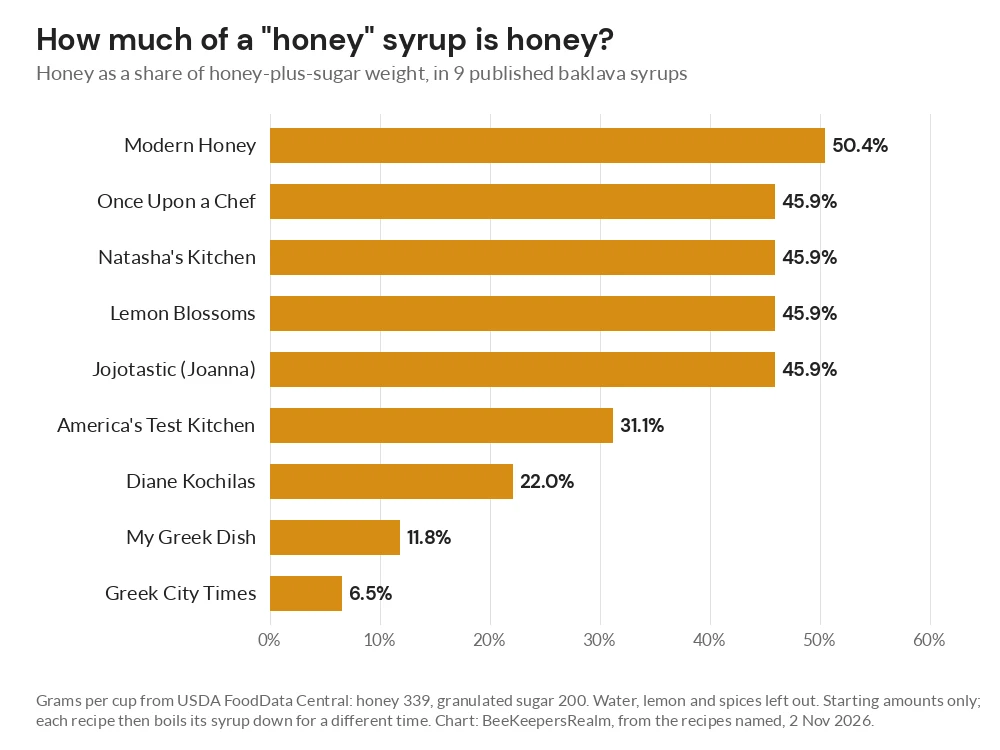
“Honey baklava” is often mostly sugar: Greek City Times uses 2 tablespoons of honey against 3 cups of sugar, and My Greek Dish uses 80 g against 600 g. Most American recipes cluster near 46%, the 1 cup of sugar to 1/2 cup of honey that Once Upon a Chef, Natasha’s Kitchen and Lemon Blossoms share. Water and boiling time vary, so the starting share guides flavor, not final sweetness. The National Honey Board (NHB) says honey is on average 1 to 1.5 times sweeter than sugar by dry weight, so more honey also means a sweeter syrup.
Which Honey to Use for Baklava
Lemon Blossoms says any honey works, and Modern Honey asks for “high-quality” honey without naming a type. The NHB notes that honey’s flavor varies with its floral source, of which the U.S. has over 300. The last column below is our judgment; we found no blind taste test of honeys in baklava.
| Honey | What sources say | Our judgment |
|---|---|---|
| Thyme (Greek) | Archestratos praised Attic thyme-slope honey on pastry, per Goldstein via Wikipedia. | The traditional choice; hard to find in U.S. stores. |
| Pine (Greek) | Kochilas uses it. Wikipedia: honeydew honey, dark amber, sweet and spicy, woody, resinous. | Strong; suits walnut and cinnamon. |
| Orange blossom | Our guide calls it light and delicately floral. Three recipes above add orange peel. | A natural match and easy to buy. |
| Clover or wildflower | The NHB lists clover among the main U.S. floral sources. | Neutral; cinnamon and lemon lead. |
Strong honeys such as buckwheat would crowd out the spices, so we would stay with light to medium ones; our guide to 16 popular U.S. honey varieties helps compare. A crystallized jar also works: warm it as in how to reliquefy honey without damage, or let it dissolve in the hot syrup (our inference).
Cool Syrup on Hot Baklava, or the Reverse?
Recipes disagree here, and their explanations are thin. On 2 November 2026 Google’s AI Overview for “baklava with honey” said to let the syrup cool “or pour warm over hot pastry.” The recipes say:
| Source | What it says to do |
|---|---|
| Modern Honey | Room-temperature syrup on hot baklava; too-warm syrup will not soak in. |
| Natasha’s Kitchen | Cooled syrup right out of the oven; it should sizzle. |
| Lemon Blossoms | Room-temperature syrup; hot on hot can make it soggy. |
| America’s Test Kitchen | Cooled syrup over the cuts from the oven, saving about 2 tablespoons for the end. |
| Diane Kochilas | Room-temperature syrup on hot baklava, then 20 minutes in a switched-off oven. |
| My Greek Dish | Cold syrup ladled slowly on hot baklava; readers ask which version is right, and the author says she updated the page for consistency. |
| Once Upon a Chef | Baklava rests 5 minutes, then cooled syrup goes into the cuts. |
| Jojotastic | Syrup cooled, poured on when the baklava is golden. |
| Greek City Times | Syrup poured after the baklava cools; syrup temperature not stated. |
| Kristen Stein (honey-only blog) | Cool syrup on hot baklava, “or hot syrup over cool baklava”; both hot may be soggy. |
Greek chef Diane Kochilas puts it most firmly:
“Remember the most important tip if you want a crispy end result: cool syrup over hot baklava!”
The pattern is clear: not both hot, and usually cool syrup on hot pastry. But it is recipe-page opinion. We found no controlled test of syrup temperature in any source, and the reasons given (a sizzle, steam) are not measured. The pages even disagree on absorption: a My Greek Dish reader says cold syrup does not soak through, while Modern Honey says warm syrup will not soak in. We follow the majority rule and note that hot-on-cool also has support.
Why Syrup Turns Grainy and Layers Turn Soggy
Grainy syrup. America’s Test Kitchen tested a plain 2-to-1 sugar-to-water syrup with no honey. The untreated control grew crystals within 24 hours; a quarter teaspoon of lemon juice or cream of tartar delayed them to 48 hours. Its fix:
“Simmering the syrup for 10 minutes, instead of merely bringing it to a boil, inverted enough of the sugar without affecting flavor.”
That syrup stayed crystal-free for at least two weeks refrigerated, the test kitchen reports. Inversion means acid and heat split sucrose into glucose and fructose, which get in the way of crystals. Honey already holds both sugars, and it is itself a supersaturated solution. USDA’s honey specification says its granulation rate depends on its fructose-to-glucose ratio, which a MethodsX paper puts between roughly 0.4 and 2.5 (see why some honeys crystallize faster). We found no test of whether honey type changes a baklava syrup’s grain. My Greek Dish adds one rule: do not stir the syrup while it boils, or it turns grainy.
Soggy layers. The recipes blame these causes, none tested: hot syrup on hot pastry (Lemon Blossoms, the honey-only blog); too much butter (Lemon Blossoms); covering the pan too soon (Natasha’s Kitchen cools it uncovered 4 hours or overnight). On cutting they split: America’s Test Kitchen cuts all the way through before baking so syrup soaks in, while Jojotastic cuts partway so syrup does not pool at the bottom. The NHB lists honey as hygroscopic and moisture-retaining in baking, so our inference is that a honey-heavy syrup keeps pastry softer for days than a sugar-heavy one.
When to Add the Honey, and What Heat Does to It
Most recipes boil the honey with the sugar; two stir it in after. My Greek Dish explains why:
“Make sure to add the honey after the syrup stops boiling. This will help maintain the aromas of honey intact.”
We found no study measuring aroma lost from honey in a simmering syrup. What is measured is enzyme loss: by USDA figures in our heating article, invertase loses half its activity in about 40 minutes at 160°F. Enzymes are not why you bake with honey, but adding it off the heat costs nothing, and honey thins fast as it warms.
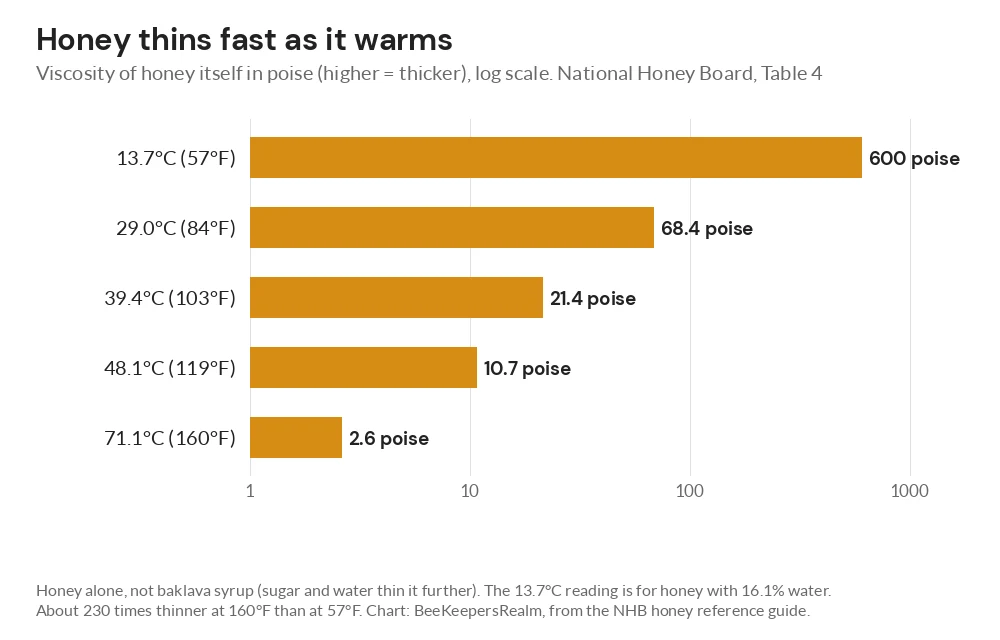
Honey is about 230 times thinner at 160°F than at 57°F. That is honey alone, not syrup, but it may be one reason recipes disagree on how fast syrup soaks in. That is our inference, not a tested result.
A Standard Greek-Style Walnut Baklava With Honey Syrup
We built this from the quantities and methods the recipes above share. We have not baked this exact batch, so times are the sources’ ranges; judge doneness by color. It fills a 9 by 13-inch pan, about 36 pieces.
Ingredients
- 16 oz (1 lb) phyllo dough, about 40 sheets, thawed overnight in the refrigerator
- 1 lb (about 4 cups) walnuts, finely chopped, mixed with 1 tsp ground cinnamon
- 1 1/4 cups (2 1/2 sticks) unsalted butter, melted
- Syrup: 1 cup (200 g) sugar, 3/4 cup water, 1/2 cup (170 g) honey, 2 tbsp lemon juice, 1 cinnamon stick, 2 strips orange peel
Method
- Make the syrup first. Boil the sugar, water, lemon, cinnamon and peel, stirring only until the sugar dissolves, then simmer about 4 minutes. Off the heat, stir in the honey and cool to room temperature.
- Heat the oven to 325°F (Natasha’s Kitchen) to 350°F (Modern Honey). Butter the pan.
- Layer 10 buttered sheets, 3/4 cup of nuts, then 5 sheets and 3/4 cup of nuts, four times over. Finish with 10 buttered sheets, as Natasha’s Kitchen and Modern Honey do.
- Cut into diamonds. Bake until deep golden: about 45 to 50 minutes at 350°F (Modern Honey) or 1 hour 15 minutes at 325°F (Natasha’s Kitchen).
- Right out of the oven, spoon cooled syrup over the cuts until about 2 tablespoons remain, then drizzle the rest on top, as America’s Test Kitchen does.
- Cool uncovered for 4 to 6 hours or overnight, then cover with a tea towel.
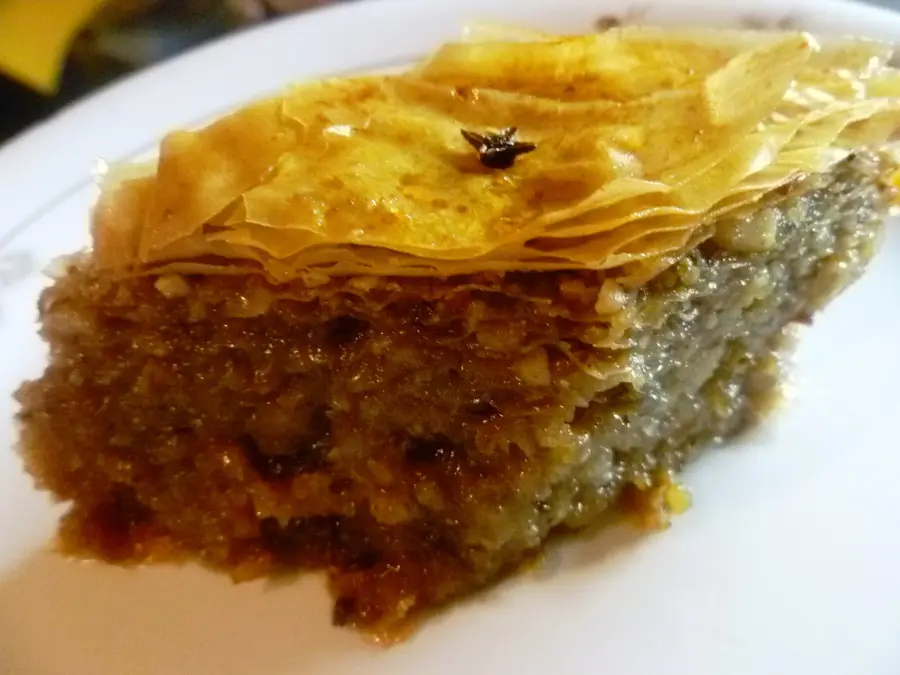
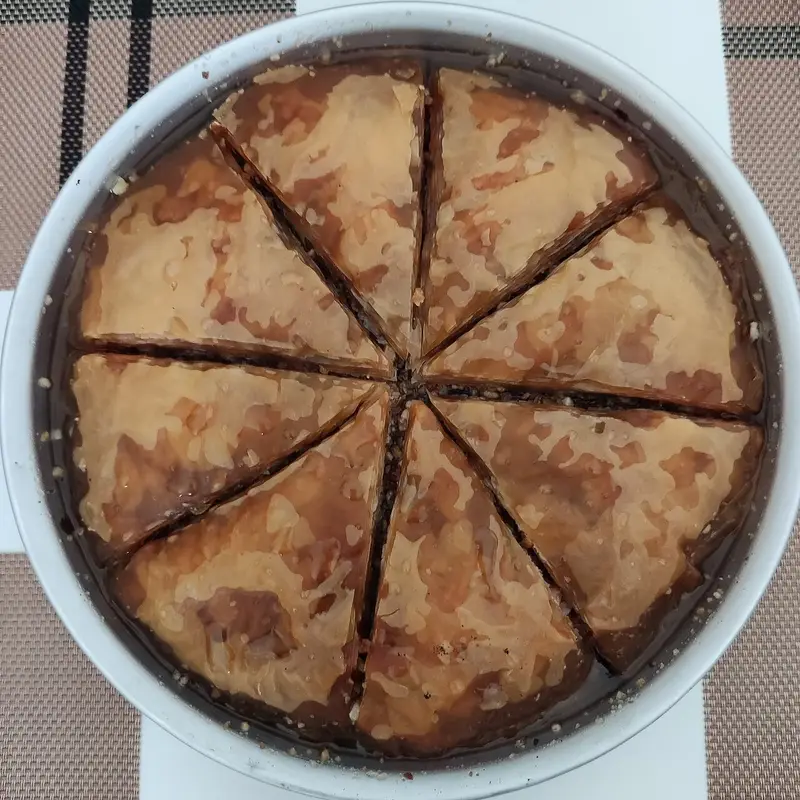
For a pure-honey syrup, the Kristen Stein blog simmers 2 cups of honey with 1/2 cup each of orange juice and water for 15 minutes. Swapping honey for sugar elsewhere? See our honey-for-sugar guide. Drink syrup is a different mix: honey cocktails and honey syrup.
How Long Baklava Keeps
None of the recipe authors cites a food-safety agency, and they differ. At room temperature, My Greek Dish says 2 to 3 days, Once Upon a Chef up to 5, Natasha’s Kitchen up to a week and Lemon Blossoms 1 to 2 weeks. The refrigerator figure is 1 to 2 weeks, with chewier pastry, and the freezer figure is 2 months (Once Upon a Chef, Lemon Blossoms) or 4 (Natasha’s Kitchen). All say room temperature keeps layers crispest. For your honey jar, see how to store honey.
Frequently Asked Questions
Is honey used in baklava?
Often, in the Greek style. Our nine recipes use honey for 6.5% to 50% of the sweetener by weight.
What type of honey is best for baklava?
No source tested this. Greek tradition points to thyme and pine; light honeys such as orange blossom suit the citrus in the syrup.
Do you pour hot or cold syrup on baklava?
Eight of nine recipes use cooled syrup on hot baklava. Avoid both hot, and know that no source tested it.
Why is my baklava soggy?
The recipes blame hot syrup on hot pastry, too much butter and covering the pan while warm. These are claims, not test results.
Why is my baklava syrup grainy?
Sugar crystals. America’s Test Kitchen found a 10-minute simmer prevented them in a sugar syrup for two weeks. Do not stir while it boils.
Can you make baklava with only honey?
Yes. One blog uses 2 cups of honey with orange juice and water and no sugar. It is a single-blog recipe, not a standard.
Is baklava safe for babies?
No. The CDC says not to feed honey, or products made with it, to a child under 1 year old; see why honey is unsafe for infants. This is educational information from the sources named, not medical advice.
The Bottom Line
Start with 1 cup of sugar to 1/2 cup of a light honey, stir the honey in off the heat, pour the cooled syrup on pastry fresh from the oven, and keep it from babies.