Reviewed by Thomas B. · Last Updated September 24, 2026 · How we review
Foundationless frames work well in honey supers, provided you decide how you will harvest the comb before you build the frames. Leave them unwired if you want cut comb or crush-and-strain honey. Add horizontal monofilament or stainless steel wire if the frames will go through an extractor. Whichever you choose, the supers need a comb guide on every top bar, a hive that is level along the line of the frames, a real nectar flow, and at least one drawn comb so the bees build straight.
This guide covers only honey supers: how bees build comb for storing honey, how to build a frame for each harvest method, and how to time foundationless supers around the short, heavy flows of the northern Plains. For the brood nest, see our guides to package bees on foundationless frames and whether to use foundation in brood boxes.
Key Takeaways
- Pick the harvest method first. Unwired frames are for cut comb and crush-and-strain. Frames you plan to extract need monofilament or wire.
- Bees build honey comb differently from brood comb. Storage comb comes out fatter and more irregular, so spacing and guides matter even more in supers.
- Use the full frame count until the comb is drawn. Put ten frames in a ten-frame super and include at least one drawn comb as a ladder.
- Level the hive along the plane of the frames. A front-to-back tilt does not affect comb direction.
- New comb is soft. Extract only comb that is attached on all four sides, and start the extractor slowly.
- Canola honey can set in the comb. In the Red River Valley, save cut-comb supers for the clover and alfalfa flows.
Table of Contents
- Why Supers Are the Hardest Place to Go Foundationless
- Choose Your Harvest Method Before You Build
- Building a Foundationless Super Frame
- Getting Straight Comb in a Honey Super
- Extracting Foundationless Comb Without Blowouts
- Cut Comb and Crush-and-Strain From the Same Super
- Timing Foundationless Supers in the Red River Valley
- Frequently Asked Questions
Why Supers Are the Hardest Place to Go Foundationless
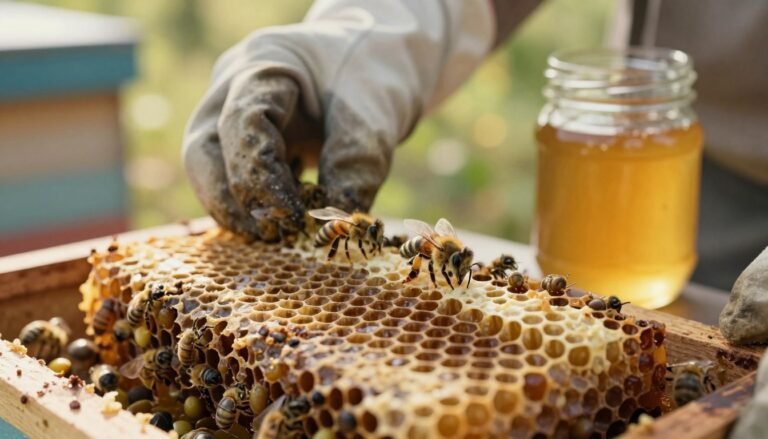
Many beekeepers try foundationless frames in the honey super first, because there is no brood to damage there. In practice, the super is where natural comb is hardest to control. Hilary Kearney of Girl Next Door Honey, writing on Beekeeping Like A Girl, observes that bees build more creatively in honey supers than in the brood nest. They draw fat combs with deep storage cells and often curve a comb so that it starts on one frame and ends on the next.
The reason is that brood comb has to stay a fixed thickness for raising brood, while storage comb has no such limit. Bees stretch honey cells into any spare space, whether that is a missing frame, uneven spacing, or a frame pushed to one side. Comb that is heavy with honey is also much harder to straighten than half-built comb in a brood box.
Without foundation, bees also build some drone-size cells and use them for honey. That doesn’t matter in an extracting super. In a cut-comb super, though, a queen who gets above the brood box will find fresh comb to lay in, so run a queen excluder under any comb honey super.
Choose Your Harvest Method Before You Build
This is the decision most guides skip. A foundationless frame built for cut comb makes a poor extracting frame, and the reverse is also true. Decide what each super is for, then build and label its frames to match.
| Harvest method | Frame support | What the comb must be | What happens to the comb |
|---|---|---|---|
| Cut comb or chunk honey | None; comb guide only | Fully capped, white, even thickness | Sold or eaten; the bees rebuild the frame from scratch |
| Crush-and-strain | None needed | Mostly capped; shape doesn’t matter | Crushed; the wax is rendered and the bees rebuild |
| Extraction | Horizontal monofilament or stainless wire | Attached on all four sides and no longer soft | Returned to the hive and reused for years |
| Mixed use | One horizontal support near the middle | Capped and attached | Extracted, or cut into squares above and below the support |
The trade-off is comb. Drawn comb is the most valuable thing in a super, because the bees can fill it right away instead of spending nectar and time making wax. Cut comb and crush-and-strain use up that comb every harvest, while extraction keeps it. A common middle path is one or two cut-comb supers per strong colony, with the rest extracted.
Building a Foundationless Super Frame
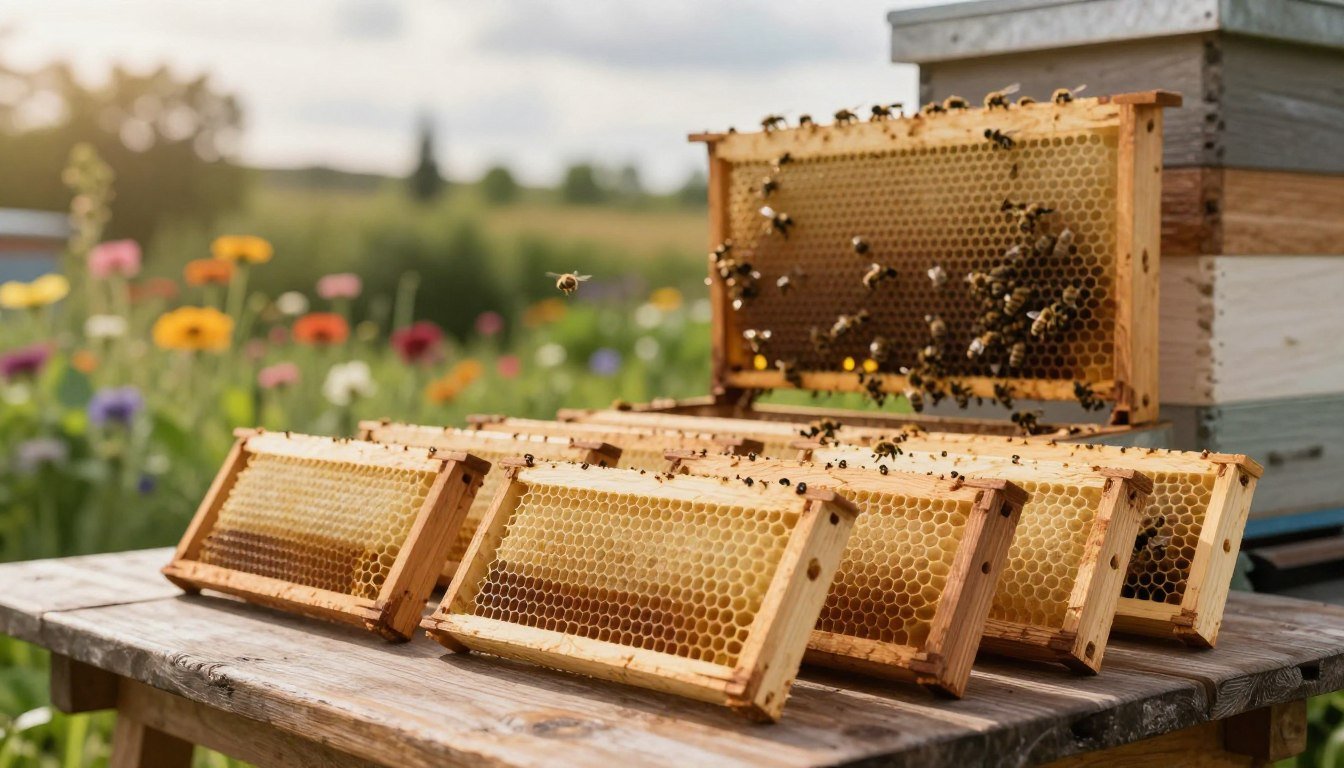
A foundationless frame is an ordinary super frame with a guide on the top bar and, if needed, a support running through the comb. Medium frames (6-1/4 inches deep, for a 6-5/8 inch super) and shallow frames both work. Shallows weigh less, so their new comb holds up better in an extractor.
Step 1: Choose a frame that is easy to convert
Wedge-top frames are the easiest. Pry the wedge out, turn it on edge, and glue and nail it back along the centre of the top bar so it hangs down as a narrow ridge. On grooved-top frames, glue a wood strip or a strip of thin foundation into the groove. Glue and nail every joint, because a full comb of honey hangs entirely from the frame.
Step 2: Add a comb guide on every frame
Bees start comb along a ridge, so every frame needs a guide. Options include the turned wedge, wooden craft sticks, or a strip of thin foundation about an inch deep. David Evans, a biologist who writes The Apiarist, glues wooden tongue depressors into his frames as starter strips. A thin coat of clean beeswax, melted in a double boiler and never over direct heat, can help the bees take to a wooden guide.
Step 3: Add support only if the frame will be extracted
For extracting frames, thread two horizontal runs through holes drilled in the side bars of a medium frame. Evans built his early frames with 40 to 50 lb breaking-strain nylon monofilament and warns that lighter line can be chewed through. Tensioned stainless steel wire also works. Leave cut-comb frames without any support, since nobody wants a wire through a square of comb honey.
“I have dozens of foundationless super frames, all built with horizontal mono support. These have been in use for almost a decade and go through the radial extractor once or twice a season with very few breakages.”
Step 4: Mark the frames by purpose
Mark the top bar of every unwired cut-comb frame with a paint dot or a letter. Frames get mixed up at harvest, and an unwired frame of new comb that goes into the extractor by mistake will usually blow out.
Getting Straight Comb in a Honey Super
- Use the full frame count. Ten undrawn frames go in a ten-frame super. With nine, the bees get room to build fat, wavy comb. Our guide to frame spacing for straight comb explains the 1-3/8 inch rule behind this.
- Level along the plane of the frames. Evans notes that the hive must be perfectly level when viewed along the plane of the frames, but it does not need to be level in the other direction. A phone level app laid along a top bar is enough.
- Give the bees a ladder. Michael Bush, in his Bush Farms foundationless FAQ, notes that bees without a comb to climb sometimes start building up from the bottom bar. He prefers to put one drawn comb or one full sheet of foundation in each super he adds.
- Add supers during a flow. Bees build wax when nectar is coming in and the colony is crowded. If new frames sit untouched, see why bees refuse to draw foundation.
- Check early, while the comb is soft. Look five to seven days after adding a super. Comb that is starting to veer can be pressed back into line while it is still soft, but not once it is full of honey. For worse cases, see what causes cross comb in foundationless hives.
Once extracting frames have been drawn and harvested once, you can drop to nine per box for fatter, faster-to-uncap comb. Keep cut-comb supers at ten, because thick comb won’t fit standard comb-honey boxes.
Extracting Foundationless Comb Without Blowouts
Foundationless comb can be extracted. The risks come from young comb and poor attachment, not from the missing foundation.
“Just make sure they are attached on all four sides and the wax isn’t so new that it’s still soft, like putty.”
- Extract warm honey. Honey straight from the hive, or supers left overnight in a warm room, comes off the comb with less force than cold honey.
- Prefer a radial extractor. Radial machines empty both faces at once and are gentler on new comb. In a tangential machine, spin each side partway at low speed, flip the frames, then finish. See radial vs tangential extractors.
- Start slowly. Raise the speed only after the first honey has come off and the comb is lighter.
- Uncap shallowly. Natural comb is uneven, so take a light pass with a sharp uncapping knife rather than cutting deep toward the midrib.
If a comb does blow out, crush and strain the pieces and add the wax to your cappings for rendering. Comb that survives a season or two gets tougher as it darkens. For when to retire it, see when to rotate honey frames out of service.
Cut Comb and Crush-and-Strain From the Same Super
A super of unwired frames seldom produces cut-comb quality in every frame, so sort the frames at harvest:
- Cut-comb grade: capped edge to edge, white or pale cappings, even thickness and no pollen cells. Cut these into squares, drain them on a rack, pack them, and freeze them until they are frozen through to kill wax moth eggs. Honey Bee Suite cites a USDA recommendation of 24 hours at 0°F. For packaging and pricing, see our cut comb honey production guide.
- Crush-and-strain grade: partly capped, wavy, or holding a few pollen cells. Crush the comb, strain it coarse then fine, and render the wax. This honey carries more pollen and wax fines than extracted honey. See raw honey filtration levels for how far to strain.
Comb honey eaters also eat the wax, which gives foundationless comb a real advantage. Mullin et al. (2010, PLOS ONE) found miticide residues in almost all comb and foundation wax samples (98%) taken mostly from commercial North American apiaries. Comb honey built on foundation has a midrib made from that recycled wax supply. Foundationless comb is made entirely of wax the bees produced that season. That new wax can still pick up residues from whatever is used in the hive, so it isn’t guaranteed residue-free, but it hasn’t come from other operations. For how the two products compare, see comb honey vs extracted honey.
Timing Foundationless Supers in the Red River Valley
North Dakota produced 30.8 million pounds of honey in 2025, about 27 percent of the U.S. crop, from 460,000 colonies averaging 67 pounds each (USDA NASS Honey report, March 2026). Most of that honey comes in during a short midsummer flow. Across eastern North Dakota and western Minnesota, that short window shapes how foundationless supers are used.
- Don’t add too many empty supers too early. Wait for a strong colony and a main flow that is under way. A colony drawing several supers at once leaves ragged, partly built frames.
- Keep canola out of your comb honey. Rusty Burlew of Honey Bee Suite notes that canola honey can crystallize in the comb while still in the field. Granulated comb can’t be sold as cut comb and is hard to extract. Put cut-comb supers on after canola, for the sweet clover and alfalfa flows, and extract canola supers promptly. If canola honey has already set, see reliquefying crystallized honey. For the chemistry, see why some honeys crystallize faster than others.
- Pull comb honey as soon as it is capped. Cappings darken as bees walk over them (known as travel stain), and white cappings are what sells cut comb.
- Protect drawn comb over winter. Drawn foundationless comb gives the colony a head start next season. Keep it cold or frozen, and away from wax moths and mice.
Frequently Asked Questions
Can you extract honey from foundationless frames?
Yes, if the comb is attached on all four sides and has firmed up. Add horizontal monofilament or wire to frames you plan to extract, extract warm honey, and start slowly. A radial extractor is gentler than a tangential one.
Do foundationless super frames need wire?
Only if they will be extracted. Leave cut-comb and crush-and-strain frames unsupported. For extracting frames, use two horizontal runs of 40 to 50 lb monofilament or stainless wire.
How many foundationless frames should go in a honey super?
Use ten in a ten-frame super until the comb is drawn, with at least one drawn comb as a ladder. Extracting supers can drop to nine once drawn. Keep cut-comb supers at ten.
Will bees build drone comb in foundationless honey supers?
Often, yes, and they fill those cells with honey. It only becomes a problem if the queen gets into the super, so use a queen excluder under comb honey supers.
Is foundationless comb honey better than comb honey on thin foundation?
Both work. Thin surplus foundation gives more uniform comb. Foundationless comb has a midrib made entirely of new wax from that season, which some buyers prefer.
Can I put a whole super of empty foundationless frames on a hive?
Yes, on a strong colony during a flow. Without a drawn comb in the box, though, you risk irregular comb or comb built up from the bottom bars.
The Bottom Line
Foundationless honey supers work when each frame is built for how it will be harvested. Leave cut-comb frames unwired, support extracting frames, keep the hive level along the frames, and give the bees drawn comb to start from. In canola country, save comb honey supers for the later clover and alfalfa flows.