Reviewed by Sofia T. · Last Updated September 24, 2026 · How we review
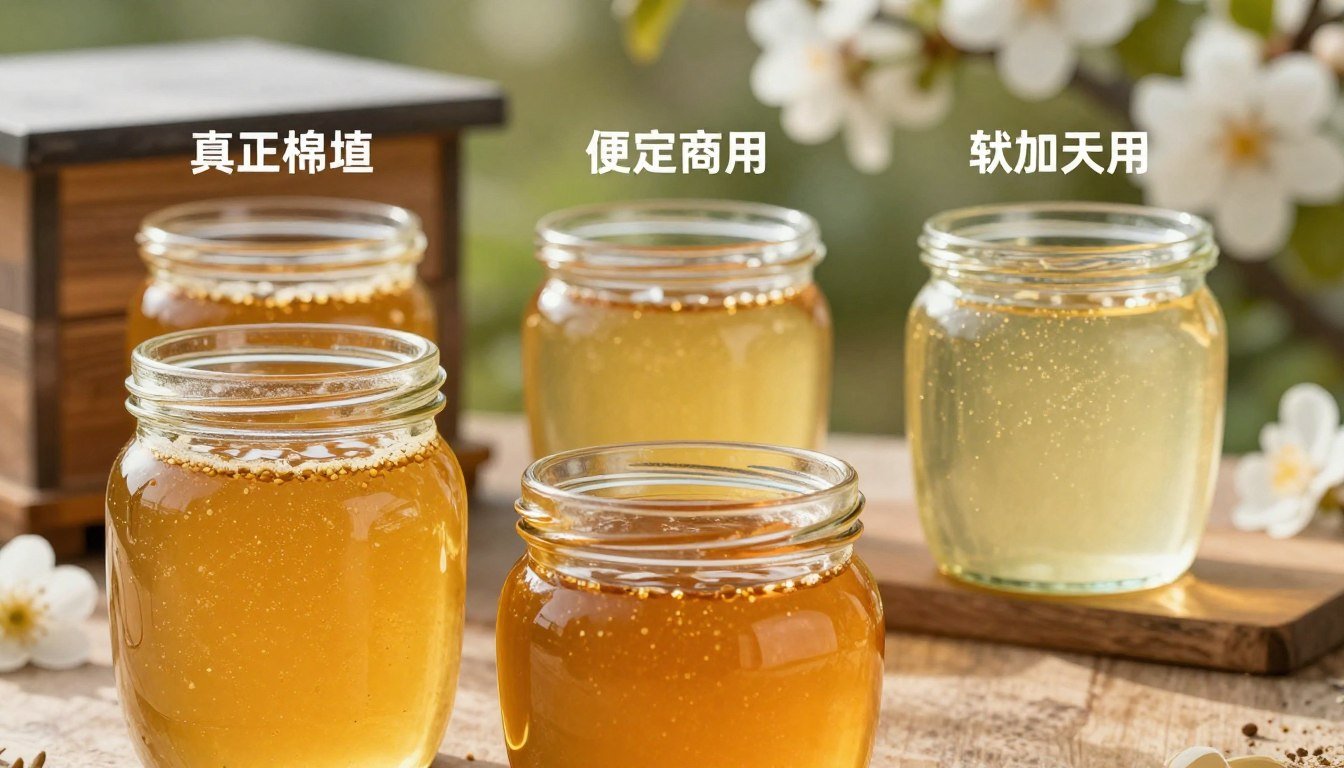
Raw honey ranges from barely processed to heavily processed, and the steps in between remove progressively smaller particles. Settled and coarse-strained honey loses only wax chunks and bee parts. Fine-strained honey, typically passed through a 200 to 400 micron mesh, loses fine wax but keeps nearly all its pollen, because most pollen grains are well under 100 microns. Filtered honey has been pushed, usually warm and under pressure, through filter media fine enough to remove much of its pollen. Ultrafiltered honey has had essentially all of its pollen removed. The first three levels are what most people mean by “raw, unfiltered.” The last two produce the glass-clear honey on supermarket shelves.
This guide covers the filtration ladder itself: what each level removes, what the official definitions say, and why pollen matters as evidence of where honey came from. For what heat does to honey, see raw vs processed honey. For pollen counts, see pollen content in unfiltered honey.
Key Takeaways
- Straining and filtering are different things. Straining removes debris and leaves pollen in. Filtering removes some or most of the pollen.
- Pollen is smaller than any kitchen or beekeeping strainer. Most grains are 10 to 100 microns across, while hobby strainers run from 200 to 600 microns.
- “Raw” and “unfiltered” are separate claims. “Raw” is about heat, and “unfiltered” is about pollen. Neither has a federal legal definition in the U.S.
- The USDA separates “strained” from “filtered” honey. Clarity is scored only for the filtered style, so cloudy strained honey isn’t marked down for its pollen.
- International rules protect pollen. The Codex honey standard says honey with significant pollen removed must be labeled “filtered.”
- Pollen shows where honey came from. Removing it also removes the main evidence of floral and geographic origin.
Table of Contents
- The Five Filtration Levels at a Glance
- How Big Is Pollen Compared With a Strainer?
- What the Official Definitions Say
- “Raw” and “Unfiltered” Are Different Claims
- Why Pollen Is the Authenticity Test
- How to Check a Honey’s Filtration Level Yourself
- Choosing a Filtration Level for Your Own Honey
- Reading a Jar as a Buyer
- Frequently Asked Questions
The Five Filtration Levels at a Glance
There is no official numbered scale for honey filtration. The levels below describe common practice, from comb crushed in a kitchen to industrial membrane systems. Mesh sizes are typical ranges, not standards. Commercial filter media vary from plant to plant and are rarely published.
| Level | Typical method | What it removes | What stays in | Usual label language |
|---|---|---|---|---|
| 1. Settled only | Honey rests in a tank or pail, and the wax and foam are skimmed off the top | Floating wax, foam and air bubbles | Pollen, fine wax, propolis traces | Raw, unfiltered |
| 2. Coarse strained | Kitchen sieve or the top screen of a double sieve (roughly 600 microns or larger) | Wax chunks, bee parts, wood splinters | Pollen, fine wax particles | Raw, unfiltered, strained |
| 3. Fine strained | Fine sieve or nylon strainer bag (roughly 200 to 400 microns) | Most visible wax and debris | Nearly all pollen | Raw, strained, unfiltered |
| 4. Filtered | Honey warmed and passed through fine filter media, often under pressure | Fine particles, air bubbles, some to most pollen | Dissolved sugars, acids, some enzymes (depending on heat) | Honey, pure honey; “filtered” under Codex rules |
| 5. Ultrafiltered | Heated, sometimes diluted, and forced at high pressure through very fine filters | Essentially all pollen and suspended solids | A clear sugar solution with no floral fingerprint | Often sold simply as “honey” |
Levels 1 to 3 are what small beekeepers and farmers-market sellers produce. Level 4 is the normal clear, shelf-stable honey sold in supermarkets. Level 5 was described by Food Safety News in 2011 as a process in which honey is heated, sometimes watered down, and forced at high pressure through extremely small filters to remove pollen. In practice, buyers often can’t tell level 4 from level 5 without a pollen test.
How Big Is Pollen Compared With a Strainer?
The whole question of “does straining remove pollen?” comes down to size. A micron is a thousandth of a millimetre. Pollen grains vary widely by plant: the smallest, from forget-me-not, are about 2.5 to 5 microns, most grass pollen is around 20 to 25 microns, and corn pollen, one of the largest common types, is about 90 to 100 microns.
| Item | Approximate size |
|---|---|
| Coarse honey sieve (top screen) | 600 microns or more |
| Fine honey sieve or strainer bag | 200 to 400 microns |
| Large pollen grain (corn) | 90 to 100 microns |
| Typical pollen grain (grasses and many crops) | 20 to 25 microns |
| Smallest pollen grain (forget-me-not) | 2.5 to 5 microns |
| Laboratory membrane used to trap pollen for counting | 3 microns |
Even the finest common hobby strainer has openings about twice the size of the largest common pollen grains, and ten times the size of typical ones, so pollen passes straight through. The finest strainers catch wax particles, crystals and bits of propolis. That’s why the strainer clogs, especially when honey is cold. For more on how fine to strain, see our comparison of coarse and fine straining.
Removing pollen takes much tighter media, and fine media need thin, warm honey pushed through under pressure. That’s why commercial filtration almost always goes with heating. The International Honey Commission’s melissopalynology methods use a 3-micron membrane filter to collect pollen for counting, which shows how fine a filter has to be to catch it all.
What the Official Definitions Say
In the U.S., the labeling terms around filtration come from voluntary grading standards and industry definitions rather than binding law. The sources don’t all say the same thing, so it helps to read them together.
| Source | Term | What it says | Legal weight |
|---|---|---|---|
| USDA Standards for Grades of Extracted Honey | Strained style | Most particles, including comb and propolis, removed; pollen, small air bubbles and very fine particles would not normally be removed | Voluntary grading standard |
| USDA (same standard) | Filtered style | All or most of the fine particles, pollen grains, air bubbles and other suspended materials removed | Voluntary grading standard |
| National Honey Board definitions (1996, updated 2003) | Strained honey | Passed through mesh to remove wax, propolis and other defects without removing pollen | Industry definition |
| National Honey Board (same) | Filtered honey | Processed by filtration to remove extraneous solids and pollen grains | Industry definition |
| Codex Alimentarius Standard for Honey (CXS 12-1981) | Filtered honey | Honey filtered so as to significantly remove pollen must be designated “filtered honey” | International reference standard |
| FDA | Raw, unfiltered | No definition. FDA’s 2018 guidance on labeling honey targets adulteration and misbranding, such as honey mixed with other sweeteners | Not defined |
The National Honey Board’s definition of raw honey is the one most producers follow:
“Raw Honey: Honey as it exists in the beehive or as obtained by extraction, settling or straining without adding heat.”
Two details are worth noting. First, the NHB definition allows settling and straining but doesn’t mention filtering, so honey fine-filtered to the point of losing pollen doesn’t fit it even if no heat was used. The NHB also defines “commercially raw honey” as honey obtained by minimum processing, and notes that this product is often labeled as raw. Second, the USDA standard scores clarity only for the filtered style. Strained honey is graded on flavor and absence of defects, so a cloudy, pollen-rich strained honey can still earn U.S. Grade A.
The Codex standard goes further. It says no pollen or constituent particular to honey may be removed except where this is unavoidable in removing foreign matter. Under Codex rules, heavy filtration isn’t just a processing choice. It changes what the product has to be called.
“Raw” and “Unfiltered” Are Different Claims
Labels often put “raw” and “unfiltered” together, but they describe different things. “Raw” is about heat, and “unfiltered” is about pollen and fine particles. A honey can meet one claim and not the other.
| Strained (pollen kept) | Filtered (pollen removed) | |
|---|---|---|
| Not heated | Typical small-beekeeper honey: raw and unfiltered | Uncommon. Cold honey is very slow to push through fine media |
| Heated | Warmed for bottling or to dissolve crystals, but still strained only | Typical supermarket honey: clear and slow to crystallize |
The bottom-left box is where most honest confusion happens. Many beekeepers warm honey to make it flow through a strainer or into jars. Moderate warming close to hive temperature, as described in our honey bottling temperature guide, keeps enzyme activity largely intact. The NHB’s raw definition, however, says “without adding heat.” If you warm your honey, a label such as “unfiltered, gently warmed” is more honest than “raw.” For how heat damages honey, see our diastase number explainer.
Why Pollen Is the Authenticity Test
Pollen grains have shapes that identify the plant they came from. Counting and identifying them, a method called melissopalynology, is how labs confirm a honey’s floral source and region. A clover honey from the Red River Valley carries a pollen profile consistent with clover and other northern-prairie plants. A honey with no pollen can’t be traced this way.
That is the main reason pollen removal became a controversy. In the 2011 Food Safety News investigation, Texas A&M palynologist Vaughn Bryant tested more than 60 honeys bought across the U.S. He found that 76 percent of samples bought at grocery stores had all of their pollen removed. The pollen-rich samples came mainly from farmers markets, co-ops and natural-food stores. The report also noted that bodies including the European Commission hold that without pollen there is no way to determine whether a honey came from legitimate and safe sources.
This matters to beekeepers as well as buyers. If you sell honey as local, the pollen in it is your evidence. Keeping records of where and when each batch was harvested, as in our lot tracking system for honey sales, together with honey that still contains its pollen, gives you a traceable product. Heavy filtering takes away half of that evidence.
How to Check a Honey’s Filtration Level Yourself
You can’t read filtration level off a label, but you can check for pollen directly. The laboratory method published by the International Honey Commission is simple enough to adapt at home, as long as you treat the result as a yes-or-no check rather than a count.
- Dissolve the honey. The IHC method dissolves 10 g of honey in 20 mL of warm distilled water, at 20 to 40°C. At home, stir about two teaspoons of honey into a few tablespoons of lukewarm distilled water until no streaks remain.
- Collect the sediment. Labs centrifuge the solution for 10 minutes. Without a centrifuge, let a narrow glass of the solution stand undisturbed for several hours, then pour off most of the liquid, leaving the last few drops.
- Look under magnification. Put a drop of the sediment on a microscope slide. The IHC method examines slides at 400 to 1000 times magnification. A basic student microscope at 400x will show pollen grains as distinct round, oval or spiky shapes, often with pores or furrows.
- Read the result. A strained honey will show many grains in most fields of view. A filtered honey will show few or none, just an occasional crystal or bubble.
This check won’t tell you the floral source, since identifying pollen takes training and reference slides. It will, however, tell you quickly whether a jar labeled “unfiltered” really kept its pollen. For a professional answer, a honey testing laboratory can run a full pollen analysis.
Choosing a Filtration Level for Your Own Honey
For most small producers, the right level is 2 or 3: coarse, then fine straining, with settling in between. Here is a simple sequence.
Step 1: Strain coarse while the honey is warm from the hive
Run honey from the extractor through a coarse screen to catch cappings wax and bee parts. Honey extracted the same day it comes off the hive is warmer and passes through far faster than honey from cold supers. In eastern North Dakota and western Minnesota, where much of the crop is fast-granulating canola and clover, straining promptly also matters because honey that begins to set will clog every screen. See why some honeys crystallize faster than others.
Step 2: Strain fine, but not finer than you need
A 200 to 400 micron nylon bag or fine sieve gives clean honey that still carries its pollen. Going finer, with layered cheesecloth or tight filter cloth, mostly slows the flow and tempts you to add heat. If you use a bottling bucket with a gate, a honey gate strainer can serve as a last check.
Step 3: Let it settle and skim
Let strained honey stand so air bubbles and fine wax rise to the top. Southern Cross University’s honey crystallisation fact sheet recommends at least 48 hours in a settling tank before drawing honey off the bottom. Skim the foam layer, as described in our guide to skimming wax and foam. Settling is free, it uses no heat, and it removes much of what a finer filter would.
Step 4: Label what you actually did
If you strained without heating, “raw, strained” or “raw, unfiltered” is accurate under the NHB definitions. If you warmed the honey above hive temperature to bottle it, drop “raw.” If you ever fine-filter enough to remove pollen, don’t call it unfiltered. Also check your state’s rules for labeling and selling honey, since cottage food laws differ between North Dakota, Minnesota and other states.
Reading a Jar as a Buyer
- Slight cloudiness or a fine foam layer is normal for strained honey, since the pollen, fine wax and tiny bubbles are still in it.
- Crystallization is a weak signal. Pollen and particles speed crystallization, so strained honey often sets sooner than filtered honey. But slow-setting honeys stay liquid even when raw, so a liquid jar doesn’t prove the honey was processed.
- “Pure” says nothing about filtration. It means nothing was added.
- Ask for numbers. A producer who can tell you the mesh size they strain through and the highest temperature the honey reaches is giving you more than a label can.
For store-bought options, see our review of raw honey brands you can actually buy.
Frequently Asked Questions
Does straining honey remove pollen?
No. Beekeeping strainers have openings of about 200 to 600 microns, and most pollen grains are 10 to 100 microns, so pollen passes through. Straining removes wax, bee parts and other debris.
What is the difference between filtered and ultrafiltered honey?
Filtered honey has been passed through fine media, usually warm and under pressure, to remove fine particles and some or most of the pollen. Ultrafiltered honey has been heated, sometimes diluted, and forced through extremely fine filters to remove essentially all pollen.
Is filtered honey still real honey?
Filtered honey is still honey, since nothing has been added. The Codex standard requires it to be labeled “filtered honey” when significant pollen has been removed. The concern with heavy filtration is traceability, because without pollen a honey’s origin can’t be checked.
Can raw honey be filtered?
By the National Honey Board definition, raw honey is obtained by extraction, settling or straining without added heat, so filtering is not part of it. In practice, pollen-removing filtration needs warm honey, which also rules out “raw.”
What micron strainer should I use for honey?
Most beekeepers use a two-stage setup: a coarse screen around 600 microns, then a fine screen or bag around 200 to 400 microns. That removes visible debris while leaving pollen in the honey.
Why is supermarket honey so clear?
It is usually heated and filtered to remove pollen, fine wax and air bubbles. That makes the honey clear and slows crystallization on the shelf, but it also removes the pollen that shows where the honey came from.
Does the USDA define raw honey?
No. The USDA grading standard defines “strained” and “filtered” styles, and the National Honey Board has an industry definition of raw honey, but no federal regulation defines “raw” for honey.
The Bottom Line
The key line in honey filtration is between straining, which removes debris, and filtering, which removes pollen. Honey that has been settled and strained through a 200 to 400 micron mesh keeps its pollen and, if unheated, meets the National Honey Board’s definition of raw. Filtered and ultrafiltered honey loses its pollen and, with it, the evidence of where it came from. Whether you are buying or selling, labels are less reliable than knowing the mesh size and the highest temperature the honey reached.