Reviewed by Thomas B. · Last Updated September 23, 2026 · How we review
Lot tracking for direct-to-consumer honey sales means giving every bottling run its own code, printing that code on each jar, and keeping a short paper trail that links the code backward to the hives and buckets it came from and forward to the market days or orders where it was sold. For most small U.S. beekeepers it is not a federal legal requirement, but it is the only thing that lets you pull back 40 jars instead of your whole season when a customer reports a fermented, off-tasting or contaminated jar.
Below is a lot system sized for a hobby or sideline seller, based on how we sell honey in eastern North Dakota and western Minnesota. It also covers the part generic inventory guides skip: most direct-to-consumer buyers are anonymous, so your records have to work even when you don’t know who bought the jar.
Key Takeaways
- A lot is one bottling run from one blended source of honey. Two bottling days means two lots.
- Federal one-up/one-back food records exclude farms and retail food businesses with 10 or fewer full-time-equivalent employees, and honey is not on the FDA Food Traceability List, so for most small sellers lot tracking is voluntary. Do it anyway: it is cheap insurance.
- The system needs four records: a harvest log, a bucket or tank log, a bottling log, and a sales log that notes which lot went to which market day or order.
- Keep one retention jar from every lot for at least a year. It tells you whether a complaint is a lot problem or a storage problem.
- A real 2025 recall of whipped honey in Wyoming was limited to specific lot codes, and customers were asked to photograph the jar bottom showing the lot number.
Table of Contents
What Counts as One Lot of Honey
A lot is honey you can reasonably assume is uniform: same source, same processing, bottled in one continuous run. Start a new lot when any of these change:
- The source honey. A different extraction day, a different yard, or a different bucket that was not blended with the first.
- The processing. Honey warmed to reliquefy crystals, honey that went through a finer strainer, or honey that was creamed or infused. Creamed and flavored honey should always be their own lots.
- The bottling session. Even from the same settling tank, a run on a different day is a separate lot. Contamination such as a chipped jar, a failed gasket or a foreign object tends to happen within one session.
- The container. A new case of jars or lids from a different supplier shipment. If a batch of lids turns out to have faulty liners, you want to know which jars got them.
For a typical Red River Valley sideline operation that pulls supers once or twice a summer, that usually means a handful to a few dozen lots per season.
| Situation | One lot or several? | Why |
|---|---|---|
| Three buckets blended in one settling tank, bottled in one afternoon | One lot | The honey is mixed, so any problem is shared across every jar. |
| One settling tank bottled over two evenings | Two lots | Equipment, jars and handling can differ between sessions. |
| Early clover honey and late sunflower honey from the same yard | Two lots | Different moisture, flavor and crystallization behavior. |
| Liquid honey, then part of it turned into creamed honey | Two lots | Creaming adds a seed and a processing step. |
Is Lot Tracking Legally Required?
For most small U.S. beekeepers selling their own honey directly to consumers, no federal rule requires lot codes. The FDA recordkeeping rule written under the Bioterrorism Act, which requires food businesses to know where food came from and where it went, carves out small operators. Under 21 CFR 1.327, farms are excluded from the whole subpart, and retail food establishments with 10 or fewer full-time-equivalent employees are excluded from everything except the requirement to make records available when FDA asks. FDA’s newer Food Safety Modernization Act traceability rule applies only to foods on its Food Traceability List, such as leafy greens, soft cheeses, shell eggs and finfish. Honey is not on it.
State rules in our region point the same way. North Dakota’s cottage food statute goes further than most and forbids agencies from requiring licensing or labeling for cottage food sold directly to an informed consumer. It does, however, leave the door open to complaint-driven investigation:
“The department of health and human services or a local regulating authority may conduct an investigation upon complaint of an illness or environmental health complaint.”
North Dakota Century Code §23-09.5-02(9), Cottage Food Production and Sales
That clause is the practical reason to keep lot records. If an investigator or an upset customer asks what else came from the same honey, “I don’t know” is the worst possible answer. In Minnesota, the Department of Agriculture says no cottage food registration or license is needed for honey from hives you own or rent with nothing added. Once you add flavorings or buy in honey from someone else, cottage food registration applies, and its label must show the date the food was made. That date works as a basic lot marker.
Lot rules are stricter outside the U.S. UK trading standards guidance, for example, expects prepacked honey to carry a lot mark or a day-and-month best-before date. Rules also change when you sell wholesale to a store or co-op, which may require codes as a condition of stocking your jars, and exporting brings its own documentation; see our overview of the honey export process. For the full label picture, see our guides to U.S. honey labeling requirements and cottage food laws for honey sellers. Treat this section as orientation, not legal advice, and check your own state’s current rules.
A Simple Lot Code Format That Works
We use this format: YYMMDD-run letter. Honey bottled on August 14, 2026, in the first run of the day becomes 260814-A, and a second run that evening becomes 260814-B. It fits on a date-stamp band and sorts correctly in a spreadsheet.
| Format | Example | Strengths | Weaknesses |
|---|---|---|---|
| Bottling date + run letter | 260814-A | Self-explanatory, sorts chronologically, easy to stamp | Reveals bottling date (rarely a problem for honey) |
| Year + sequential number | 26-07 | Very short; fits tiny labels and comb boxes | Meaningless without your log |
| Year + yard + harvest + run | 26-NY-H2-A | Encodes origin for varietal or single-yard claims | Longer; more room for transcription errors |
Put the code where it survives the jar’s life: the jar bottom or the lower back label edge, not the lid.
Batch Coding the Jars Themselves
“Batch code” and “lot code” mean the same thing here: a code on the jar that points to one bottling run. How you apply it matters less than doing it the same way every time, during the bottling session, before any jar leaves the bench. The common options for a small seller:
| Method | How it works | Watch out for |
|---|---|---|
| Adjustable date or number stamp | Stamp the code on the back label, or on a small blank sticker for the jar bottom | Use a quick-drying permanent ink and test it on your label stock; ordinary pad ink can smear on sticky glass |
| Pre-printed label with a lot field | Print “Lot:” on the label and fill in the code with a fine permanent marker | Handwriting errors, and slow beyond a few dozen jars |
| Code printed with the label | Add the lot code to the label file and print one label run per lot on an inkjet, laser or thermal printer | Leftover labels from one lot must never go on the next; mark or destroy extras |
- Code at the bench, not later. Apply codes as each case is filled and capped, so uncoded jars never sit in a box waiting for a labeling day where they can get mixed with another lot.
- One lot on the bench at a time. Finish, code and box one run before starting the next, and write the lot code on the outside of each case.
- Use labels that survive honey. Uncoated paper labels stain and smear when honey runs down a jar. Waterproof polypropylene or coated labels keep the code legible. If you print on an inkjet, check that the ink does not run when wiped with a damp cloth.
- Keep the code human-readable. A plain code such as 260814-A is easy for a customer to read out over the phone or photograph. A QR code linking to harvest details is optional marketing, not a replacement for a printed code.
For printers, stamps and label stock, see our label printer and packaging supplies guide.
The Four Records That Make Up the System
The code on the jar is only useful if it points to records. For a small seller, four short logs are enough. Each one links to the next.
1. Harvest log
For each extraction, record the date, the yards and hives or supers the frames came from, and the approximate weight. Also note any treatment status that matters for label claims. Most importantly, never extract supers that were on the hive during a miticide treatment whose label forbids it.
2. Bucket or tank log
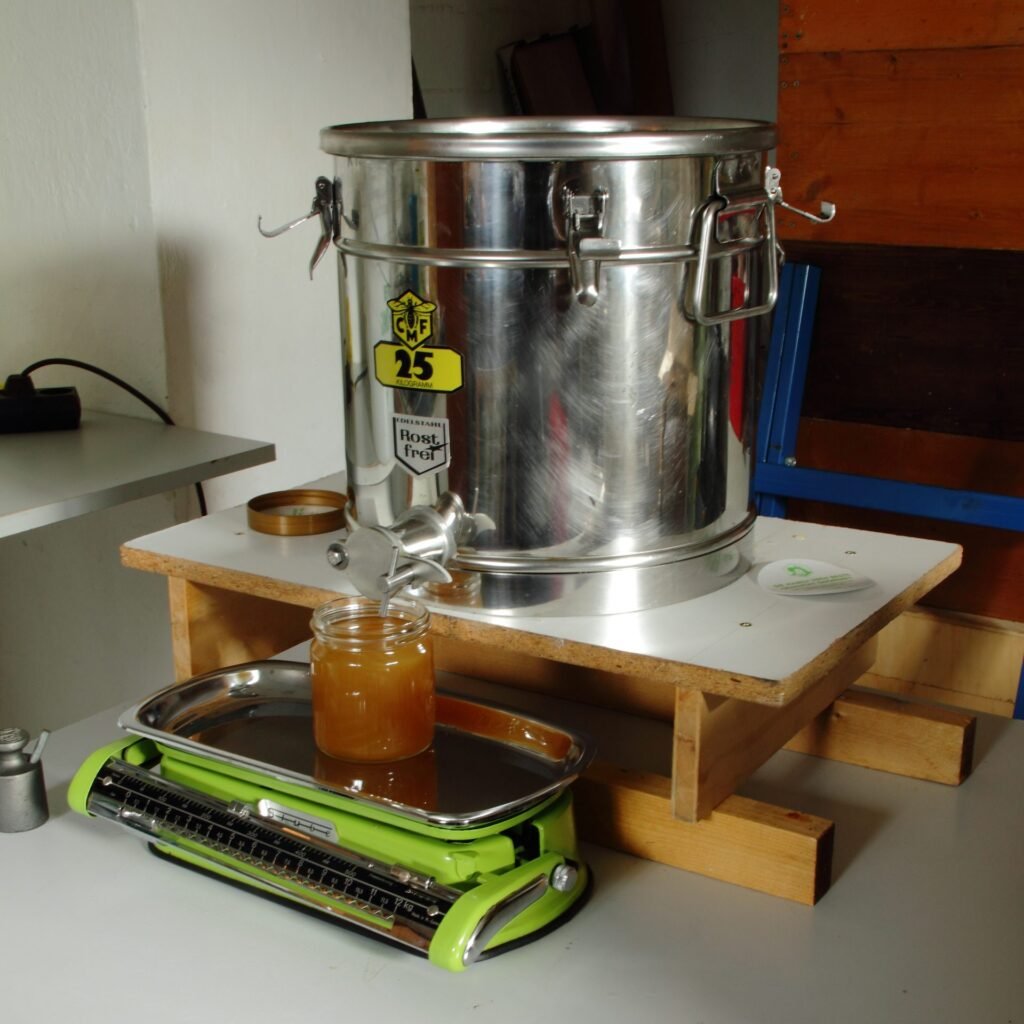
Give every bucket or settling tank an ID, such as a number on masking tape, and record which extraction filled it, the refractometer reading, and whether it was warmed. The moisture reading matters more than people think. USDA’s grade standard caps Grade A honey at 18.6% moisture, and honey much above that is the usual culprit in fermentation complaints. Our guides on using a honey refractometer and target moisture for ripe honey cover how to take and interpret the reading.

3. Bottling log
This is the heart of the system. One line per lot: the lot code, which buckets or tank went into it, the jar size and count, the jar and lid supplier or case number, and the initials of whoever bottled. Note anything unusual, such as a lid that wouldn’t seat or a jar that cracked mid-run. At the end of the run, set aside one retention jar per lot, label it “RETAIN” with the lot code, and store it with your records. It lets you tell a lot problem from a storage problem.
4. Sales log
Record which lots left the house and where they went: which market day, which farm-stand restock, which online orders or wholesale drops. You don’t need a customer’s name for every jar. You do need to know that lot 260814-A was the lot on the table at the Saturday market on August 22.
| Record | Minimum fields | Links to |
|---|---|---|
| Harvest log | Date, yard, hives/supers, approx. weight | Bucket IDs filled |
| Bucket/tank log | Bucket ID, harvest date, moisture %, warmed Y/N | Lot code(s) it went into |
| Bottling log | Lot code, bucket IDs, jar size and count, jar/lid source, retention jar Y/N | Sales entries |
| Sales log | Date, channel (market, stand, online, store), lot codes and jar counts | Customers or venues |
Keep the logs for at least two years, or longer than the shelf life you tell customers, since jars can sit in a pantry for years before a complaint surfaces. For under roughly 50 lots a year, a paper notebook kept with the extracting equipment is enough, as long as it is filled in at the bench and not from memory a week later. A spreadsheet with one tab per log helps once you sell through several channels. Blockchain ledgers and GPS-tagged hive platforms pitched to small producers solve problems a direct-to-consumer beekeeper rarely has.
Tracking Lots When Buyers Are Anonymous
A cash sale at a farmers market leaves no record of who took the jar home. Warehouse-style lot guides assume every shipment has a known recipient; a market seller has no such thing. A few habits close most of that gap:
- Sell one lot at a time per venue where you can. If only one or two lots are on the table on a given day, the sales log alone tells you which lot a market customer could have bought.
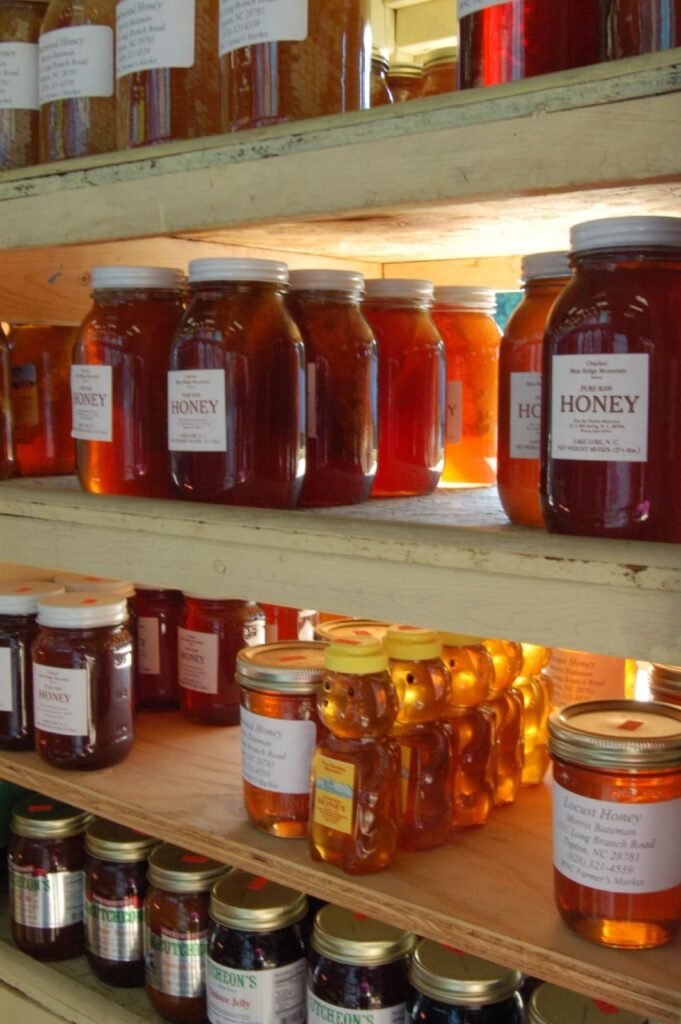
- Put your contact details on every jar. A name and phone number or website on the label is what lets a customer who notices a problem reach you, months after the market is over.
- Build an opt-in list. A “new harvest” email sign-up at the stand doubles as a way to send a lot notice.
- Record online orders by lot. Note the lot code in the order notes, and you can contact every affected buyer directly.
- Keep wholesale and consignment separate. A store or co-op is a known recipient. Log exactly which lots and how many jars you delivered on which date.
Each channel needs its own line in the sales log. Our guides to selling raw honey at farmers markets and choosing between Etsy, markets and co-ops cover the sales side.
What to Do When a Complaint or Problem Arrives
Most honey complaints, such as crystallization, a foam layer, or darkening in a warm cupboard, describe normal changes. A few are real: fermentation from high-moisture honey, a foreign object such as glass or metal, a seal that failed, or a label claim that turns out to be wrong. Lot records let you sort one from the other fast.
A real case shows how this works at small-producer scale. In July 2025, Queen Bee Gardens of Lovell, Wyoming, recalled three whipped honey products over possible foreign material. The recall named two specific lot codes and a purchase window instead of the whole product line, and customers were asked to email a photo of the jar bottom showing the lot number. Without those codes, the only safe response would have been to pull everything.
A simple response plan:
- Get the lot code. Ask the customer for a photo of the jar, including the code, and a description of the problem. Ask how and where the jar was stored.
- Open the retention jar from the same lot. If it shows the same fermentation, foreign material or off-smell, the problem is in the lot. If it is fine, storage or contamination after sale is more likely.
- Trace backward. Use the bottling log to find the buckets and the bucket log to find the moisture reading and harvest. A high reading points to fermentation. A cracked-jar note points to glass.
- Trace forward. Use the sales log to find every venue and order that received the lot. Pull any unsold jars of that lot from inventory and from stores holding your honey.
- Notify affected buyers. Contact online and wholesale buyers directly and post the lot code at your stand and on your email list. For any possible safety risk, ask your state department of agriculture or health for guidance.
- Write down what happened and change one thing, such as a lower moisture cutoff or a jar inspection step.
Prevention sits upstream of all of this. Our fermentation risk checklist and quality checklist before labeling for sale catch most problems before a lot code is ever needed.
Frequently Asked Questions
Do I legally need lot numbers on honey I sell at a farmers market?
In most U.S. states, no federal or state rule requires lot numbers on pure honey sold directly to consumers by the beekeeper who produced it. Wholesale buyers, stores and some states may require codes or a production date, and flavored honey sold under a cottage food registration, as in Minnesota, must show the date it was made. Check your state’s current rules before selling.
Can I use the bottling date as my lot code?
Yes, and it is the simplest reliable option. Add a run letter (A, B, C) if you ever bottle more than once in a day, so that two runs from different tanks never share a code.
Is a batch code the same as a lot number?
For a small honey seller, yes. Both mean a code on the jar that identifies one bottling run and links it to your records. Use one term and one format consistently on your labels and in your logs.
Where on the jar should the lot code go?
On the jar bottom or a printed field on the main label. Lids get swapped between jars in customers’ kitchens, so a code on the lid alone is unreliable.
Do I need to track lots for comb honey and creamed honey too?
Yes. Comb honey can be coded on the box or clamshell by cutting date. Creamed and flavored honey should always be separate lots from the liquid honey they were made from, because they involve extra processing steps and, for flavored honey, added ingredients.
What should I do if a customer says their honey fermented?
Ask for the lot code and a photo, then open your retention jar from the same lot. If it is fermenting too, check the bucket-log moisture reading, pull remaining jars and notify buyers you can reach. If it is fine, the customer’s jar most likely absorbed moisture after opening.
The Bottom Line
For a direct-to-consumer beekeeper, lot tracking is a date code on each jar, one retention jar per run, and four short logs that tie harvest to bucket to bottling to sale. It is rarely legally required at small scale, but it turns a vague complaint into a specific answer, and a possible whole-season recall into a single lot.