Reviewed by Daniel M. · Last Updated September 24, 2026 · How we review
Pumpkins need bees to carry pollen from male flowers to female flowers, and each flower is open for only one morning. Extension guides that recommend renting honey bees for pumpkins suggest about 0.5 to 1 colony per acre, moved in when the first female flowers open. But research in the Northeast found that many pumpkin fields already get enough pollination from wild bumble bees and squash bees. In one Cornell trial, adding rented honey bee hives did not raise yields at all. So the best first step is to scout your own field at dawn, then rent hives if bee visits are low or your field is large and isolated from wild bee habitat.
This guide is written for growers. It explains how pumpkin pollination works, who does it, how to decide whether renting pays, how many hives to use and where to put them, and what growers in the Midwest actually paid in 2025.
Key Takeaways
- Timing is everything. Pumpkin flowers open at sunrise and are finished by about noon, and most pollination happens before 11 a.m.
- Female flowers set the fruit. Pumpkin plants produce many more male than female flowers, and the first flowers are mostly male.
- Stocking rates are modest. Published guidelines range from 0.5 to 1 honey bee colony per acre for pumpkins.
- Wild bees often do the job. Bumble bees are the most efficient pumpkin pollinators, and in many studied fields they supplied enough pollen on their own.
- Rental fees are lower than for almonds. USDA put the 2025 average for pumpkin pollination in its Region 1 at $84.30 per colony.
Table of Contents
How Pumpkin Flowers Get Pollinated
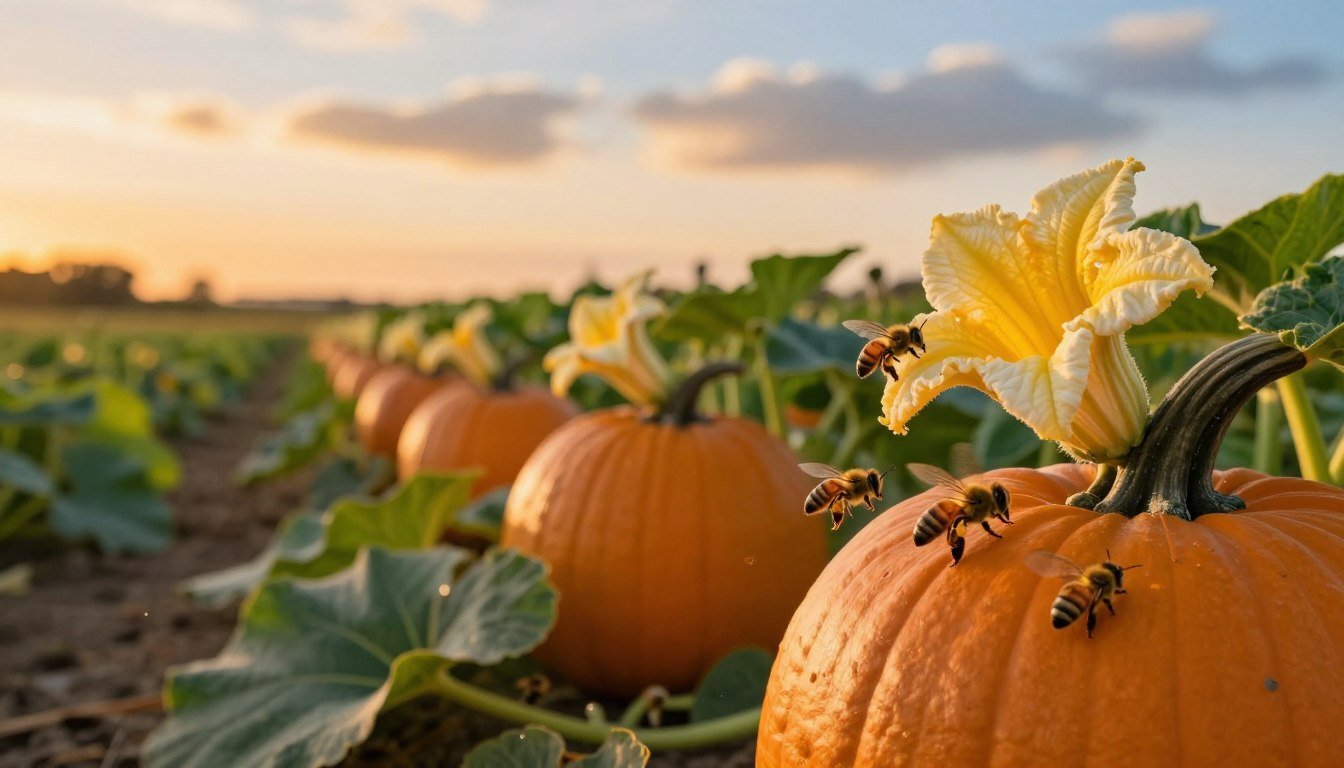
Pumpkins, squash and zucchini belong to the genus Cucurbita. Each plant carries separate male and female flowers. Only the female flower, with a small pumpkin-shaped ovary at its base, can become a fruit. Pumpkin pollen is large, sticky and spiny, so the wind cannot move it. A bee has to carry it.
A fact sheet by Susan Chan, hosted by Michigan State University’s vegetable entomology program, explains that each flower lasts only about 5 to 6 hours. Flowers open at sunrise and wilt by about noon, or earlier on a hot day. Early in the season most flowers are male. Connecticut Field pumpkins produce about twenty times as many male flowers as female ones.
How much pollen does a female flower need? Kimberly Stoner of the Connecticut Agricultural Experiment Station summarises research from Cornell as 1,250 to 2,000 pollen grains per stigma for full fruit set, or around 8 to 12 bee visits per female flower. She adds that most pollination happens before 11 a.m. Nebraska Extension notes that poor fruit set and deformed fruit are often the result of inadequate pollination.
Honey Bees, Bumble Bees and Squash Bees
Three kinds of bees do most of the work in pumpkin fields. They are active at different times and carry pollen differently.
| Pollinator | When it works | Strengths | What growers can do |
|---|---|---|---|
| Honey bee (rented or local) | More active later in the morning | Can be brought in when and where needed | Rent at 0.5 to 1 colony per acre if wild bees are scarce |
| Common eastern bumble bee | Early morning, and in cooler weather | The most efficient pumpkin pollinator per visit in Cornell and Connecticut studies | Keep flowering field edges and grassland nearby |
| Squash bee | Dawn, as flowers open | Specialist on pumpkin and squash pollen | Avoid deep tillage where last year’s pumpkins grew; they nest in the ground |
Squash bees are ground-nesting solitary bees that need Cucurbita pollen to feed their young. Their unusual habits are covered in our profile of squash bees, the native specialist that pollinates before sunrise.
Do You Need to Rent Hives at All?
This is the question most rental guides skip. The research answer is often “not necessarily.”
In 2011 and 2012, Jessica Petersen and Brian Nault of Cornell University tested it on commercial pumpkin fields in the Finger Lakes region of New York. Their report, “Is it worth supplementing pumpkin fields with bees?”, compared 17 fields given one rented honey bee hive per 3 acres, 12 given commercial bumble bees, and 14 given nothing. Yield per plant did not differ among the three groups. Fields with rented hives did not even get more honey bee visits to pumpkin flowers. When the researchers checked the pollen honey bees were bringing home, only 2.5% was pumpkin pollen. About 30% came from corn. Of the bees they counted, only bumble bee visits were linked to higher yield.
Connecticut researchers reached a similar view. In 80 field samples, pollen on female flowers averaged less than 2,000 grains only once. The Integrated Crop Pollination Project’s Pennsylvania fact sheet sums up the regional evidence:
“In fact, many pumpkin fields receive enough pollination from wild bees that adding managed honey bees or bumble bees does not improve yield.”
That does not make renting pointless. These studies come from the Northeast, where fields sit among woods, hedgerows and weedy edges. Large fields, fields surrounded by row crops, new ground with no squash bee nests, or a string of cool, cloudy mornings can all leave pollination short. The practical test is to scout. Walk a line through the field between sunrise and about 10 a.m. on a few mornings once female flowers appear. Look inside the flowers. If bumble bees and squash bees are common in female flowers, rented hives may add little. If flowers are mostly empty, or small fruit are yellowing and dropping, rent.
How Many Hives per Acre for Pumpkins
Where supplemental honey bees are used, published rates are low compared with many crops.
| Source | Rate for pumpkins | Notes |
|---|---|---|
| Midwest Vegetable Production Guide (2023) | 1 colony per acre | Same rate listed for squash; 2 to 3 for cucumber and cantaloupe |
| Integrated Crop Pollination Project (Pennsylvania) | 0.5 to 1 hive per acre | Notes a 6 to 8 frame colony has roughly 14,000 to 19,000 pollinating bees on a given day |
| Cornell trial, New York | 1 hive per 3 acres | No yield gain over unsupplemented fields in that study |
| USDA NASS, Region 1, 2025 | 7,500 colonies on 7,400 paid acres | Close to one colony per acre; the colony count includes unpaid colonies |
The Midwest guide notes that the right number depends on colony strength, the local wild pollinator community, competing flowers, how attractive the crop is, the expected yield and the weather. Strong colonies matter more than hive count. Ask what frame count the beekeeper guarantees and how it will be checked; our guide to documenting hive strength shows what a fair record looks like. Pumpkin stocking is much lighter than for tree fruit. For comparison, see our guide to apple orchard hive density.
Renting Hives for Pumpkins, Step by Step
Step 1: Decide and book early
Scout the previous season if you can, then contact beekeepers over the winter. Pumpkin bloom falls in midsummer, when many beekeepers have colonies on honey crops, so confirm numbers and dates in writing. Our grower’s season timeline for renting bees covers booking lead times.
Step 2: Time delivery to the first female flowers
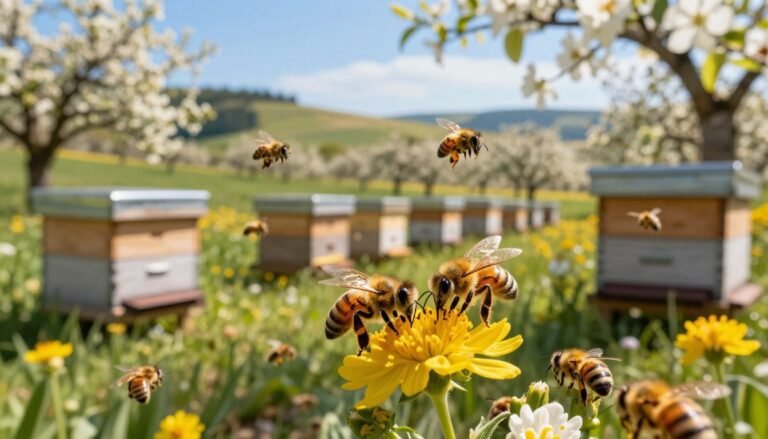
University of Nebraska–Lincoln Extension’s Bee Pollination of Cucurbit Crops advises moving colonies near the field about the time the first female flowers are seen. The Midwest guide warns against placing hives before the crop’s flowers are available, because bees will learn to forage elsewhere and may not work the crop well.
Step 3: Place hives where bees will work the crop
The Midwest guide notes that bees forage best within about 100 yards of the colony. On a large field, set colonies in groups around the field rather than in one block at a corner. Choose sunny, level spots with truck access, away from tractor lanes, and make sure clean water is available nearby.
Step 4: Agree on pesticides before the bees arrive
The Integrated Crop Pollination Project advises growers to avoid spraying during bloom, and to spray after flowers have closed if a spray is needed. Pumpkin flowers close by early afternoon, which helps. Write the plan into the rental agreement and tell your beekeeper before any application near the hives.
Step 5: Release the hives after bloom
Pennsylvania’s fact sheet notes that honey bees are usually removed as soon as bloom is complete. Agree on the removal date and field access in advance.
How the bill is structured is covered in our guide to pollination payment terms for growers.
What Pumpkin Pollination Costs
The best public price data comes from the USDA’s annual Cost of Pollination survey, released in February 2026 for the 2025 season.
| USDA region | Year | Price per colony | Price per acre | Paid acres |
|---|---|---|---|---|
| Region 1 (incl. Iowa, Wisconsin, Illinois, Nebraska, Kansas, New York, Pennsylvania) | 2024 | $88.70 | $46.90 | 7,800 |
| Region 1 | 2025 | $84.30 | $52.00 | 7,400 |
| Region 2 (Southeast and Mid-Atlantic) | 2024 | $58.90 | $58.40 | 2,500 |
| Region 2 | 2025 | $49.10 | $34.90 | 2,550 |
USDA did not publish a separate pumpkin figure for Region 4, which includes Minnesota and North Dakota. For fuller context on what drives rental fees, see our articles on what growers pay for bee pollination services and how beekeepers price pollination.
Pumpkins on the Northern Plains
In eastern North Dakota and western Minnesota, pumpkin bloom comes in the middle of summer, when sunflower, canola and sweet clover can also be in flower. The Cornell pollen finding is worth remembering here: honey bees placed by a pumpkin field may work other crops, and in that study corn pollen outweighed pumpkin pollen. Scouting female flowers early in the morning tells you more than a hive count does. North Dakota requires beekeepers to register every apiary location with the state Department of Agriculture, so a beekeeper placing hives on your land will need your permission for the site.
Frequently Asked Questions
How many beehives do I need per acre of pumpkins?
Published guidelines range from 0.5 to 1 honey bee colony per acre. The Midwest Vegetable Production Guide lists 1 colony per acre. Many fields with healthy wild bee populations need none.
When should hives go into a pumpkin field?
When the first female flowers appear. Male flowers come first, and hives placed too early can train bees to forage elsewhere.
Why are my pumpkin flowers not setting fruit?
Early in the season most flowers are male, which is normal. If female flowers are open but fruit yellows and drops, poor pollination is likely, often from cool, wet mornings or too few bees in the first hours after sunrise.
Are bumble bees better than honey bees for pumpkins?
Per visit, yes. Cornell and Connecticut studies found the common eastern bumble bee to be the most effective pumpkin pollinator. Honey bees still help where wild bees are scarce.
How much does it cost to rent hives for pumpkins?
USDA’s 2025 survey put the average at $84.30 per colony in Region 1 and $49.10 in Region 2. Prices vary with distance, colony strength and local supply.
Can I spray insecticide while hives are in the pumpkin field?
Avoid spraying open flowers. If a spray is needed, apply it after the flowers close in the afternoon, choose products less toxic to bees and tell your beekeeper first.
The Bottom Line
Pumpkin pollination happens in a few morning hours, and wild bumble bees and squash bees often handle it. Scout female flowers before you rent. If you do rent, use about 0.5 to 1 strong colony per acre, bring them in with the first female flowers, keep sprays off open blooms and release the hives when bloom ends.