
Reviewed by Thomas B. · Last Updated September 23, 2026 · How we review
To price a crop pollination job, work out your floor price first, then check it against the market. Add up what the job costs you per colony: trucking, labor, feed to build colonies up to grade, and a risk allowance for losses. Add the honey your colonies would have made at home during those weeks, then your margin. Then compare that floor with what growers in your region actually pay, using the USDA’s annual Cost of Pollination survey. If the market is well above your floor, charge the market rate. If it sits below your floor, the job loses money and you should turn it down or change the terms.
Most pricing advice online stops at “rates run $45 to $200 a hive.” This guide gives you a worksheet you can fill in with your own numbers. It includes the current 2025 federal benchmarks by region and a worked example for a northern-plains beekeeper. Here, the honey you give up in July often costs more than the diesel.
Key Takeaways
- Price from the bottom up: direct job costs + forgone honey + risk allowance + margin gives you a floor. Never quote below it.
- Then price from the top down. USDA’s 2025 Cost of Pollination survey put almonds at $209 per colony, while other crops averaged roughly $20 to $115 depending on crop and region.
- In Region 4 (which includes North Dakota and Minnesota), the 2025 average was just $37.20 per colony across all crops. Local paid pollination is a thin market, so know your floor.
- Summer jobs in honey country have to cover forgone honey. The University of Minnesota’s Marla Spivak made this point in her guidance for cranberry growers.
- Tie the fee to colony strength (per frame, or grade A/B tiers) and put strength standards, payment timing, and pesticide terms in writing.
Table of Contents
- What Growers Actually Pay: 2025 USDA Benchmarks
- Why Rates Differ So Much Between Crops
- Building Your Floor Price, Line by Line
- A Worked Example From the Red River Valley
- Choosing a Pricing Model: Per Colony, Per Frame, or Graded
- Terms That Protect the Price
- Frequently Asked Questions
What Growers Actually Pay: 2025 USDA Benchmarks
The best public benchmark is the USDA National Agricultural Statistics Service (NASS) Cost of Pollination report. The latest edition was released February 13, 2026, and covers the 2025 season. NASS surveyed about 15,000 farm operations. It publishes prices by region, not by state, so the figures are averages across several states and several contract types.
| Crop (NASS region) | 2025 price per colony | 2025 price per acre |
|---|---|---|
| Almond (Region 6 & 7: CA, AZ, HI) | $209.00 | $310.00 |
| Watermelon (Region 1: Northeast and Great Lakes) | $114.00 | $56.60 |
| Blueberry (Region 1) | $85.90 | $151.00 |
| Apple (Region 1) | $85.60 | $41.80 |
| Cranberry (Region 1) | $83.90 | $172.00 |
| Pumpkin (Region 1) | $84.30 | $52.00 |
| Apple (Region 4: CO, MN, MT, NV, ND, SD, UT, WY) | $72.80 | $66.50 |
| Cherry (Region 5: Pacific Northwest) | $59.90 | $83.80 |
| Apple (Region 5) | $54.40 | $50.00 |
| Sunflower (Region 6 & 7) | $48.80 | $65.40 |
| All other crops (Region 4) | $30.20 | $37.70 |
| Cherry (Region 4) | $26.80 | $37.90 |
| All crops, Region 4 average | $37.20 | $46.70 |
Source: USDA NASS, Cost of Pollination, released February 13, 2026. Per-colony prices exclude colonies the farm owned or used without payment.
Two things stand out for beekeepers in the Dakotas and Minnesota. First, the whole paid-pollination market in Region 4 was worth only about $346,000 in 2025. That was down 50 percent from 2024, spread over roughly 9,300 colonies. Second, the regional average fell from $66.70 per colony in 2024 to $37.20 in 2025. A small market with a few large contracts swings hard from year to year. Treat the regional figure as a rough guide, not a price list.
Why Rates Differ So Much Between Crops
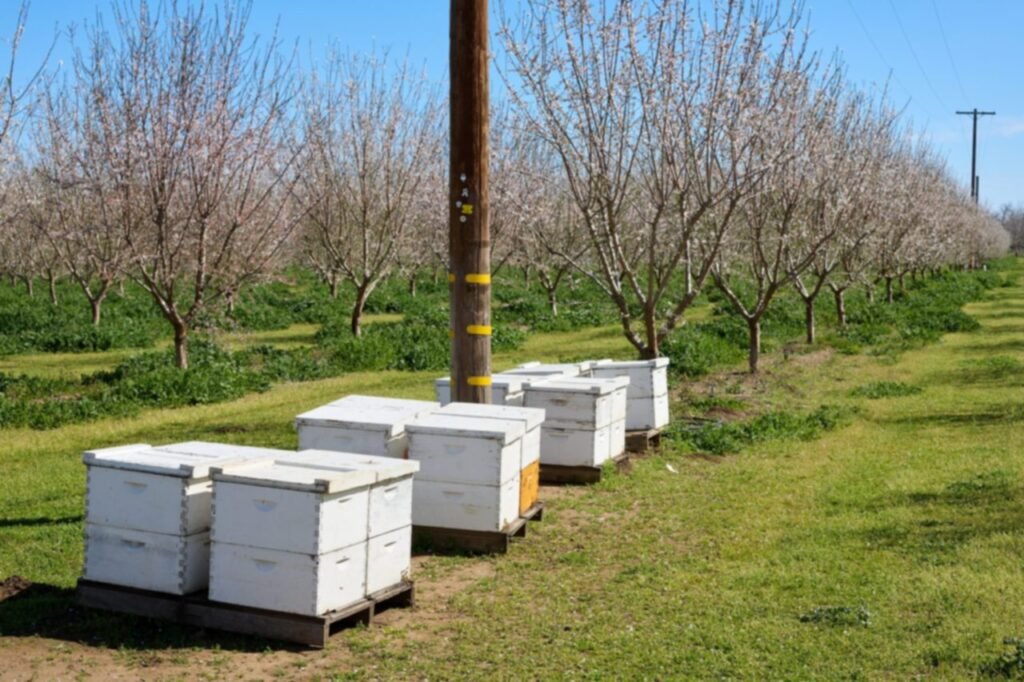
The gap between almonds and apples is not about the work. Moving a pallet of bees into an orchard takes about the same effort either way. According to the USDA Economic Research Service’s special article on the U.S. pollination-services market (Bond, Plattner and Hunt, 2014), fees vary with bloom time, how many bees are available, and how much sellable honey the crop yields.
- Honey the crop gives back. Almond honey has little commercial value, and the ERS notes that fees can be lower when the crop produces valuable honey. A crop that feeds your bees well and fills supers is worth part of the fee to you. A crop that drains colonies is not.
- Bloom timing. Almonds bloom in February, when colonies are at their smallest. Getting eight or more frames of bees by then takes feeding, often a southern overwintering yard, and early mite control. That preparation is built into the price.
- Supply at that moment. The ERS notes that Pacific Northwest crops blooming right after almonds get lower fees, because a lot of commercial colonies are already nearby, on their way home from California.
- Distance. Auburn University economist Brittney Goodrich, writing in Choices magazine (2019), reported that shipping alone can make up 25 percent of the almond fee for colonies coming from the eastern U.S.
- Forgone honey elsewhere. Goodrich also points out that a beekeeper who could be making honey during the bloom has to be paid enough to cover that lost honey.
That last point is the one most northern beekeepers underprice. It is the core of the floor-price method below.
Building Your Floor Price, Line by Line
Your floor price is the lowest per-colony fee at which a job still pays. Work it out for each job, because distance, timing, and risk change every time.
Step 1: Direct trucking cost
Take the round-trip miles, multiply by the number of trips (delivery, removal, and any mid-contract moves), and multiply by your real cost per mile for fuel and vehicle wear. Divide by the number of colonies on the job. Small jobs carry the same trips as large ones, so trucking per colony goes up quickly as colony counts fall.
Step 2: Labor
Count the hours for loading, unloading, and placement, plus any grower-required checks. If a contract asks you to document hive strength for the grower, that is inspection time on every sampled colony. Price your own hours at what you would pay a helper, not at zero.
Step 3: Preparation to grade
This covers syrup, pollen patties, and any extra mite treatment or requeening needed to get colonies up to the contracted strength by the start date. Early-season jobs carry the most preparation cost. If you need to split out or boost colonies, your choice of double-deep or single-brood setups affects how much headroom you have.
Step 4: Forgone honey
Estimate how many pounds of honey a colony would have stored at your home yard during the contract weeks. Subtract what it will store on the crop. Multiply the difference by the price you actually get per pound. Your own yard records are the only reliable source for the first number. If you have none, start keeping weekly scale-hive or super-count notes this season.
Step 5: Risk allowance
Estimate the chance of losing or badly setting back a colony on this job, from spray exposure, theft, chilling, or rough handling. Multiply it by your replacement cost. NASS reported average 2025 prices of $130 for a nuc, $110 for a package and $22 for a queen in its March 2026 Honey report. A field next to an actively sprayed crop earns a higher allowance than an isolated orchard with a no-spray clause.
Step 6: Margin
Add a margin on top of the total. A job that only breaks even leaves nothing for equipment replacement, bad years, or your time spent negotiating.
A Worked Example From the Red River Valley
The figures below are illustrative. The honey yield and price come from NASS. Every other line is an assumption labeled as such, and you should replace it with your own records. The example compares two jobs for the same 40 colonies based in eastern North Dakota: a mid-May apple orchard in western Minnesota and a three-week job in July on a crop that gives little honey.
| Line item (per colony) | May orchard job | July low-honey crop |
|---|---|---|
| Trucking: 2 round trips of 120 miles at an assumed $0.70/mile, split over 40 colonies | $4.20 | $4.20 |
| Labor: an assumed 12 hours at $25/hour, split over 40 colonies | $7.50 | $7.50 |
| Preparation: assumed syrup and patties to reach grade | $6.00 | $1.00 |
| Forgone honey: assumed 10 lb lost at the 2025 North Dakota average of $1.89/lb | $0.00 (before main flow) | $18.90 |
| Risk: assumed 5% chance of replacing a colony at a $130 nuc price | $6.50 | $6.50 |
| Subtotal | $24.20 | $38.10 |
| Margin at 20% | $4.84 | $7.62 |
| Floor price per colony | about $29 | about $46 |
North Dakota led the country in 2025 with 30.8 million pounds of honey from 460,000 colonies, an average of 67 pounds per colony at $1.89 a pound in bulk, according to NASS. The main summer flow from sweet clover, alfalfa, canola and sunflower is when those pounds are made. That is why the July job needs a much higher floor than the May job, even though the trucking and labor are the same.
Now compare the floors with the market. The Region 4 apple average of $72.80 leaves plenty of room above the May floor, so quote near the market. The July floor of about $46 sits above the $30.20 Region 4 “all other crops” average. A grower offering that average is asking you to subsidize their crop with your honey. You can decline, ask for a higher fee, or send colonies you would not have supered anyway, provided they still meet the contract’s strength minimum.
If you sell honey retail at several times the bulk price, your forgone-honey line grows accordingly. Use the price you actually get, not the state average.
Choosing a Pricing Model: Per Colony, Per Frame, or Graded
Once you know your floor, decide how the fee is structured. Each model shares the strength risk between you and the grower in a different way.
| Model | How it works | Best for | Watch out for |
|---|---|---|---|
| Flat per colony | One fee per colony, with a stated minimum strength | Small jobs, repeat growers, orchards | Disputes if strength is never checked |
| Per frame of bees | Fee per frame of bees counted at inspection, usually capped | Large contracts with independent inspection | Inspection cost and weather-dependent counts |
| Graded tiers | Separate fees for Grade A and Grade B colonies | Mixed-strength outfits | Needs agreed grade definitions |
| Base plus strength bonus | Base fee plus a premium above a frame threshold | Almonds and other strength-sensitive crops | Bonus terms must be precise |
| Per acre | Fee per acre at an agreed stocking rate | Growers budgeting by acreage | Stocking rate drifts if not fixed in writing |
Per-frame pricing has a long history. In a guide for Wisconsin cranberry growers, the University of Minnesota’s Marla Spivak described almond growers paying $6.50 to $7.00 per frame of bees, capped at 10 frames. Those are older dollar figures, but the structure is still used. Goodrich reported strength premiums of 5.7 to 8.6 percent for colonies above the usual eight-frame minimum. She also reported broker fees of $2 to $20 per contracted colony, which come out of the gap between what the grower pays and what the beekeeper receives.
For crops that need extra colonies per acre, such as hybrid seed, see our guide to renting hives for seed crop pollination. It sets out stocking rates and seed-contract fees crop by crop.
“If growers want strong colonies for pollination, they must be willing to pay for them.”
Terms That Protect the Price
A good per-colony number can still lose money if the contract is loose. These terms carry the most weight:
- Strength standard and inspection method. Define a frame of bees, the minimum per colony, who inspects, and what share of colonies is sampled. Spivak’s sample agreement suggests inspecting at least 10 percent, preferably by an independent person.
- Payment timing. Half on delivery and the balance within a set number of days is a common pattern, used in Spivak’s sample agreement. Our guide to pollination payment terms covers deposits, late fees, and broker arrangements.
- Pesticide protection. In a 2024 study in Ecological Economics, summarized by the University of Illinois, Goodrich and colleagues found beekeepers would accept about $8 less per colony on a $200 almond contract in exchange for stronger pesticide protections. Those terms are worth money to you, so negotiate them. See our walkthrough of pesticide clauses in pollination agreements.
- Extra moves and delays. Charge separately for extra moves, and for removal delayed past the agreed date. A late pickup during a honey flow costs you honey.
- Itemized invoicing. Show the colonies delivered, the grade, and any surcharges on the invoice. Our list of pollination invoice items is a useful checklist, and a written pollination contract template saves you drafting from scratch.
Frequently Asked Questions
How much do beekeepers charge per hive for pollination?
USDA’s 2025 survey found almonds averaging $209 per colony. Other crops averaged roughly $20 to $115 per colony, depending on crop and region. In Region 4, which includes North Dakota and Minnesota, the average across all crops was $37.20. Your own price should never fall below your calculated floor.
Why is almond pollination so much more expensive than other crops?
Almonds bloom in February, when colonies are small and costly to build up. They produce little sellable honey, need very large numbers of colonies at once, and many of those colonies travel long distances. All of those costs go into the fee.
Should I charge per hive or per frame of bees?
For small jobs with growers you know, a flat per-colony fee with a written minimum strength is simpler. For large contracts with independent inspection, per-frame or graded pricing pays you fairly for stronger colonies and protects the grower from weak ones.
Is pollination more profitable than honey production?
It depends on timing and location. Early-season jobs like almonds can add income without costing honey. Summer jobs in strong honey regions often pay less than the honey the colonies would have made, unless the fee includes forgone honey.
What happens to the fee if my colonies fail the strength inspection?
That should be set out in the contract before delivery. Common approaches are paying Grade B colonies at a lower rate, replacing weak colonies within a set number of days, or not paying for colonies below the minimum. Without a written term, you will be negotiating from a weak position.
How far ahead should I quote a pollination price?
Quote as soon as the grower confirms colony numbers and bloom dates, and lock the price in a signed agreement. Goodrich notes that almond contracts are usually agreed months before bloom, which lets both sides plan around a fixed fee.
The Bottom Line
Know your floor before you quote. Build it from your own trucking, labor, preparation, forgone honey, risk, and margin, then check it against the USDA regional benchmarks. In the northern plains, where July is honey season, forgone honey is usually the biggest line on the worksheet and the one most often left out.

-104A8316.jpg)
-104A8312.jpg)
.jpg)