
Reviewed by Sofia T. · Last Updated September 23, 2026 · How we review
For most pollination contracts, a double-deep hive is the safer choice because it has room to present 8 to 12 or more frames of bees at inspection, while a single 10-frame deep tops out at about 10 frames of bees and has almost no headroom. Singles still make sense for orchard contracts with lower strength grades, for operations that prioritize lighter lifting and faster handling, and for beekeepers who manage brood space tightly. The right answer depends on the strength grade in your contract, not on habit.
This guide compares the two configurations specifically for colonies rented out for pollination, using published colony-strength standards to show where each one fits, and what that means for Northern Plains beekeepers whose colonies spend summer in the Dakotas and Minnesota before heading to orchards.
Key Takeaways
- Pollination is paid by colony strength, usually measured in frames covered with bees, so the box configuration matters only insofar as it lets a colony reach and hold the contracted grade.
- Oregon State University extension puts a fully covered deep frame at about 2,400 adult bees; a single 10-frame deep therefore maxes out near 24,000 bees.
- OSU’s Grade A field-crop standard calls for 10 frames of bees and 3,000 square inches of comb, more than one standard deep (about 2,700 square inches) can physically provide.
- Orchard grades are lower (6 frames for Grade A, 4.5 for Grade B), which a well-managed single deep can meet.
- Common almond contracts ask for an average of 8 frames with a 4 to 5 frame minimum; singles can hit that, but with little margin for a weak queen or a cold spell.
- Doubles cost more to buy, move and treat, and a full deep often weighs 70 to 90 pounds; singles need tighter feeding and swarm management.
Table of Contents
- Why Colony Strength Is the Product
- The Capacity Math: What Each Configuration Can Hold
- Matching Configuration to the Contract
- Side-by-Side Comparison
- The Northern Plains Year: Summer, Winter and the Trip South
- Grade Your Own Colonies Before the Contract Does
- If You Run Singles: How to Make Them Work
- If You Run Doubles: Avoiding the Common Pitfalls
- Frequently Asked Questions
Why Colony Strength Is the Product
A grower renting bees is buying foragers, not boxes. Colonies are graded by how many frames are covered with adult bees and, often, how much brood they have, because brood drives pollen collection. Research summarised by University of California farm advisor Joe Connell in Sacramento Valley Orchard Source found that an 8-frame colony did about three times as much pollination work as a 4-frame colony, which is why contracts reward strength and many exclude weak units entirely.
That shifts the double-deep versus single question. It is not “which is better for bees in general” but “which configuration most reliably delivers the frame count in my contract, at the time the crop blooms, at a cost I can carry.” For how strength is actually graded in the field, see our guide to colony strength grading before pollination contracts.
The Capacity Math: What Each Configuration Can Hold
Oregon State University Extension’s publication Evaluating Honey Bee Colonies for Pollination (PNW 623), by Ramesh Sagili and Michael Burgett, gives the numbers that make this comparison concrete: one standard deep comb, fully covered on both sides, holds about 2,400 adult bees, and a standard deep Hoffman comb provides about 270 square inches of comb.
| Configuration | Deep-frame equivalents | Approximate comb area | Approximate maximum adult bees |
|---|---|---|---|
| Single 10-frame deep | 10 | 2,700 sq in | About 24,000 |
| Single 8-frame deep | 8 | 2,160 sq in | About 19,000 |
| Deep plus medium (10-frame) | About 16.5 | About 4,500 sq in | About 40,000 |
| Double 10-frame deep | 20 | 5,400 sq in | About 48,000 |
These are ceilings, not targets. Frames also hold honey, pollen and brood, and bees in a single deep have nowhere to go once the box is full except up into supers or out in a swarm. The practical point is that a single deep grading at 8 frames of bees is at roughly 80% of its physical capacity, whereas a double at 8 frames is using well under half its space and can keep growing through bloom.
Matching Configuration to the Contract
OSU’s standards separate field crops, which bloom later and need larger colonies, from orchards, which bloom early when colonies are naturally smaller:
| Grade (OSU PNW 623) | Frames of bees | Brood | Single deep can meet it? |
|---|---|---|---|
| Orchard, Grade B | 4.5 | 450 sq in | Yes, comfortably |
| Orchard, Grade A | 6 | 600 sq in | Yes, with a good queen |
| Field crop, Grade B | 7.5 | 750 sq in | Possible, but little margin |
| Field crop, Grade A | 10 | 1,000 sq in, in 3,000 sq in of comb | No: needs more comb than one deep holds |
OSU notes that the 3,000-square-inch comb requirement for a Grade A field unit is typically met with two standard deeps or one deep plus a semi-deep (medium). In other words, the standard itself assumes more than one brood box for top-grade field colonies.
A Grade B field crop unit would have a minimum of 750 square inches of brood and 7½ frames of bees, or approximately 18,000 adults.”
Almonds sit between these grades. Contract language varies, but a common structure is an 8-frame average with a 4 to 5 frame minimum, checked at or shortly after delivery in February. A strong single deep can meet an 8-frame average, but only if nearly every colony is near full, so one weak queen or a late-winter setback drags the yard average down. Doubles give you the buffer. Our article on almond pollination hive strength requirements covers almond grading in more detail, and apple orchard hive density covers a typical orchard contract.
Side-by-Side Comparison
| Factor | Single deep | Double deep |
|---|---|---|
| Peak frames of bees at bloom | Up to about 10; realistically 6 to 9 | 12 to 16 or more is achievable |
| Fit for high-grade field contracts | Poor | Good |
| Fit for orchard and early-bloom contracts | Good | Good (more than needed for some) |
| Weight per colony on a pallet | Much lighter | Heavier; fewer colonies per load |
| Inspection and queen-finding time | Faster | Slower |
| Varroa treatment cost | Lower for products dosed per brood box | Up to double for those products |
| Food reserve margin | Thin; needs close feeding | Larger buffer |
| Swarm pressure after bloom | High once box is full | Lower, but still present |
| Equipment cost | Lower | Higher |
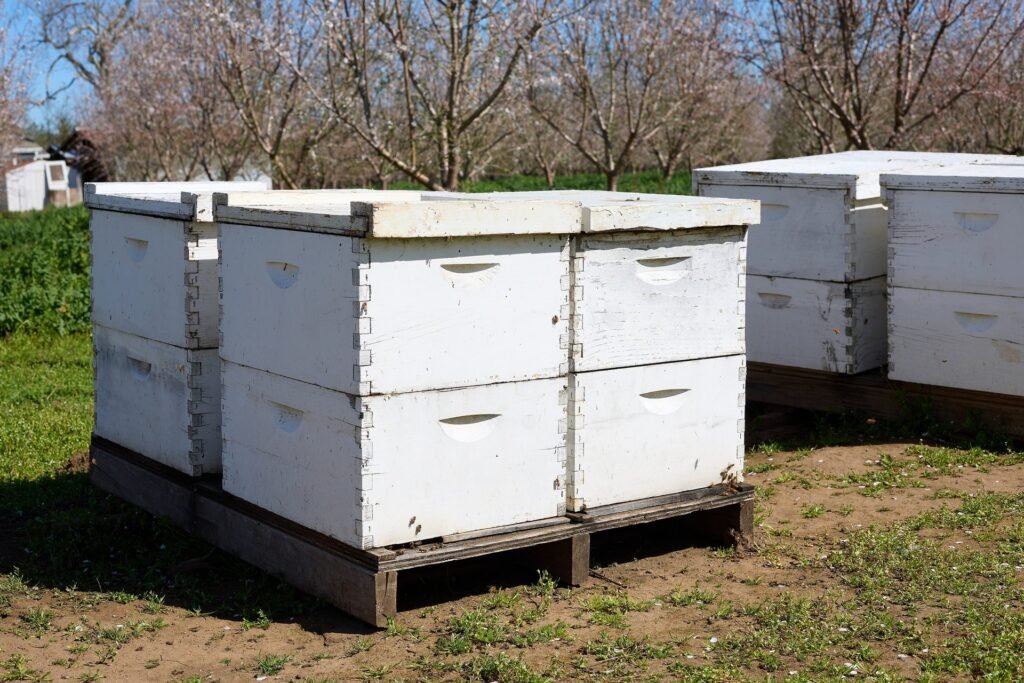
Weight is not a trivial factor in pollination work. A deep full of bees, brood and stores commonly weighs 70 to 90 pounds, and pollination colonies are lifted onto pallets, loaded, unloaded and sometimes moved between crops. See our guides to pollination pallet setup and loading hives for overnight moves for the handling side.
The Northern Plains Year: Summer, Winter and the Trip South
In eastern North Dakota, the Red River Valley and western Minnesota, the brood-box decision has to work for more than one crop. Colonies spend June through August on canola, sunflower, sweet clover and alfalfa, when large populations pay off in honey. Many commercial colonies then leave for California in autumn to overwinter and work almonds in February, while those that stay face some of the coldest winters in the lower 48 states.
- Summer honey production favors a large colony with generous brood space, which is a point for doubles.
- Wintering in place in our region requires heavy stores close to the cluster. The University of Minnesota Bee Lab teaches beginners a three-deep system (or the equivalent in mediums) for northern climates, which is the opposite end of the spectrum from a single. See our guide to winterizing beehives in northern states.
- Colonies shipped south build up on California forage and supplemental feed over winter. A single can work here if it is fed well, requeened with a young queen, and graded honestly before contracts are signed. Our article on feeding colonies before pollination contracts covers the buildup phase.
A pattern that suits many mid-sized Northern Plains operations is to run doubles (or a deep plus a medium) through the honey season, then reduce or equalize colonies in late summer so that each one heading to a contract has a young queen and the frame count the grade requires.
Grade Your Own Colonies Before the Contract Does
Whichever configuration you run, grade a sample of colonies yourself a week or two before delivery so there are no surprises. A simple routine:
- Pick the right time. Count early in the morning or late in the day, or on a cool day, when most foragers are home. Counting on a warm afternoon undercounts a strong colony.
- Count seams, box by box. Remove the lid and look down between the frames. Count the gaps (seams) filled with bees in each box, then add the boxes together. A frame covered on both sides counts as one frame of bees.
- Pull a brood frame or two. Growers increasingly want to see open, uncapped brood at bloom, because brood drives pollen foraging.
- Use entrance counts as a cross-check. OSU suggests that on a good foraging day above 65°F, with wind under 10 mph, a strong colony shows more than 100 incoming bees per minute.
- Record and sort. Rank colonies by frame count. Send the strongest to the highest-grade contracts and combine or hold back the weakest rather than risk failing an inspection.
If your singles consistently grade at 6 frames and your contract requires 8, that is your answer; the same goes for doubles that grade no better than singles.
If You Run Singles: How to Make Them Work
Single-brood-chamber management has a long track record, including among commercial beekeepers in Ontario, who pair it with a queen excluder and prompt feeding. For pollination singles:
- Requeen on schedule. A single depends heavily on queen performance; a young, vigorous queen is the difference between 6 and 9 frames at inspection.
- Feed early and steadily. Singles have little stored food. Pollen substitute and syrup ahead of bloom build nurse bees and brood when natural forage is thin.
- Add a super before the box fills. Put a medium on top, with or without an excluder, as soon as bees cover 8 frames; bees counted in a super usually count toward grading if the contract measures the whole colony.
- Plan for swarm pressure after bloom. A crowded single leaving a warm orchard is a swarm candidate. Split or add space immediately after the contract ends.
- Match singles to the right contracts. Use them for orchard and early-season work graded at 4 to 6 frames rather than for top-grade field crops.
If You Run Doubles: Avoiding the Common Pitfalls
- Do not rent out empty space. A double with 5 frames of bees spread across two boxes grades no higher than a single with 5 frames, costs more to move and chills brood more easily in a February orchard. Consolidate weak doubles to a single box before delivery.
- Check both boxes. Graders count frames of bees in every box. A colony clustered entirely in the top box can look strong from the lid and grade weak when counted.
- Budget treatment by box. Some varroa products, such as amitraz strips, are dosed per brood box, so mite control can cost more per colony.
- Keep the queen where the bees are. Reversing boxes in spring, or checkerboarding, can keep the brood nest expanding rather than stalling at the top of the stack. Our explainer on checkerboarding describes one approach.
If you are also weighing frame size rather than box count, our comparison of deep vs medium frames for brood nests covers that decision.
Frequently Asked Questions
Can a single deep hive be used for almond pollination?
Yes, if it grades at the contracted strength when inspected. A strong single can present 8 frames of bees, but it has little room to spare, so singles need a young queen, good feeding and honest grading before delivery.
How many bees are on a frame of bees?
Oregon State University Extension estimates about 2,400 adult bees on one standard deep frame that is fully covered on both sides. Eight frames of bees is therefore roughly 19,000 adult bees.
Do bees in a honey super count toward colony strength?
That depends on the contract and the inspector. Many graders count all frames covered with bees in every box, but check your contract language and ask how strength will be measured before delivery.
Is a deep plus a medium as good as a double deep for pollination?
For most contracts, yes. OSU notes that a deep plus a semi-deep is a common way to meet the comb area required for top-grade field colonies, and it is lighter to lift than a second deep.
Are double deeps better for wintering in North Dakota?
For colonies that winter in place on the Northern Plains, larger configurations with heavy stores are generally safer than singles. Many northern beekeepers winter in two or three deeps, or the equivalent in mediums, and wrap them.
Do single brood box colonies swarm more?
They can, because they run out of space sooner. Adding supers early, splitting after bloom and keeping young queens all reduce swarming in singles.
The Bottom Line
Choose the configuration that reliably delivers your contracted grade. For top-grade field crops and for almonds where every frame counts, doubles, or a deep plus a medium, provide the capacity and buffer you need. For orchard and early-season contracts graded at 4 to 6 frames, a well-fed single with a young queen does the job at lower cost and with lighter lifting. Grade your own colonies before the contract does, and you will know which one is working for you. For a broader overview of stocking decisions, see how many hives per acre for pollination.

-104A8312.jpg)
