Reviewed by Thomas B. · Last Updated September 23, 2026 · How we review
Deep frames are the better fit for a brood nest if you can lift them: they give the queen larger unbroken combs, mean fewer boxes and frames to inspect, and in cold northern winters give the cluster fewer box gaps to cross. Medium frames are the better choice if a full deep box (commonly 80 to 90 pounds) is more than you can lift safely, or if you want every frame in your apiary to be interchangeable. Both work. Bees raise brood and overwinter successfully in either, as long as the total comb area is right.
The practical rule is that three medium boxes hold roughly the same comb as two deeps. The real decision, then, is not how much space the colony gets, but how that space is divided, how much each piece weighs, and how many parts you want to manage. This guide works through those trade-offs with the actual numbers, including what the choice means for wintering colonies in the Northern Plains, where we keep our bees.
Key Takeaways
- A deep frame has about 1.5 times the comb area of a medium frame. Two deep boxes and three medium boxes hold roughly the same brood nest.
- Deeps win on continuity: fewer horizontal breaks in the comb, 20 brood frames to inspect instead of about 30, and less hardware per hive.
- Mediums win on weight and interchangeability: a full medium commonly weighs 50 to 60 pounds against 80 to 90 for a full deep, and one frame size fits every box.
- A single 10-frame deep holds about 42 liters, which falls right in the 30 to 60 liter range of wild honey bee nest cavities.
- In northern climates, the University of Minnesota Bee Lab teaches two-deep and three-deep hive systems with at least 75 pounds of winter stores. The same capacity can be built from mediums; it just takes more boxes.
Table of Contents
Deep vs. Medium: The Numbers Side by Side
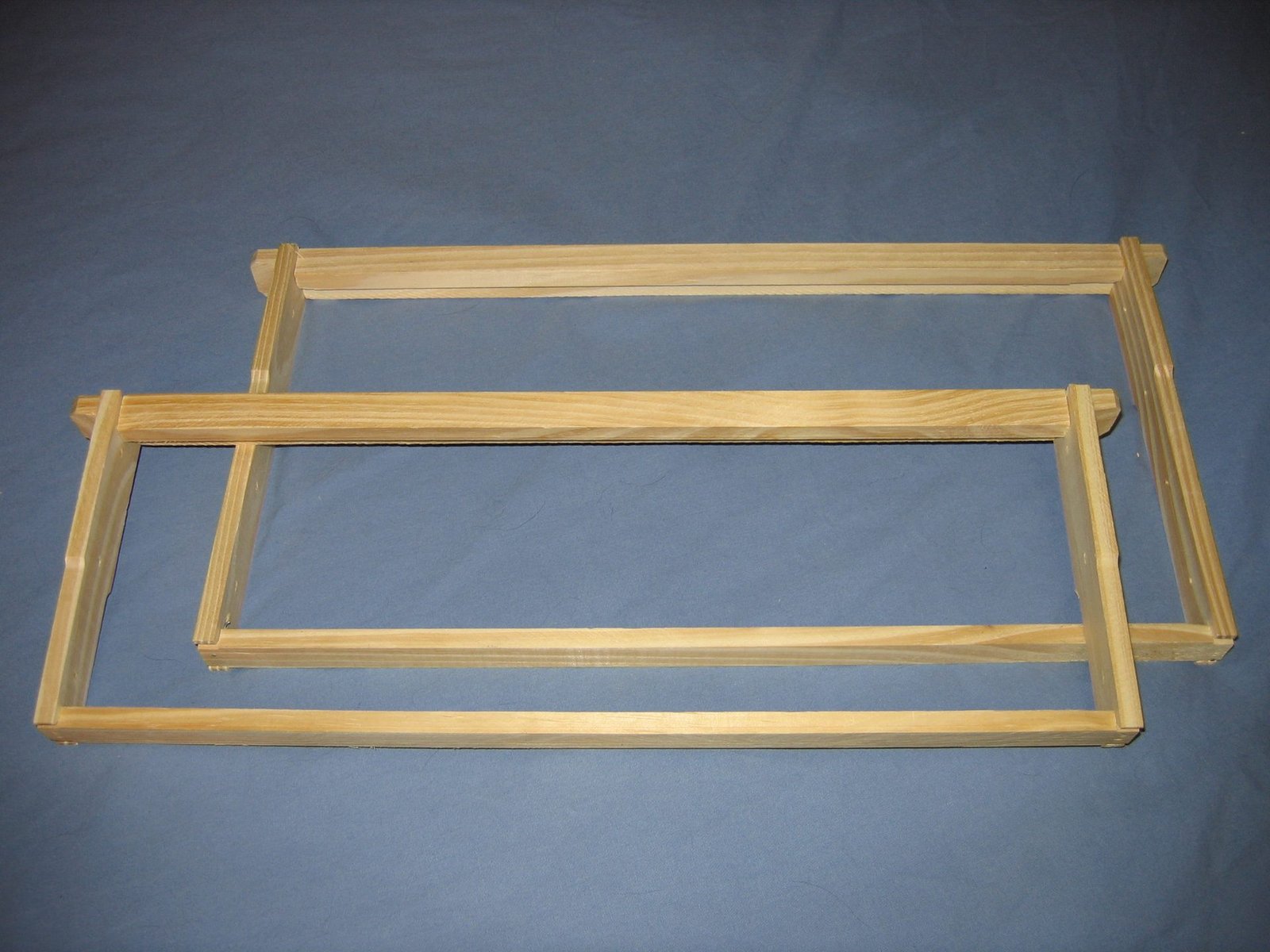
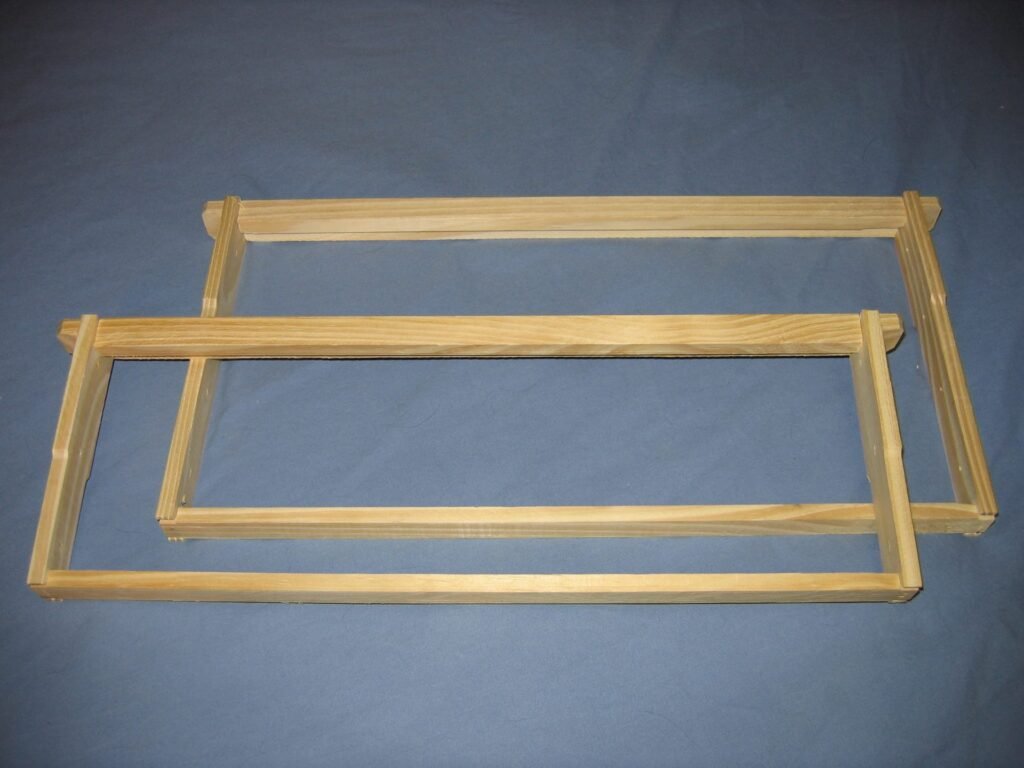
Standard U.S. Langstroth boxes come in three heights, and each takes its own frame. The figures below are for 10-frame equipment; 8-frame boxes are the same height but about 15% narrower inside, and hold two fewer frames.
| Measure | Deep | Medium |
|---|---|---|
| Box height | 9-5/8 in | 6-5/8 in |
| Frame height | 9-1/8 in | 6-1/4 in |
| Approx. internal volume (10-frame box) | about 42 liters | about 29 liters |
| Worker cells per frame, both faces (approx.) | about 6,900 | about 4,600 |
| Typical weight of a full box | 80 to 90 lb | 50 to 60 lb |
| Boxes for a roughly equal brood nest | 2 | 3 |
| Frames to inspect in that brood nest | 20 | 30 |
The cell counts are our own arithmetic, not a manufacturer spec. Worker cells built on standard 5.4 mm foundation pack at roughly four cells per square centimeter on each face. That gives a deep frame’s comb area about 6,900 cells counting both sides, and a medium about two-thirds of that. Actual numbers vary with how fully the bees draw the frame and how much drone comb they add. Weights vary with box width and how full the frames are, but a deep full of honey is consistently about half again as heavy as a medium.
What the Bees Care About
Bees don’t read box labels. What matters to the colony is total comb area, how continuous it is, and whether the nest is a volume they can warm and defend.
Research on wild colonies gives a useful reference point. In their classic study of bee trees in New York State, Thomas Seeley and Roger Morse found that natural nest cavities are vertically elongated, and that most are 30 to 60 liters in volume, with honey stored above the brood nest and pollen between the two. A single 10-frame deep, at about 42 liters, lands in the middle of that range. Two deeps or three mediums give a larger, taller space than most wild nests. That space holds a managed colony bred and fed to build up faster than a wild one, plus its winter honey.
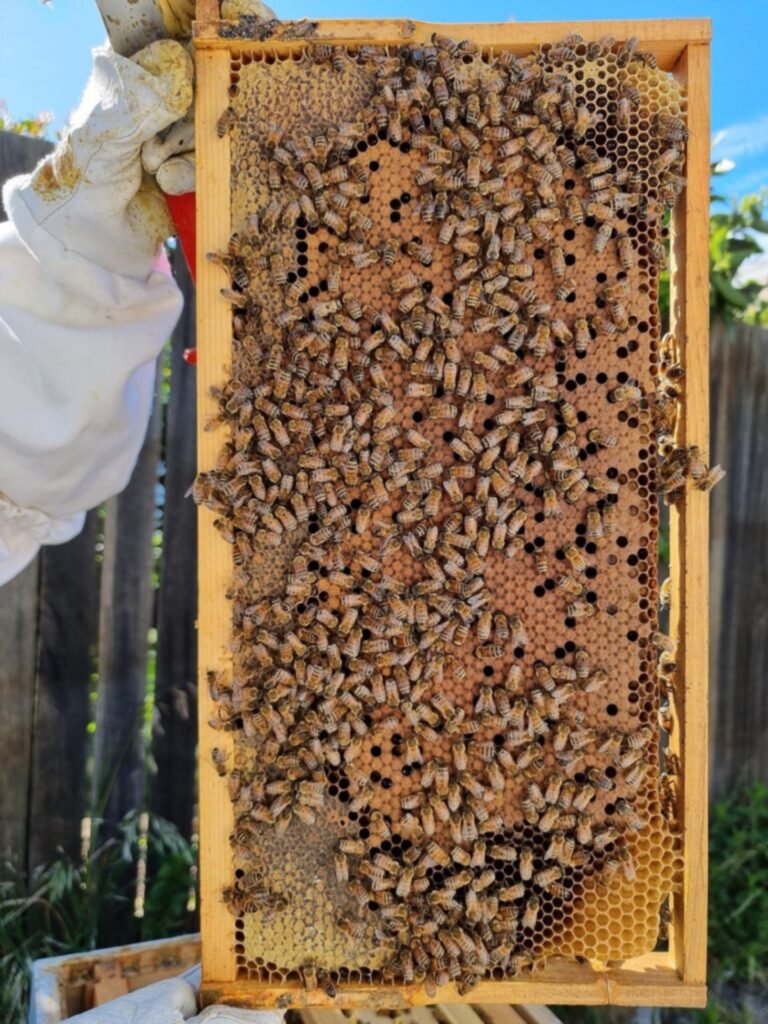
The one real biological difference between the two sizes is continuity. In a tree, comb runs top to bottom without interruption. In a Langstroth hive, every box joint puts a horizontal break of an inch or more in the comb: a bottom bar, a bee space and a top bar. Bees cross these gaps constantly and raise brood on both sides of them, but the queen tends to lay in a roughly spherical brood nest, and each gap splits that sphere. With deeps, a typical spring brood nest spans one or two boxes; with mediums, it often spans two or three.
The Case for Deep Frames in the Brood Nest
- Fewer frames to inspect. Finding eggs, checking for queen cells and reading a brood pattern takes noticeably less time across 20 frames than across 30. That adds up over a season of inspections, especially in swarm season.
- A more compact brood nest. The queen can lay a large, continuous patch on a single deep comb. Brood patterns are easier to read. Our guide to reading a brood frame is easier to apply on a full deep.
- Less equipment per hive. Two brood boxes instead of three means fewer boxes to buy, paint and store, and fewer joints to crack apart.
- Nucs fit directly. Most nucs sold in the U.S. come on deep frames, so a deep brood box accepts them without any conversion.
The drawback is weight. A deep brood box full of brood, pollen and honey is heavy, and at some point in the season you will have to lift or tip it back to inspect the box below. Hive handles, a frame grip and a lifting partner help. See our guides to hive handle types and frame grips. They reduce the strain, but they don’t make a deep lighter.
The Case for All-Medium Brood Boxes
- Weight you can manage for years. A full medium is roughly 30 pounds lighter than a full deep. For many beekeepers, especially those with back problems, that difference decides whether they can keep bees alone.
- One frame size everywhere. Any frame fits any box. You can move a frame of honey from a super into the brood nest in fall, pull a brood frame to boost a weak colony in the same yard, or rebuild a hive from any spare comb.
- Simpler inventory. One box size and one frame size means fewer parts to stock and no wrong-size frames at the bottom of a pile.
- Finer adjustments. A medium adds or removes a smaller block of space. That can suit small colonies and gradual buildup.
The trade-offs are more frames and more boxes. An all-medium hive typically has 50% more brood frames to check, and a brood nest split across more box joints. Queens are also harder to find when they can be on any of 30 frames.
Mixed Setups: Deep Below, Mediums Above
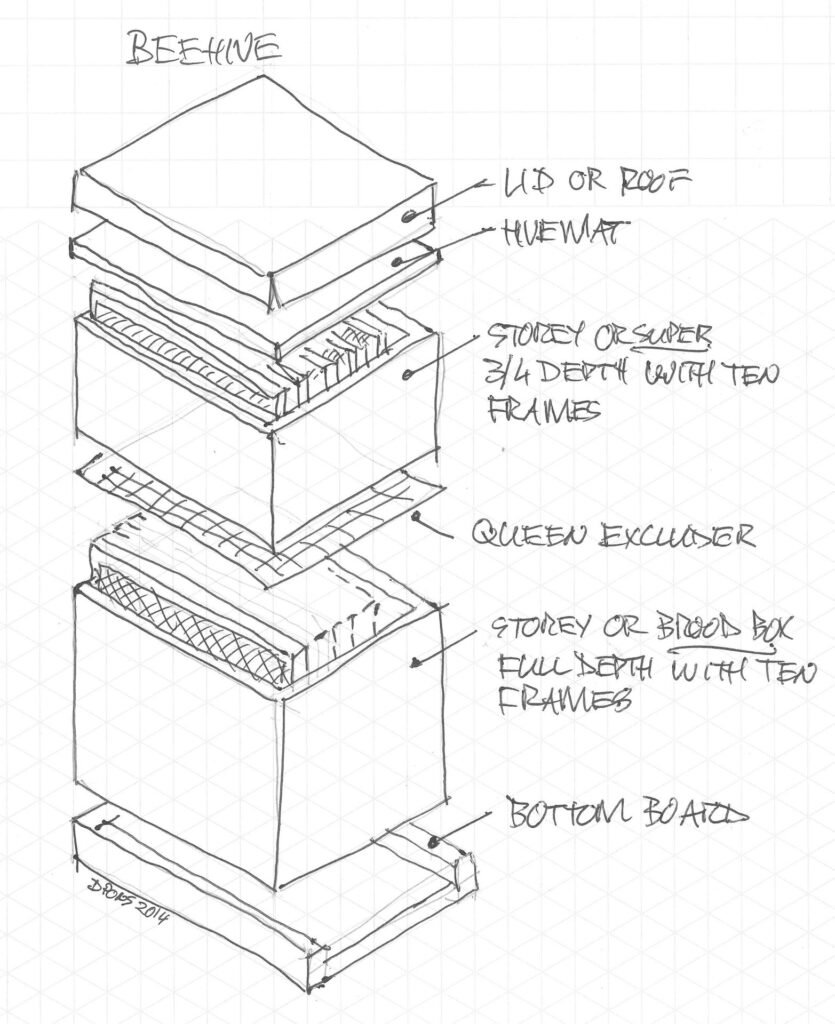
Many beekeepers run one or two deeps for brood and mediums for honey supers. It’s also common to run a single deep brood box plus one medium as a food chamber above it. This keeps the brood nest compact and keeps the boxes you lift most often, the honey supers, at a manageable weight.
The cost is that deep and medium frames don’t interchange. You can’t drop a medium frame of honey into a gap in the deep brood box without leaving a space beneath it, which the bees will fill with burr comb, often drone comb. Some beekeepers use exactly that as a deliberate drone-comb trap for Varroa, but it should be a choice, not an accident.
| Setup | Brood nest | Main advantage | Main drawback |
|---|---|---|---|
| Two deeps + medium supers | 2 deeps | Compact brood nest; lighter honey supers | Two frame sizes; heavy brood boxes |
| One deep + medium food chamber + medium supers | 1 deep + 1 medium | Lighter than two deeps; still mostly continuous brood | Two frame sizes; brood nest can straddle the joint |
| All mediums | 3 mediums | Light boxes; full interchangeability | More frames and boxes; more joints in the brood nest |
| All deeps (including supers) | 2 to 3 deeps | Full interchangeability; fewest frames | Very heavy honey supers |
For the pollination-scale version of this decision, see our comparison of double-deep vs. single-brood hives for pollination work.
What Changes in a Northern Winter
In eastern North Dakota and western Minnesota, the brood-box decision is also a wintering decision. The University of Minnesota Bee Lab’s guidebook, Beekeeping in Northern Climates, gives options for keeping colonies in two-deep or three-deep hives. It asks for at least 75 pounds of stores going into winter, with the top box full of honey, and it notes that beekeepers may use either deep or medium boxes for the brood nest.
“Make sure the colony has at least 75 pounds of stores and the top box is full of honey.”
University of Minnesota Bee Lab, A Guide to Beekeeping in Northern Climates (Third Edition), fall management checklist
Box size matters here in two ways:
- Cluster movement. Over winter, the cluster eats its way upward through the honey. Each box joint is a break in the comb the cluster has to move across in the cold. Deeps put fewer breaks in that path, which is one reason many northern beekeepers prefer deep brood boxes. Colonies do overwinter well in mediums, but it pays to make sure honey sits directly above the cluster in late fall rather than off to the sides.
- Counting stores. The same guide pairs its 75 to 100 pound target with about 10 full deep frames of honey. That implies roughly 7 to 8 pounds per full deep frame, so the equivalent in mediums is closer to 15 full frames. Hefting the hive, or weighing it with a hive scale, is more reliable than counting frames either way.
For wrapping, ventilation and entrance setup that apply whichever box size you use, see our guide to winterizing beehives in northern states.
How to Choose (and Switch Later)
A quick way to decide:
- Choose deeps for brood if you can comfortably lift about 80 pounds from knee height, keep bees in a cold climate, buy nucs on deep frames, or want the fewest frames to inspect.
- Choose all mediums if lifting is a limit now or likely to become one, you value interchangeability above everything, or you often need to shuffle honey frames between hives in the same yard.
- Choose a mix if you want a compact brood nest but lighter honey supers, and you are comfortable keeping two frame sizes.
Switching is possible but slow. The usual method is to add a box of the new size directly above the brood nest during a strong flow. Once the queen is laying in it, stop returning old-size frames to the brood nest and remove them as the brood emerges and they empty. The change usually takes one or two seasons. Bees also need to draw new comb in the new size, so plan the switch for a season with a good flow. Our guide on foundation choices for brood boxes covers the comb-drawing side.
Frame width matters as much as depth; see narrow (1 1/4 in) vs standard (1 3/8 in) frames for brood.
Width matters as well as depth; see 8-frame vs 10-frame hives.
Frequently Asked Questions
How many medium boxes equal two deep boxes?
Three mediums hold roughly the same comb area as two deeps. A medium frame has about two-thirds the comb of a deep frame, so three mediums total about the same as two deeps.
Can a queen lay eggs in medium frames?
Yes. Queens lay in any worker comb the colony keeps warm. The brood nest in an all-medium hive simply spans more boxes and frames than in a deep hive.
Is one deep brood box enough?
For summer brood rearing in a well-managed colony, one deep can be enough if you add supers early and manage swarming. In cold northern climates, a single deep rarely holds enough winter stores on its own, which is why guidance for the Upper Midwest uses two or three deeps or the medium equivalent.
Can I put medium frames in a deep box?
You can, but the bees will build comb in the gap below each medium frame, usually drone comb. Some beekeepers do this on purpose as a Varroa drone trap. As a general practice it creates messy burr comb.
How much does a full deep box weigh compared to a medium?
A full 10-frame deep commonly weighs 80 to 90 pounds and a full medium 50 to 60 pounds. Eight-frame boxes are lighter because they hold two fewer frames. Actual weight depends on how much honey versus brood the box holds.
Do bees winter better in deeps or mediums?
Colonies winter successfully in both. Deeps give the cluster fewer box joints to cross as it moves up through its honey, which many northern beekeepers see as an advantage. What matters most is the right total stores, honey positioned above the cluster, a healthy population and low mite levels.
The Bottom Line
Deep frames give a more continuous brood nest, fewer frames to inspect and fewer joints in the winter cluster’s path. Medium frames give lighter boxes and one frame size throughout. Match total comb area to your climate, which in the Northern Plains means two deeps or three mediums at minimum, then choose the frame size you can lift and manage for as many years as you plan to keep bees.