
Reviewed by Thomas B. · How we review
An 8-frame hive is a Langstroth hive about 2-1/2 inches narrower than the 10-frame standard. It takes the same frames, holds two fewer per box, and a full deep weighs roughly 11 to 17 pounds less. Choose 8-frame if lifting is your limit and 10-frame if you want the widest choice of parts, nucs and used gear. Bees do well in either.
For other hive styles, see beehive types for US beekeepers.
Key Takeaways
- Both widths use identical frames. Only the boxes and the parts sized to them differ.
- A full 10-frame deep weighs 60 to 90 pounds, depending on the source. By our arithmetic the 8-frame version is about 49 to 73 pounds, roughly 18% less.
- Covers, bottoms, queen excluders and hive-top feeders are width-specific. Frames, extractors and nuc frames are not.
- For winter, count frames: the University of Minnesota Bee Lab’s 10 full deep frames of honey fill one 8-frame deep and spill into the next.
- No controlled study shows either width winters better.
Table of Contents
- Side by Side: Size, Weight and Capacity
- How Much Lighter an 8-Frame Box Really Is
- Which Parts Fit Both Widths
- Wintering Up North: Does the Narrow Box Help?
- Which Width Suits a Beginner
- Frequently Asked Questions
- The Bottom Line
Side by Side: Size, Weight and Capacity
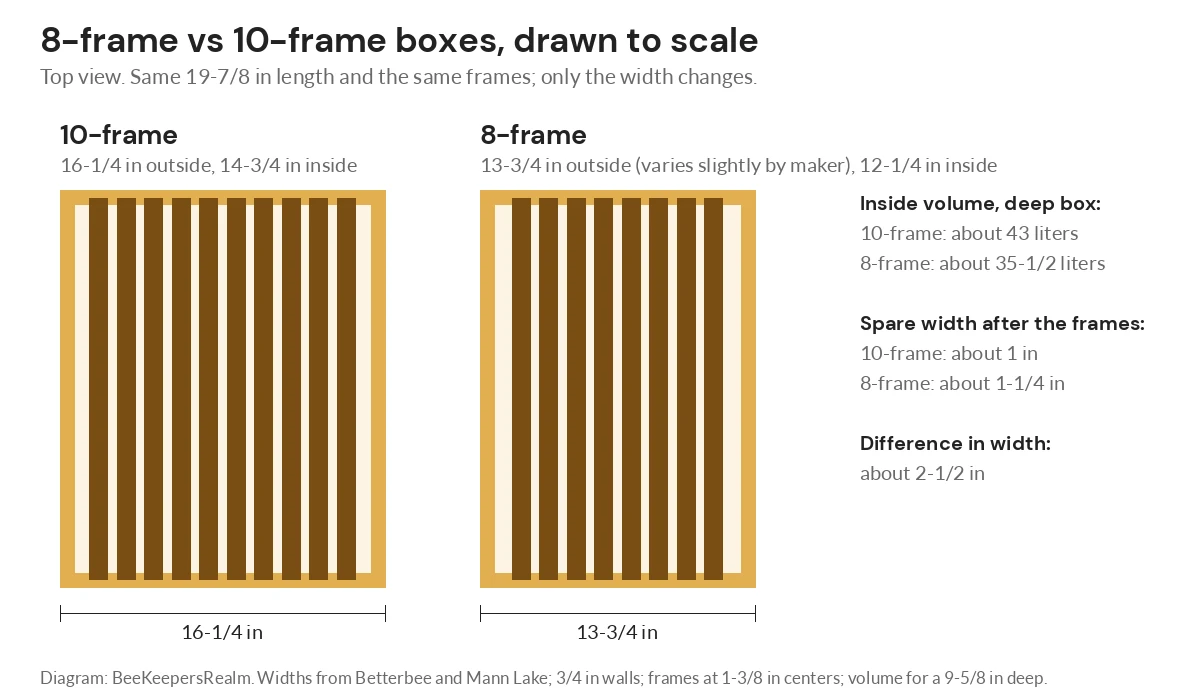
Both are Langstroth hives with the same box length, box depths and frames. Only the width changes.
| 10-frame | 8-frame | |
|---|---|---|
| Outside width | 16-1/4 in | About 13-3/4 in; varies slightly by maker |
| Inside width | 14-3/4 in | About 12-1/4 in |
| Length and frames | 19-7/8 in; standard frames | Same |
| Frames per box | 10 | 8 |
| Inside volume, deep | About 43 liters | About 35-1/2 liters |
| Empty deep box | 8 lb (Mann Lake listing) | About 7.5 lb* |
| Full deep of honey | 60 to 90 lb, by source | About 49 to 73 lb* |
| Full medium of honey | 40 to 60 lb, by source | 31 to 45 lb, by source |
| Boxes for 20 deep frames | 2 | 2.5 (3 boxes hold 24) |
| Parts | Everything, new and used | Most; fewer specialty items |
| Cold climate | What northern guides assume | Same stores, more boxes, taller stack |
*Our estimates; method below. Widths come from Betterbee’s comparison (16-1/4 and 13-3/4 inches) and Mann Lake’s listing for its 10-frame deep (16-1/4 by 19-7/8 inches). Inside figures are our arithmetic for 3/4-inch walls and a 9-5/8-inch deep. With frames at the standard 1-3/8-inch spacing, an 8-frame box has about 1-1/4 inches of spare width against 1 inch in a 10-frame box, so it has 83% of the volume, not 80%.
How Much Lighter an 8-Frame Box Really Is
Published weights for a full 10-frame deep range from 60 to 90 pounds:
- Betterbee’s guide to deeps versus all-medium hives: 60 to 70 pounds for a deep, 40 to 50 for a medium.
- The University of Minnesota Bee Lab guidebook: deeps “can weigh over 80 pounds when full of honey.”
- Longtime beekeeper Michael Bush, on his Bush Bees site: 90 pounds for a deep, 60 for a 10-frame medium and 45 for an 8-frame medium.
The spread reflects how fully the combs are drawn and capped and how thick they are built. The gap between widths is steadier. Betterbee says the empty boxes weigh “nearly the same” and that a medium frame of honey weighs almost 5 pounds; its full 8-frame medium, 31 to 41 pounds, is 9 pounds under its 10-frame figure.
No source we found gives a full 8-frame deep, so we estimated it: take each 10-frame figure, subtract the 8-pound empty box Mann Lake lists, divide by 10 for one full frame, then remove two frames and about half a pound of wood.
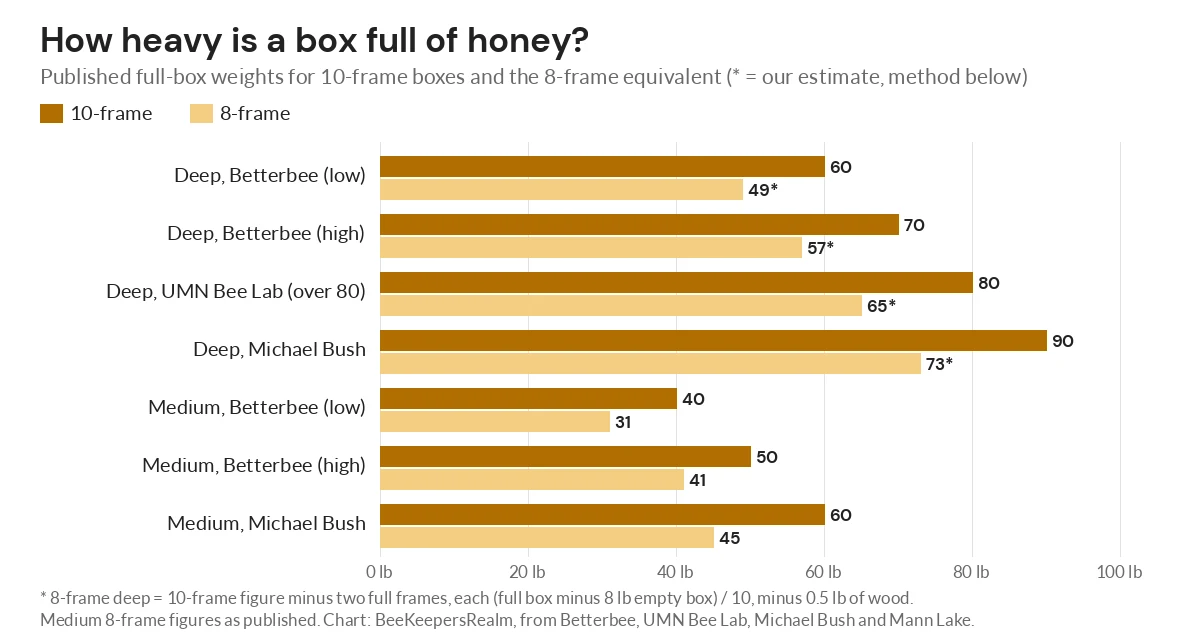
An 8-frame deep saves about 11 to 17 pounds, or 18 to 19%, slightly less than the 20% often quoted. If weight is your main worry, box depth matters as much as width; see deep vs medium frames for the brood nest. An 8-frame medium is the lightest common choice.
Which Parts Fit Both Widths
Anything that holds or spins frames works with both widths. Anything sized to the box’s footprint does not.
| Equipment | Fits both widths? |
|---|---|
| Frames and foundation | Yes |
| Honey extractor | Yes; it holds frames, not boxes |
| Nuc frames | Yes |
| In-hive frame feeder | Yes, if built to frame size |
| Inner and telescoping covers | No |
| Bottom board | No (some stands take both) |
| Queen excluder | No; a 10-frame one overhangs by about 2-1/2 in |
| Hive-top feeder | No |
| Entrance reducer, mouse guard | Mostly sold per width; some adjustable ones fit both |
“Boxes of two different widths aren’t compatible with each other, so an efficient beekeeping operation will be one size or the other.”
A second trap: Mann Lake’s listing warns that 8-frame equipment is “not always compatible with other 8 frame equipment as dimensions vary slightly by manufacturers.” Buy 8-frame boxes, covers and bottoms from one maker, or test-fit first.
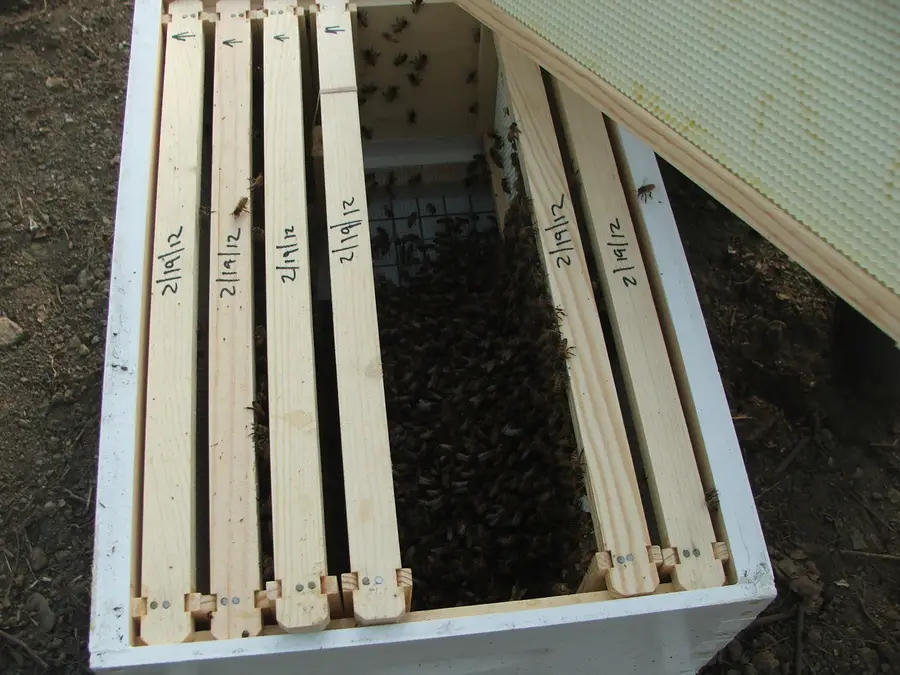
In a pinch, Betterbee and Michael Bush both describe an 8-frame super on a 10-frame hive, with a strip of wood over the exposed edge. To switch widths for good, move frames in their original order; going from 10 to 8, set aside honey or pollen frames, not brood.
Wintering Up North: Does the Narrow Box Help?
Sellers often claim the winter cluster uses about eight frames, so the narrow box is “cozier.” We found no study testing that. Here is what primary sources say.
How wide a winter cluster gets
It depends on strength and cold. In USDA Production Research Report 169 (1977), research entomologist Floyd E. Moeller wrote that a colony of suitable strength in November should “fill at least two standard 10-frame hive bodies from wall to wall” at about 40°F. Cold shrinks the cluster: in USDA Technical Bulletin 1429 (1971), Charles D. Owens described a Madison, Wisconsin, colony on a 7°F day whose cluster “covered part of seven combs in the top body,” in boxes 20 inches square. A cluster that tight fits either width.
Honey above the bees matters more
“When honey bees are in their cluster to keep warm and generate heat, the bees only move up and down in the hive, not side to side.”
So outer-frame honey in a 10-frame box can sit beside a cluster that never reaches it; an 8-frame hive stacks it higher. What counts is honey directly above the bees; see thermoregulation in winter clusters.
Count frames, not boxes
Northern advice assumes 10-frame gear. The University of Minnesota Bee Lab guidebook lists 10-frame deeps in its equipment checklists, and its fall check says to feed if the top box has fewer than 8 frames of honey or the hive lacks 10 full deep frames. In an 8-frame hive, that means a completely full top deep plus two more frames below.
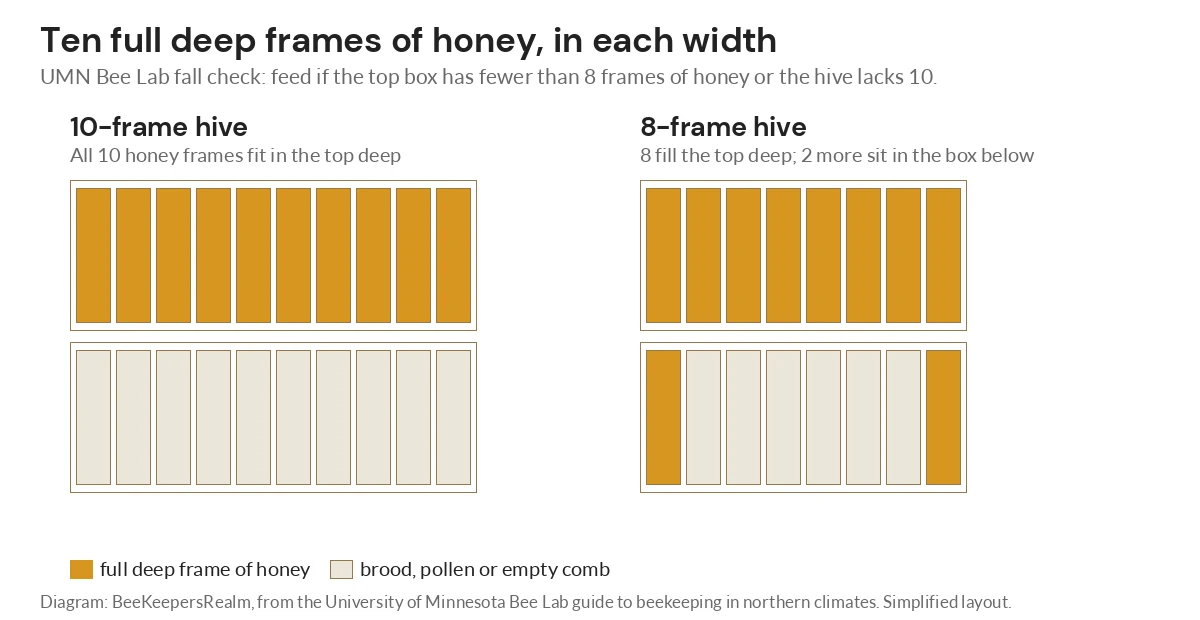
Betterbee notes that “two deeps full of honey” means 20 frames, so an 8-frame hive may need two full deeps plus a filled medium. Moeller’s three 10-frame deeps for the northern states become about four 8-frame boxes. To convert pounds to frames, see how much honey bees need for winter.
The one side-by-side trial
A farmer-led SARE-funded trial in western Massachusetts (FNE15-818) started 20 nucs in single 10-frame deeps and 20 in single 8-frame deeps with an in-hive feeder. Ten and 12 reached winter as set up; 50% of the 10-frame and 83% of the 8-frame colonies survived to April. But the groups sat in different bee yards, only the 8-frame hives had feeders, and these were nucs; the report itself calls the 8-frame group’s 50% survival from its original 20 commercially unacceptable. It hints that small colonies do better in a box matched to their size, nothing more.
Which Width Suits a Beginner
Pick 8-frame if lifting 60 pounds to chest height is hard for you. Pick 10-frame for the widest choice of parts and used equipment. Betterbee’s advice: 10 frame “if you want things simple,” 8 frame for “a slightly easier time lifting things.”
- Nucs. Nuc frames fit either width. A two-deep 10-frame hive splits into four 5-frame nucs, an 8-frame one into three, per Betterbee. See package bees vs nucs.
- Wind. The same volume in 8-frame gear makes a taller stack. Foxhound Bee Company lists tipping in storms as a drawback, so strap tall hives.
- Cost. An 8-frame box usually costs a little less, but you need more of them, so most of the saving disappears. Compare kits in our starter kit guide.
Eight-frame gear is not new. In March 1914, an American Bee Journal adviser told a Georgia beginner to use “the regular 8-frame dovetailed one-story hives” for brood chambers.
Frequently Asked Questions
Is an 8-frame or 10-frame hive better?
Neither is better for the bees. The 8-frame is lighter to lift; the 10-frame has the widest parts selection.
How much does a full 8-frame deep weigh?
About 49 to 73 pounds by our estimate, from published 10-frame figures of 60 to 90 pounds.
Can you put an 8-frame box on a 10-frame hive?
Only as a stopgap, with a strip of wood covering the exposed rim.
Do bees overwinter better in 8-frame hives?
Not proven. Honey directly above the cluster matters more than box width.
How many 8-frame boxes equal two 10-frame deeps?
Two and a half by frame count. In practice, three 8-frame boxes, holding 24 frames.
Can I use a 10-frame queen excluder on an 8-frame hive?
It overhangs by about 2-1/2 inches. Buy excluders, like covers, in your box width.
The Bottom Line
Choose the width you can lift and buy parts for, then stay with it. In a cold climate, plan 8-frame winter stores in frames, not boxes; see beekeeping in cold-winter climates.




_(14781469454).jpg)