
Reviewed by Michael R. · How we review
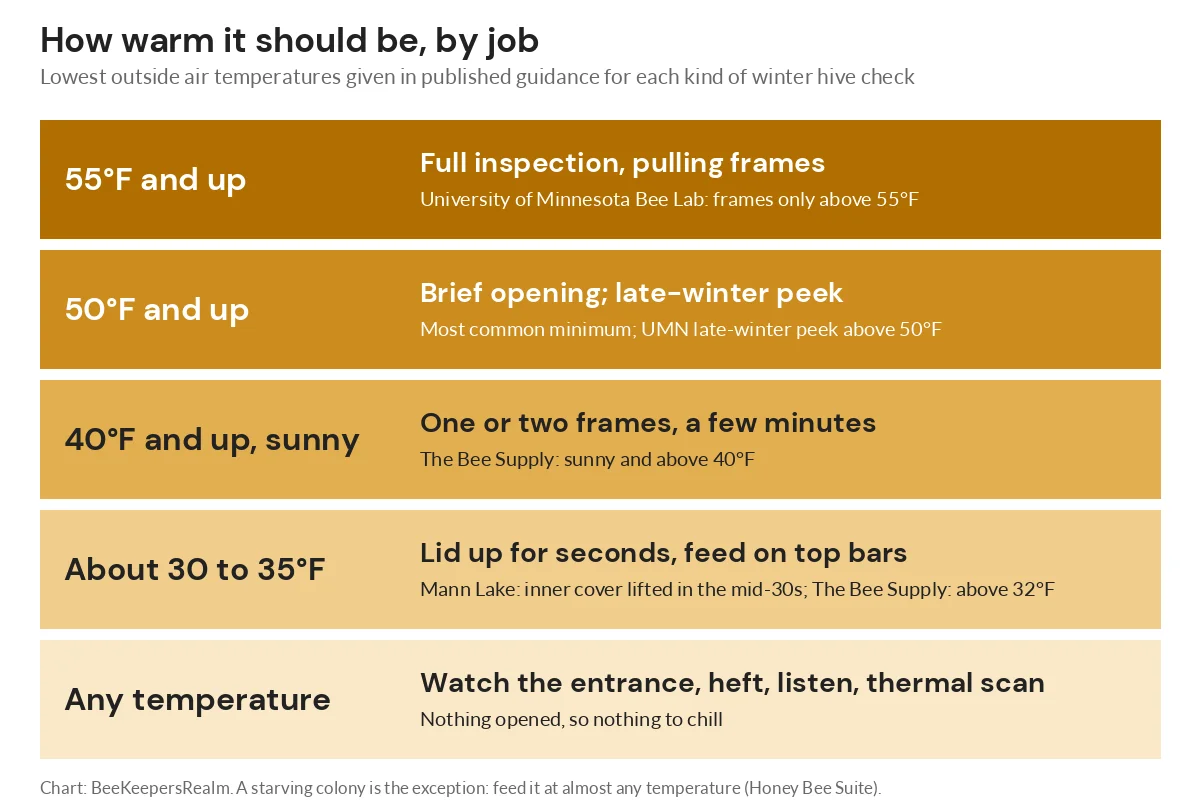
No single temperature is too cold to open a beehive. It depends on what you do and for how long. The University of Minnesota Bee Lab says to pull frames only above 55°F and to peek in late winter on a day above 50°F, while experienced beekeepers lift the lid for a few seconds near freezing to check food. A starving colony can be fed in almost any weather. This guide is written from the northern Plains (see beekeeping in cold-winter climates), where 50°F winter days barely exist.
Key Takeaways
- Pull frames at 55°F or warmer. A seconds-long look under the lid, boxes left together, is done in the 30s°F.
- Fargo, North Dakota, averages 0.7 days from December to February with a high of 50°F (NOAA 1991–2020 normals).
- The often-quoted 57°F is the temperature among the bees inside the hive, from a 1914 USDA study, not the air outside.
- Most winter checks need no opening: watch the entrance, heft, listen, or use a thermal camera.
The Safe Temperature Depends on the Job
The longer the hive is open and the more you pull apart, the more heat the cluster loses, so published minimums differ by job. Work in the warmest part of the day, a few hours before dark, so the cluster can re-form before night (the Bee Supply’s advice).
| Source | Quick look or emergency feeding | Pulling frames |
|---|---|---|
| University of Minnesota Bee Lab, 2026 guidebook | Late-winter peek above 50°F | Only above 55°F |
| The Bee Supply (Chari Elam) | Under 1 minute, no frames: above 32°F | 1 or 2 frames: sunny, above 40°F |
| Mann Lake Bee Supply (Pennsylvania) | Inner cover lifted at about 30 to 35°F | Avoided in late winter |
| PerfectBee (Mark Williams, 2025) | Brief lid lift in the upper 40s°F | At least 50°F; 55 to 60°F ideal |
| Beekeeping Insider | Under 1 minute between 50 and 60°F | Ideally 60°F or warmer |
| Honey Bee Suite (Rusty Burlew) | Starving colony: almost any temperature | Avoided in deep cold |
The Quick Peek: Lid Up, Frames Stay Put
The University of Minnesota Bee Lab guidebook says to check stores “without disturbing the cluster” by looking between the top-box frames and hefting, and to feed if fewer than two full frames of honey remain or the honey is far from the cluster. Bees packed against the top bars need food now; lay fondant or a sugar brick right over them (see candy board vs sugar bricks).
In this three-minute 2023 video, Frank of Mann Lake Bee Supply calls “never open your hive in winter” a fallacy, since colonies that run short starve. In northeastern Pennsylvania, in late February or March, on a day “in the mid-30s or so,” he lifts the inner cover just long enough to see where the bees are. Bees at the top get a feed patty; bees down in the frames get nothing. The check takes two or three minutes.
Why a 50°F Rule Barely Works Up North
We pulled NOAA’s 1991–2020 U.S. Climate Normals for 15 airport weather stations, counting average December-to-February days with highs of at least 40°F and 50°F.
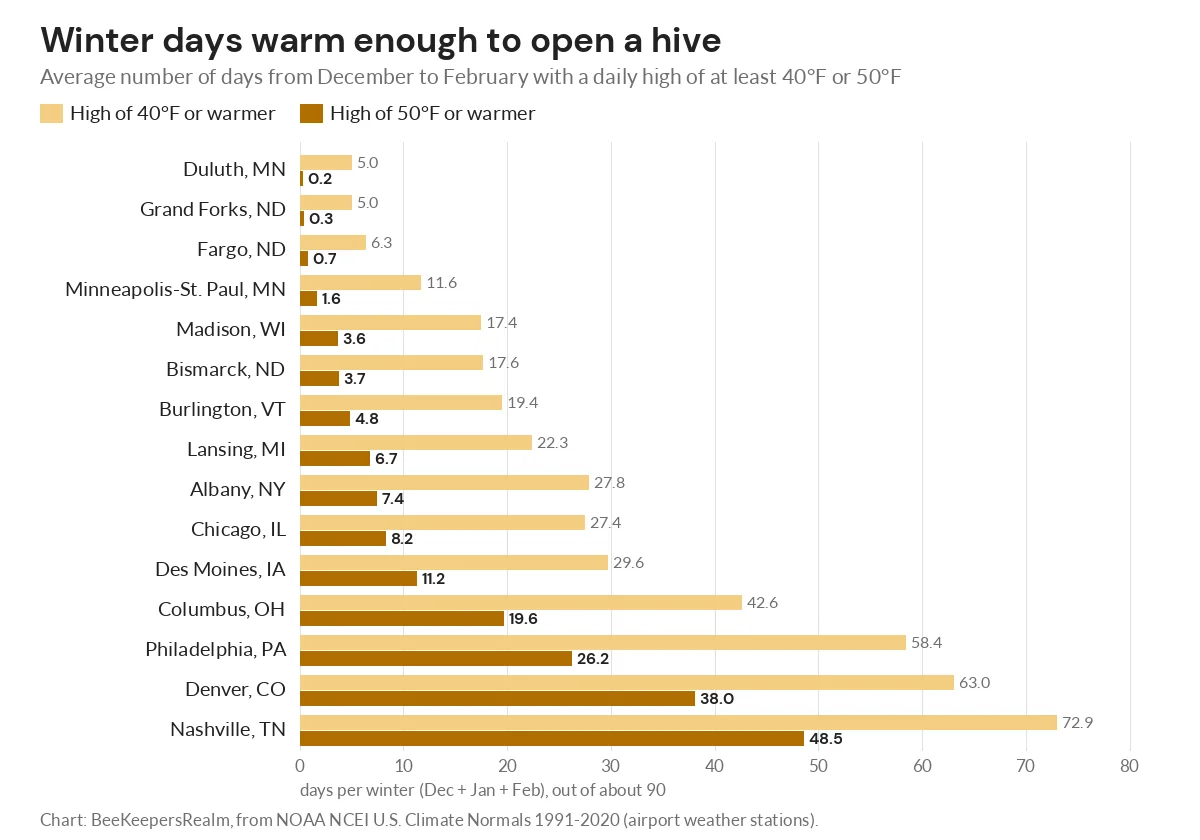
| Station | Days at 40°F or more (Dec–Feb) | Days at 50°F or more (Dec–Feb) |
|---|---|---|
| Grand Forks, ND | 5.0 | 0.3 |
| Fargo, ND | 6.3 | 0.7 |
| Minneapolis–St. Paul, MN | 11.6 | 1.6 |
| Chicago, IL | 27.4 | 8.2 |
| Columbus, OH | 42.6 | 19.6 |
| Nashville, TN | 72.9 | 48.5 |
Fargo’s last 50°F stretch before spring is usually November (5.7 days on average); the next is March (5.1). Averages vary by year and a sunny hive wall beats an airport thermometer, but in the Red River Valley frame work happens by early November or waits for March. Hence the UMN advice to go into winter with at least 75 pounds of honey; see how much honey bees need for winter.
Where the 57°F Figure Comes From
It traces to USDA Bulletin 93 (1914). E. F. Phillips and George S. Demuth read electrical thermometers inside colonies from another room and found a broodless colony made almost no heat “until the coolest point among the bees reaches a temperature of about 57° F.” That is a temperature among the bees, not on your porch thermometer.
“Colonies of bees in winter, either in cellars or out of doors, should be disturbed as little as possible.”
How to Check on Bees in Winter Without Opening the Hive
Watch the entrance
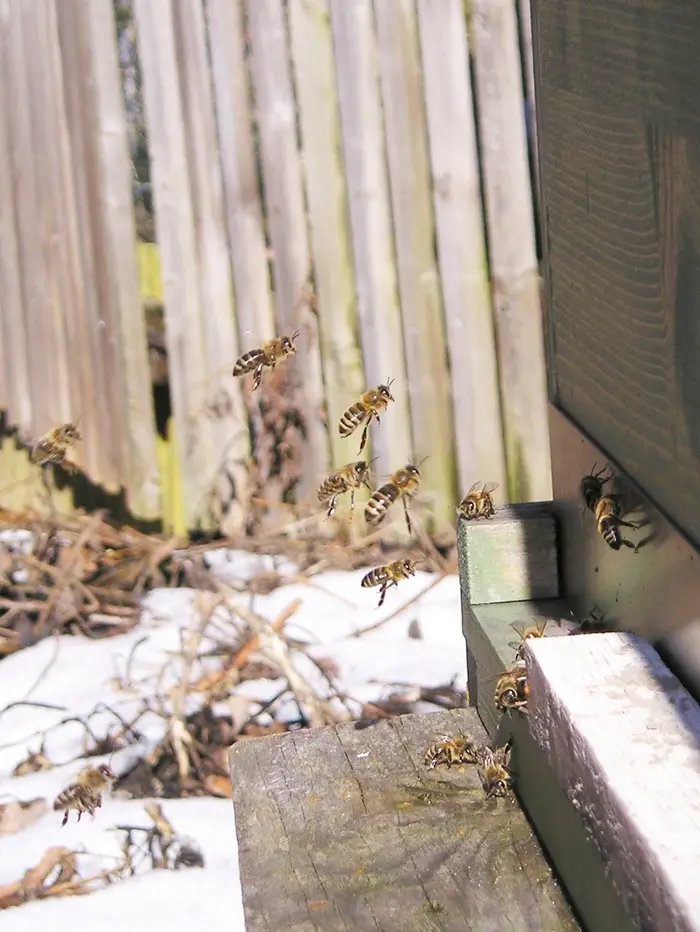
On mild, sunny days a living colony takes cleansing flights, leaving yellow-brown spots on the snow; PerfectBee puts these at the mid-40s°F or higher. A few dead bees on the snow is normal housekeeping. A hive that never flies while its neighbors do, over several warm days, may have died.
Heft the hive
Lift the back an inch and judge the weight. The UMN guide suggests hefting before each inspection in season and noting how many honey frames match that weight, so the feel means something by winter. A scale turns the feel into numbers; see reading a hive weight curve.
Listen before you knock
A stethoscope against the box picks up the cluster’s hum. Betterbee advises one or two knocks while it is cold; Rob Gilliam of Weller Bee Supply says knocking shakes outer bees off the cluster, too cold to climb back. Listen first.
Use a thermal camera or a borescope
A thermal camera shows the cluster’s heat through the wall; a borescope through the entrance shows the cluster itself. Neither shows the honey left, so pair them with hefting.
When to Open the Hive Anyway
Starvation overrides every threshold. Rusty Burlew of Honey Bee Suite argues a starving colony dies for certain if left alone, while opening costs some bees at most; she once combined two colonies at 22°F in under a minute. Her limit: at 40 below in the Prairie Provinces, it is probably wasted effort.
“It’s almost never too cold to open a hive.”
Use solid feed: the UMN guide lists sugar patties or dry sugar below 50°F, syrup only above it. A hive blown over also needs attention at any temperature.
For the whole fall sequence before the cold arrives, see winterizing beehives in northern states.
Frequently Asked Questions
What is the lowest temperature you can open a bee hive at?
Above 55°F for pulling frames; about freezing for a few seconds under the lid; almost any temperature to feed a starving colony.
Is 50 degrees too cold for bees?
No. It is the most common minimum for a brief opening, though a full inspection should wait for 55°F.
What temperature is too cold for bees?
PerfectBee puts the danger point for a single bee away from the cluster at about 40°F. Colonies survive far colder by clustering.
Why don’t I see bees in the winter?
They are clustered inside on stored honey and come out only for cleansing flights on mild, sunny days.
How often should you check on bees in winter?
Outside checks any time, especially after storms. The Bee Supply suggests a lid-up check at least monthly; Betterbee says every month or two.
When can you open the hive after winter?
The UMN Bee Lab waits for a day above 55°F before pulling frames in spring.


.jpg)