
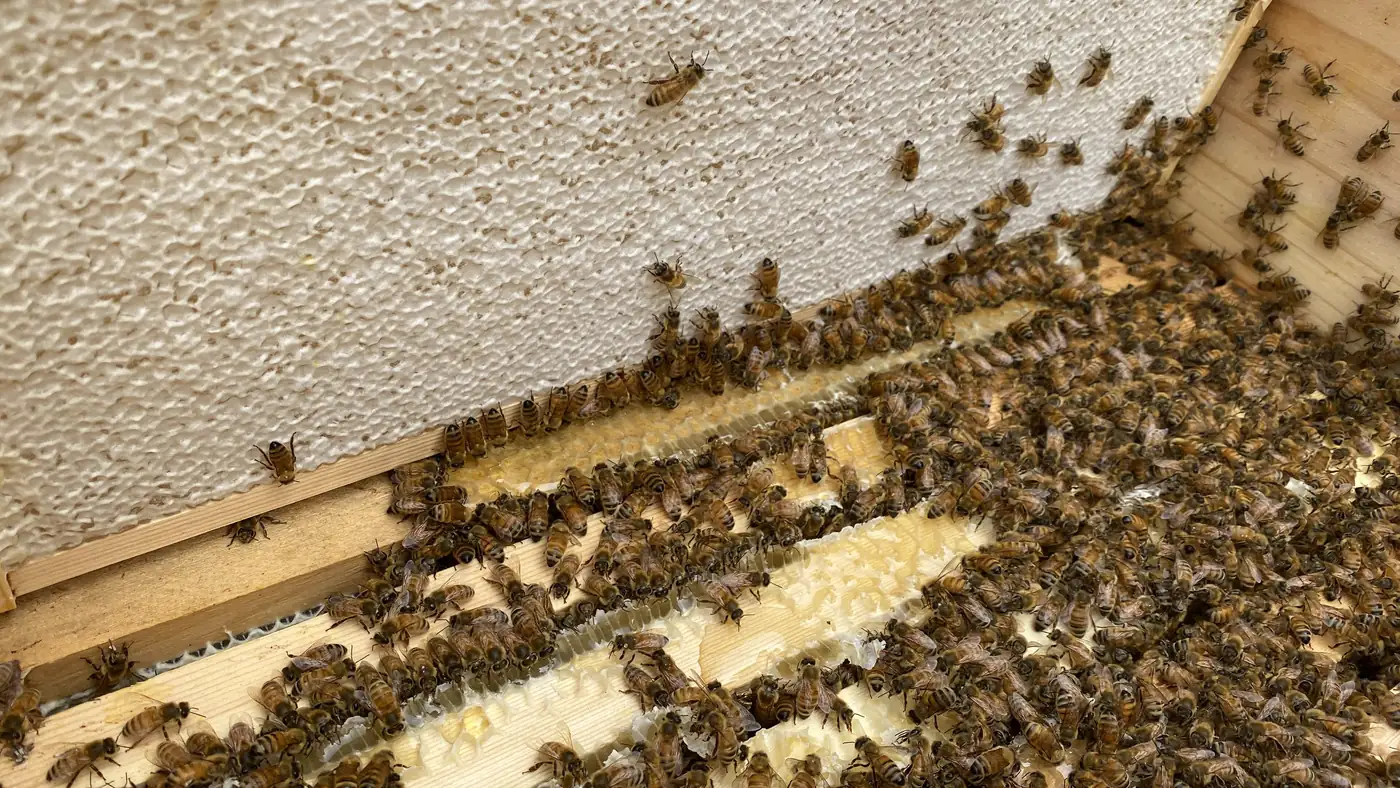
Reviewed by Thomas B. · How we review
Most honey bee colonies need 60 to 100 pounds of honey to get through winter: about 90 to 100 pounds across the northern states and Canada, about 60 pounds in the middle states, and 40 to 60 pounds where winters are mild. Those figures are pounds of honey, not the weight of the whole hive. Mixing up the two is the main reason published targets seem to disagree, and it is how a hive that “feels heavy” can still starve in March.
This guide is written from eastern North Dakota, so the northern numbers get the most detail, but the method works anywhere: set a target for your winter length, measure what the hive is carrying, and close any gap while the bees can still process syrup. For wraps, ventilation and entrances, see our guide to winterizing beehives in northern states.
Key Takeaways
- Leave 90 to 100 pounds of honey on a full-size colony in the northern tier, about 60 pounds in the middle states and 40 to 60 pounds in mild-winter areas. The UK’s National Bee Unit uses about 20 kg (44 pounds) for British winters.
- Those are honey weights. A three-deep colony carrying 90 to 100 pounds of honey should weigh at least 175 pounds in October, according to USDA research.
- In an eight-year USDA study of 1,034 Wisconsin colonies, average consumption from October to April was 59 pounds, and the strongest colonies used up to 80.
- Most starvation happens in March and April, when late-winter brood rearing burns through what is left. Keep checking weight until the spring flow starts.
- Close a shortfall with 2:1 syrup while daytime temperatures are still above roughly 50 to 57°F. After that, switch to solid sugar.
Table of Contents
- Winter Honey Targets by Climate
- Honey Weight vs. Hive Weight: Why Published Numbers Disagree
- How Much a Colony Actually Eats Between October and April
- Converting Pounds Into Frames and Boxes
- Three Ways to Check What Your Hive Is Carrying
- Where the Honey Sits Matters as Much as How Much
- If the Hive Is Light: Closing the Gap Before Cold Weather
- Frequently Asked Questions
- The Bottom Line
Winter Honey Targets by Climate
How much honey a colony needs depends mostly on how long it has to live on stores. That means how many weeks pass between the last fall nectar and the first spring pollen, and how many of those weeks are too cold for flight. A colony in Minnesota may go from October to April without a useful flight day, while a colony on the Gulf Coast forages on warm days all winter.
| Winter type | Honey to leave (full-size colony) | Roughly what that looks like |
|---|---|---|
| Long, hard winters: northern tier of states, Canada, the Upper Midwest | 90 to 100 lb | In a three-deep hive: a top deep sealed nearly wall to wall, plus 25 to 35 lb in each box below |
| Moderate winters: the middle states | About 60 lb | A full medium super plus several heavy frames in the brood box |
| Mild winters: the Southeast, Gulf Coast, coastal California | 40 to 60 lb | Six to nine full deep frames, spread above and beside the cluster |
| Maritime winters: UK and similar | About 20 kg (44 lb) | A full British super plus three brood frames of honey |
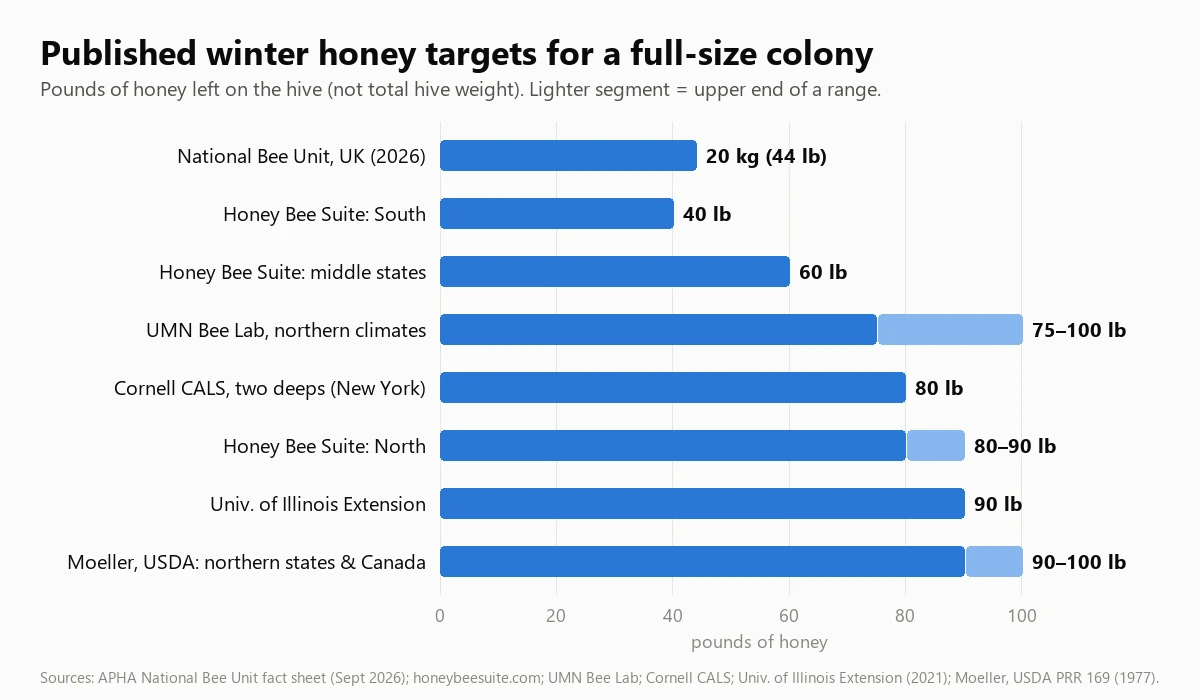
The northern figure comes from USDA entomologist Floyd E. Moeller, who wrote that a full-strength colony in the northern states and Canada “will require no less than 90 to 100 lb” of honey to survive from October to April (Moeller, Overwintering of Honey Bee Colonies, USDA Production Research Report 169, 1977). The University of Minnesota Bee Lab’s northern-climate guidance sets a working minimum of 75 pounds, with the top box full of honey (UMN Bee Lab, Beekeeping in Northern Climates). Honey Bee Suite’s widely used regional guideline is about 40 pounds in the South, 60 in the middle states and 80 to 90 in the North. The UK figure is from the National Bee Unit’s September 2026 winter fact sheet.
Treat every figure as a floor for a strong colony, not a goal to shave. Moeller put the cost of cutting it close bluntly:
“Shorting a colony by a pound (0.45 kg) of honey may result in the death of that colony.”
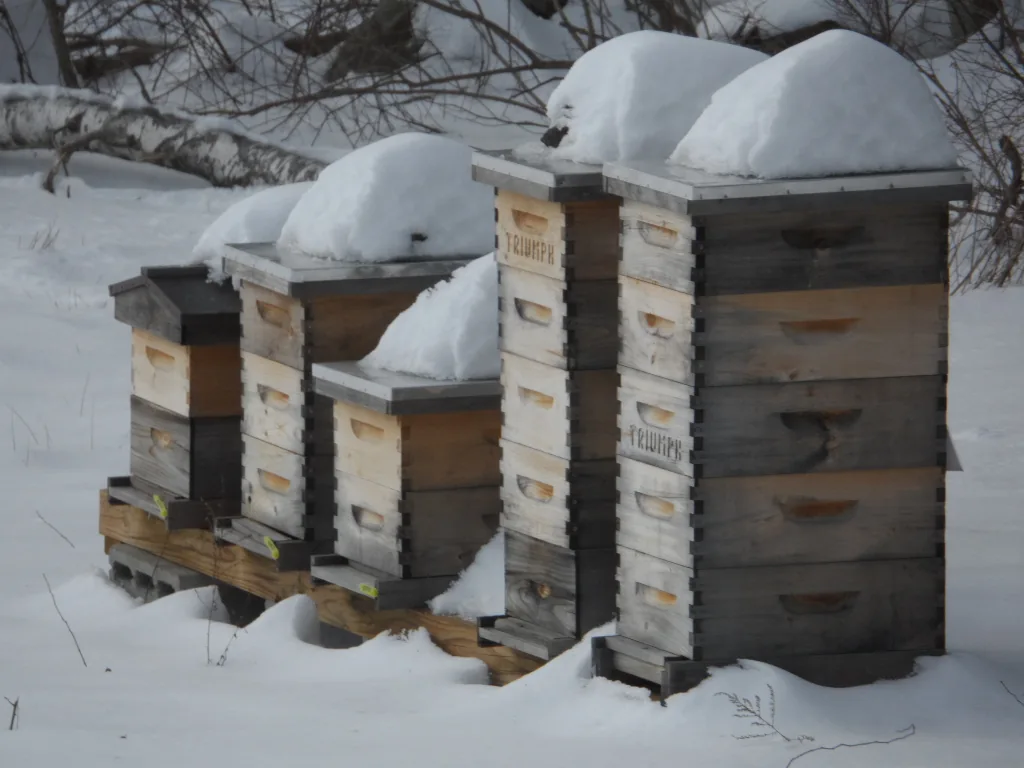
Honey Weight vs. Hive Weight: Why Published Numbers Disagree
Read enough winter guides and you will see “leave 44 pounds,” “leave 80 pounds” and “the hive should weigh 175 pounds,” sometimes on the same page. They are not really in conflict. They measure different things, in different climates, in different hive sizes. Here is what the main published figures actually count.
| Source | Figure | What it measures |
|---|---|---|
| National Bee Unit (APHA, UK), 2026 | About 20 kg (44 lb) in autumn | Honey only, British winters, National hive |
| Honey Bee Suite (Rusty Burlew) | 40 / 60 / 80 to 90 lb by region | Honey only |
| University of Illinois Extension (Gucker, 2021) | At least 90 lb, “a full deep hive box or 2 medium supers full of honey” | Honey only |
| UMN Bee Lab northern-climate guide (2025) | At least 75 lb; stop feeding at 75 to 100 lb | Stored honey or syrup |
| Cornell CALS (Wahl, Mizer and Sammataro) | At least 80 lb of honey for two deeps; 50 lb for a nuc; about 160 lb total for the setup | Honey, and separately the whole hive |
| Moeller, USDA (1977) | 90 to 100 lb of honey; at least 175 lb gross for three 10-frame deeps in October | Honey, and separately the whole hive |
| Döke, Frazier and Grozinger (2015) | 90% survival at 22.5 kg (about 50 lb) or more; 27% at 18 kg (about 40 lb) or less | Hive minus woodenware: bees, comb, honey and pollen |
Two things explain most of the spread. First, climate: the UK’s 20 kg and Moeller’s 90 to 100 pounds describe very different winters. Second, what is on the scale. Moeller’s two numbers imply that everything other than honey in a three-deep hive (boxes, frames, comb, bees, pollen, bottom board and covers) weighs roughly 75 to 85 pounds. Cornell’s figures imply a similar gap: at least 80 pounds of honey in a two-deep (or deep-and-two-medium) hive that ideally totals about 160 pounds (Cornell CALS, Overwintering).
So if someone tells you their hive “weighs 100 pounds,” that could mean a comfortable colony in a mild climate, or a hive carrying only about 20 pounds of honey. Before you compare your hive to any target, check whether the target is honey or gross weight.
The Penn State figure from Döke, Frazier and Grozinger’s 2015 review in Current Opinion in Insect Science shows how sharply the odds change. The authors report their group’s then-unpublished data: 90% of colonies weighing 22.5 kg or more in fall survived, compared with only 27% of those at 18 kg or less, with woodenware excluded from both weights. Ten pounds of difference in fall weight was the difference between likely survival and likely loss.
How Much a Colony Actually Eats Between October and April
Moeller’s recommendation was not guesswork. At the USDA’s Madison, Wisconsin laboratory he tracked winter consumption and next-season yields for 1,034 colonies over eight years. Average consumption from October to April was 59 pounds. Individual colonies ranged from 20 to 25 pounds at the low end to 80 pounds for “the better class of colonies.”
The colonies that ate more were not the problem colonies. The group that used more than the average amount of winter stores gained an average of 49 pounds more honey the following season, about one extra super. Strong colonies burn more fuel, largely because brood rearing drives honey use, and Moeller found they usually replace most of it quickly from willow, dandelion and fruit bloom. Research reviewed by Döke and colleagues also found that food use per bee is lower in large colonies than in small ones, so a strong colony gets more out of each pound (how the winter cluster makes its heat).
That is why the 90-to-100-pound target is sized for a strong colony, not an average one.
Timing matters as much as the total. Moeller found that most colonies are broodless in November and December and start rearing brood around the end of December. Most of the fall reserve is eaten during early spring brood rearing, and he placed most so-called winter loss from starvation in March and April. A hive that hefts fine at Christmas can be in trouble by mid-March. Water is part of the picture too: for every 10 pounds of honey a colony eats, it gives off about a gallon of water vapor, which is why heavy colonies also need a way to handle winter moisture.
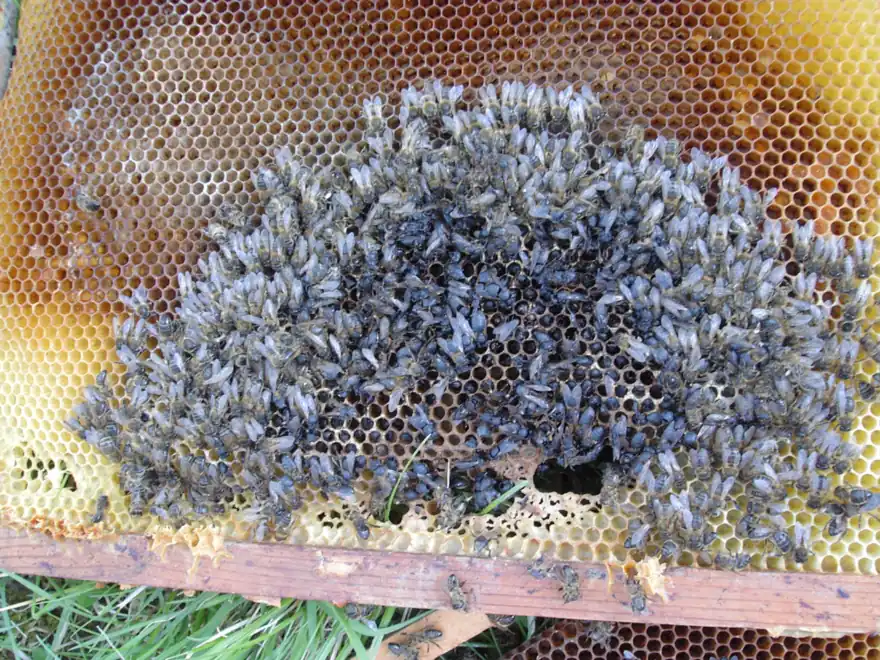
If you lose a colony anyway, bees head-first in empty cells with honey a few inches away usually point to starvation or isolation from stores. Our deadout autopsy checklist separates that from mites, disease and moisture.
Converting Pounds Into Frames and Boxes
Few beekeepers can picture 90 pounds of honey, but most can count frames. Published frame weights vary with comb thickness and how completely the frame is capped, so here are the ranges, with the planning figures we use.
| Unit (Langstroth) | Honey when full and capped | Planning figure |
|---|---|---|
| Deep frame | About 6 to 8 lb (the NBU gives up to 3 kg, or 6.6 lb) | 6.5 lb |
| Medium frame | About two-thirds of a deep frame | 4.5 lb |
| Deep box, winter-heavy (sealed to the bottom bars except the center 2 or 3 combs) | At least 45 lb (Moeller) | 45 lb |
| Full 10-frame deep box, total weight | 80 to 90 lb or more | Weigh your own |
At those planning figures, 90 pounds of honey is about 14 full deep frames or about 20 full medium frames. Sixty pounds is about nine deep frames. Eight-frame equipment holds 20% less comb per box, so an eight-frame colony usually needs an extra medium on top to reach the same target. If you are deciding what box size to winter in, our comparison of deep and medium frames for the brood nest covers the trade-offs for a northern winter.
A quick worksheet for a September inspection:
| Step | Example (two deeps, northern target) |
|---|---|
| 1. Pick your target | 90 lb |
| 2. Count full-frame equivalents (two half-full frames count as one) | Top deep: 8 full; bottom deep: 4 full |
| 3. Multiply by the planning figure | 12 × 6.5 = 78 lb |
| 4. Shortfall | 90 − 78 = 12 lb |
| 5. Plan the fix | At least 12 lb of dry sugar as 2:1 syrup (about 1.6 gallons), then heft again |
In this video, beekeeper David Burns walks through his own formula for deciding how much honey to leave. Any fixed formula should be adjusted for the length of your own winter.
Three Ways to Check What Your Hive Is Carrying
Count frames while it is still warm
The only direct measure is to look. Do it in September, on a day above 50°F, which is Cornell’s cutoff for fall hive work. Count capped honey on both faces of every frame, and note where it is, not just how much. After mid-fall, opening the hive costs the cluster heat and breaks the propolis seals the bees have built.
Heft it, and calibrate your hands
Hefting means lifting the back of the hive an inch off the stand by the handhold and judging the weight. It sounds crude, but Moeller wrote that “with practice, one can learn to estimate weights of hive bodies quite accurately by lifting.” The UMN Bee Lab suggests lifting the hive before you open it at an inspection, then noting how many frames are actually full, which trains your hands against real frame counts. The NBU adds a useful detail: heft one side, then the other, because stores are often lopsided. A heavy left side and a light right side can mean the cluster is sitting next to its last few frames.
Weigh it with a luggage or crane scale
A hanging scale turns hefting into a number. Hook the scale under the back handhold, lift until the back just clears the stand, and read it. Then do the same at the front. The two readings added together come very close to the weight of the whole hive, because each lift carries the share of weight on that end while the other end acts as the pivot. Subtract the weight of your empty equipment (weigh one empty box with drawn comb once and keep the figure) and an allowance for bees and pollen, and you have a working estimate of stores. Be careful lifting: the UMN guide notes that a full deep can weigh more than 80 pounds.
If you want continuous numbers instead of spot checks, a permanent hive scale shows the slow winter decline week by week. Our guide to reading a hive’s weight curve explains what a normal winter slope looks like and when a steeper one is a warning.
Where the Honey Sits Matters as Much as How Much
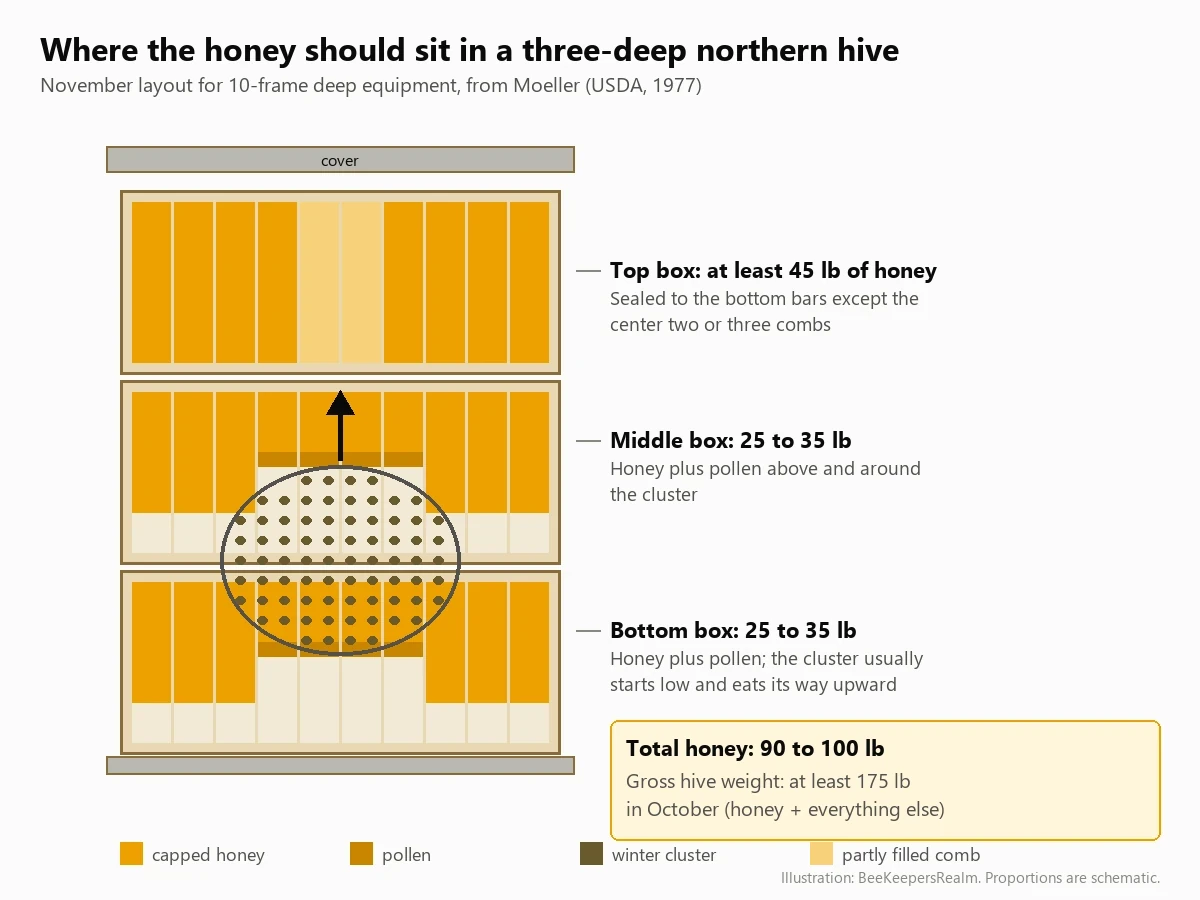
A winter cluster moves slowly upward through its stores. In hard cold it can starve with full frames a few inches to one side, a failure known as isolation starvation. Moeller’s layout for a three-deep northern colony puts the weight where the cluster will travel: at least 45 pounds in the top box by November, sealed to the bottom bars except the center two or three combs, and 25 to 35 pounds of honey plus pollen in each of the two boxes below.
Two practical details from the same sources are easy to miss:
- Take the queen excluder out for winter. The NBU warns that a cluster can move up through an excluder toward stores and leave the queen behind to die.
- Dark comb makes better winter honey storage than new white comb. Moeller noted that bees cluster more readily on dark brood comb and are “somewhat reluctant” to move up onto white comb that has never held brood. A top box of honey in old brood frames is better placed than the same weight in fresh super comb.
Within a single box, bees naturally store honey in an arc above and around the brood, with pollen in a band between. In fall that arc should fill most of each frame as the brood area shrinks.
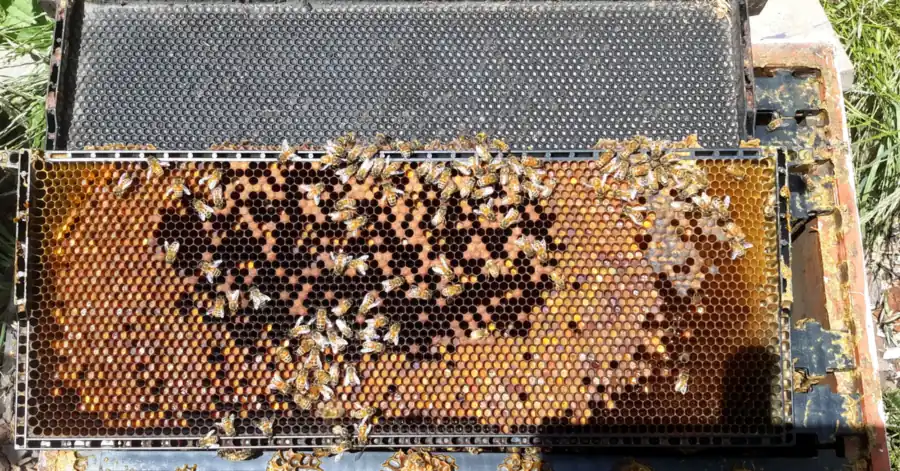
If a check on a mild winter day shows the cluster pressed against the top bars with little honey beside it, move full frames next to the cluster or add solid feed directly above it. Our guide to detecting early hive starvation covers the warning signs.
If the Hive Is Light: Closing the Gap Before Cold Weather
The best winter feed is capped honey the bees stored themselves, so the first fix is to move full frames from heavy colonies into light ones. Do this only between colonies you know are disease-free. After that, fall syrup is the standard tool. Cornell, the UMN Bee Lab and the Döke review all recommend 2:1 syrup (two parts sugar to one part water by weight) because the bees have less water to evaporate before they can cap it. Our guide to syrup ratios by season covers mixing it.
“Food stores are one of the most important predictors of winter survival.”
How much sugar closes the gap? A gallon of 2:1 syrup weighs about 11 pounds and holds about 7.4 pounds of sugar. Honey is about four-fifths sugar, so in theory each pound of sugar could become more than a pound of stored honey. In practice the bees spend some of it processing and storing the rest. A conservative planning rule is one pound of dry sugar for each pound of shortfall. Feed, wait a week, then heft or weigh again rather than trusting the arithmetic.
Don’t overshoot. Moeller advised feeding only what is needed, because ripening large amounts of syrup stresses bees going into winter. The UMN guide says to stop at 75 to 100 pounds so syrup doesn’t fill the space the queen needs for spring laying. In a yard of several colonies, feeding can also start robbing, so use internal feeders and reduced entrances. See feeding bees without causing robbing.
Know your cutoff. Bees stop taking and curing syrup as it gets cold. Oregon State University Extension advises stopping liquid feed once daytime highs fall below 57°F, and cites the Honey Bee Health Coalition’s 50°F guideline. In eastern North Dakota that usually means finishing syrup around the start of October. After the cutoff, emergency feed goes on top of the cluster as solid sugar: a candy board or sugar bricks, fondant, or dry sugar using the Mountain Camp method.
A small colony may not be worth feeding up. The NBU guidance is that colonies covering fewer than about five brood frames should usually be combined, and that colonies under about 9,000 bees have a poor chance of surviving. Those are British Standard frames, which are smaller than Langstroth deeps. In deep cold, Moeller noted, a small cluster may cover only 2 or 3 pounds of honey however much is in the box. Combining it with a stronger colony often saves more bees than feeding it. For first-year colonies, our northern nuc build-up plan sets out the late-August decision point.
Frequently Asked Questions
How many frames of honey do bees need for winter?
About 14 full deep frames or 20 full medium frames for a 90-pound northern target, and about nine deep frames for 60 pounds.
How much honey is in a deep frame?
About 6 to 8 pounds when fully capped. The UK’s National Bee Unit gives up to 3 kg (6.6 pounds) for a Langstroth brood frame.
Can I leave a honey super on over winter?
Yes. In cold climates a super of honey often serves as the top food box. University of Illinois Extension describes 90 pounds as a full deep or two full medium supers. Remove the queen excluder so the queen isn’t stranded below it as the cluster moves up.
When should you stop feeding bees for winter?
Stop liquid syrup once daytime temperatures fall below roughly 50 to 57°F, or once the colony reaches its target, whichever comes first. The UMN Bee Lab suggests stopping at 75 to 100 pounds. After that, use solid sugar only if the hive hefts light.
Do bees eat their own honey in the winter?
Yes. Stored honey is the fuel bees burn to keep the cluster warm by shivering their flight muscles, and later to rear the first spring brood. USDA measurements in Wisconsin averaged 59 pounds eaten between October and April.
What is the best thing to feed honey bees in the winter?
Capped honey from your own disease-free colonies is best. After fall syrup season, use solid sugar placed directly above the cluster: a candy board, fondant, sugar bricks or dry sugar. Avoid liquid syrup in cold weather, which the NBU warns can go moldy in the feeder.
How much honey do bees need for winter in Texas and other southern states?
Plan on 40 to 60 pounds. Southern colonies fly and often rear some brood through winter, so they keep eating. Moeller wrote that 60 pounds “is not too much in southern areas,” so lean high if unsure.
The Bottom Line
Match your target to your winter: about 90 to 100 pounds of honey in the North, about 60 in the middle states and 40 to 60 where winters are mild. Make sure you are comparing honey to honey, not to the weight of the hive. Count frames in September, heft or weigh through winter and spring, and close any shortfall with 2:1 syrup while it is still warm enough for the bees to store it.





.jpg)