
Reviewed by Thomas B. · How we review
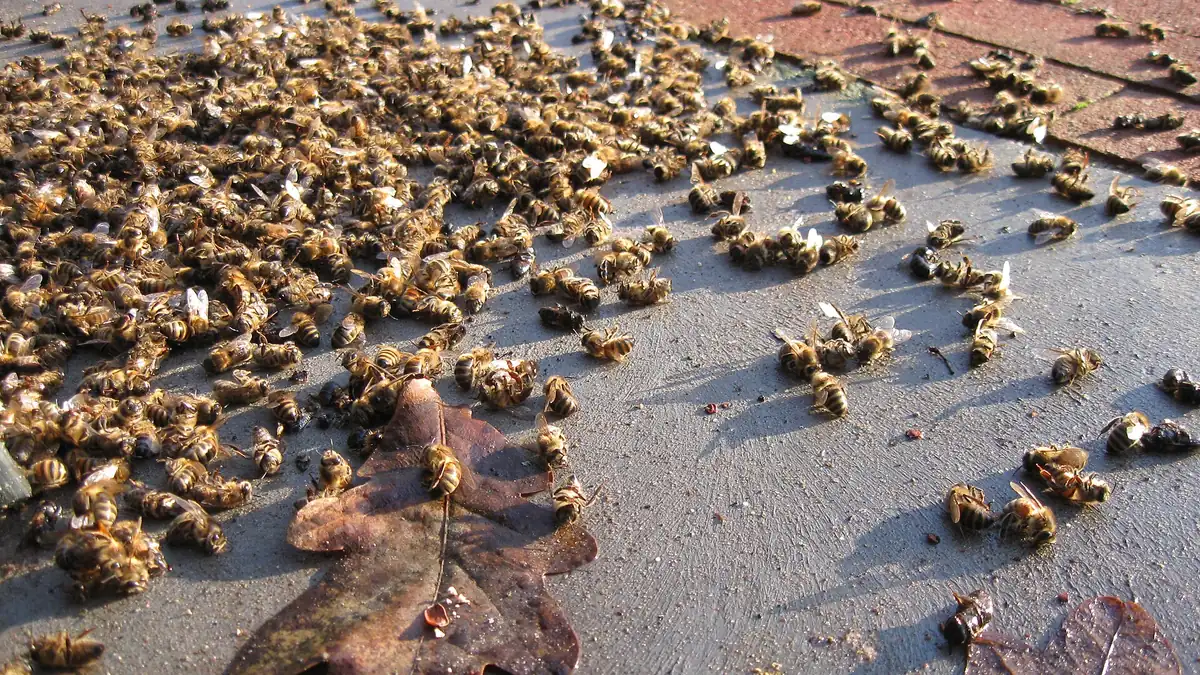
A few dead bees in front of a hive, even a few dozen on a busy day, is normal in every season. It becomes a problem when hundreds appear within a day or two, when the dead and dying bees look abnormal, or when every hive in the yard is hit at once. A healthy colony loses bees constantly and carries its dead outside, so the size of the pile tells you less than how fast it grew, what the bodies look like and where they are lying.
This guide is written from the Red River Valley, where the first thaw in March can leave a dark scatter of bees on the snow in front of every hive, but the checks below work anywhere. For how a colony finds and removes its dead, see our explainer on undertaker bees.
Key Takeaways
- NC State University’s pesticide stewardship program puts the upper end of normal at about 100 dead bees per hive per day. In a dead-bee-trap study of colonies at untreated apple orchards, the average was 8 a day.
- An FAO beekeeping bulletin grades a pesticide kill at 200 to 400 dead bees a day (low), 500 to 1,000 (medium) and more than 1,000 (high).
- Speed matters more than size. A winter backlog hauled out on the first warm day is normal. A pile that appears within hours in midsummer is not.
- Twitching or tongue-out bees, crumpled wings, black hairless bees, headless bees and white mummies each point to a different cause.
- If you suspect poisoning, photograph it, freeze at least 2 ounces of bees, leave the hive alone and call your state pesticide regulator before cleaning up.
Table of Contents
- Why a Healthy Colony Leaves So Few Bodies at the Door
- Four Questions That Separate Turnover From Trouble
- Dead Bees Through the Year
- If You Suspect Pesticide Poisoning
- Frequently Asked Questions
- The Bottom Line
Why a Healthy Colony Leaves So Few Bodies at the Door
Worker honey bees do not live long. Summarizing earlier research in a 2020 Frontiers in Ecology and Evolution paper, Stephanie Feliciano-Cardona and colleagues, including Penn State’s Christina Grozinger, note that temperate workers live up to about 60 days in the foraging season, while bees raised at the end of summer routinely survive more than 200 days through winter. For a summer colony of 40,000 to 50,000 workers living five or six weeks, that works out to roughly a thousand deaths a day.
You never see most of them. Foragers wear out and die in the field, and bees that die inside are found fast. In Kirk Visscher’s 1983 study of undertaking behavior (Animal Behaviour 31:1070–1076), a dead worker was usually removed within about 30 minutes by undertakers, only 1 to 2% of the colony, who typically fly the body 50 to 100 meters away before dropping it. What collects on your landing board is the fraction too heavy, wet or cold to carry far, plus bees that died at the entrance itself.
So measured counts are small. Sjef van der Steen and Axel Dinter used dead-bee traps on colonies in flowering apple orchards, and colonies at the untreated control orchards averaged 8 dead bees per colony per day (Pest Management Science, 2007). Extension guidance uses a looser ceiling: North Carolina State University’s Center for Integrated Pest Management says healthy hives may lose up to about 100 dead bees per hive per day. The FAO bulletin Beekeeping in Asia (Akratanakul, 1990) uses the same 100-a-day baseline and grades a pesticide kill at 200 to 400 a day (low), 500 to 1,000 (medium) and more than 1,000 (high).
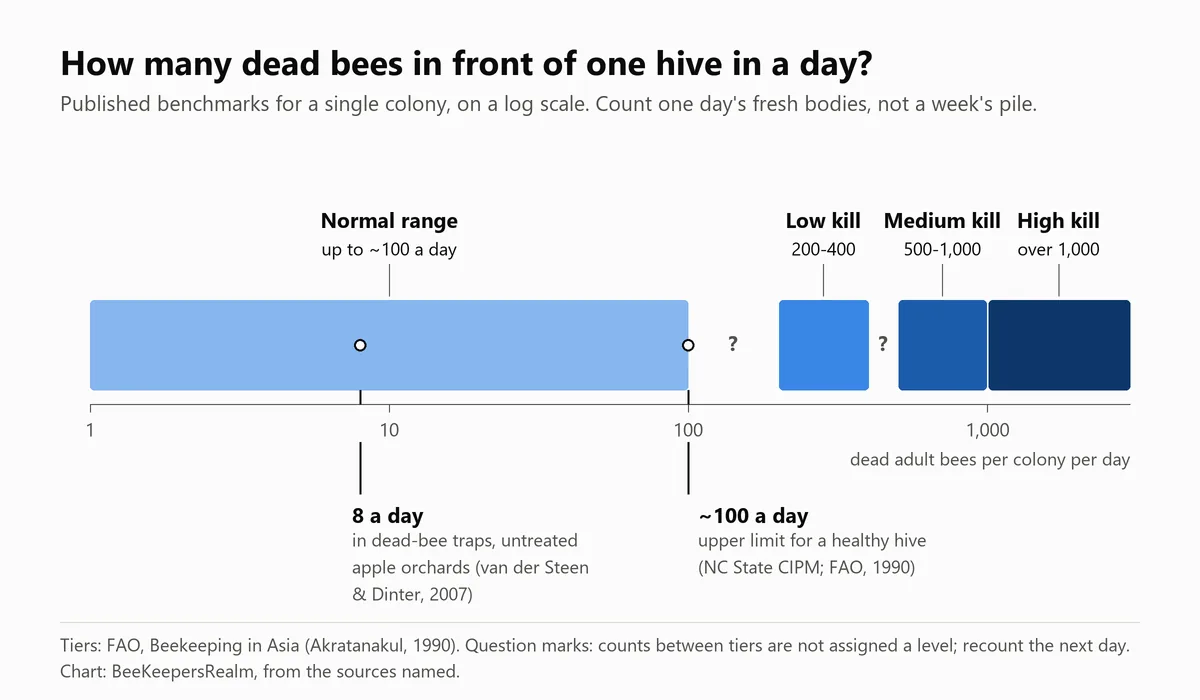
Compare those figures with one day’s fresh bodies, not a week’s or a winter’s pile: sweep the ground or lay a light-colored board out in the evening and count it 24 hours later. Treat it as a minimum: birds, ants, wasps, rain and grass remove or hide bodies.
A steady trickle is also a sign of life. In her deadout-diagnosis column, Tina Sebestyen lists “no dead bees at all” in front of a hive as a clue in its own right.
A live colony should have “a few dead bees out front because the undertakers are doing their job.”
Four Questions That Separate Turnover From Trouble
How fast did the pile appear?
Rusty Burlew of Honey Bee Suite calls the rate of accumulation “important diagnostic evidence.” Most diseases build slowly, so the pile starts small and grows over days or weeks. Poison works on a different clock.
“A colony that was poisoned can die all at once.”
The exception is winter. Bodies that collect during a cold spell come out in a rush on the first flying day, so a big overnight pile in February or March usually means a cleared backlog.
What do the bodies look like?
Bees that died of old age look worn, with frayed wing edges and bodies rubbed partly bald. Anything else is worth identifying.
| What you see | What it usually means | Next step |
|---|---|---|
| A scattering of workers with frayed wings and worn bodies | Normal turnover of old bees | Nothing |
| Hundreds of fresh dead workers within hours, some twitching, spinning on their backs or with tongues out | Pesticide poisoning | Follow the pesticide steps below before disturbing anything |
| Trembling, crawling bees, some black, shiny and hairless, with the pile growing daily | Chronic bee paralysis virus | Compare chronic bee paralysis vs. pesticide poisoning |
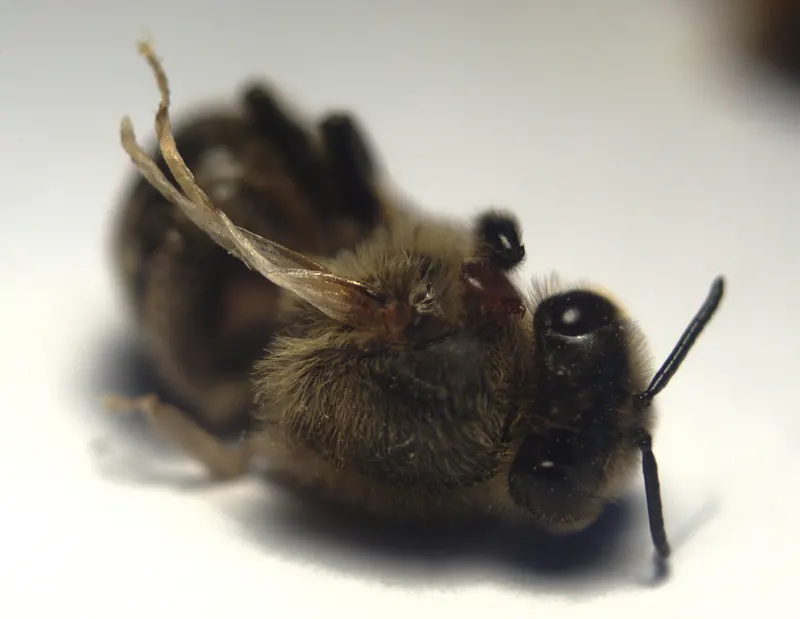
| Bees with crumpled, stubby wings crawling in the grass | Deformed wing virus, a sign of high varroa levels | Do a mite count now |
| Dead bees plus brown streaks on the hive front in late winter | Dysentery after long confinement | Check stores and moisture on a mild day |
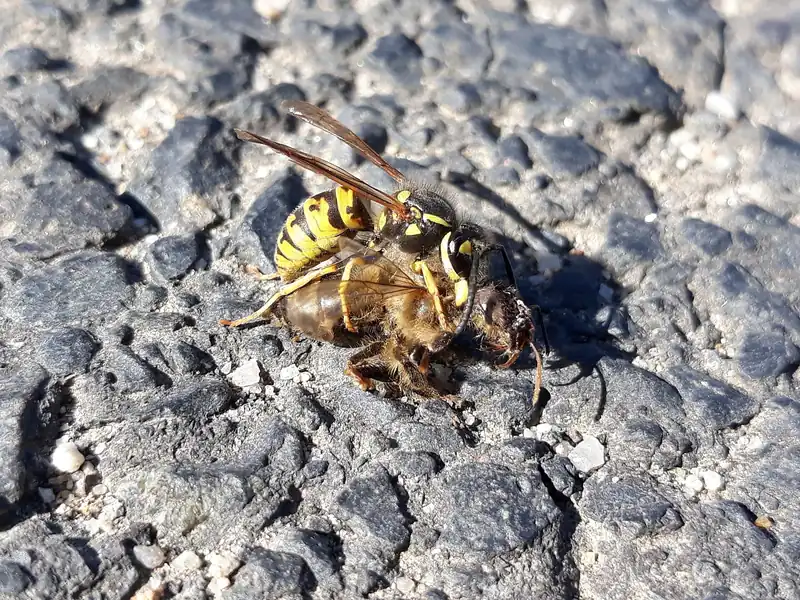
| Headless or bitten-in-half bees, with yellowjackets or hornets at the entrance | Predation | Reduce the entrance and trap the wasps |
| Dead bees among fighting bees, with shredded wax cappings on the landing board | Robbing | Narrow the entrance and remove anything sweet from the yard |
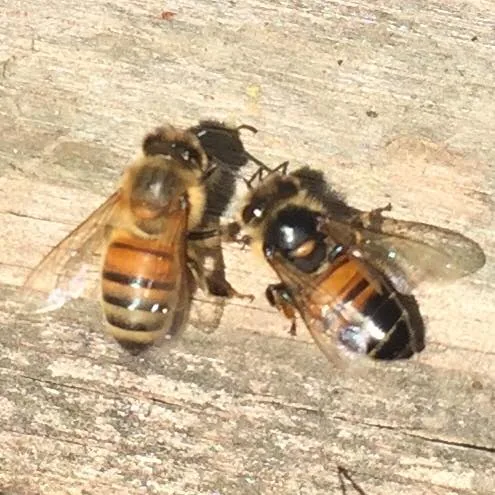
| Dead or dying drones (large, blunt-ended, big-eyed) in late summer or fall | Drones being evicted before winter | Nothing |
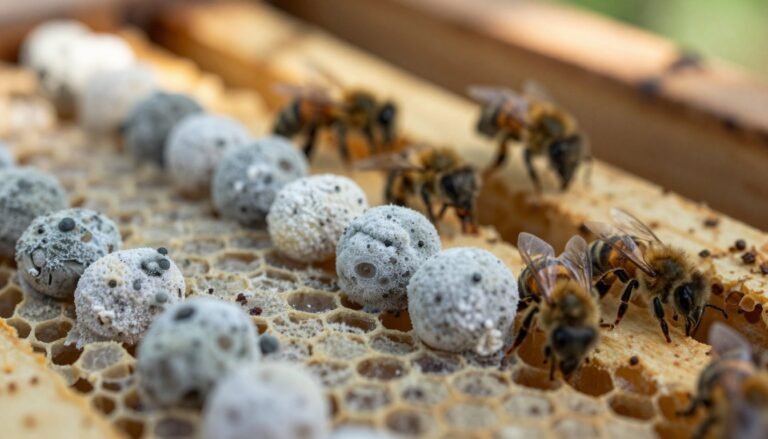
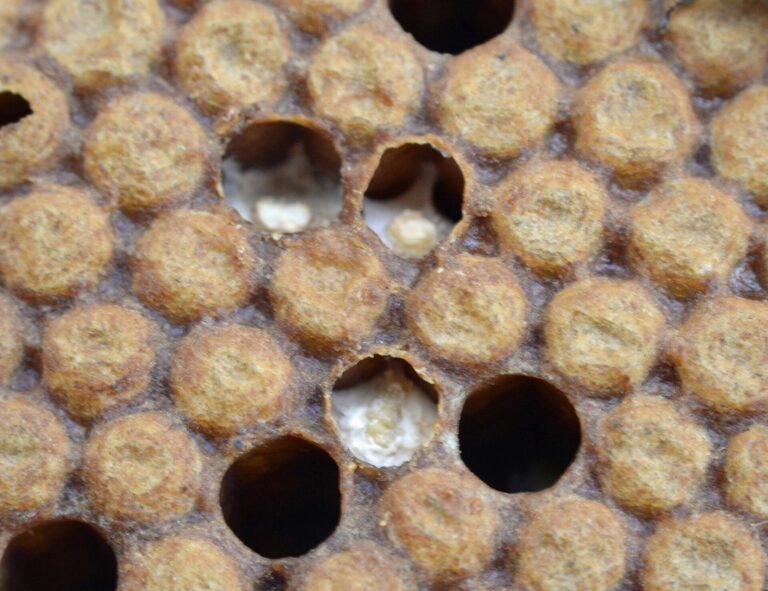
| White or gray chalky “mummies” | Chalkbrood | Improve ventilation and consider requeening |
| White or purple-eyed pupae dragged out | Chilled brood, mite-infested brood removed by hygienic workers, wax moth or hive beetle damage, or contaminated pollen | Inspect the brood nest |
Where are they lying?
- On the snow, a few feet to several yards out: bees that flew on a bright, cold day and chilled. Normal in modest numbers.
- Heaped on the bottom board or blocking a lower entrance in winter: too cold to carry out. Clear the entrance gently with a bent wire; our comparison of upper and lower winter entrances explains why an upper opening stays clear.
- On the landing board and right in front: deaths at the entrance itself: fighting, predation or poisoned foragers that made it home.
- Crawling away through the grass: sick bees often leave on foot. Check their wings and bodies.
- Inside, head-first in cells in a dead cluster: the usual picture of winter starvation. It often leaves little outside, so a clean landing board is no proof the bees are fed.
Is it one hive or the whole yard?
One colony with a growing pile points to that colony: disease, mites, a failing queen or robbers. Every colony at once, often worst in the strongest hives, points to something they all flew to, usually a pesticide.
In this short video, Black Mountain Honey, a UK beekeeping business, walks through the same distinction between routine clean-up and a warning sign.
The video explains why turnover rises during rapid brood expansion, after cold snaps and after mite treatments, and flags the warning signs: sudden large numbers, trembling or crawling bees, deformed wings, robbing and an unusual smell. Its advice is to watch the entrance for five minutes, checking flight, incoming pollen and the colony’s tone, before opening the hive.
Dead Bees Through the Year
Months are for the northern United States; shift them earlier where spring comes sooner.
| Season | Usually normal | Worth a closer look |
|---|---|---|
| Winter (December to February) | Bees dead on the snow after flying days; a slow buildup on the bottom board | An entrance clogged solid; brown streaks down the hive front; no flight at all on a warm, sunny day |
| Late winter and spring (March to May) | A big clean-out on the first warm days as the winter’s dead are hauled out and old winter bees die off | Trembling or crawling bees; chalkbrood mummies; pupae dragged out after a cold snap; a sudden kill during bloom-time spraying |
| Summer (June to August) | A low, steady trickle, since most foragers die in the field | Hundreds overnight; black, hairless, trembling bees; deformed wings as mites build; fighting during a nectar dearth |
| Fall (September to November) | Drones pushed out to die; a trickle of worn-out summer bees | Robbing; yellowjacket attacks; crawling bees with deformed wings as mite-damaged colonies fail |
Winter and the first warm days
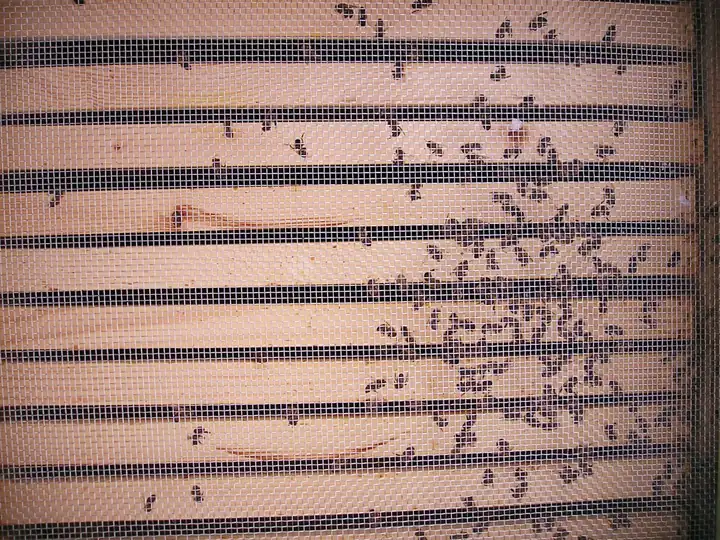
In deep cold the undertakers cannot fly, so bodies collect on the hive floor. On the first flying day the colony clears the backlog, and some bees on cleansing flights land on the snow and never lift off. It looks grim but usually means a living colony doing its hauling. If you also see brown spotting on the hive front, read our guide to dysentery after winter cleansing flights.
Spring
Spring brings heavy turnover as winter bees reach the end of their lives. Watch the brood instead: dead pupae after a cold night can mean the cluster left brood uncovered, and white or gray mummies mean chalkbrood, most common in cool, damp springs. See chalkbrood mummies in front of the hive. A sudden, yard-wide kill during bloom-time spraying should be treated as possible poisoning.
Summer
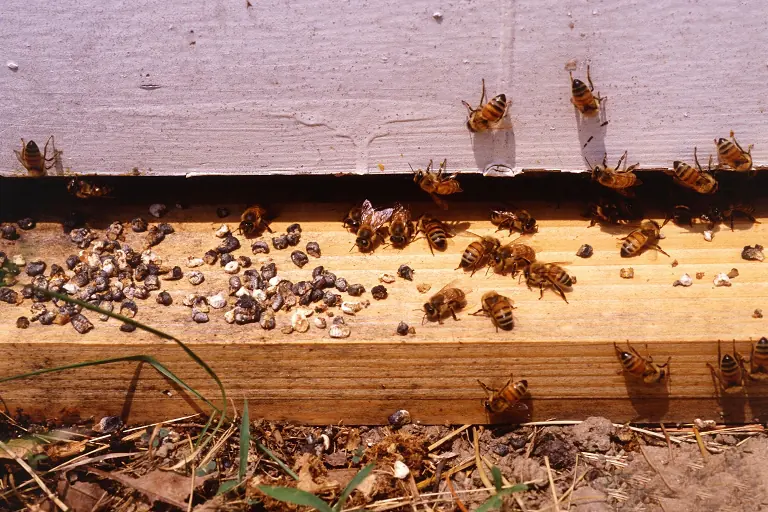
In summer the pile out front should stay small. A sudden heap is the classic sign of a spray. A pile that grows day after day, with trembling bees and some that look black and greasy, is the classic sign of chronic bee paralysis virus. Infected bees usually die within a week, and the disease “leads to piles of dead bees just outside honey bee hives,” according to Newcastle University’s summary of a 2020 Nature Communications study by Giles Budge and colleagues, which found cases in England and Wales rising exponentially from 2007 to 2017.
Fall
Fall brings the one pile that is almost always harmless: drones, dragged out once the colony stops rearing them. It also brings three problems that do leave bodies. Varroa populations peak, and bees with deformed wing virus crawl out on crumpled wings (see deformed wing virus signs in adult bees).
During the fall dearth, strong colonies rob weak ones; our guide to spotting robbing early shows what to look for. Yellowjackets hunt at entrances at the same time and cut bees up to carry away, so headless and half bees are their signature. Unsure what is patrolling your entrance? See yellowjackets vs. honey bees.
If You Suspect Pesticide Poisoning
The PNW Insect Management Handbook chapter on bee poisoning (Erik Johansen, reviewed March 2019, adapted from Pacific Northwest Extension publication PNW 591) lists these signs in honey bees:
- Excessive numbers of dead and dying bees in front of the hives
- Bees more defensive than usual
- Stupefaction, paralysis and jerky, wobbly or rapid movements, including bees spinning on their backs
- Regurgitated nectar and extended tongues
- “Crawlers” that cannot fly and act as if chilled
- Dead brood and dead newly emerged workers
The same chapter warns that viral paralysis, starvation, winter kill and chilled brood can mimic poisoning, which is why speed, season and the number of hives affected matter. If it still looks like a spray, work in this order:
- Record it. Photos or video, plus the date, time, weather and wind, anything in bloom nearby, any spraying you saw and any treatments in your own hives.
- Save a sample. The PNW handbook advises freezing at least 2 ounces of adult bees, plus brood, pollen or wax if you can, in clean, clearly labeled containers.
- Leave the site alone. Some states collect their own samples for enforcement, so do not clean up or move hives until the state investigator is finished.
- Report it. Call your state pesticide regulatory agency, which investigates bee kills. The EPA also asks beekeepers to report bee kills through its incident portal or by email, since patterns only emerge across many reports.
- Use the right lab. The USDA Bee Disease Diagnosis Service in Beltsville checks U.S. samples for bacterial, fungal and microsporidian diseases and mites at no charge, but it does not test for pesticide residues or viruses. Our guide to bagging and sending bee samples covers packing.
If a colony has already died, our deadout autopsy checklist walks through reading what is left, so the same cause does not take the next one.
Frequently Asked Questions
Is it normal to see dead bees in front of a hive?
Yes. Workers die every day and undertakers carry out those that die inside, so a few to a few dozen a day is routine. An entrance with no dead bees for a long stretch can itself be a warning sign.
How many dead bees in front of a hive is too many?
NC State’s Center for Integrated Pest Management puts normal at up to about 100 per hive per day. The FAO grades 200 to 400 a day as a low pesticide kill and over 1,000 as a high one.
Why are there so many dead bees outside my hive in winter?
Bees that die in cold spells collect inside until the colony can fly. On the first warm day it hauls them out, and some bees on cleansing flights chill and fall on the snow.
What do bees do with dead bees in the hive?
Undertaker bees, 1 to 2% of the colony, usually remove a body within about 30 minutes and fly it well away from the hive, according to Kirk Visscher’s 1983 study.
Do bees die if they don’t make it back to the hive?
Usually. A forager caught out by cold, rain or dusk can chill and die in the field, one reason most deaths never show up at the entrance.
Do bees die at the end of summer?
Summer workers keep dying on their normal schedule of a few weeks while the colony raises long-lived winter bees. The colony also evicts its drones, so dead drones often appear in front of hives in fall.
Why am I suddenly finding a lot of dead bees?
In winter or early spring, a backlog is probably being cleared on a warm day. In the flying season, hundreds of dead or twitching bees within hours, especially at several hives, suggests poisoning.
The Bottom Line
A trickle of dead bees means a working colony, and a pile after a thaw is usually house-cleaning. Judge any pile by its speed, the bodies, where they lie and how many hives are involved, and compare one day’s count with the benchmarks. When the answers point to trouble, record the evidence first, then act.

.jpg)
_L.S._Olive_%26_Spiltoir_1324048.jpg)
.jpg)

