Reviewed by Elena P. · Last Updated September 24, 2026 · How we review
In a cold northern winter, the upper entrance is the one that matters most, but the best setup is usually both: a small upper entrance near the top of the brood nest, plus a lower entrance cut down to a mouse-proof slot. The upper opening stays clear of snow and dead bees. It sits in the warmest part of the hive, so bees can leave for cleansing flights on mild days, and it lets some moist air escape. The lower entrance adds a second air path and a backup exit. On its own, a bottom entrance fails in exactly the conditions a Red River Valley winter delivers: drifting snow, ice, a pile of dead bees on the floor, and a lower box that stays too cold for bees to walk out of.
Key Takeaways
- For most full-size colonies in a northern winter, run both entrances: a small upper one and a reduced lower one.
- In a USDA thermal study in Wisconsin, closing the top entrance kept bees from flying on warm days. The unheated bottom box never warmed enough for bees to fly from the bottom entrance.
- An upper entrance of roughly 1/2 to 1 inch is enough. The University of Minnesota Bee Lab drills a 1-inch hole about 3 inches above the bottom edge of each deep.
- Put the upper and lower entrances on the same side of the hive so wind can’t blow straight through the cluster.
- Small or weak colonies, and hives in late-fall robbing season, are the main exceptions. Keep upper openings closed or very small for them.
- The upper entrance is not your moisture control. It supports an absorbent or insulated ceiling; it doesn’t replace one.
Table of Contents
What a Five-Winter Study Found
Most online debate about top entrances is opinion. There is one piece of hard data that most articles on this question skip: Charles D. Owens’s The Thermology of Wintering Honey Bee Colonies (USDA Technical Bulletin 1429, 1971). Owens placed thermocouples through Langstroth hives at Madison, Wisconsin, and logged temperatures from December 1 to March 31 over five winters. The mean outside temperature was 24.5°F and the lowest reading was -20°F. That’s milder than a Fargo or Grand Forks winter, but it’s the same kind of weather.
His hives were three bodies high, with a 1-inch entrance hole in the middle body and a 3-inch by 3/8-inch entrance at the bottom board. For part of the study, he closed the bottom entrances and left the top ones open for a few days, then reversed them. The findings bear directly on this question:
- The bottom entrance barely mattered to the cluster. Closing it had no effect on how the cluster reacted to temperature. In his control and packed hives, it didn’t change the temperature of the bottom box either.
- Closing the top entrance trapped the bees. With the top entrance shut, the cluster moved closer to it and stopped pulling back at night. But the bees could no longer get out on warm days.
- The bottom box stayed too cold to fly from. In the unheated hives, the lower body never warmed enough for bees to leave through the bottom entrance.
“Periodical bee flights in winter seem to make for a healthier colony.”
Charles D. Owens, USDA Technical Bulletin 1429, “The Thermology of Wintering Honey Bee Colonies” (1971)
Owens was careful not to overclaim. He wrote that without an upper entrance, the bees’ chance of winter survival “possibly was decreased”, not that it was proven lower. Still, the mechanism is clear. Heat collects around the cluster, and the cluster usually sits high in the hive by midwinter. An exit near that warm zone is one bees can actually use. An exit in the cold bottom box often isn’t.
Upper vs Lower Entrance, Side by Side
| Factor | Upper entrance | Lower entrance |
|---|---|---|
| Access for cleansing flights | Good: opens near the warm cluster | Poor in deep cold: bees must cross a cold box to reach it |
| Snow drifts | Usually stays clear | Buried after most blizzards on open ground |
| Dead bees | Not affected | Can be blocked by bees dropping onto the bottom board |
| Moisture escape | Lets some warm, moist air leave at the top | Mainly lets cold air in |
| Heat loss | Some, because warm air rises | Little |
| Mice | Rarely the way mice get in | The usual way in; needs a guard or a 3/8-inch slot |
| Robbing and guarding | A second door for a weak colony to defend | The colony’s normal guarded entrance |
| Best use | Main winter exit for a strong colony | Reduced backup exit and air inlet |
The table shows why the answer is usually “both” rather than one or the other. Each opening covers the other’s weak points. The upper entrance handles snow, dead bees, and flight access. The lower one gives air a way in low and moist air a path out through the top, which is how a chimney works, and it’s still there if ice glazes over the upper hole.
Why a Bottom Entrance Alone Fails Up North
A bottom-only hive can come through a mild winter fine. On the northern plains, four things work against it:
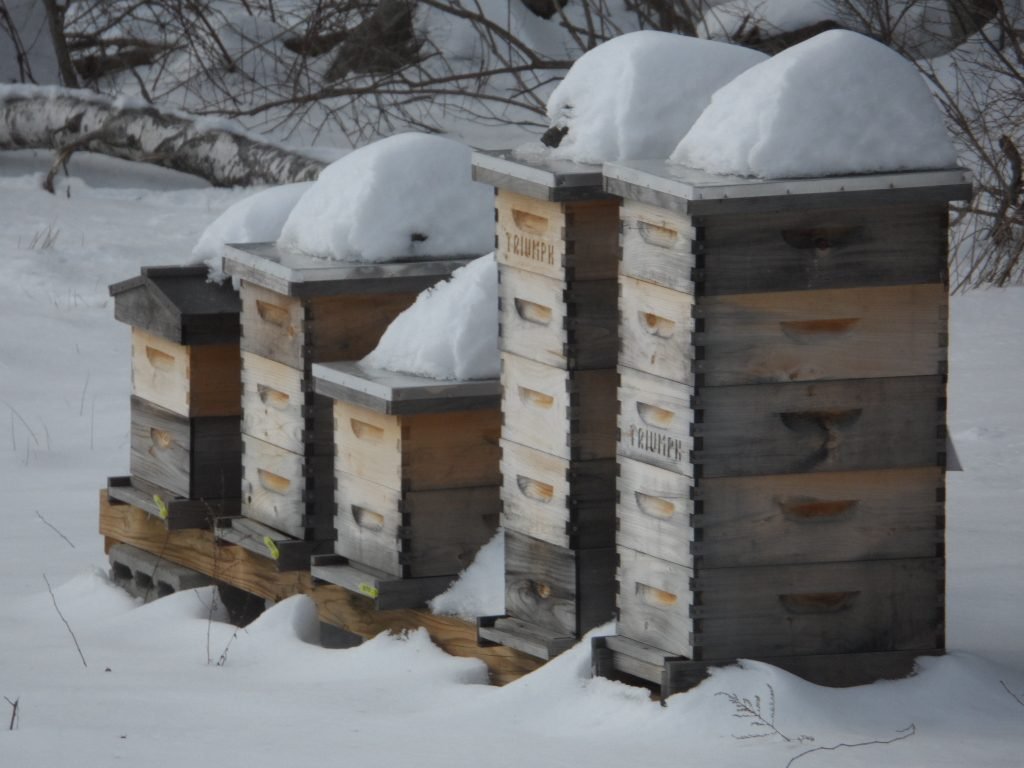
- Snow. On open, flat land the wind moves snow all winter and packs it against anything in its path, including hive fronts. A light, fluffy cover of snow lets air through. A wind-packed drift or a layer of ice after a thaw and refreeze does not.
- Dead bees. A colony loses older bees steadily through the winter. Many drop onto the bottom board and pile up behind a reduced entrance. By February, a 3/8-inch slot can be completely blocked from the inside.
- Cold air pooling. Cold air sinks. Owens found the lower box of unheated hives never warmed enough for flight. On a 40°F February afternoon, bees at the top of a cluster can reach a top entrance quickly. Walking down through a cold, empty box to the floor is a much harder trip.
- Ice at the entrance. Condensation runs down the inside walls and collects on the bottom board. When it refreezes at the front edge, it can seal the lower slot even when there’s no snow.
None of these block an upper entrance. That’s why wintering guidance for Minnesota and the Dakotas treats an upper entrance as standard practice rather than an option.
When an Upper Entrance Costs You
An upper entrance has real costs, and it shouldn’t be treated as a fix for everything.
Heat loss
Warm air rises, so any hole near the top lets some heat out. That’s why the opening should be small, about 1/2 to 1 inch, and never a full-width gap. A small upper hole under an insulated or absorbent ceiling costs much less heat than a propped lid or a large notch.
Cross-drafts
If the upper entrance faces into the wind and the lower one faces away from it, air can blow straight through the hive and across the cluster. In his review of winter hive research, Randy Oliver recommends putting the top entrance on the same side as the bottom entrance to prevent cross-drafts. Face both away from the prevailing winter wind. On most of the northern plains, that means away from the north and northwest.
Small or weak colonies
A small cluster can’t heat much space and can’t guard two doors. For a nuc or a small colony going into winter, keep the upper opening closed or at its smallest. Put the effort into insulation and stores instead.
Robbing season
If warm spells in October bring robbing pressure in your area, a second entrance on a weaker colony gives robbers another way in. Many northern beekeepers open the upper entrance only once nights stay cold and flying weather is mostly over.
It is not moisture control on its own
A hole lets some vapor out, but most of a wintering colony’s water has to be handled by what’s above the cluster: a moisture board, a quilt box, or rigid foam that keeps the ceiling warm enough to stop drips. The ceiling matters more than the size of the hole. For the ceiling side, see how to reduce moisture inside winter hives and our comparison of a winter quilt box vs a moisture board.
How to Size and Place Each Entrance
The University of Minnesota Bee Lab has decades of experience wintering colonies in a climate much like ours. Its wintering tips, from Bee Lab staff member Gary Reuter, give the specifics. Drill a 1-inch hole centered 3 inches above the bottom edge of each deep hive body. The hole can be 1/2 to 1 inch in diameter, and it must be closable in any box that isn’t the top one. The same page says to cut a matching hole in the winter wrap so the entrance isn’t covered.
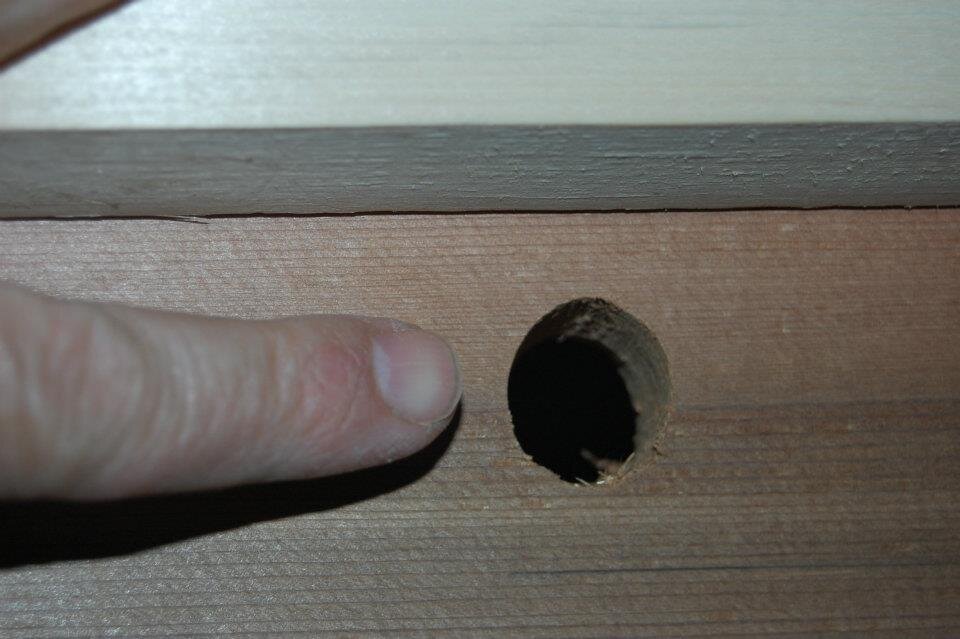
You don’t have to drill boxes. Common alternatives:
- Inner cover notch facing down. This gives a direct top exit. See inner cover notch up or down for the burr-comb trade-off.
- An entrance shim. This is a rim about 3/4 to 1-1/2 inches deep with a small notch or hole, set between the top box and the inner cover or moisture board. It also gives you room for emergency sugar.
- A slot in a feeding rim or candy board. Useful if you already winter with a candy board on top.
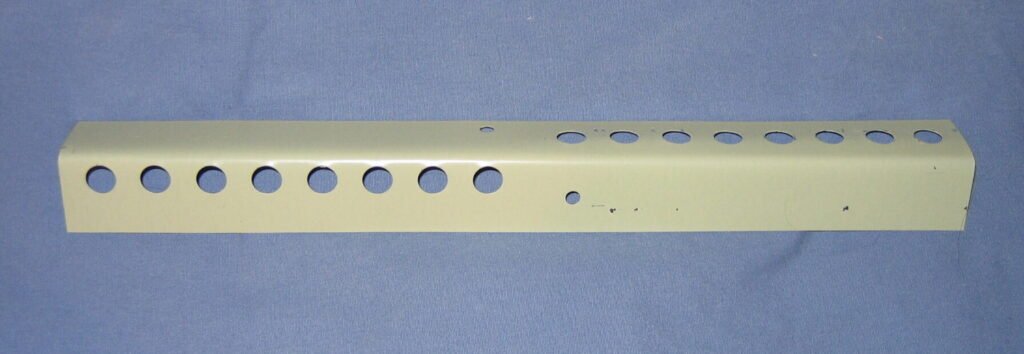
For the lower entrance, the goal is a slot a bee can use but a mouse can’t. Use the small setting on an entrance reducer or a mouse guard with 3/8-inch openings. Our guide to mouse guard hole size explains why 3/8 inch works. Don’t close the bottom entrance completely on a screened bottom board unless the screen is also covered for winter. Otherwise you’ve built a bottom vent with no bottom door.
A Northern Winter Setup, Step by Step
This is the sequence we’d suggest for a full-size colony in eastern North Dakota or western Minnesota. Adjust it to your hive and your bees.
- Step 1: Finish feeding and treating first. Close upper openings while you’re feeding syrup in September and early October. An open top hole next to a feeder invites robbing.
- Step 2: Reduce the lower entrance when nights turn cold. Fit a mouse guard or the small reducer setting before mice start looking for winter shelter, usually in October.
- Step 3: Open the upper entrance when you wrap. In late October or early November, open or install a 1/2 to 1 inch upper entrance on the same side as the bottom entrance, facing away from the prevailing wind.
- Step 4: Put the ceiling on. Add a moisture board, quilt box, or rigid foam over the inner cover. If you use a wrap, cut it so the upper entrance stays open. Our roundup of hive wraps for cold climates covers the main options.
- Step 5: Tip the hive slightly forward. A small forward tilt lets condensation run out of the front instead of pooling on the bottom board, where it can freeze across the lower entrance.
- Step 6: Leave it alone. Once the entrances are set, the job is monitoring from outside, not opening the hive.
For the rest of the winter checklist, including stores, wind breaks, and mite treatment timing, see winterizing beehives in northern states.
Checking Entrances Through the Winter
Entrances are the one part of a wintering hive you can check without breaking the propolis seal. After each blizzard, and on the first mild day after a long cold spell:
- Look at the upper entrance first. Bees at the hole, or yellow spotting on the snow after a flight day, tell you the colony is alive and able to fly. Rusty Burlew of Honey Bee Suite noticed that bees gathered at her new upper entrances in winter because that’s where the hive is warm. It’s a quick check that doesn’t disturb the colony.
- Clear, don’t dig out. Brush packed snow or ice away from the lower slot, but you don’t have to clear snow from around the whole hive. Loose snow against the walls can act as insulation.
- Pull out dead bees gently. A length of stiff wire bent into a hook will rake dead bees out through the lower entrance without lifting the hive.
If you’re still deciding how many openings a hive should have the rest of the year, see how many entrances a hive should have. This article covers only the winter decision.
Frequently Asked Questions
Should I close the bottom entrance completely in winter?
Usually not. Reduce it to a mouse-proof slot instead. Owens found that closing the bottom entrance made little difference to the cluster, but it still gives you a backup exit if ice closes the upper hole, and a low air inlet. Close it fully only if your hive design and moisture control are built around a top-only entrance.
How big should an upper entrance be in winter?
About 1/2 to 1 inch across. The University of Minnesota Bee Lab uses a 1-inch drilled hole in a deep box. Bigger openings lose more heat without giving much more benefit.
Where should the upper entrance go?
Near the top of the brood nest, on the same side as the lower entrance, facing away from the prevailing winter wind. A hole just below the inner cover, or an entrance shim under a moisture board, both work.
Does a top entrance make a hive colder?
A small one costs a little heat, because warm air rises. For a strong colony with an insulated or absorbent ceiling, the benefits usually outweigh that cost. For a small colony they often don’t, so keep the upper opening closed or very small on weak hives.
Can I use the inner cover notch as the upper entrance?
Yes. With the notch facing down it becomes a direct top exit, and burr comb is less of a problem in winter because the bees aren’t building. Make sure the outer cover and any wrap or moisture board don’t block it.
When should I open the upper entrance?
After fall feeding and robbing season are over. In eastern North Dakota and western Minnesota that usually means when you wrap in late October or early November. Close or reduce it again in spring once the lower entrance is reliably clear and the colony starts building up.
Do I still need a moisture board if I have an upper entrance?
In a northern winter, yes. The upper entrance lets some vapor escape. The moisture board, quilt, or foam above the cluster stops condensation from dripping onto the bees. See the best moisture board for winter hives for materials.
The Bottom Line
In a cold northern winter, the upper entrance does most of the work, but it works best with a reduced lower entrance behind it. Keep the upper hole small, put both entrances on the sheltered side, and don’t open the top until feeding and robbing season are over. Rely on the ceiling above the cluster, not the hole, for moisture control. Then use both entrances as your winter check: bees at the top hole on a mild day tell you the colony is alive without opening the hive.