Reviewed by Daniel M. · Last Updated September 23, 2026 · How we review
To reduce moisture inside a winter hive, stop water from condensing directly above the cluster and give the excess vapor a way out. In practice that means a warm ceiling (rigid foam or an absorbent quilt or moisture board over the inner cover), a small upper exit, a clear bottom entrance and a slight forward tilt so any water runs out, not in. If a hive is already wet in midwinter, you can usually fix it from the top on a calm, mild day. Swap soaked absorbent material for dry, add insulation over a bare inner cover, open or clear a small upper vent and clear the bottom entrance, all without pulling a single frame.
This guide focuses on finding and fixing moisture you already have, but the same setup is also the best prevention. Put it in place in fall, before the first hard frost: square up the boxes so humid air leaves through the top instead of cutting across the cluster through side gaps, add the warm ceiling and small upper exit, and shim the back of the hive. Then adjust for your winter. Where winters are damp, as in the Pacific Northwest, lean on upper ventilation plus an absorbent quilt, and check and replace damp fill mid-season; where winters are cold and dry, lean on thicker insulation over the inner cover and keep venting minimal. At cold, windy sites, most beekeepers close a screened bottom board with its insert.
Key Takeaways
- A colony makes a lot of water. Agriculture and Agri-Food Canada researcher Adony Melathopoulos puts it at about 0.68 kg of water for every kg of honey eaten. On a prairie winter’s 80–90 lb of stores, that works out to more than 50 lb of water.
- The danger is water dripping onto the cluster. Damp walls and wet outer frames are usually tolerable.
- Diagnose by where the water is: ice or drips on the lid, pooled water on the floor, and soaked quilt material each have a different cause and fix.
- Fix from the top on a calm, mild day, and don’t break the cluster by pulling frames.
- Pick one approach, either a vented hive with absorbent material or a sealed, heavily insulated “condensing” hive. Mixing the two undermines both.
Table of Contents
How Much Water a Wintering Colony Makes
A winter cluster runs on honey, and burning sugar produces water and carbon dioxide. In The Biology and Management of Colonies in Winter, written for the Canadian Association of Professional Apiculturists, Melathopoulos of AAFC’s Beaverlodge Research Farm writes: “It is estimated that bees produce 0.68 kg of water per kg of honey they consume.” The same document lists recommended stores of 80–90 lb for a double-brood colony in Saskatchewan, the climate closest to ours among those it lists.
Multiply those two figures and a prairie colony that eats 80 lb of honey over winter releases roughly 54 lb of water, about six and a half gallons. That is our own arithmetic, but the scale is the point: moisture control means dealing with water that has to go somewhere every day from October to April.
Nor is the load constant. Melathopoulos cites a study in which colonies ate honey at twice the rate in March (0.84 kg per week) as in December (0.42 kg per week), because brood rearing restarts after the winter solstice. More honey burned means more water, so moisture problems often show up in late winter, not early.
“Bees can cope with some moisture outside the cluster, but if the moisture accumulates and begins dripping back on the bees it saps them of heat.”
Adony Melathopoulos, Agriculture and Agri-Food Canada, Beaverlodge Research Farm — The Biology and Management of Colonies in Winter (CAPA)
Where the Water Actually Goes
Not all of that water condenses where you’d expect. In a study in the Journal of Apicultural Research (2013), Toomemaa, Martin, Mänd and Williams of the Estonian University of Life Sciences placed thin sheet-metal condensers above and below the frames of wintering colonies. Colonies that ate an average of 7.17 kg of food released an estimated 4.88 kg of water, but only about 445 g of it condensed on the collectors; the rest left as vapor or condensed elsewhere in the hive. Of the water the collectors caught, all but about 2.5% formed on the collectors below the frames, not above them.
Results depend on hive design and climate, so this isn’t a rule for every hive. But it supports two practical points: the problem is the fraction of water that condenses in the wrong place, and a lot of condensation ends up low in the hive. That is why a forward tilt and a clear bottom entrance matter as much as anything you do at the top.
How the colony handles humidity in the first place is covered in how bees regulate humidity inside the hive.
Diagnose It: Where Is the Water?
Lift the outer cover for a few seconds and look at the entrance. Match what you see:
| What you see | Likely cause | Fix |
|---|---|---|
| Water drops or frost on the underside of the inner cover or lid | A cold, uninsulated ceiling directly over the cluster | Add rigid foam over the inner cover, or an absorbent moisture board or quilt |
| Soaked, heavy quilt fill or moisture board | The absorbent material is saturated and no longer buffering | Replace it with dry material on the next mild day |
| Ice or water at the bottom entrance; water pooled on the bottom board | No forward tilt, or the entrance blocked by dead bees, snow or ice | Clear the entrance and shim the back of the hive so it tilts forward |
| Frost ring or icicles around the upper entrance | Warm, humid air leaving as it should | Usually fine; just keep the hole open |
| Damp walls or outer frames, dry cluster | Condensation forming away from the bees | Usually tolerable; bees can drink it on mild days |
| Mold on outer frames in spring | Water that sat in the hive for weeks | Improve ventilation and tilt next winter; our guide on preventing mold inside a beehive covers cleanup |
If you’d rather not open the hive to check, a small wireless sensor under the lid will record humidity and temperature all winter; see temperature and humidity sensors inside the hive.
Fixing a Wet Hive in Midwinter
Choose a calm, sunny day, as mild as your winter allows, and have everything you need with you before you lift the lid. You are working above the inner cover and at the entrance, not in the brood box.
- Clear the bottom entrance first. Pull out dead bees and ice with a bent wire or stick. A blocked entrance stops air moving and traps water on the floor.
- Lift the outer cover and check the ceiling. If the inner cover is bare and dripping, put a piece of rigid foam insulation cut to size on top of it, under the outer cover. Our inner cover insulation thickness guide covers how thick to go.
- Swap or add absorbent material. Replace soaked shavings, burlap or a moisture board with dry material. If you have nothing on the hive, a shallow shim or empty super over the inner cover with a layer of newspaper or cloth and a few inches of dry wood shavings works as an emergency quilt. Minnesota beekeeper Bridget Mendel, affiliated with the University of Minnesota Bee Lab, lists particle board, wood chips and newspaper as absorbents placed over the inner cover in a four-season moisture guide. To build a proper one, see DIY hive moisture board.
- Make sure there is a small upper exit, such as the inner cover notch or a small hole in the upper box, so humid air has somewhere to go. It also gives bees a way out for cleansing flights when snow covers the bottom entrance. See upper vs lower entrance in winter.
- Tilt the hive forward by putting a thin shim under the back so condensation runs toward the entrance.
- Close up within a few minutes. Don’t pull frames, break the propolis seals between boxes, or feed liquid syrup. Liquid syrup adds water the colony can’t evaporate in the cold.
Check the underside of the lid again on the next mild day. A dry inner cover means it worked.
Vent-and-Absorb vs Condensing Hive
There are two coherent ways to manage winter moisture, and both have experienced advocates.
“There are a lot of configurations in which honey bee colonies can survive the winter, including ventilating hives and condensing hives.”
Ana Heck, Apiculture Extension Educator, Michigan State University Extension — Ask Extension
| Vent-and-absorb | Condensing hive | |
|---|---|---|
| Idea | Buffer vapor in an absorbent layer and let excess leave through a small upper exit | Heavily insulate the ceiling and walls so vapor condenses on cooler side walls and runs down, away from the cluster |
| Top | Quilt box or moisture board over the inner cover, plus a small upper entrance | Thick insulation, no upper vent |
| Main risk | Too much venting wastes heat; saturated absorbents stop working | Any cold spot or gap in the ceiling becomes a drip point |
| Best fit | Most standard Langstroth setups; beekeepers who check hives from the top in winter | Beekeepers who build or buy well-insulated hives and want a sealed setup |
What fails is a mix of the two. In the same answer, Heck notes that for a condensing-hive system, “an upper entrance negates his system of moisture control.” A condensing hive with an open top vent loses the warm ceiling it depends on. A vented hive with no absorbent and a bare inner cover gets drip-back. Choose one approach and set it up fully. Our comparison of quilt boxes vs moisture boards helps if you’re going the vent-and-absorb route.
Northern Plains Conditions
In eastern North Dakota, the Red River Valley and western Minnesota, moisture problems follow a pattern:
- Frost first, rain later. In deep cold, vapor freezes as frost under a bare inner cover, then a thaw melts it all at once onto the cluster. A warm ceiling stops the frost forming.
- Snow and dead bees block the bottom entrance. Check entrances after every storm and long cold spell. This is the main argument for an upper entrance here.
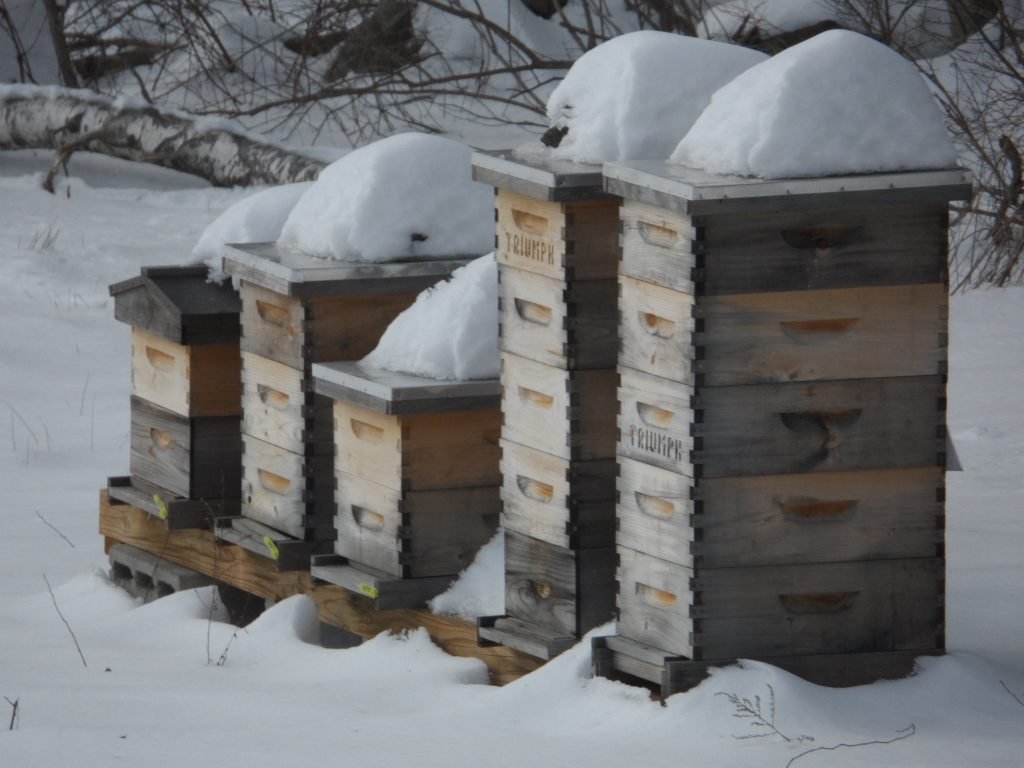
- Wind strips heat. A windbreak (a fence, shelterbelt, straw bales or even a row of hives set close together) cuts the heat loss that drives condensation on the windward walls. Wraps help, but don’t seal a wrapped hive airtight; see winter wrap ventilation gap size.
- Late winter is the crunch. Honey use roughly doubles once brood rearing restarts, overlapping with March thaws. Plan a top check then.
Some prairie commercial operations sidestep the problem by wintering colonies indoors in ventilated buildings, which Melathopoulos notes are typically held around 5°C, where bees use the least honey. For the wider picture, see how to keep bees alive through winter.
The Bottom Line
A wintering colony produces a surprising amount of water. You can’t stop that, but you can decide where it ends up. Keep the ceiling warm, give vapor a small way out, keep the bottom entrance clear and tilt the hive forward. When a hive is already wet, fix it from the top on a mild day without disturbing the cluster, and check it again after the next thaw.
For where moisture control fits in the full fall routine, see winterizing beehives in northern states.
Frequently Asked Questions
How do I know if my winter hive has too much moisture?
Lift the outer cover briefly on a mild day. Water drops or frost on the underside of the inner cover, soaked quilt material, or water or ice at the bottom entrance all point to excess moisture. Damp outer walls with a dry cluster are usually fine.
Can I open a hive in winter to fix moisture?
Yes, from the top and only briefly. On a calm, mild day you can swap wet absorbent material, add insulation over the inner cover and clear entrances without pulling frames or breaking the cluster.
Should a winter hive have an upper entrance?
In a vented setup, yes. A small upper exit lets humid air escape and gives bees a way out when snow blocks the bottom entrance. In a fully sealed condensing hive, an upper entrance works against the design.
What is the best absorbent material for a moisture quilt?
Dry wood shavings over cloth or screen are the most common choice; burlap, newspaper and fiberboard also work. Replace them once saturated.
Why does my hive get wetter in late winter?
Colonies restart brood rearing after the winter solstice and eat honey faster, roughly twice the December rate by March in one study. More honey burned means more water vapor, often just as thaws melt frost that built up on cold surfaces.
Does tilting the hive forward really help?
Yes. Condensation drains out of the entrance instead of pooling under the cluster. A thin shim under the back is enough.