Reviewed by Elena P. · Last Updated October 8, 2026 · How we review
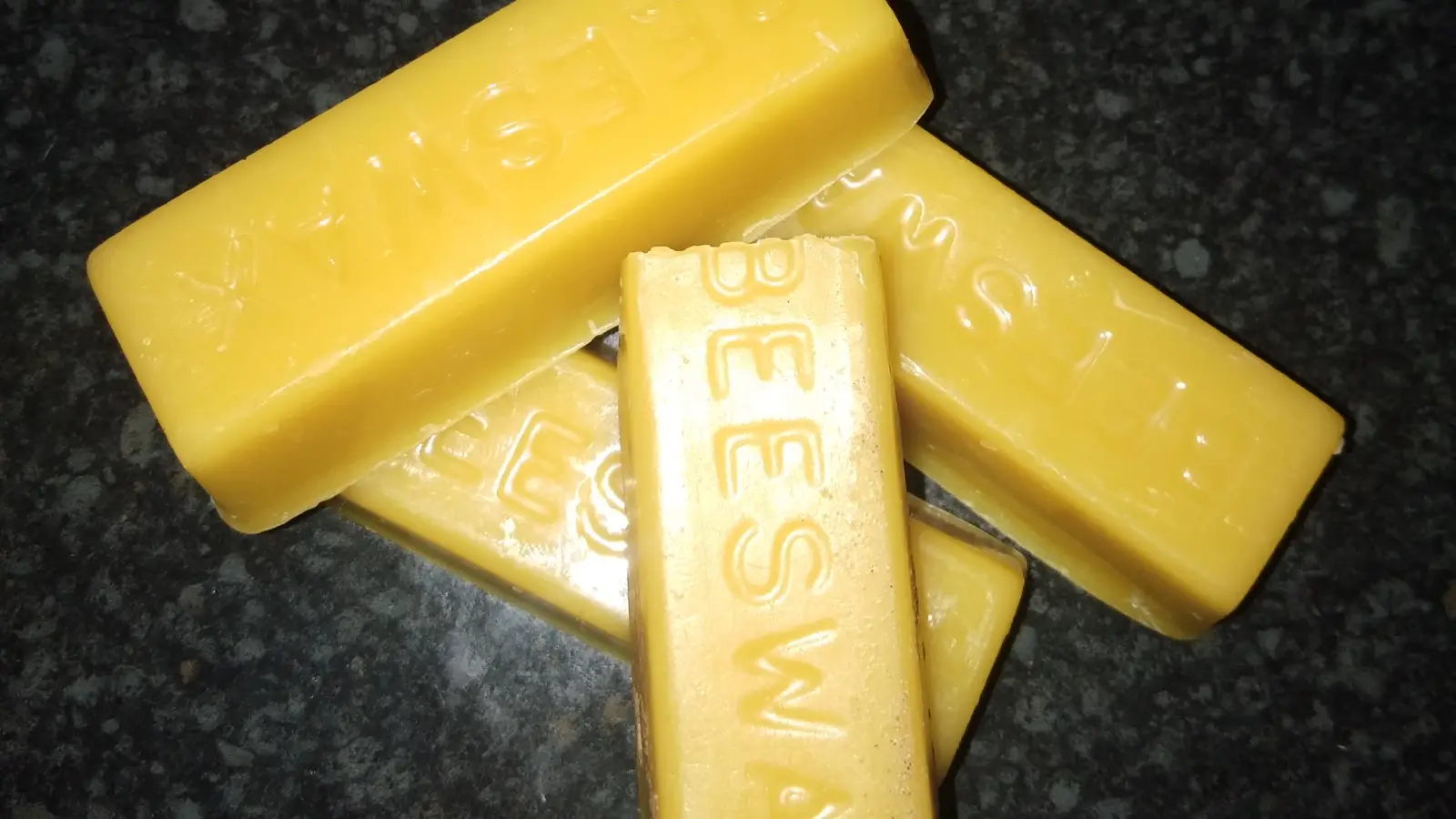
Wax bloom is a thin white or grayish film of tiny crystals that forms on beeswax over weeks to months. It comes from the wax itself: some of its hydrocarbons stay mobile after the wax hardens, drift to the surface and crystallize there. It is not mold, it does not spoil the wax, and a soft cloth or gentle warmth removes it.
Colored pencil drawings get a similar haze, covered briefly near the end.
Key Takeaways
- Bloom is beeswax’s own material: mostly linear monounsaturated hydrocarbons, per conservation chemists in Prague.
- Those molecules stay liquid-like for months after the wax sets, so new blocks and candles can bloom even in steady, cool storage.
- It often starts at fingerprints and scratches.
- It wipes off or vanishes with brief warmth, then may return. Melted down, it rejoins the wax with no residue.
- Bloom is not a purity test. Paraffin-based products can bloom too.
What Wax Bloom Is Made Of
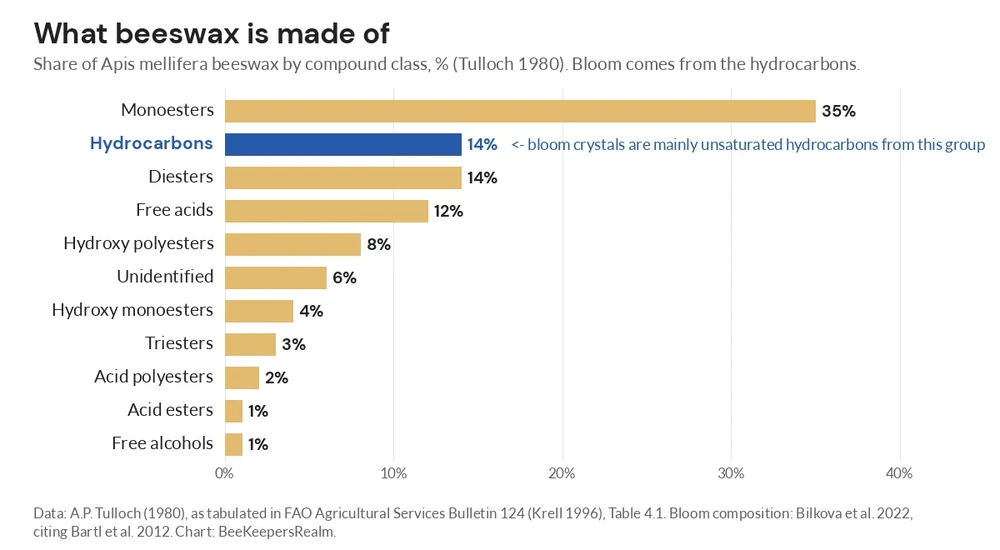
Beeswax is a mixture of more than 300 compounds, mostly esters, according to Stefan Bogdanov’s Beeswax Book. In Tulloch’s classic 1980 analysis, about 14% of it is hydrocarbons. Bloom comes from that group.
In 2012, Czech conservation scientists led by Benjamin Bartl analysed the white crust on historic beeswax seals. A 2022 follow-up study in Materials sums up the result: the bloom “consists primarily of a mixture of linear monounsaturated hydrocarbons and a small proportion of saturated hydrocarbons,” all natural parts of beeswax.
Some guides blame stearic acid. In beeswax testing, stearic acid is better known as an adulterant that labs look for, per Bogdanov.
In this two-minute clip from April 2022, Lori of The Nova Studio rubs the white film off a years-old piece of yellow beeswax with a paper towel. The video notes add two other fixes, a hair dryer on a low setting or a short spell in the sun, without letting the wax get hot enough to melt.
Why Beeswax Blooms
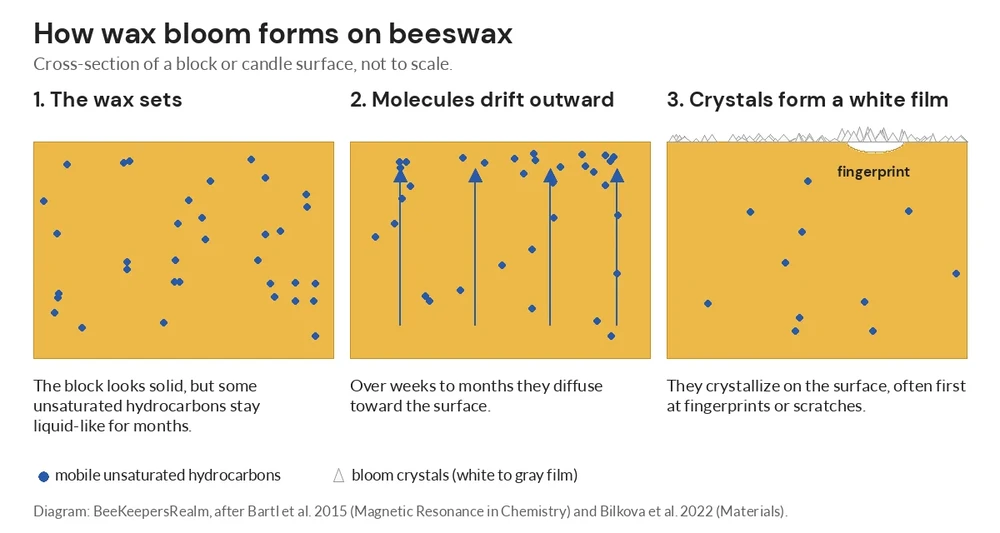
When molten wax cools, most of it locks into a solid quickly. A small fraction does not.
“Secondary crystallization of unsaturated hydrocarbons from beeswax was determined as a primary cause. After the macroscopic solidification of beeswax from the melt, these molecules remain for months in a highly mobile, liquid-like state.”
Those molecules diffuse outward and crystallize as a fine film. In the 2022 tests, beeswax samples kept at 18°C (64°F) and 50% humidity bloomed “within several months, starting from the surface defects, e.g., fingerprints.” Steady storage does not prevent it.
Ohio’s Honeyrun Farm finds cold weather makes candles bloom more readily, and Rusty Burlew of Honey Bee Suite reports that slowly cooled wax blooms sooner than fast-cooled wax. We found no lab study testing either effect.
Bloom or Mold? Two Quick Tests
Bloom can look powdery or even fuzzy, so smell it, then warm it.
| Wax bloom | Mold | |
|---|---|---|
| Where it appears | Any wax: blocks, candles, foundation, cappings, wraps | Mostly stored combs, especially with honey left in them |
| Smell | Like beeswax | Musty, like mildew |
| Hair dryer on low | Clears as the surface warms | Stays put |
| Risk | None; cosmetic only | Can give honey an off flavor |
The smell test and flavor warning come from Honey Bee Suite; Bogdanov notes molds “arise often when storing combs.”
How to Remove Bloom Without Damaging the Wax
- Buff it with a soft, lint-free cloth.
- Warm the surface with a hair dryer on low, kept moving; stop once the film clears.
- Use a warm room. Bogdanov notes the dust goes away when the wax is melted or kept warm. Avoid hot sun or a parked car: beeswax turns plastic at 30-35°C (86-95°F).
- Wraps: Abeego suggests a cold-water rinse and a hard buff with a lint-free cloth.
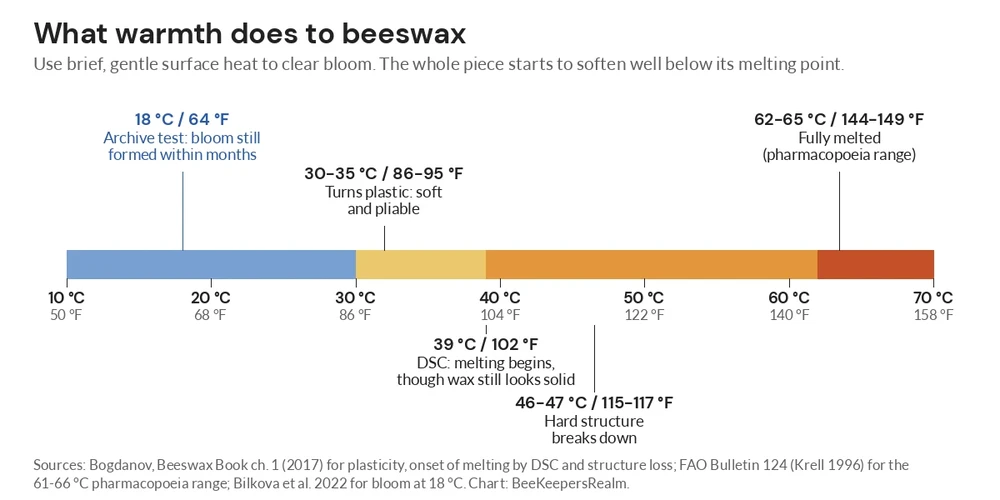
You may read that bloom melts at about 102°F (39°C). The only matching figure we found is different: calorimetry data in Bogdanov’s book show whole beeswax starting to melt at 39°C. We found no published melting point for the bloom itself.
Rendering the wax, as in our guide to rendering cappings wax cleanly, takes care of bloom too.
“The white bloom, i.e. dust, that sometimes appears on the outside of a wax cake or candle consists of small wax crystals. When melted or pressed with the rest of the wax it reverts to normal beeswax without any residues or impurities.”
Expect it back after several months, as Honeyrun Farm notes. To slow it, handle finished pieces with clean hands or gloves, and store wax wrapped in paper or in closed containers, as Bogdanov recommends.
Does Bloom Prove Beeswax Is Pure?
No. Conservators Margaret Holben Ellis and M. Brigitte Yeh list wax bloom as a feature of wax crayons and oil pastels, whose waxes include paraffin, and Honey Bee Suite notes some paraffin grades bloom.
Labs test purity by gas chromatography: beeswax hydrocarbons have odd-numbered carbon chains, so the even-numbered ones in paraffin give it away, per Bogdanov. See our beeswax purification and testing guide and beeswax vs paraffin vs soy wax. The “frosting” on soy candles is a separate crystal change in soy wax.
Wax Bloom on Colored Pencil Drawings
Colored pencil leads contain wax, such as paraffin, beeswax or carnauba, according to Ellis and Yeh. Heavy layers can develop a whitish haze, which artists wipe off gently with a soft cloth or tissue before spraying a fixative. The dusty “bloom” on plums and grapes is wax made by the plant, unrelated to beeswax.
Frequently Asked Questions
Is wax bloom harmful?
No. It is harmless to people and bees.
Why did my new beeswax candles bloom so fast?
Fresh wax holds mobile hydrocarbons for months, and cold rooms seem to speed bloom up.
Can bees use foundation or comb with bloom on it?
Yes. Honey Bee Suite notes bees don’t mind bloom, so bloomed sheets of homemade wax foundation are fine.
Does bloom change how a beeswax candle burns?
No, per Honeyrun Farm; the crystals are wax. For pouring tips, see making beeswax candles from your hive.
Can mold grow on beeswax?
Mold is common on stored combs, especially with honey left in them. A musty film that will not clear with gentle heat points to mold, not bloom.
The Bottom Line
Leave bloom as a patina, buff it off or warm it away; the wax is unharmed. Some candle makers let a molded design bloom, then wipe only the high spots so the pattern stands out, as Honey Bee Suite describes. For more uses, see our beeswax crafts for beginners.
Image credits: Photo: Jack Soley, via Wikimedia Commons, CC BY-SA 4.0, cropped.