Reviewed by Thomas B. · How we review
Beeswax’s modern technology applications — in cosmetics, pharmaceuticals, 3D printing, flexible electronics, and food packaging — trace directly back to its microstructure: a semi-crystalline matrix of more than 300 individual compounds that gives it a controllable, gradual melting behavior no simple synthetic wax fully replicates. That combination of properties is why beeswax keeps finding new, genuinely modern applications well beyond the candle and cosmetic uses it’s best known for.
Beeswax is one of the more remarkable materials produced by any animal — a self-assembled substance built cell by cell inside a hive, yet stable, workable, and useful enough to show up in laboratories and factories today. Its behavior, from how it melts to how it coats a surface, comes down to what’s happening at the microstructural level: a dense mixture of hundreds of individual compounds locked into a matrix that’s simultaneously rigid enough to hold a honeycomb’s shape and pliable enough to be worked, printed, and molded.
Key Takeaways
- Beeswax is a semi-crystalline lipid matrix made of over 300 distinct compounds — wax esters, hydrocarbons, and free fatty acids — that together give it thermoplasticity, biocompatibility, and structural stability.
- It melts across a defined range, roughly 61–67°C (142–153°F), rather than at a single sharp point, which makes it useful anywhere a controllable, moldable melting behavior is needed.
- In pharmaceuticals and cosmetics, beeswax acts as a stiffening agent, emulsion stabilizer, and occlusive skin barrier.
- Researchers are actively using beeswax and beeswax composites in 3D printing, printable electronics, and biomedical formulations — active, current research areas, not historical curiosities.
- Its biodegradability and low toxicity make it an attractive alternative to petroleum-derived waxes in several of these applications.
Table of Contents
- What Beeswax Is Made of, at the Microstructural Level
- Beeswax vs. Synthetic and Petroleum-Derived Waxes
- Cosmetics and Pharmaceuticals
- 3D Printing and Additive Manufacturing
- Printable and Flexible Electronics
- Biomedical Applications
- Food Science and Packaging
- Why the Microstructure Matters
- Frequently Asked Questions
What Beeswax Is Made of, at the Microstructural Level
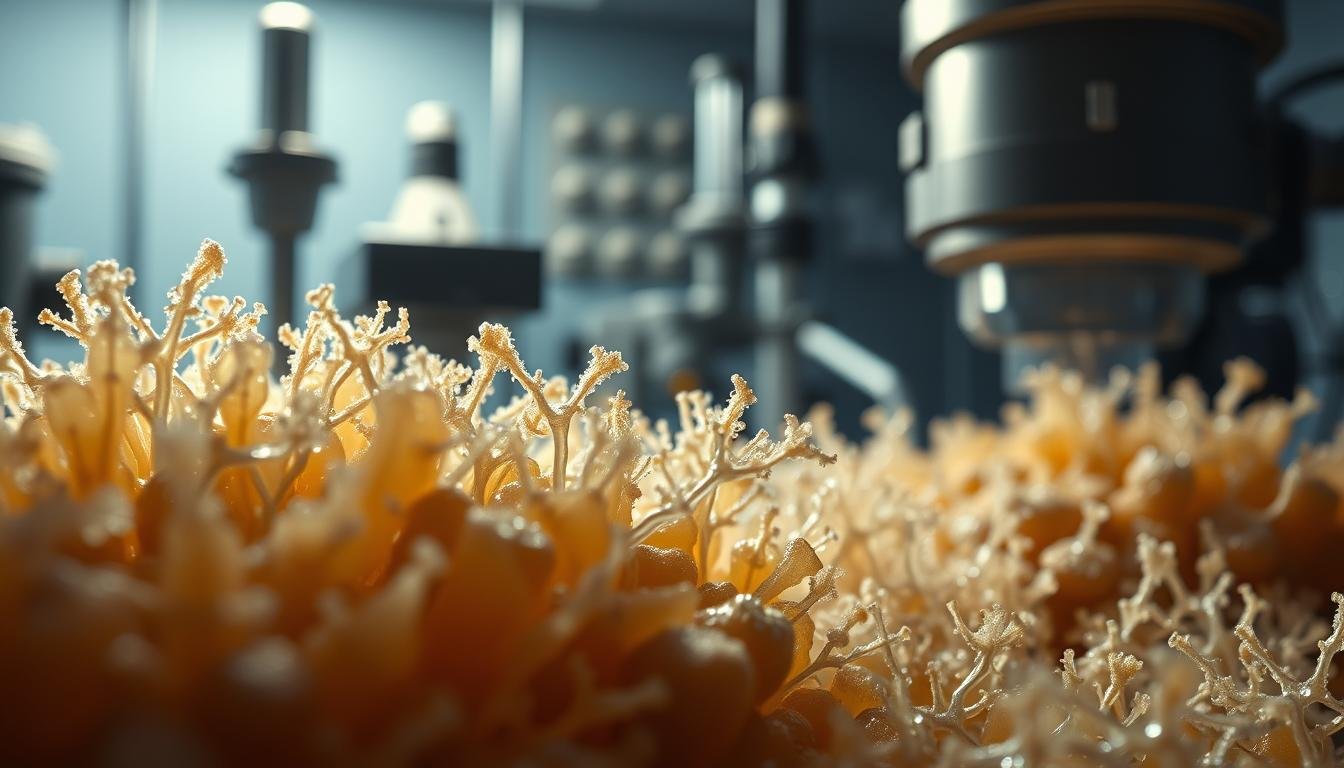
Chemically, beeswax is a lipid-based matrix built from more than 300 individual constituents, dominated by wax esters, long-chain hydrocarbons, and free fatty acids. According to a comprehensive review published in the International Journal of Molecular Sciences on beeswax in pharmaceutical sciences, this composition gives beeswax a semi-crystalline structure with a melting range of roughly 61–67°C — along with thermoplasticity (it softens and can be reshaped with heat), biocompatibility, ductility, and hydrophobicity. A 2026 review in Food Biomacromolecules covering beeswax’s applications from food to advanced materials reinforces the same picture: a naturally occurring composite whose microstructure, not just its chemistry, determines how it performs.
Researchers reviewing beeswax’s pharmaceutical roles in the International Journal of Molecular Sciences describe its value less in terms of any single standout compound and more as an emergent property of the whole mixture — the specific combination of ester and fatty-acid chain lengths is what produces a material that’s simultaneously biocompatible, moldable, and stable at body and room temperature alike.
That microstructure is what separates beeswax from a simple, uniform hydrocarbon wax like paraffin. The mix of ester and fatty-acid chain lengths creates a network of small crystalline domains within a softer matrix, which is part of why beeswax has more give and more workability than harder, more uniformly crystalline waxes. For more on beeswax’s chemical makeup and where it fits among the hive’s other products, see our piece on the bioactive compounds in beeswax.
Beeswax vs. Synthetic and Petroleum-Derived Waxes
It’s worth being specific about what sets beeswax apart from the petroleum-derived waxes it sometimes competes with, like paraffin and microcrystalline wax. Those are refined from crude oil through processes like distillation and solvent dewaxing, and their properties come almost entirely from the length and branching of their hydrocarbon chains.
| Property | Beeswax | Paraffin wax | Microcrystalline wax |
|---|---|---|---|
| Source | Natural, secreted by honey bees | Refined from crude oil (distillation) | Refined from crude oil (solvent dewaxing) |
| Chemical makeup | 300+ compounds: esters, hydrocarbons, fatty acids | Mostly straight-chain hydrocarbons | Branched/cyclic hydrocarbons, finer crystals |
| Melting behavior | Broad, gradual range (~61–67°C) | Narrower, sharper melting point | Higher melting point, more plastic/tacky |
| Biodegradability | Naturally biodegradable | Poorly biodegradable | Poorly biodegradable |
| Skin/food contact history | Long-established safe use | Requires food/cosmetic-grade refining and testing | Primarily industrial use |
| Typical modern role | Pharma matrices, 3D printing, electronics, packaging | Candles, basic coatings | Adhesives, coatings, rubber/tire industry |
Beeswax’s microstructure is more chemically diverse — esters and fatty acids alongside hydrocarbons — which is part of why it behaves differently: a broader, more gradual softening range rather than a narrow one, along with natural biodegradability and a long track record of safe contact with skin and food that purely synthetic waxes have to establish through separate testing. That doesn’t make beeswax a drop-in replacement for every industrial use of petroleum wax — cost, supply, and specific performance requirements all matter — but it explains why researchers keep evaluating it as an alternative rather than dismissing it as a novelty.
Cosmetics and Pharmaceuticals
This is beeswax’s most established modern role. As a stiffening agent, viscosity modifier, and emulsion stabilizer, it’s a standard ingredient in balms, lotions, and ointments, where it forms an occlusive barrier on skin that helps retain moisture. In pharmaceutical formulations specifically, beeswax’s biocompatibility and non-cytotoxicity make it useful as a coating and matrix material in topical and oral products, a role the MDPI review covers in detail across formulation types. Our broader overview of beeswax uses in cosmetics, candles, and medicine covers this territory from a more practical angle.
3D Printing and Additive Manufacturing
Beeswax has become a genuinely active ingredient in 3D-printing research. Studies have combined it with polycaprolactone and gum rosin to create new printable materials for fused-deposition 3D printing, and separate research on beeswax-based oleogels found that formulations with higher beeswax content improved printability and dimensional accuracy at specific infill levels. More recent work has compared 3D-printed beeswax-based oral films directly against traditional solvent-casting methods for pharmaceutical film production, and separate research has used beeswax as a sacrificial support material in semi-solid extrusion printing of sustained-release tablets, evaluating beeswax as a practical printing substrate rather than a novelty material. In all of these, beeswax’s controllable melting and re-solidification behavior — a direct result of its microstructure — is what makes it printable in the first place, echoing the much older technique of lost-wax casting, where a wax pattern is melted away cleanly to leave a precise mold behind.
Printable and Flexible Electronics
One of the more surprising modern uses is in electronics. Researchers have developed wax-based conductive and piezoresistive nanocomposites — including formulations mixed with graphene — for deformation and thermal sensors that can be screen-printed onto flexible substrates like paper or Kapton film, aimed at next-generation printable and wearable electronics. Separately, beeswax’s natural non-conductivity has made it useful as a simple protective coating on circuit boards, forming a barrier layer without interfering with electrical signals. A related line of research has also explored beeswax composites engineered for thermal self-healing and recyclability, properties that trace directly back to its semi-crystalline, thermoplastic microstructure.
Biomedical Applications
The same properties that make beeswax useful in cosmetics — biocompatibility, a controllable melting range, and the ability to form a stable matrix around other substances — also make it a candidate material in biomedical research. Reviews of its pharmaceutical roles describe beeswax being investigated as a component in drug-delivery matrices, where it can slow the release of an active ingredient by controlling how quickly a formulation breaks down, and in wound-care and topical formulations, where its occlusive, protective barrier properties support skin healing rather than just moisturizing skin. None of this makes beeswax a treatment on its own — it’s a functional material within formulations designed and tested by researchers and manufacturers — but it’s an active area of study rather than a historical footnote.
Food Science and Packaging
Beeswax shows up increasingly in food applications as well: as a component in edible coatings and films, in oleogels used to replace saturated fats in some formulations, and in intelligent or active packaging systems designed to extend shelf life — recent work on beeswax-containing “bigels” has even explored freshness-sensing packaging alongside 3D-printed food structures. Its combination of biodegradability, food safety, and a controllable, well-characterized melting behavior makes it a practical substitute in places where synthetic waxes have traditionally been used.
Why the Microstructure Matters
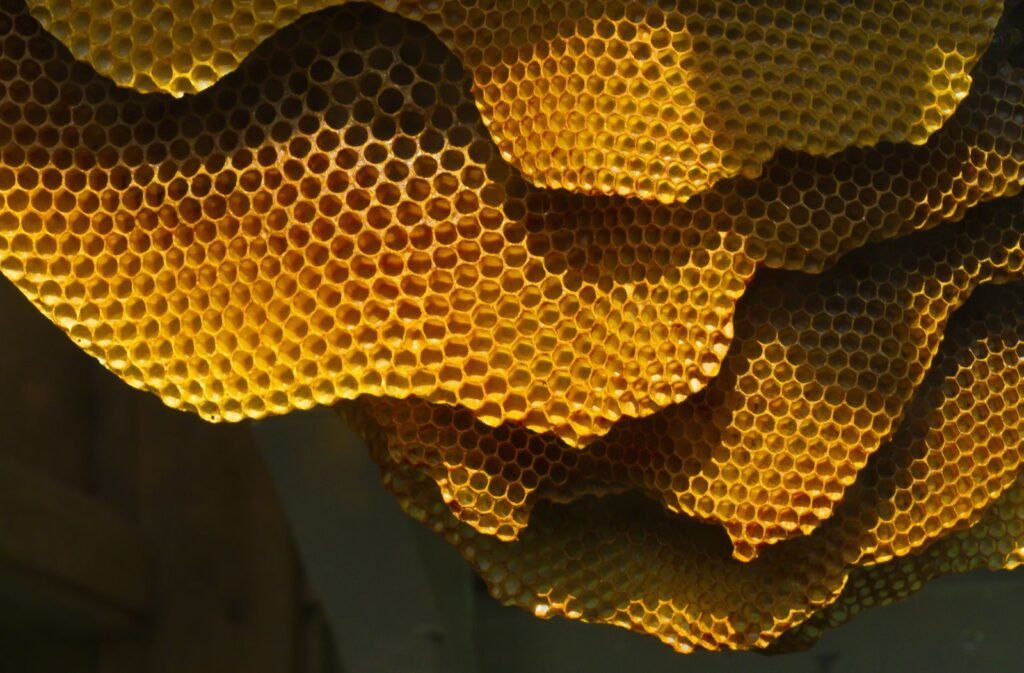
Every one of these applications traces back to the same underlying fact: beeswax isn’t a single, simple chemical, but a self-organized matrix of hundreds of compounds that happens to combine structural stability, controllable melting, biocompatibility, and biodegradability in one material. That’s an unusual set of properties to find together, and it’s exactly why researchers keep finding new places to use a substance bees have been building in hives for tens of millions of years. Raw wax purity matters here too — industrial and pharmaceutical uses generally need more consistently purified wax than a candle or a cosmetic balm does, which is where proper wax extraction and purification practice becomes relevant even before a researcher ever touches the material. For a look at the market side of this growing demand, see our U.S. beeswax, pollen, and propolis market analysis.
Frequently Asked Questions
What is beeswax made of, chemically?
More than 300 individual compounds, dominated by wax esters, long-chain hydrocarbons, and free fatty acids, organized into a semi-crystalline matrix rather than a single uniform substance.
Why does beeswax melt gradually instead of at one sharp temperature?
Its microstructure contains a range of ester and fatty-acid chain lengths rather than one uniform molecule, so different parts of the matrix soften at slightly different temperatures, producing a broad melting range of roughly 61–67°C instead of a single melting point.
Is beeswax actually used in 3D printing, or is that experimental only?
It’s an active, current research area. Beeswax has been combined with materials like polycaprolactone for fused-deposition printing, used in oleogel-based extrusion printing, and tested as a sacrificial support material for pharmaceutical tablet printing — genuine, ongoing research rather than a novelty.
Can beeswax really be used in electronics?
Yes — researchers have developed beeswax-graphene composites that function as printable, flexible deformation and temperature sensors, and beeswax’s natural non-conductivity also makes it useful as a simple protective coating on circuit boards.
Is beeswax safe for pharmaceutical and cosmetic use?
Yes. Beeswax has a long-established history of safe skin and food contact and is recognized as biocompatible and non-cytotoxic in the pharmaceutical literature, which is part of why it’s a standard ingredient in topical formulations and an actively studied component in oral drug-delivery systems.
How is beeswax different from paraffin wax?
Paraffin is refined from crude oil and is chemically simpler (mostly straight-chain hydrocarbons), giving it a narrower, sharper melting point. Beeswax’s more chemically diverse microstructure gives it a broader melting range, natural biodegradability, and an established safety record that paraffin has to establish separately through refining and testing.
Is beeswax biodegradable?
Yes, naturally so, which is a meaningful advantage over petroleum-derived waxes like paraffin and microcrystalline wax in applications like food packaging and biomedical devices where biodegradability matters.
The Bottom Line
Beeswax’s modern technological applications aren’t a stretch from its natural role — they’re a direct extension of it. The same semi-crystalline, multi-compound structure that lets bees build a honeycomb strong enough to hold gallons of honey is what makes beeswax useful today in cosmetics, pharmaceuticals, 3D printing, flexible electronics, and food packaging. It’s a genuine case of a natural biomaterial holding its own against synthetic alternatives, not in spite of its complexity, but because of it.