Reviewed by Elena P. · Last Updated October 14, 2026 · How we review
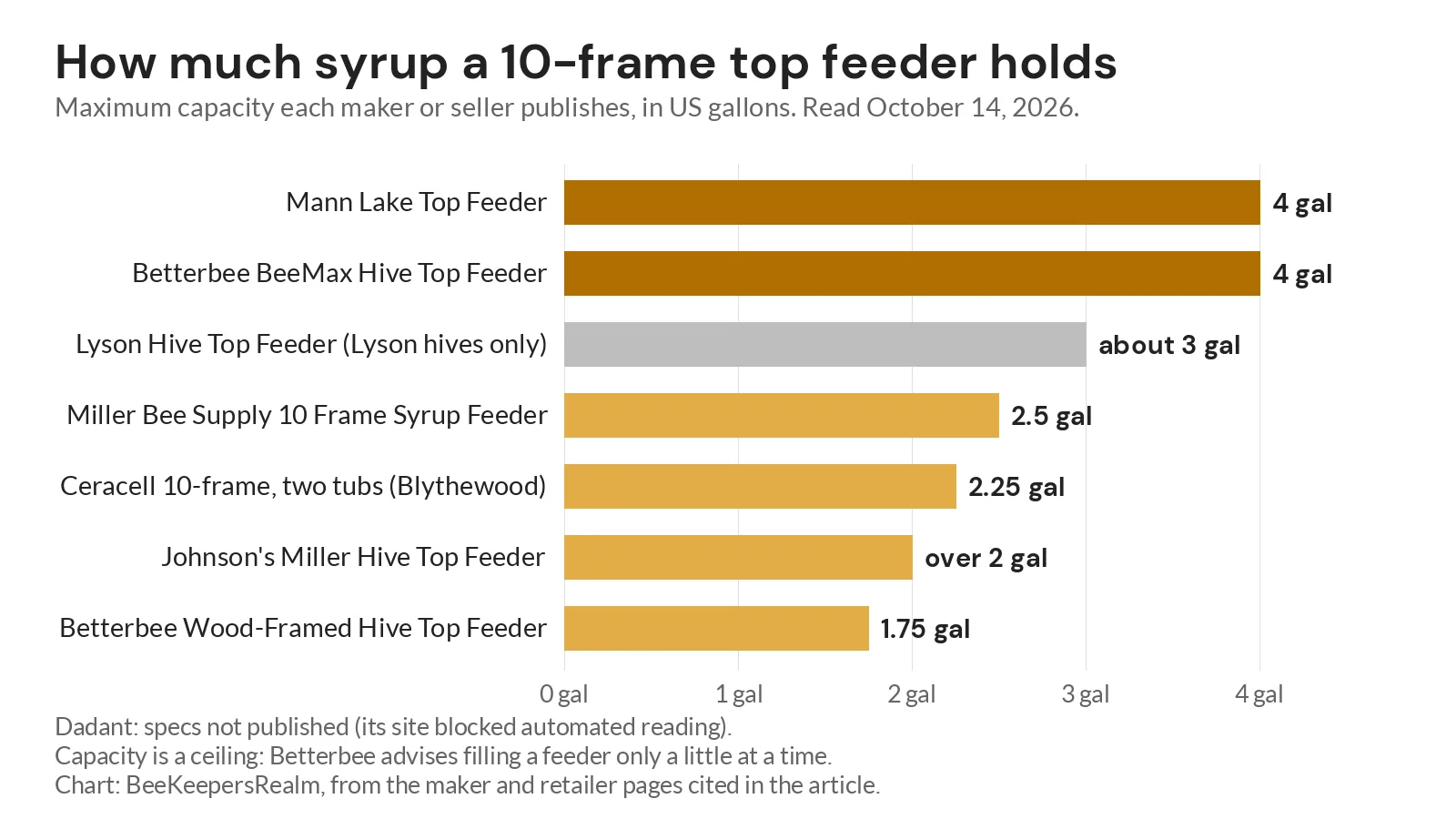
For a large colony on 10-frame equipment, the best top feeder is the one that holds enough syrup to close your fall stores gap in one or two fills. On published specs, that means the Mann Lake 10-frame feeder or Betterbee’s BeeMax, both listed at up to 4 gallons. Feeders of 2 to 2.5 gallons work too, but a big colony will need an extra refill. We did not test these feeders; every spec and price below was read from the maker or seller page on October 14, 2026.
Other feeder types suit other jobs. For a three-way comparison, see top, frame and pail feeders compared.
Key Takeaways
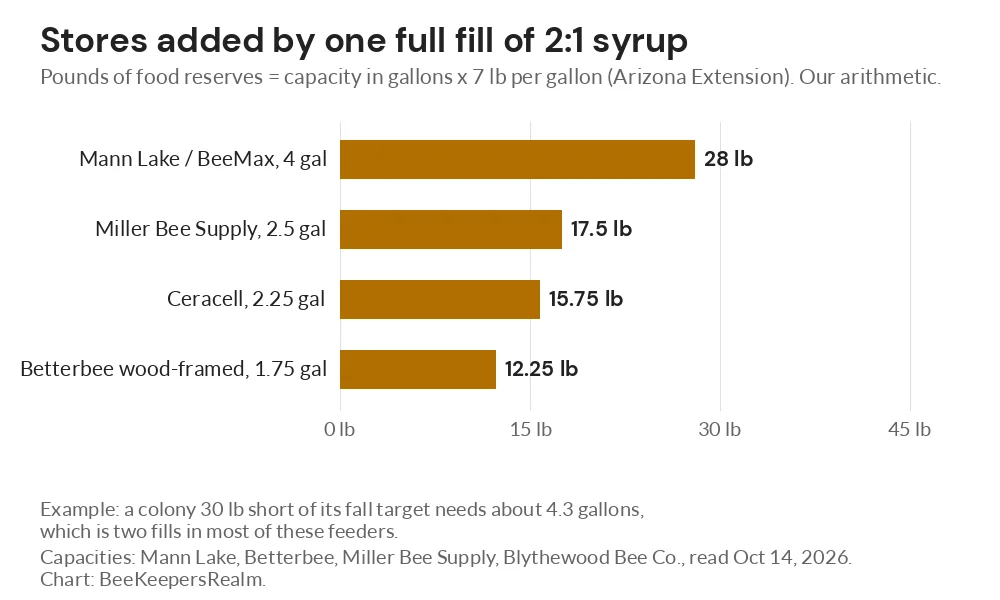
- One gallon of 2:1 syrup raises a colony’s reserves by about 7 pounds (Arizona Extension), so a 4-gallon feeder adds roughly 28 pounds per full fill.
- Largest published capacities for wood hives: Mann Lake and Betterbee’s BeeMax, 4 gallons on a 10-frame hive and 3 to 3.2 gallons on an 8-frame.
- Smaller feeders cost more per gallon of capacity and need more fills: Miller Bee Supply 2.5 gallons, Ceracell 2.25, Betterbee’s wood-framed feeder 1.75.
- Capacity is a ceiling, not a target: Betterbee says syrup left sitting in a top feeder turns moldy.
- Stop syrup when daytime highs fall below 50°F, and never feed with honey supers on.
Table of Contents
- How Much Syrup Does a Large Colony Take?
- Top Feeders Compared: Capacity, Fit and Price
- Fitting a Top Feeder to Your Hive
- Drowning, Ladders and Mold
- Robbing and Disease Risk
- When a Top Feeder Is the Wrong Tool
- Frequently Asked Questions
- The Bottom Line
How Much Syrup Does a Large Colony Take?
Start with the gap between what your colony has and what it needs, not with the feeder. The University of Minnesota Bee Lab guidebook tells northern beekeepers to feed 2:1 syrup in fall to a colony with less than 75 pounds of stored honey, and to stop once it holds 75 to 100 pounds. Arizona Extension says one gallon of 2:1 syrup can raise a colony’s reserves by seven pounds. Divide the gap by seven and you have the gallons to feed. That step is our arithmetic from the two sources, and your region’s target may differ.
| Stores short of target | 2:1 syrup needed | Mann Lake or BeeMax (4 gal) | Miller Bee Supply (2.5 gal) | Ceracell (2.25 gal) | Betterbee wood-framed (1.75 gal) |
|---|---|---|---|---|---|
| 15 lb | about 2.1 gal | 1 fill | 1 fill | 1 fill | 2 fills |
| 30 lb | about 4.3 gal | 2 fills | 2 fills | 2 fills | 3 fills |
| 45 lb | about 6.4 gal | 2 fills | 3 fills | 3 fills | 4 fills |
Fills are full-capacity refills, rounded up. Check where your colony stands before you pour; how much honey bees need for winter explains how to turn frames and hive weight into pounds, and our feeding guide covers timing across the year.
The University of Guelph’s Honey Bee Research Centre in Ontario sets its own target at about four imperial gallons per colony, which is roughly 4.8 US gallons. By the Arizona rule that is about 34 pounds of stores. Its apiary manager explains why speed matters:
“we are trying to get a large amount of feed in as quickly as possible so there is a pretty narrow window in the fall after we’ve harvested the honey to get the feed in before the weather gets cold.”
He also describes a four-gallon wooden hive-top feeder with two tanks as enough to winter a colony on, and says bees take a fill down in roughly four to seven days, faster when it is warm. That is the case for a big feeder: a large population of summer bees can move syrup quickly, and a small feeder means more visits during a short window.
Top Feeders Compared: Capacity, Fit and Price
The table lists top feeders for wood Langstroth hives, with capacity and price as published on October 14, 2026. The last column is our arithmetic: price divided by the highest capacity listed.
| Feeder | Capacity | Fits | Drowning protection | Price | Per gallon |
|---|---|---|---|---|---|
| Mann Lake Top Feeder with Unpainted Super (Z136) | Up to 4 gal (10-frame), 3.2 gal (8-frame) | 8- and 10-frame | Galvanized steel safety screen over a one-piece plastic reservoir | $39.99 ($43.99 painted, Z376) | $10.00 |
| Betterbee BeeMax Hive Top Feeder (BHTF) | 4 gal (10-frame), 3 gal (8-frame) | 8- and 10-frame wood hives, BeeMax | Plexiglas panel and narrow access channel; polystyrene body | $39.89 | $9.97 |
| Miller Bee Supply 10 Frame Syrup Feeder (W621) | 2.5 gal | 10-frame (an 8-frame model, W8621, is $31.95; capacity not read) | Screened bee access; bees cling to the screen | $31.95 | $12.78 |
| Ceracell 10-frame with wooden rim, sold by Blythewood Bee Company | 2.25 gal in two tubs (8-frame version: 1.98 gal) | 10-frame | Five access points, four corners and a center chimney | $24.50 | $10.89 |
| Johnson’s Bees Miller Hive Top Feeder | “Over 2 gal” | 10-frame | Bees reach syrup from one end; no other detail published | $29.00 | Under $14.50 |
| Betterbee Wood-Framed Hive Top Feeder (HTF10) | 1.75 gal | 10-frame only | Plastic insert “ladders” behind a wall | $34.59 | $19.77 |
| Lyson Hive Top Feeder (Betterbee) | About 3 gal | Lyson 10-frame polystyrene hives only | Stainless steel ladder | $67.99 | $22.66 |
| Dadant wooden hive-top feeders | Not published | Not published | Not published | Not published | Not published |
Dadant is listed because many beekeepers will look for it. Its product pages returned a security check instead of the product when we tried to read them, so we published nothing rather than guess. Betterbee’s “Ultimate External Hive Top” page showed no product text either. Note that Betterbee’s Bee Smart Ultimate feeder is a different, 1-gallon in-hive feeder, so it does not suit a large colony.
On these numbers the two 4-gallon feeders are also the cheapest per gallon, which runs against the instinct that a bigger feeder costs more for what it holds. The smallest wood-framed unit is the most expensive per gallon.
Which one to pick
- One big colony on 10-frame boxes: Mann Lake or BeeMax, so a 30-pound gap takes two fills.
- 8-frame hive: the same two models in their 8-frame sizes, 3 to 3.2 gallons.
- Tight budget: Ceracell at $24.50 for 2.25 gallons, planning on an extra refill.
- Wooden, screened design: Miller Bee Supply’s 2.5-gallon feeder, or Johnson’s if you want to compare.
- Lyson hives: only the Lyson feeders fit, and the price shows it.
“Top feeders are the easiest to service since they can be refilled without disturbing the bees or opening the hive proper.”
One correction to older advice on this page: the BeeCastle Pro, once listed here at 5 gallons, is a frame feeder. A seller lists it at 6 liters and says it takes the place of two to three frames, so it is not a top feeder. The wooden Miller design has its own guide: Miller feeder, complete guide.
Fitting a Top Feeder to Your Hive
Match width first. Mann Lake lists 3.2 gallons for an 8-frame hive and BeeMax lists 3 gallons, so an 8-frame colony still gets a large feeder. Betterbee’s wood-framed model is 10-frame only, and Lyson feeders fit Lyson hives. Boxes, covers and feeders are all width-specific, which is why our 8-frame vs 10-frame hive guide lists the feeder among the parts that do not cross over.
Then check height. Mann Lake’s feeders sit inside a wooden surround 4-5/8 inches deep, the BeeMax is 5-7/8 inches high, and Betterbee’s wood-framed unit is 2-3/4 inches. Betterbee notes that some feeders need an empty box around them, so measure what your outer cover will clear. Empty weights are modest: Mann Lake lists 5.5 pounds for the unpainted version and 5.9 for the painted one.
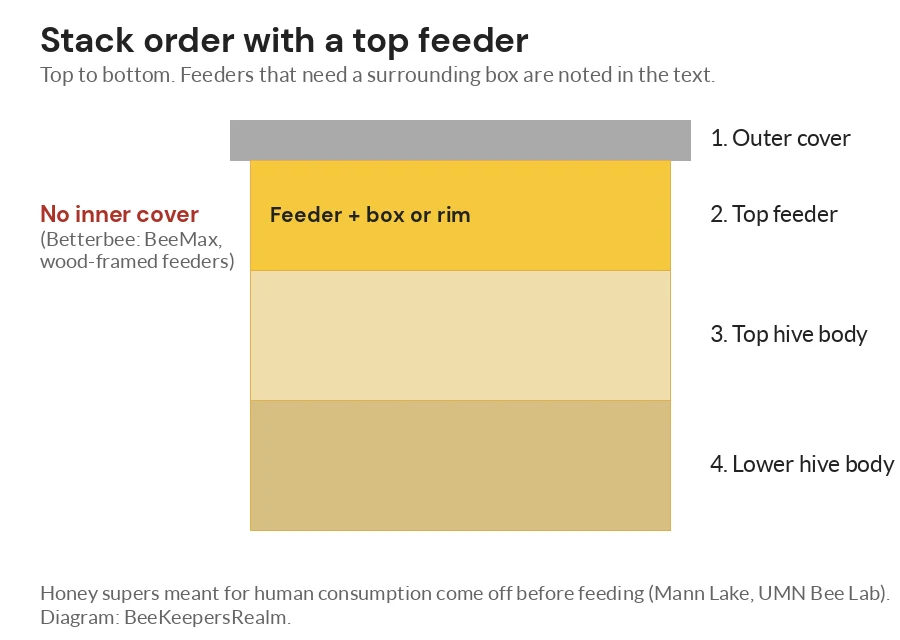
Two more notes from the makers. Betterbee advises two coats of exterior latex paint on the polystyrene BeeMax feeder to protect it from sunlight. Mann Lake, along with the University of Minnesota guide, says to take off any honey supers meant for people before feeding.
Drowning, Ladders and Mold
Every design on the list keeps bees out of the main reservoir and gives them a surface to climb. Mann Lake uses a galvanized steel screen, BeeMax a Plexiglas panel, Betterbee’s wood-framed model plastic ladders, and Ceracell five small access points.
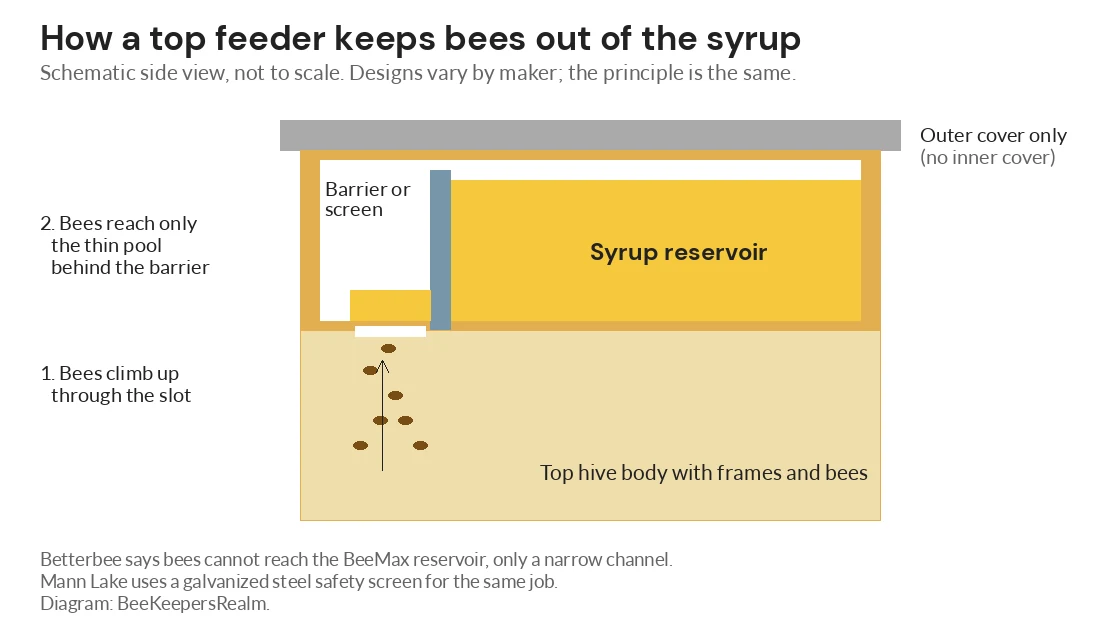
Failures usually come from a low or empty feeder. Mann Lake warns that if its feeder runs completely empty or nearly so, bees may crowd under the screen and struggle to find their way back, and suggests a bead of food-grade caulking along the bottom of the screen. Betterbee suggests roughening the BeeMax Plexiglas inside with 80-grit sandpaper so bees can grip it. At Guelph, the apiary manager lays straw on the syrup as a float instead.
Mold is the other risk of a big reservoir. Betterbee says the BeeMax holds 3 or 4 gallons but recommends putting in only a little at a time, because the feeder will get moldy if syrup sits for long. Its feeder guide adds a couple of drops of apple cider vinegar to the syrup, and the product page says to clean and dry the feeder before winter storage. For the cleaning routine, see how to clean feeders between colonies.
Robbing and Disease Risk
Placement matters more than feeder brand. Betterbee says inside-the-hive feeders give the most protection against robbing, which matters most in fall, and that entrance feeders are more likely to draw robbers. A top feeder sits under your outer cover, so the syrup is out of sight. Spilled syrup is not: pour carefully and wipe drips before you close up.
In fall, the University of Minnesota guide says to put the entrance reducer back and set it to the larger opening. For screens and other tools, see robbing screens for beehives and feeding bees without causing robbing. Guelph’s apiary manager takes the opposite view of fast feeding in his own yard, saying it prevents robbing because the bees get what they need very quickly. That is one operation’s experience with barrels, not a rule for a backyard hive.
Feeders that move between hives can carry trouble with them. Wash them as above, and read whether shared feeders spread disease.
When a Top Feeder Is the Wrong Tool
Stop syrup before daytime temperatures drop below 50°F; the University of Minnesota guide says cooler weather slows syrup consumption and hinders curing. A top feeder also holds more than a small colony can take, so a new package or nuc does better with a frame feeder; see frame feeders for spring buildup and feeders for new packages.
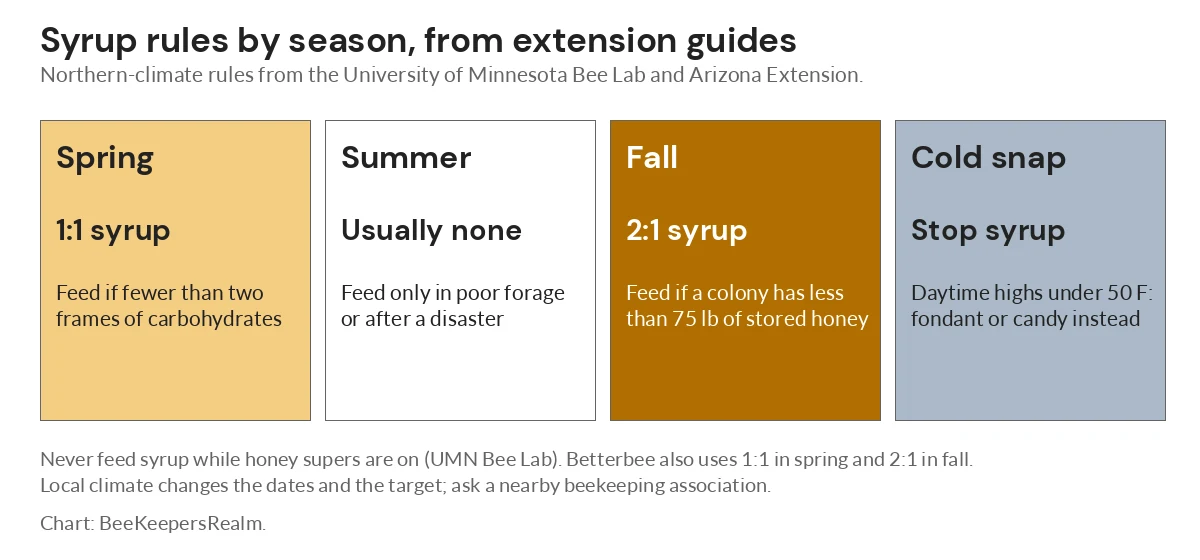
When it is too cold for syrup, switch to solid feed. Arizona Extension describes candy and dry sugar for late winter and early spring. We cover fondant for bees and candy boards versus sugar bricks separately.
Frequently Asked Questions
What is the best top feeder for a large colony?
On published capacity, Mann Lake’s 10-frame feeder (up to 4 gallons, $39.99) and Betterbee’s BeeMax (4 gallons, $39.89) lead. We have not tested them.
How much syrup does a strong colony take in fall?
Enough to close its gap to about 75 pounds of stores in the University of Minnesota’s northern guidance. At about 7 pounds per gallon of 2:1 syrup, a 30-pound gap needs roughly 4.3 gallons.
Should I feed 1:1 or 2:1 syrup?
Arizona Extension and Betterbee both recommend 1:1 in spring and 2:1 in fall. The Minnesota guide gives the same split.
Do top feeders cause robbing?
Betterbee says entrance feeders draw robbers more than in-hive feeders. A top feeder sits under the outer cover, but spilled syrup can still attract robbers.
How do I stop bees drowning in a top feeder?
Choose a model with a screen, panel or ladders, and do not let it run empty. Mann Lake warns that a nearly empty feeder is when bees crowd under the screen.
Can I use a top feeder in winter?
Not for syrup once daytime highs stay under 50°F. Use fondant or a candy board instead.
Does a top feeder fit an 8-frame hive?
Yes, if you buy the right width. Mann Lake lists 3.2 gallons and BeeMax 3 gallons for 8-frame hives.
How often should I refill a top feeder?
Refill when the level is low, but never let it run dry. Guelph’s apiary manager says bees empty a four-gallon fill in roughly four to seven days, depending on warmth. Betterbee suggests starting with a little syrup to learn how fast your colony drinks it.
The Bottom Line
Work out your stores gap first, then buy the feeder that clears it in one or two fills. Fill it only as fast as the bees empty it, keep the level from running dry, and clean and dry it before it goes into storage. Prices and specs here were read on October 14, 2026, so confirm them with the seller before you order.