Reviewed by Thomas B. · How we review
Fondant for bees is white sugar and water boiled to the soft-ball stage, about 234 to 240°F, then beaten as it cools until it sets into a soft, white cake. You lay it on the top bars, right over the winter cluster, when a colony is short of honey and it is too cold for syrup. For poured hard-candy boards, see candy board vs sugar bricks; for loose sugar, see the Mountain Camp method.
Key Takeaways
- Fondant is emergency food: feed it only to a colony that needs it, per University of Minnesota (UMN) Extension.
- Published fondant recipes stop between 234 and 245°F and are beaten as they cool; hard bee candy goes to about 250°F and is poured.
- Overheated sugar forms HMF, which is toxic to bees. Never let a batch brown; the vinegar is optional.
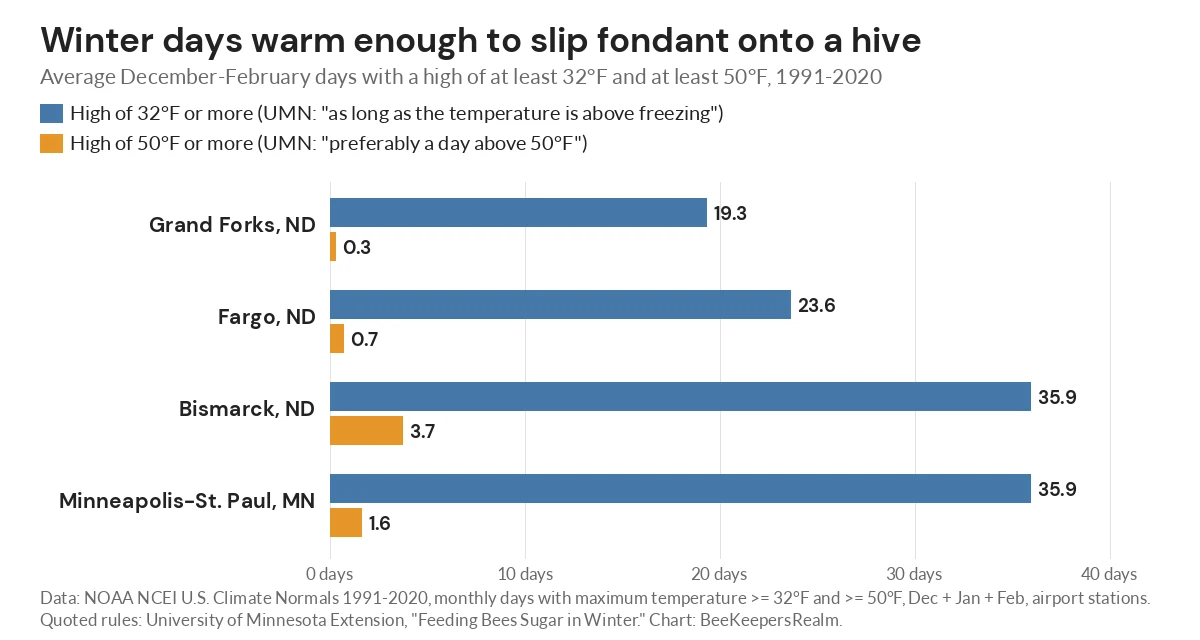
- Fargo averages under one winter day at 50°F but 23.6 at 32°F or more, so northern beekeepers follow UMN’s freezing rule.
Soft Fondant vs Hard Candy
In 1914 the Massachusetts State Board of Agriculture published Burton N. Gates’s bulletin Soft Candy for Bees. It set the “Fuller candy,” “a soft fondant, not dissimilar to the fondant of chocolate creams,” against hard candy, “virtually a taffy,” and named what separates them:
“As a warning or explanation it may be said that the higher the temperature at which the candy is boiled the harder it will become.”
The Exploratorium’s candy guide puts the soft-ball stage at 235 to 240°F and 85% sugar, and lists fondant among the candies cooked there. Rusty Burlew of Honey Bee Suite gives the beekeeping version: 234°F for fondant, 250°F for hard candy. Fondant is also beaten as it cools, which turns it white and smooth; candy-board syrup is poured and left to harden.
How to Make Fondant for Bees
This version uses Burlew’s proportions: 10 lb of white granulated sugar and 1 quart of water. Use a tall pot, a candy thermometer and a mixer.
- Check your thermometer in boiling water. Stage temperatures assume sea level; the Exploratorium says to subtract 1°F for every 500 feet, about 2°F at Fargo’s 900 feet.
- Heat the water, add the sugar and stir until no grit remains. Then stop stirring; Gates warned that stirring while it cooks “will cause a coarse grain.”
- Boil to 234 to 238°F and take the pot off the heat. Do not let it color.
- Let it cool undisturbed. Burlew beats at about 200°F; other recipes wait until 120 to 130°F.
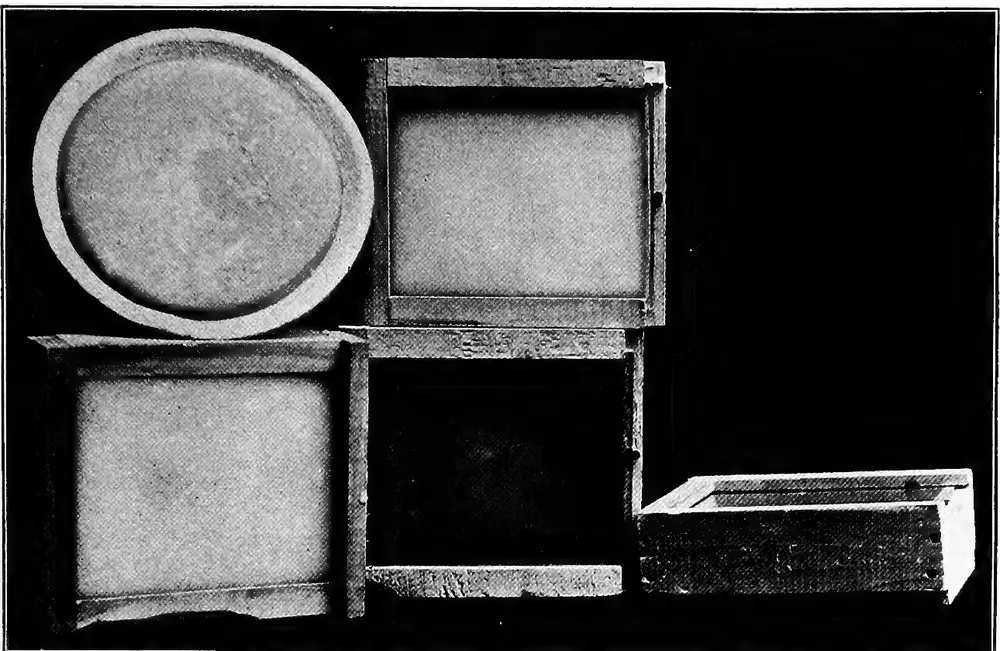
- Beat until white, opaque and thick, then pour at once into paper plates, thin enough to fit under a 1- to 2-inch shim. Cool, wrap, and store cool or frozen.
At 85% sugar, 10 pounds of sugar makes about 11.75 pounds of fondant, or 8 to 10 plates, the number Burlew suggests.
| Source | Sugar : water | Cook to | Beat at | Acid |
|---|---|---|---|---|
| Honey Bee Suite (Burlew) | 10 lb : 1 qt | 234°F | About 200°F | 1 Tbsp vinegar or lemon juice |
| Gypsy Shoals Farm | 4 lb : 16 oz | 234°F | 200-210°F | None |
| Backyard Beekeeping (2020) | 4 : 1 by weight | 235°F | About 190°F | 1/4 tsp vinegar per lb of sugar |
| Gates, Massachusetts (1914) | 12 lb plus 1-1/2 lb liquid glucose : 1-1/4 qt | 238°F | 125-130°F | 1/4 tsp cream of tartar |
| The Beekeeper’s Corner (2026 update) | 8 lb plus 1/4 cup corn syrup : 4 cups | 240-245°F | 120°F | 1-1/4 Tbsp lemon juice |
| Oregon board recipe (DC Beekeepers handout) | 20 lb : 1 qt | 5-minute boil, no thermometer | Poured, not beaten | 1 Tbsp cider vinegar |
The Oregon mix starts at about 91% sugar, stronger than soft-ball syrup, so it sets more like a sugar brick than a beaten fondant.
Vinegar, Overheating and HMF
Most recipes add an acid to split sucrose into glucose and fructose, though Backyard Beekeeping says it is fine to leave it out. The concern is hydroxymethylfurfural (HMF).
“Hydroxymethylfurfural (HMF) is a heat-formed contaminant and is the most noted toxin to honey bees.”
A 2016 Austrian study (Krainer and colleagues) called HMF “heat-formed, acid-catalyzed”; in its larval tests 5 to 750 ppm made no difference, but 7,500 ppm or more killed every larva. In Belgium, abnormal colony losses followed feeding inverted beet-sugar syrup with up to 475 mg/kg HMF (Zirbes and colleagues, 2013). We found no study that measured HMF in home-made fondant, so use a thermometer, discard any batch that turns tan or smells of caramel, and leave the acid out. See also HMF in honey explained. This is educational information, not veterinary advice.
When and Where to Put Fondant on a Hive
Fondant does not replace fall feeding. UMN’s handout Feeding Bees Sugar in Winter asks for at least 75 pounds of stores going into winter; see how much honey bees need for winter. Fondant comes later: UMN says to feed a colony with fewer than two frames of stores, or one that lifts easily when hefted. Bees packed against the top bars are another sign of early hive starvation.
“If the bees are very hungry, do not wait to feed and very quickly open the colony and slide a patty in as long as the temperature is above freezing.”
UMN prefers a day above 50°F, but that day rarely comes on the northern Plains. In NOAA’s 1991-2020 climate normals, Fargo averages 0.7 December-to-February days with a high of 50°F or more and 23.6 days at 32°F or more; Grand Forks averages 0.3 and 19.3. In the Red River Valley, the freezing rule is the one you will use.
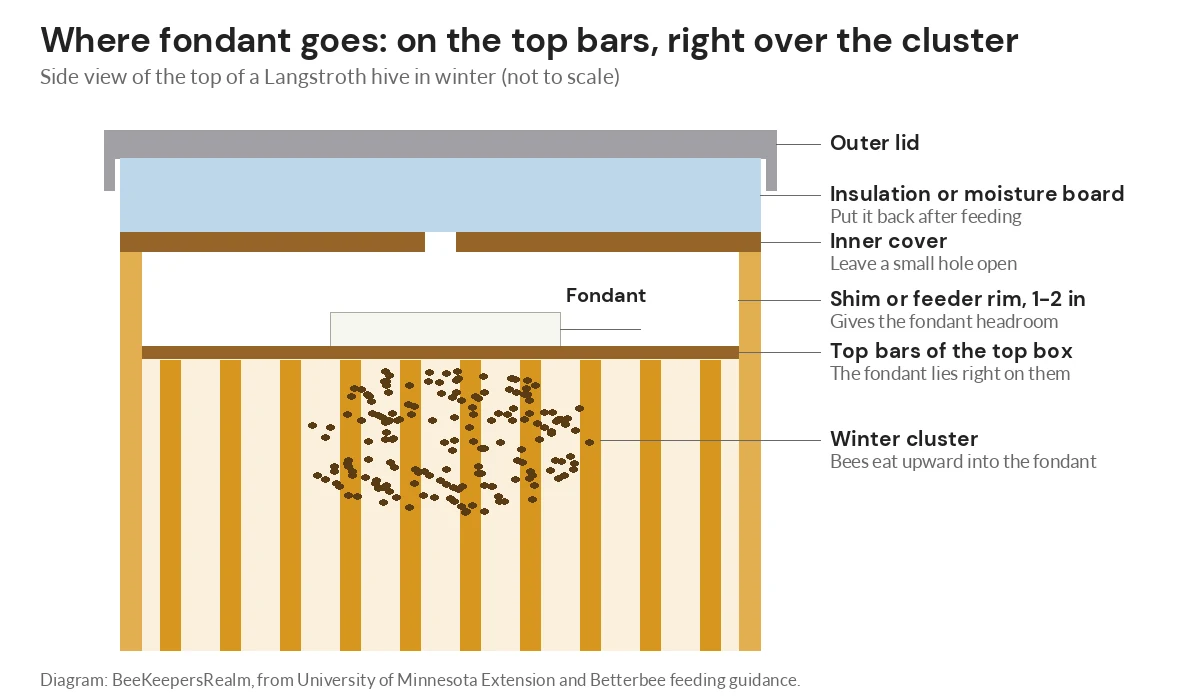
Set the fondant on the top bars directly above the cluster, as UMN describes, inside a 1- to 2-inch shim or empty box. Foxhound Bee Company starts with 3 pounds and swaps in more once the bees have eaten through it.
Fondant is carbohydrate only; for protein, see pollen patties vs winter patties.
Frequently Asked Questions
When should I put fondant on my bees?
When a colony is light in winter or early spring, on a day above freezing.
Where do you put fondant in a hive?
On the top bars directly above the cluster, inside a shim, under the inner cover.
Should you add vinegar to bee fondant?
It is optional. Acid speeds HMF formation, so leaving it out is the safer choice.
Can I use store-bought or baker’s fondant?
Yes, if the label is simple. Backyard Beekeeping warns bakery fondant can contain high-fructose corn syrup, cornstarch, coloring and flavorings, and UMN advises against powdered sugar because of its corn starch.
How long does bee fondant last?
Several weeks in a cool place and longer frozen, per Burlew.