Reviewed by Thomas B. · How we review
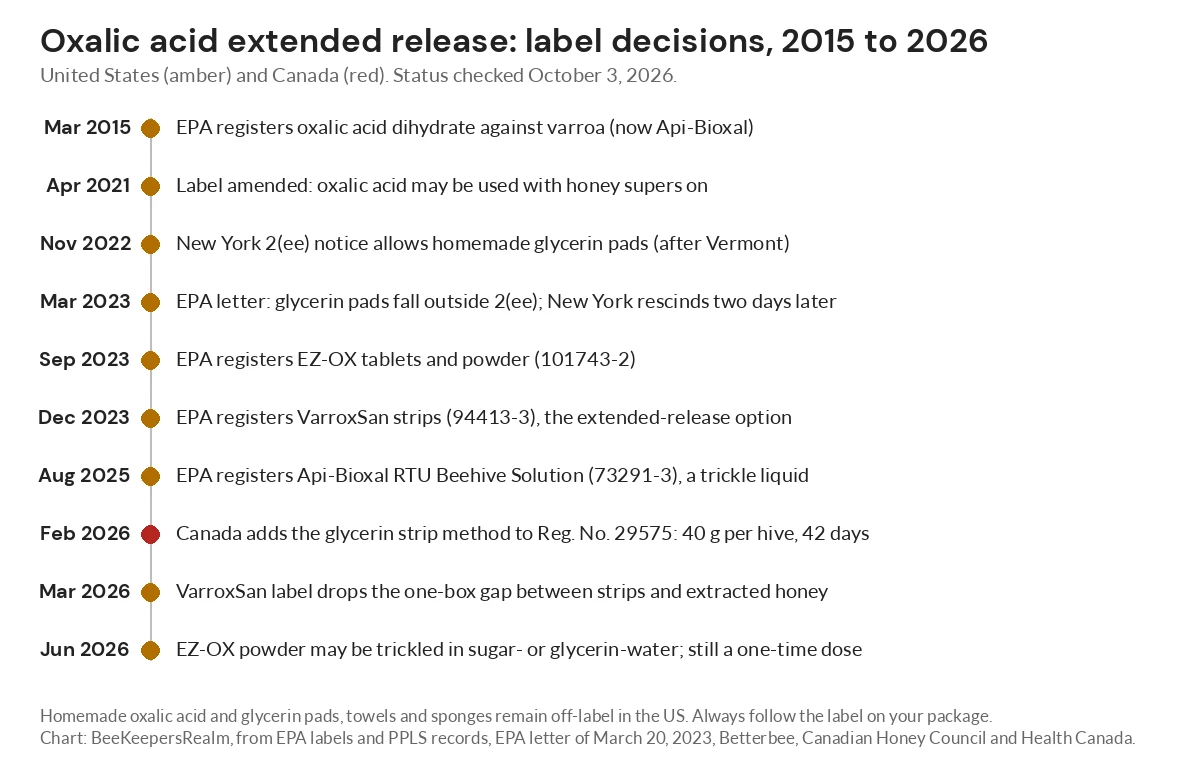
Oxalic acid extended release is oxalic acid dissolved in glycerin and held in strips or pads that stay in the brood nest for six to eight weeks, so mites emerging from brood keep meeting the acid. In the United States the only legal way to use it is a registered product, VarroxSan. Homemade glycerin pads, towels and sponges are not on any EPA-accepted label. In Canada, a label approved in February 2026 now covers the glycerin strip method.
Educational information only, not legal or veterinary advice. The pesticide label is the law. Check the current label through EPA’s list of registered varroa mite products and ask your state pesticide regulatory agency before you treat. We checked every regulatory fact below on October 3, 2026.
Key Takeaways
- EPA lists four oxalic acid products for varroa. Only VarroxSan (EPA Reg. No. 94413-3) is an extended-release strip.
- Soaking Api-Bioxal or EZ-OX into glycerin pads is off-label. EPA told six states so on March 20, 2023, and New York withdrew its approval two days later.
- Since June 2026, EZ-OX powder may be trickled in glycerin-water instead of syrup. That is a one-time dose of up to 50 mL per colony, not a pad left in the hive.
- VarroxSan’s March 17, 2026 label dropped the rule to keep one box between the strips and honey for extraction. Older packs may still carry it, so follow the label on your package.
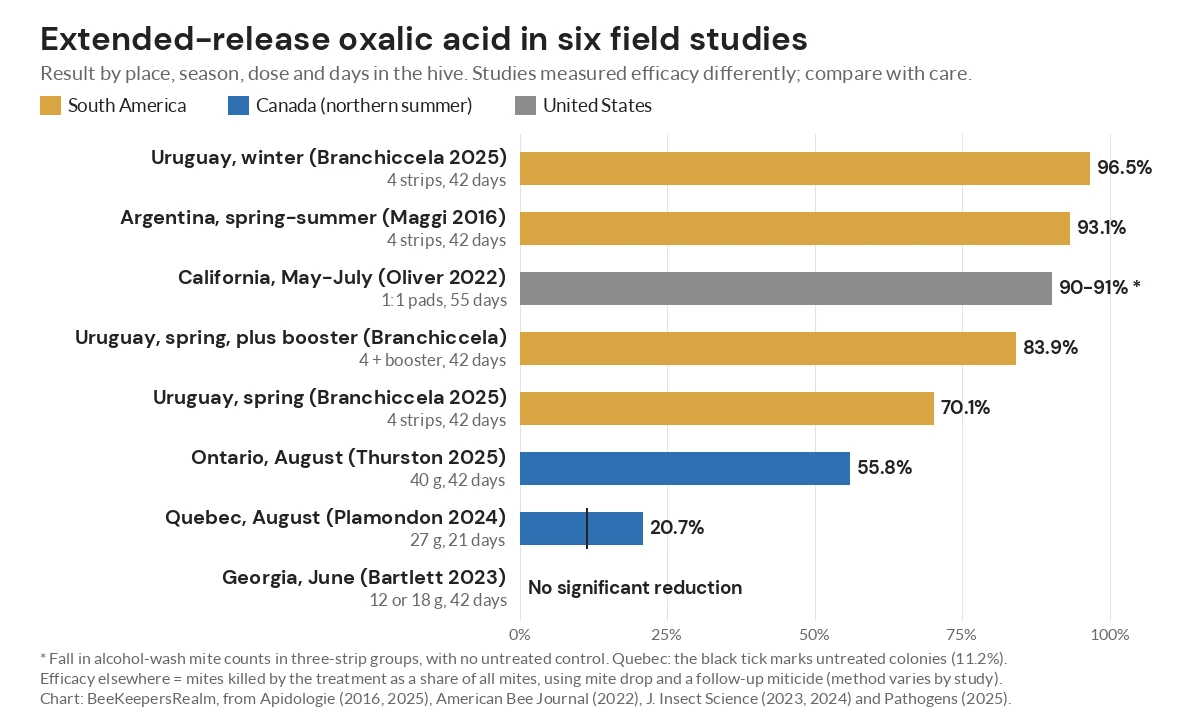
- Published trials range from 93% efficacy in Argentina to no measurable effect in Georgia. Summer trials in Ontario and Quebec found 56% and 21%.
Table of Contents
- How Extended-Release Oxalic Acid Works
- Is It Legal in the United States?
- VarroxSan: The Registered Strip
- Canada Now Has a Glycerin Strip Label
- What the Field Trials Found
- What It Means in a Northern Climate
- Safety and Honey Residues
- Frequently Asked Questions
- The Bottom Line
How Extended-Release Oxalic Acid Works
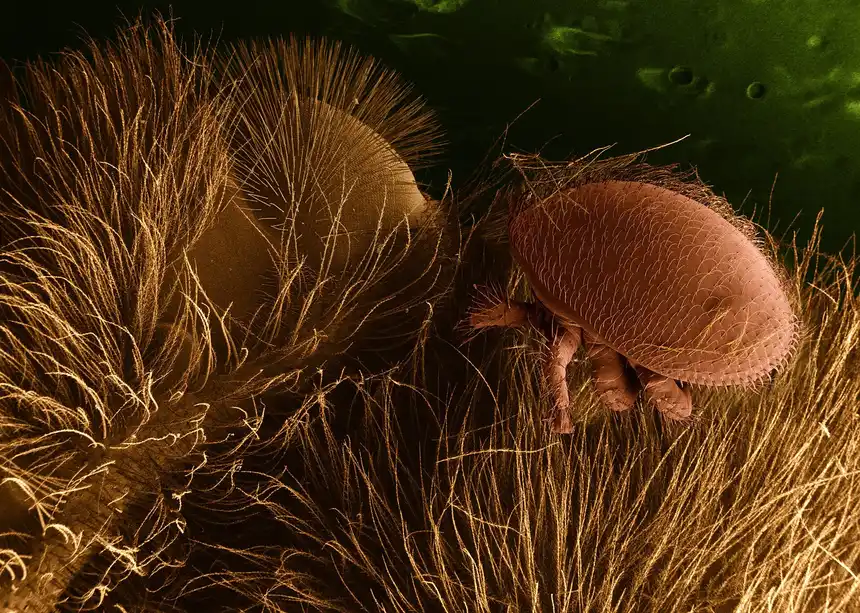
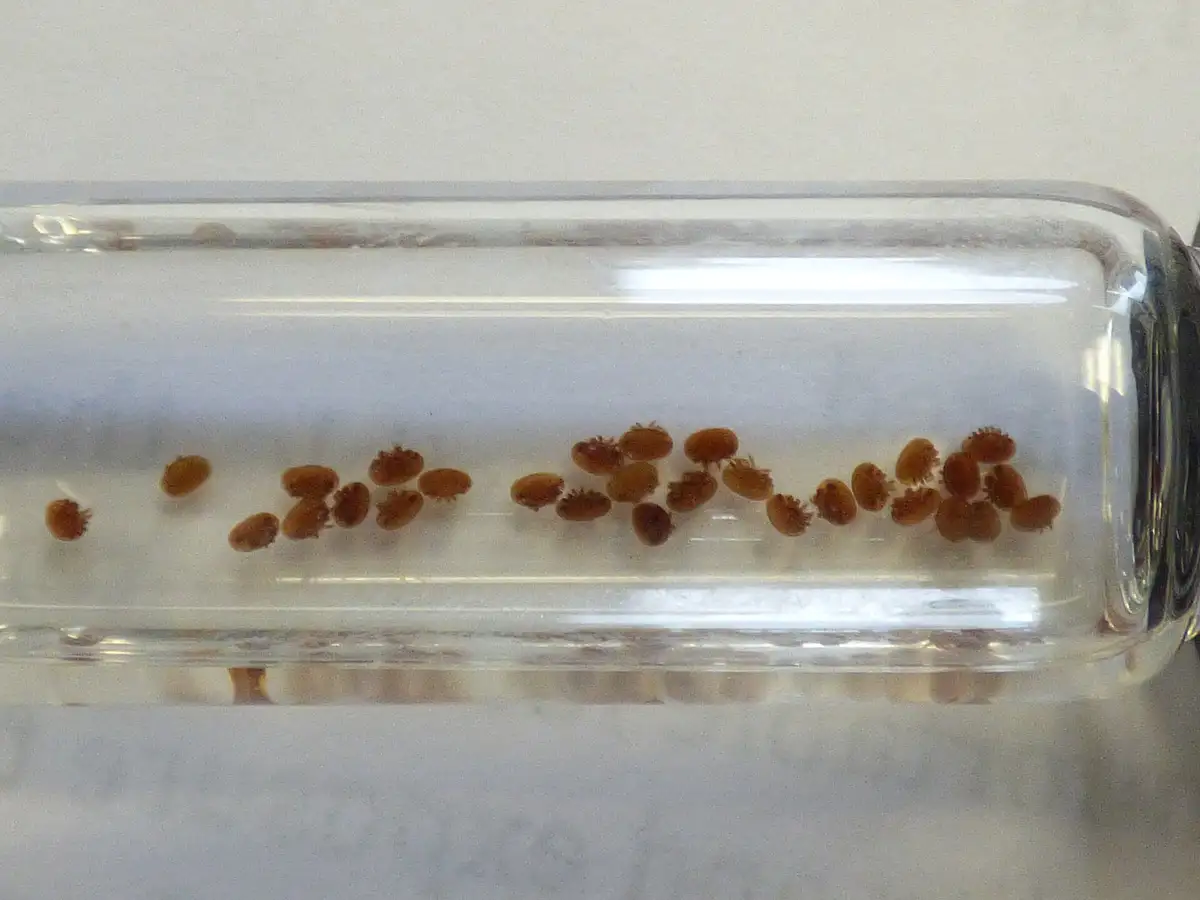
Oxalic acid kills mites riding on adult bees but cannot reach mites sealed under cappings, where they reproduce (see varroa in capped brood). A dribble or vaporization treatment is one short dose. The Api-Bioxal label says that when capped brood is present, “multiple treatments several days apart will be needed to reduce successive cohorts of adult mites.”
An extended-release strip tries to replace those repeat visits. The acid sits on an absorbent matrix (cardboard, cellulose sponge or fiber) hung between or laid across the brood frames. Bees walk over it and spread the acid through the colony while successive rounds of mites leave their cells, which is why these treatments last 42 to 56 days rather than one afternoon (see the varroa life cycle).
Glycerin is the carrier. California beekeeper Randy Oliver, who has tested the method for years under a state research permit, explains on his site that glycerin pulls moisture from the hive air, which activates the acid; once a pad dries out it stops working. He also reports that it is slow, needing about two months to reach full effect, so it suits early, preventive use better than a mite crisis.
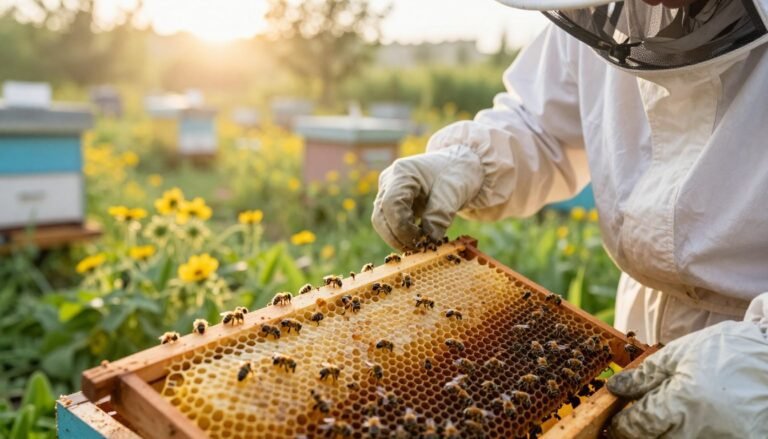
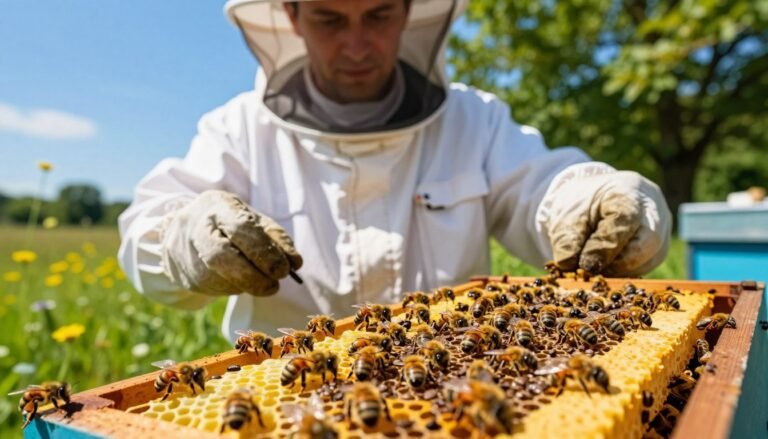
This three-minute August 2025 video from Betterbee shows the registered strip in a real hive. The head beekeeper sizes the dose by counting frames of bees: ten frames in the top box get four strips, about five in the bottom box get two. She folds the strips over frames in the brood nest, records the date and plans to discard the strips after seven to eight weeks. When she adds supers, she puts a box of foundation between the brood nest and the first honey super, as VarroxSan’s label then required. A March 2026 label change dropped that requirement, as explained below.
Is It Legal in the United States?
Only as a registered product, used exactly as its label says. EPA’s list of varroa products, last updated September 17, 2026, includes four oxalic acid products:
| Product (EPA Reg. No.) | What it is | Labeled methods | Extended release? |
|---|---|---|---|
| Api-Bioxal (73291-2) | 97% oxalic acid powder | Trickle in sugar syrup, vaporizer, package-bee spray | No |
| Api-Bioxal RTU Beehive Solution (73291-3) | 6.2% ready-to-use liquid, registered August 2025 | Trickle | No |
| EZ-OX (101743-2) | 97% tablets or powder | Vaporizer; powder also trickled in sugar- or glycerin-water | No |
| VarroxSan (94413-3) | Fiber strip, 18.42% oxalic acid dihydrate, registered December 2023 | Strips hung in the brood nest for 42 to 56 days | Yes |
| Homemade glycerin pads, towels or sponges | Any oxalic acid soaked into a matrix | Not on any EPA-accepted label | Off-label |
Two of these labels were amended this summer. EZ-OX’s label amendment of June 29, 2026 lets the powder be trickled in “[sugar][or][glycerin]-water,” with a maximum of 50 mL per colony; earlier versions said sugar only. The brackets mark optional wording, so check what your package actually prints. Either way it is a single trickle, so it does not make pads legal. Api-Bioxal’s label, amended July 7, 2026, still reads “Only apply Api-Bioxal as a solution when mixed with sugar-water.”
Why homemade glycerin pads are off-label
By late 2022, Vermont had published a FIFRA section 2(ee) bulletin telling beekeepers how to soak Api-Bioxal and glycerin into cellulose pads, and New York followed on November 28, 2022. On March 20, 2023, EPA’s Biochemical Pesticides Branch answered Delaware’s state apiarist, copying Vermont, Washington, New York, North Carolina and Virginia:
“The FIFRA 2(ee) bulletin instructs for mixing with glycerin, which appears to be inconsistent with both of the label statements above, and such mixing does not fit any exemption specified in FIFRA section 2(ee).”
The letter also objected that the bulletin’s dose, about 50 grams of oxalic acid per pad, exceeded the 35 grams on the label, and that section 2(ee) allows mixing a pesticide only with fertilizer. Among EPA’s further concerns: a pad left in the hive means chronic rather than acute exposure, adding glycerin and a pad creates a new product that would need its own registration to be sold, and many cellulose pads contain flame retardants. New York’s Department of Environmental Conservation rescinded its recommendation on March 22, 2023, according to Betterbee’s dated update.
What about using pads only on your own hives? EPA’s beekeeper advisory notes that “own personal use” does not appear in FIFRA. It says a hobbyist who eats all their own honey “might be considered” a personal user, but nobody may sell or transport an unregistered pesticide or sell honey with residues not covered by a tolerance. Oliver argues that EPA leaves this to each state’s lead agency; he says plainly that he is not an attorney. Neither are we, so we cannot call homemade pads legal. If you sell honey, bees or pollination services, assume they are not.
VarroxSan: The Registered Strip
VarroxSan is registered to Vita Bee Health and made in Uruguay. Its US label calls it a “sustained-release fiber strip” and does not list the inert ingredients, but the Uruguayan Varroxsan formulation tested by scientists at Uruguay’s national agricultural research institute is oxalic acid and glycerin in cellulose strips. The current label, accepted March 17, 2026, says:
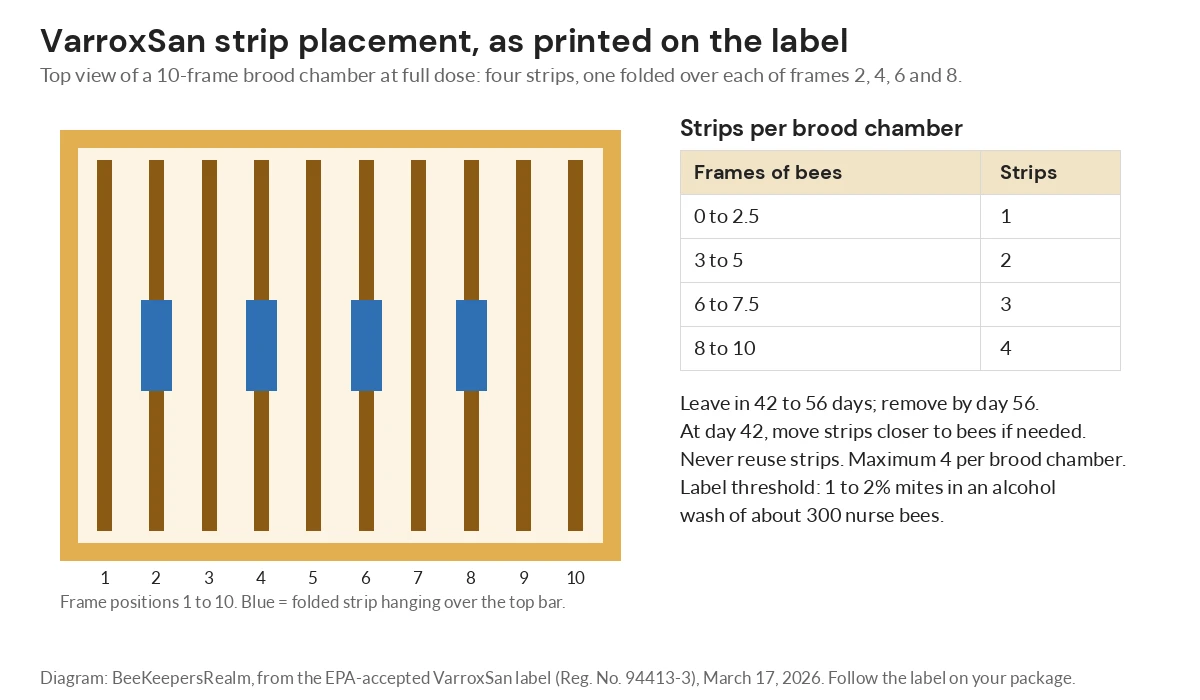
- Treat when an alcohol wash of about 300 nurse bees shows 1 to 2% infestation (see how to do an alcohol wash).
- Use one strip per 2.5 frames of bees, up to four strips per brood chamber, folded over a frame inside the brood area.
- Leave strips in for 42 to 56 days, move them closer to the cluster at day 42 if bees are not touching them, remove them by day 56 and never reuse them.
- “Extended-release method permitted with honey supers on.”
The March 2026 amendment struck one sentence: the treatment no longer has to be separated by at least one chamber from honey to be extracted. EPA’s acceptance letter lets the company keep selling packs with the old label for 18 months, so a box bought this year may still require that spacer. Follow the label on your package.
Canada Now Has a Glycerin Strip Label
On February 20, 2026, the Canadian Honey Council announced that Health Canada’s Pest Management Regulatory Agency had approved the glycerin strip method under its oxalic acid registration, Pest Control Products Act Reg. No. 29575. The council says it invested about $70,000 and that the registration makes legal what had been an off-label practice for some beekeepers. Health Canada’s label search lists No. 29575 as registered until December 31, 2031.
The label sets a 1:1 ratio by weight of oxalic acid and food-grade glycerin, heated no higher than 70°C, and a dose of 40 grams of oxalic acid per single or double brood chamber colony. Strips stay in for 42 days and may be used in spring, summer or fall, with brood and honey supers present, and the label calls this method “for suppression of Varroa mites,” not control. Canadian beekeepers should work from the full label text. It has no legal standing south of the border.
What the Field Trials Found
Most extended-release data comes from beekeepers rather than journals. We found six field studies with stated methods. Read each result with its season, dose and time in the hive, because they change everything:
| Study | Where and when | Dose and time in hive | Result |
|---|---|---|---|
| Maggi et al., Apidologie 2016 | Argentina, spring and summer, brood present | Four oxalic acid cellulose strips, 42 days | 93.1% average efficacy |
| Branchiccela et al., Apidologie 2025 | Uruguay, winter 2017 and spring 2020 | Varroxsan, four strips per box, 42 days | 96.5% in winter; 70.1% in spring (83.9% with a booster dose) |
| Oliver, American Bee Journal 2022 | California, late May to July 2021 | 1:1 oxalic acid and glycerin on sponges or pads, 55 days | 90 to 91% drop in mite wash counts in three-strip groups; no untreated control |
| Bartlett et al., Journal of Insect Science 2023 | South Georgia, June 2017, 129 colonies | 12 or 18 g on shop towels, 42 days | No significant reduction |
| Plamondon et al., Journal of Insect Science 2024 | Quebec, August 2021, 135 colonies | 27 g on pads, 21 days | 20.7% efficacy (untreated 11.2%; Formic Pro 33.3%) |
| Thurston et al., Pathogens 2025 | Guelph, Ontario, mid-August 2018, 116 colonies | 40 g on four strips, 42 days | 55.8% efficacy (six dribbles 42.6%; 65% formic acid 39.5%) |
The Georgia trial, run by University of Georgia and Auburn researchers in a commercial beekeeper’s colonies, tested the homemade shop-towel method directly. Its conclusion is blunt:
“Data from our experiment does not support the use of a “home-made” shop towel delivery for extended-release oxalic acid application in hives, at least in the Southeast United States and at the doses used here.”
Note the last clause. The Georgia towels held 12 or 18 grams, well under the 40 to 50 grams used in Ontario and in Oliver’s work, and the authors suggested the region’s humidity (76% average relative humidity during the trial) may have interfered. Oliver’s 90% reductions came without untreated colonies, and he calls his own efficacy figures questionable for that reason. The Quebec pads stayed in only 21 days, half the usual time.
Season matters as much as dose. In Uruguay the same strips reached 96.5% in winter, when there is little brood, but 70.1% in spring. The Ontario authors drew a practical conclusion:
“this treatment should be considered as part of an IPM strategy and not a stand-alone method for V. destructor control.”
What It Means in a Northern Climate
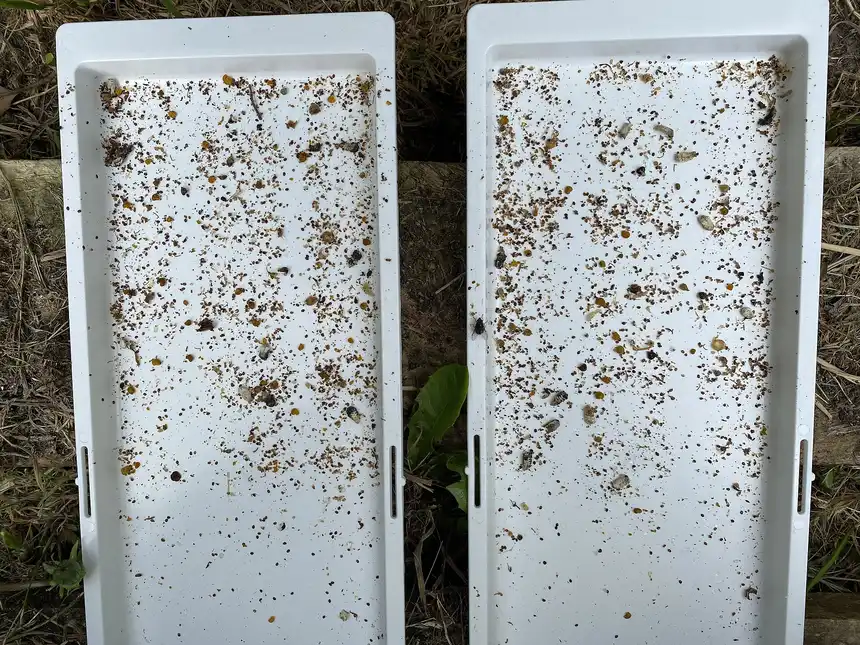
The two Canadian summer trials are the closest match to our conditions in the Red River Valley. The Quebec apiaries sat near 46°N, about Fargo’s latitude, and the Ontario colonies were in single brood boxes, with daily highs of 20 to 34°C during treatment. Neither trial approached the 90%-plus results reported from Argentina and Uruguay. In Quebec, Formic Pro brought 33 of 45 colonies under the fall threshold within a week of the treatments ending, against 13 of 45 with oxalic acid pads.
Timing is the bigger northern problem. The Ontario authors note that northern beekeepers must treat right after the honey flow ends, which leaves a short window for overwintering colonies. A treatment that needs about two months does not fit easily into it. Where your package’s label allows supers on, VarroxSan can go in before the flow ends; otherwise faster options fit the window better, such as Formic Pro or MAQS or the supers-on HopGuard, with oxalic acid as a broodless late-fall clean-up. Our seasonal treatment calendar and guide to cold-winter beekeeping cover how these fit together.
States also register pesticides for sale and use. Before buying, confirm that a product is registered in your state; in North Dakota, start with the Department of Agriculture (see our North Dakota beekeeping laws page).
Safety and Honey Residues
Handle oxalic acid as the hazardous chemical it is. VarroxSan’s label carries the signal words DANGER and POISON, warns that the product is fatal if inhaled, and requires chemical-resistant gloves, goggles or a face shield, and at least a NIOSH-approved particulate respirator. Every homemade method also involves heating acid and glycerin, a step the Canadian label restricts to well-ventilated areas.
On residues, oxalic acid has an exemption from a residue tolerance in honey (40 CFR 180.1381). EPA’s advisory adds that the exemption assumes a registered product used by its label, and that other ingredients in an unregistered mix may lack one. In the Ontario trial, honey from treated and untreated hives held similar oxalic acid levels (39.36 and 36.85 µg/g), and the paper gives 11.3 to 160 µg/g as the normal natural range in honey. The Quebec study found no extra oxalic acid or glycerin in honey, though its pads reduced hive weight gain. For a wider view of the chemistry, see our oxalic acid treatment guide.
Frequently Asked Questions
What is the recipe for an extended release oxalic acid treatment?
In the US there is no legal homemade recipe; use VarroxSan as labeled. Canada’s label for Reg. No. 29575 sets a 1:1 oxalic acid and glycerin mix at 40 grams per colony.
How effective are oxalic acid strips?
From no measurable effect to 96.5%, depending on season, dose and climate. Northern summer trials found 21 to 56%.
How long do you leave VarroxSan strips in?
42 to 56 days. Reposition them at day 42 if bees are not touching them, and remove them by day 56.
Can you eat honey from hives treated with oxalic acid?
Yes, when a registered product is used as labeled. Oxalic acid occurs naturally in honey, and trials found no increase above untreated hives.
How long will oxalic acid last?
VarroxSan expires 24 months after manufacture. Canada’s label says to use homemade strips within a month and pull them at 42 days.
When is it too late to treat for varroa mites?
There is no single date, but late summer decides it: the Ontario team cites research showing colonies at 1% infestation or more in late summer or early fall are more likely to die in the spring. Extended release needs about two months, so up north it belongs in early summer, not October.
What is the best oxalic acid for bees?
Any registered product used by its label: Api-Bioxal, Api-Bioxal RTU, EZ-OX or VarroxSan. Oxalic acid sold for other purposes is not a registered pesticide.
The Bottom Line
If you want extended-release oxalic acid in the US, buy VarroxSan and follow the label printed on your package. Treat homemade glycerin pads as off-label, whatever older club handouts say, and watch EPA’s list for changes. For background on the researcher behind the method, see our profile of Randy Oliver.