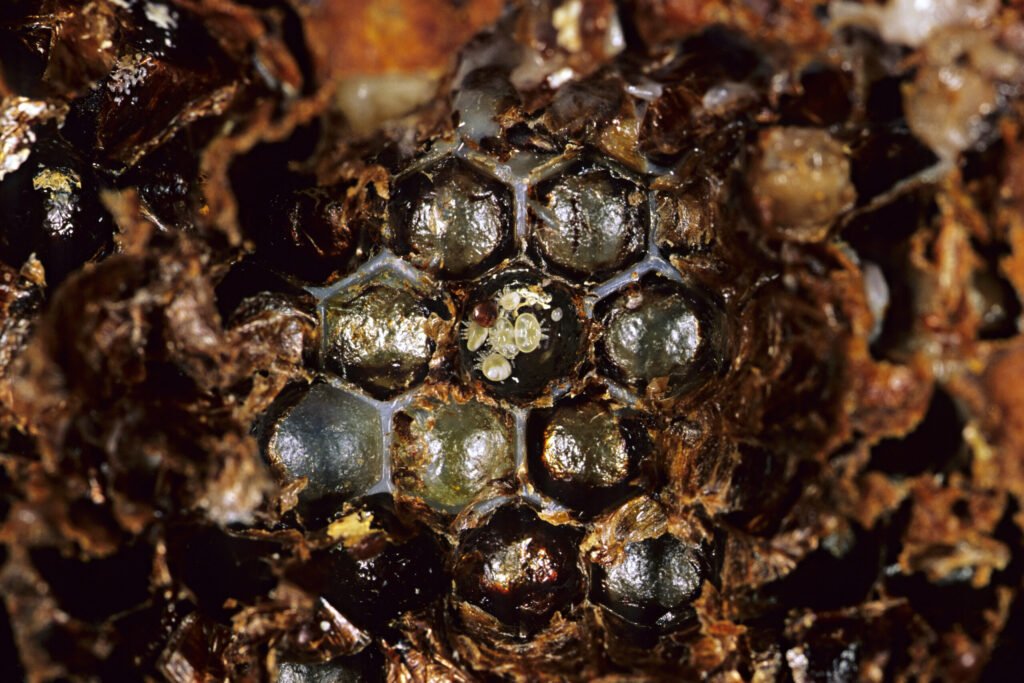
The varroa mite life cycle alternates between two phases: a reproductive phase inside a sealed honey bee brood cell, and a dispersal phase riding on adult bees. A mated female mite, the foundress, slips into a worker or drone larva’s cell in the last hours before workers cap it, begins feeding on the larva within about six hours of sealing, and starts laying eggs roughly 60 hours after capping. Her first egg becomes a male, every later egg a female, and the daughters mate with their brother inside the cell before the adult bee emerges. Because drone cells stay capped several days longer than worker cells, a foundress in drone brood produces roughly 2.2 to 2.6 mated daughters against 1.3 to 1.4 in worker brood — which is why mite populations accelerate in spring and why every monitoring and treatment decision you make is really a decision about where mites are in this cycle.
Key Takeaways
- Varroa has only two phases: reproduction inside capped brood, and dispersal on adult bees. Nothing else happens.
- Reproduction is timed to the host. The foundress enters 15–20 hours before a worker cell is capped and 40–50 hours before a drone cell is capped, which is the real reason drone brood collects so many mites.
- A foundress yields about 1.3–1.4 mated daughters in worker brood and 2.2–2.6 in drone brood, and may reproduce up to about seven times in her life.
- During brood rearing, most of the colony’s mites are sealed under cappings, so an alcohol wash samples only the visible minority — your count is a floor, not a ceiling.
- Treatments that only kill dispersal-phase mites must either be repeated across a full brood cycle or applied when the colony is broodless.
- Mites feed on fat body tissue, not hemolymph. Many life-cycle pages still repeat the older, incorrect version.
Table of Contents
- The Two Phases of the Varroa Life Cycle
- Varroa Mite Development Timeline, Hour by Hour
- Worker Brood vs Drone Brood: Why the Math Differs
- The Dispersal Phase: What Mites Do Between Cells
- How the Life Cycle Drives Population Growth
- What the Life Cycle Means for Your Mite Counts
- What the Life Cycle Means for Treatment Timing
- Turning the Life Cycle Against the Mite
- Frequently Asked Questions
The Two Phases of the Varroa Life Cycle
Varroa destructor is an obligate parasite of honey bees, meaning it cannot complete any part of its life away from a colony. Its entire existence is divided between two states, and understanding which state a mite is in at a given moment is the single most useful piece of varroa biology a beekeeper can carry into the apiary.
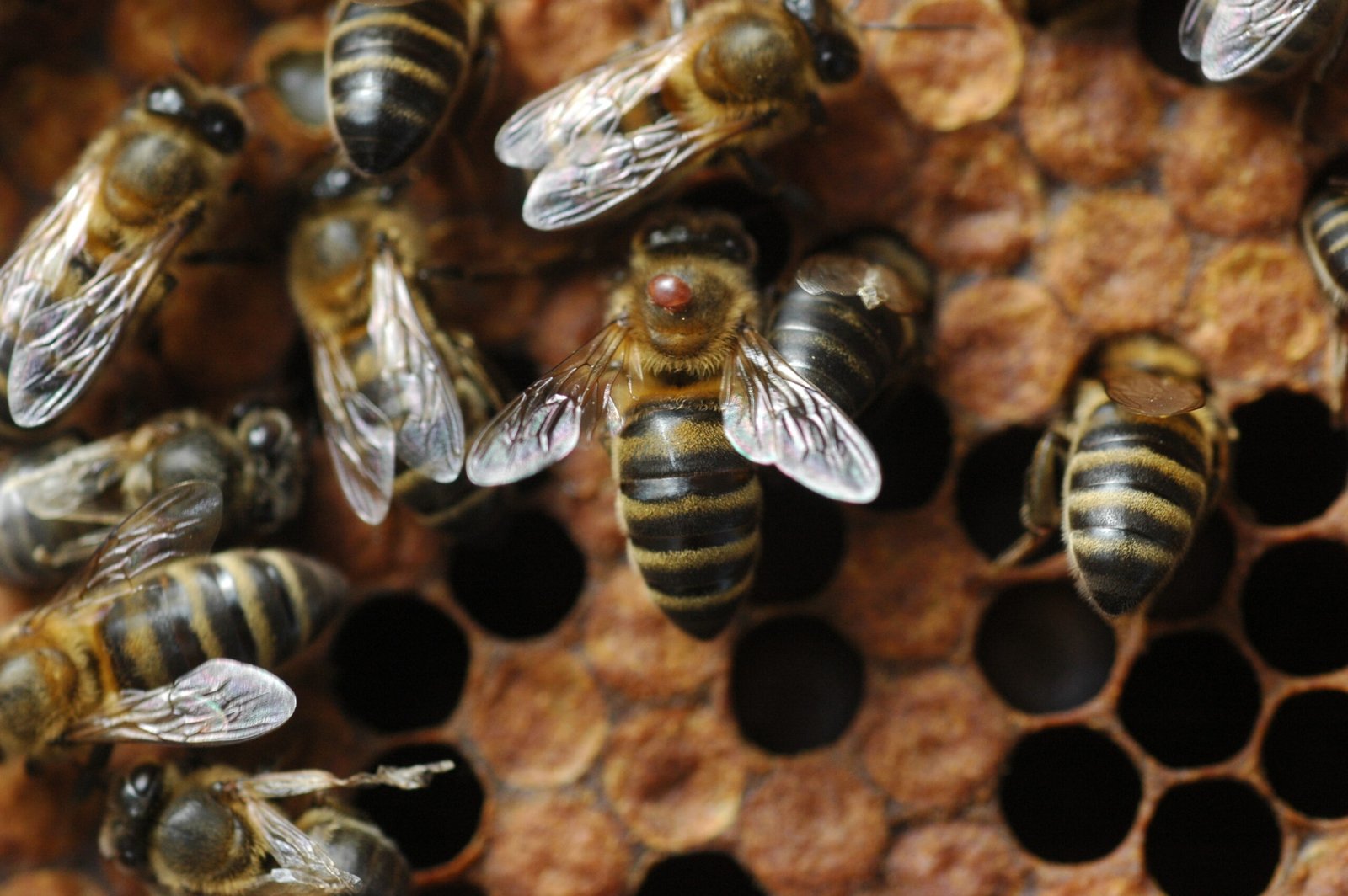
The reproductive phase happens entirely inside a capped brood cell. It is invisible from the outside, it is chemically sheltered from most treatments, and it is where all mite reproduction occurs. The dispersal phase — older literature calls it the phoretic phase — is the stretch when a mature female mite rides on an adult bee, wedged between the abdominal plates where she is hard to see and hard to groom off. During this phase she does not reproduce. She feeds, she is moved around the colony, and she is potentially carried into a neighbouring hive by drifting or robbing bees.
The life cycle of the mite can be divided into phoretic and reproductive phases. The reproductive phase begins when a mature female leaves her adult host, enters a brood cell containing a worker or drone larva shortly before it is capped, and sequesters herself in the bottom of the cell.
One correction worth making up front, because a great many life-cycle articles still get it wrong: varroa does not primarily drink hemolymph. Work published by Samuel Ramsey and colleagues in the Proceedings of the National Academy of Sciences in 2019 used fluorescent biostains to show that the tissue in mite guts matched the fat body rather than the hemolymph. The fat body is the organ bees use for detoxification, immune function and overwinter reserves — which explains why mite damage is so much worse than simple fluid loss would predict, and why mite-heavy colonies so often fail in late winter rather than in the season they were infested.
Varroa Mite Development Timeline, Hour by Hour
The reproductive phase runs on a tight schedule, keyed to the bee’s own development. The table below assembles the timeline from the primary literature. Times are measured from the moment workers seal the cell, except for the invasion window, which happens before capping.
| Stage | Timing (worker brood) | Timing (drone brood) | What happens |
|---|---|---|---|
| Cell invasion | 15–20 hours before capping | 40–50 hours before capping | Foundress leaves her adult host, enters the cell and hides in the brood food at the bottom |
| Cell capped | Hour 0 | Hour 0 | Workers seal the cell; the mite is now enclosed with the larva |
| First feeding | Within about 6 hours | Within about 6 hours | Foundress pierces the cuticle; that wound becomes the shared feeding site for all her offspring |
| First egg laid | About 60–70 hours | About 60–70 hours | The first egg is male |
| Subsequent eggs | About every 30 hours | About every 30 hours | All later eggs are female |
| Egg to adult mite | About 5.8 days (female), 6.6 days (male) | Same | Protonymph and deutonymph stages, then adult |
| Mating | Inside the cell, before emergence | Inside the cell, before emergence | Daughters mate with their brother; the male never leaves the cell |
| Post-capping period available | About 11–12 days | About 14–15 days | The hard ceiling on how many daughters can mature |
| Mature mated daughters produced | 1.3–1.4 on average | 2.2–2.6 on average | Immature or unmated daughters die when the cell opens |
Two details in that table do most of the explanatory work. The first is that the male is always the firstborn, and he dies inside the cell. If that first egg fails, every daughter in the cell emerges unmated and is reproductively dead, which is one route by which some colonies suppress mite growth. The second is the roughly 30-hour egg interval set against a fixed post-capping window: the arithmetic of how many daughters can reach adulthood is decided the moment the cell is capped.
The foundress starts feeding on the brood within six hours of the cell being sealed, and feeding occurs regularly thereafter. The site on the larvae where the foundress pierces the cuticle to feed becomes the feeding area for her offspring.
Worker Brood vs Drone Brood: Why the Math Differs
Almost every guide notes that mites prefer drone brood and attributes it to the longer capped period. That is half the answer, and the half that gets left out is arguably more interesting.
The longer post-capping period does matter. With eggs arriving roughly every 30 hours and each daughter needing close to six days to mature, a worker cell sealed for 11 or 12 days simply runs out of time. A drone cell, sealed for 14 or 15, allows one or two more daughters to finish development. Penn State Extension puts the post-capping periods at 15 days for drones versus 11 days for workers.
But the other half is the invasion window. Boot and colleagues, publishing in Experimental and Applied Acarology in 1995, measured the period during which mites can successfully enter a cell and found mites invaded worker cells from 15–20 hours before capping, but drone cells from 40–50 hours before capping. A drone cell is therefore receptive to invasion for roughly two to three times as long as a worker cell. Each drone larva presents a much wider door, and then rewards the mite that walks through it with extra days of sheltered development.
Stack those two effects and you get the figures commonly reported from field sampling: mites turn up in drone brood somewhere between five and twelve times as often as in worker brood. That is not a mild preference. It is the basis of drone brood trapping as a control method, and it is why colonies allowed to raise large slabs of drone comb in spring can carry far heavier mite loads than their worker-brood mite counts suggest. If you want the field side of this, our guide to spotting varroa mites in capped brood covers what uncapping actually looks like.
Queen cells are a useful edge case. Queens are capped for only about eight days, too short for mite offspring to mature, so varroa essentially cannot reproduce on queen brood.
The Dispersal Phase: What Mites Do Between Cells
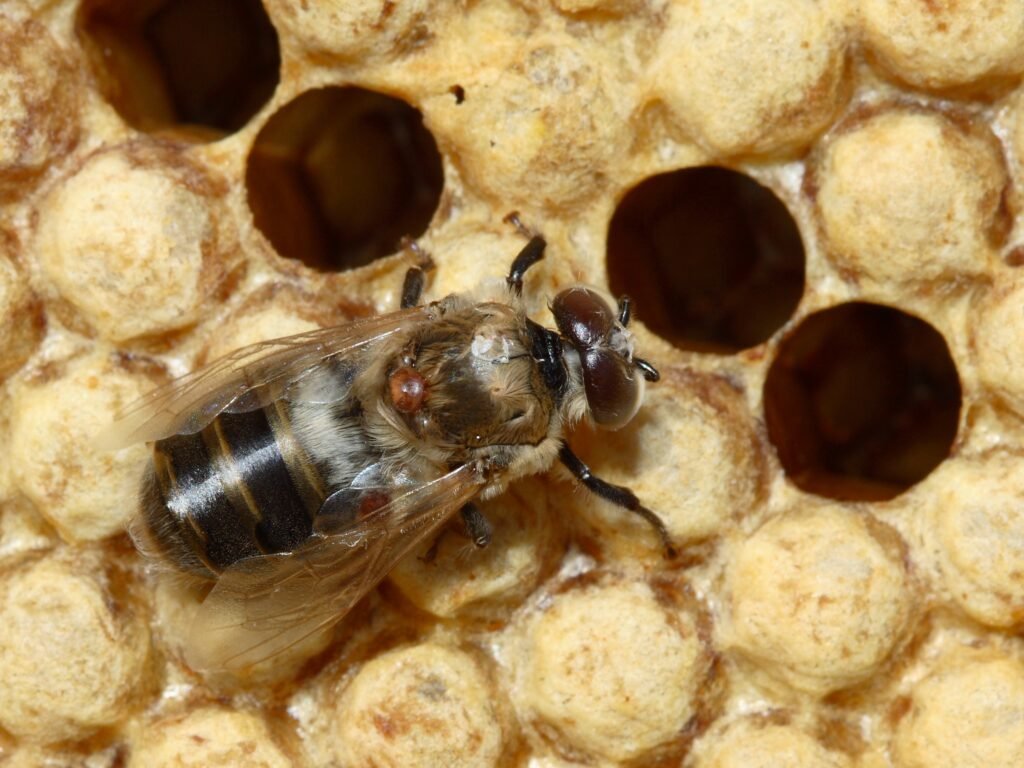
When the adult bee chews its way out, the foundress and any mature mated daughters leave with it or walk out shortly afterward. They then need a host. Mites strongly prefer young nurse bees working in the brood nest, for the obvious reason that a nurse bee is a taxi to the next available larva. Calderone’s SARE fact sheet records mites on brood nest bees about twice as often as on bees in honey supers, and around ten times as often as on foragers.
How long the dispersal phase lasts depends entirely on whether brood is available:
- Peak season, abundant brood: a few days to a couple of weeks. The mite finds a pre-capping larva quickly and re-enters reproduction.
- Dearth or reduced brood rearing: longer, because suitable larvae are scarcer.
- Broodless winter cluster: potentially months. Mites overwinter on adult bees, which is precisely the vulnerability that makes winter treatment so effective.
A mature female may go through this loop up to about seven times, laying on the order of 30 eggs across her life. Not all of those cycles are successful — a proportion of foundresses produce no viable mated daughters at all — but a mite is not a one-shot reproducer, which matters when you are deciding whether a single treatment application is enough.
How the Life Cycle Drives Population Growth
Put the numbers together and you can see why varroa outruns unmanaged colonies. Every completed reproductive cycle in worker brood returns, on average, more than one mated daughter plus the surviving foundress. That is compound growth, and its rate is set by three things you can partly influence: how much brood is available, what proportion of it is drone brood, and how long each mite spends exposed in the dispersal phase.
The colony’s own calendar then works against the beekeeper. Mite numbers build through spring and summer while bee numbers are also building, so the ratio can look acceptable for months. Then the colony contracts in late summer, brood rearing tapers, and the same mite population is suddenly concentrated onto far fewer bees — right when the colony is rearing the long-lived winter bees whose fat bodies varroa attacks. That mismatch, not a sudden mite explosion, is what kills most colonies over winter. It is also the reason our seasonal varroa treatment calendar weights late-summer action so heavily.
What the Life Cycle Means for Your Mite Counts
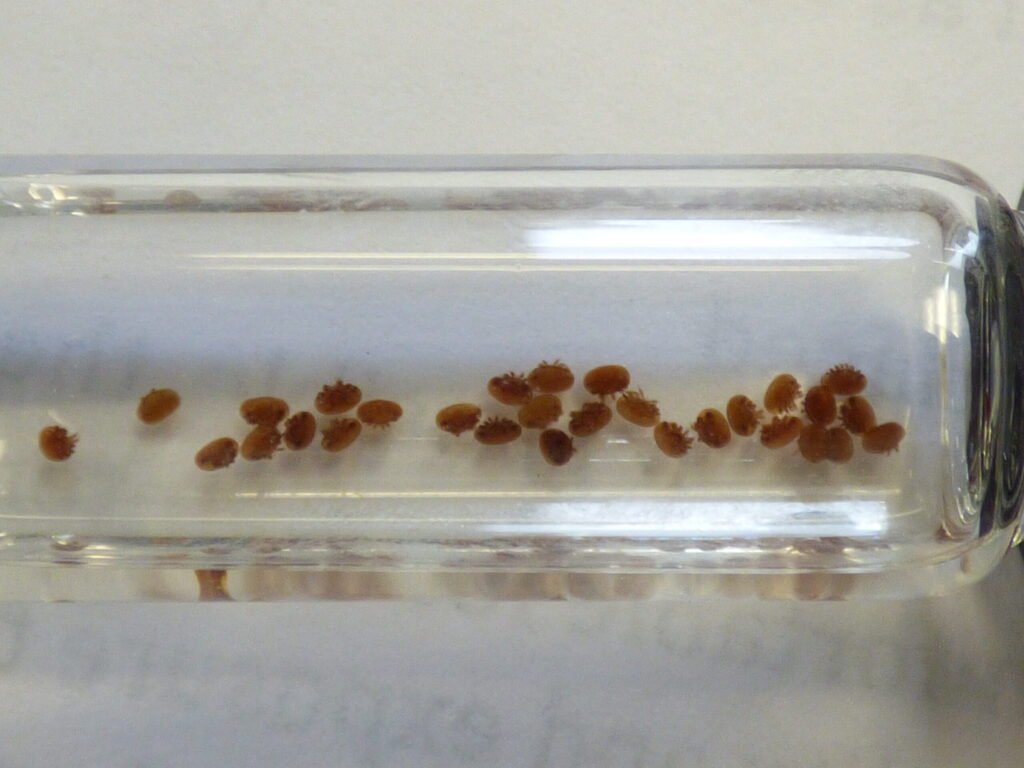
This is where biology stops being trivia. An alcohol wash, a sugar roll and a sticky board all sample dispersal-phase mites only. Every mite currently sealed inside a capped cell is invisible to all three methods. During heavy brood rearing that hidden fraction is the majority of the colony’s mites.
Three practical consequences follow:
- Your count is a floor. A wash result of 2 mites per 100 bees in June does not mean the colony holds only that proportion — it means that proportion was riding on adults at that moment. Treat the number as an index you track over time, not an inventory.
- The same number means different things in different months. Two mites per 100 bees in a broodless November colony is close to the whole population. The same reading in a brood-heavy May colony sits on top of a much larger hidden reservoir.
- Counts can rise sharply without new mites arriving. When brood rearing slows, mites that were under cappings move onto adults. A jump in your wash result can reflect redistribution, not invasion.
Penn State Extension’s action threshold is to keep mite levels at or below roughly 2 mites per 100 bees. Thresholds vary between extension services and some use season-specific figures, so follow one source consistently rather than mixing them. The mechanics of taking a reliable sample are covered in our walkthrough of the alcohol wash and how it compares to sugar roll and sticky boards, and how often to repeat it is covered in our guide to varroa testing frequency and interpreting counts.
What the Life Cycle Means for Treatment Timing
Nearly every frustrating varroa outcome traces back to a mismatch between a product’s reach and where the mites actually were. Miticides fall into two broad groups:
- Dispersal-phase only. Oxalic acid dribble and vaporization act on mites riding adult bees and do not meaningfully penetrate cappings. Applied once to a colony with brood, such a treatment addresses only the exposed minority.
- Partially brood-penetrating. Formic acid is the main product that reaches mites under cappings, which is also why it is the one most sensitive to temperature and colony condition.
If you are using a dispersal-phase-only product on a colony with brood, you have two honest options. Either apply it repeatedly across a full brood cycle, so that mites emerging from cells are met by an active treatment, or apply it during a genuine broodless window when essentially the whole mite population is exposed at once. A single mid-summer application with brood present is the classic way to get a disappointing follow-up count. Our comparison of oxalic acid, formic acid, thymol and natural varroa treatments lays out which products sit in which group.
Always re-test after treating. The post-treatment count is the only evidence you have that the product reached the mites, and if it did not drop, the life cycle usually explains why. If you are looking at a bad result right now, start by matching the treatment to the season and the brood situation, and if repeated treatments are failing, consider the signs of miticide resistance in a hive.
Turning the Life Cycle Against the Mite
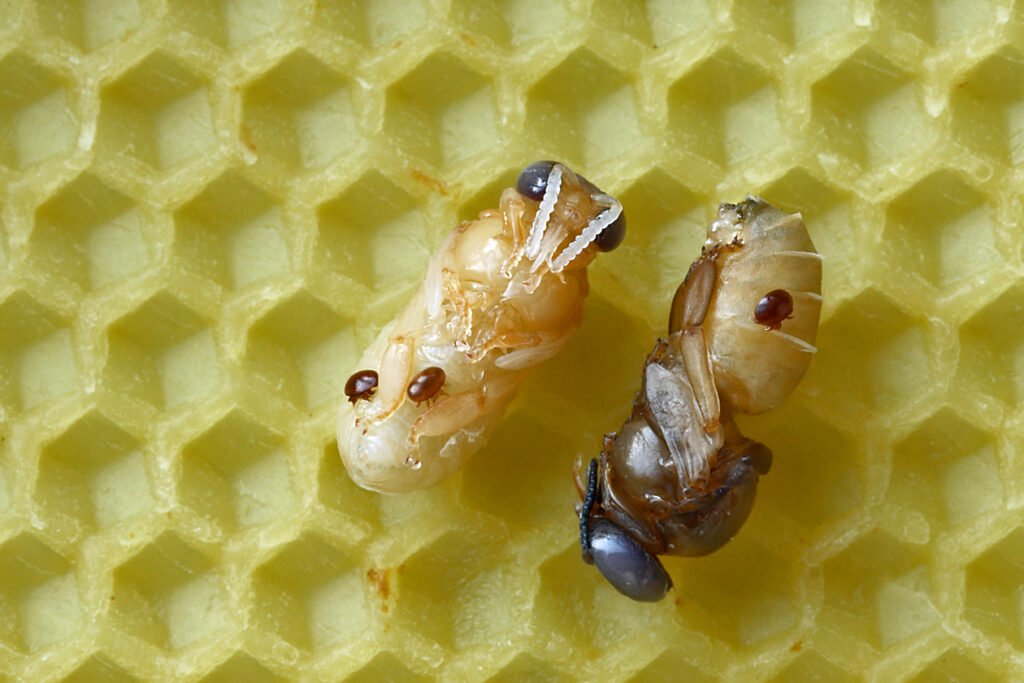
Because varroa reproduction is completely dependent on capped brood, anything that removes capped brood removes reproduction. Three cultural methods exploit this directly.
Brood breaks. Caging or removing the queen for around three weeks lets all existing capped brood emerge with nothing to replace it. Every mite in the colony is pushed into the dispersal phase, reproduction halts, and the colony becomes an ideal target for a dispersal-phase treatment. Splits and requeening produce the same effect as a side benefit, which is why varroa management around splits, nucs and requeening is worth planning deliberately rather than treating as an afterthought.
Drone brood removal. Insert a frame of drone foundation, let it be drawn, laid up and capped, then remove and freeze it before the drones emerge. Given the wide invasion window and the higher offspring yield in drone cells, that frame acts as a mite magnet. The one rule that cannot be broken: if the frame is not removed before emergence, you have run a mite breeding programme.
Selecting for hygienic stock. Bees that detect and uncap infested pupae interrupt the reproductive phase before the daughters mature. Breeders assess this with standardised tests — our article on the freeze-kill assay for hygienic behavior explains how. For a broader look at building a programme around these methods, see our guide to varroa management for treatment-free beekeepers.
Mechanical interventions such as grooming aids and screened bottom boards target the dispersal phase instead, removing mites while they are exposed on adults rather than interrupting reproduction. None of these replace monitoring. They change the slope of the curve, and you still need counts to know whether the slope changed enough.
Frequently Asked Questions
How long is the varroa mite life cycle?
There is no single fixed length. The reproductive phase is bounded by the host’s post-capping period, about 11 to 12 days in worker brood and 14 to 15 in drone brood. The dispersal phase varies from a few days in peak season to several months in a broodless winter colony, so a full cycle ranges from roughly two weeks to many months.
How many eggs does a varroa mite lay?
A foundress lays about five or six eggs in a worker cell, starting roughly 60 hours after capping and continuing at about 30-hour intervals. Across up to seven reproductive cycles she may lay on the order of 30 eggs in total. Only a fraction reach adulthood as mated females, averaging 1.3 to 1.4 per worker cell.
Why do varroa mites prefer drone brood?
Two reasons compound. Drone cells stay capped several days longer, allowing more daughters to mature, and mites can invade drone cells from 40 to 50 hours before capping versus only 15 to 20 hours for worker cells. Field sampling finds mites in drone brood five to twelve times as often as in worker brood.
Can varroa mites reproduce outside capped brood?
No. Varroa reproduction is entirely dependent on sealed brood cells. A mite on an adult bee is feeding and waiting, not breeding. This is why brood breaks stop mite population growth outright and why a genuinely broodless colony offers the cleanest treatment window of the year.
What is the difference between phoretic and dispersal phase?
They describe the same stage, when a mature female mite rides on an adult bee. Researchers increasingly prefer dispersal because phoresy strictly means transport only, whereas varroa actively feeds on its adult host during this period. Older extension literature and many beekeeping guides still use phoretic.
Do mites feed on bee blood?
Not primarily. Ramsey and colleagues showed in 2019 that varroa feeds mainly on fat body tissue, the organ responsible for detoxification, immunity and overwinter reserves, rather than hemolymph. That finding explains why mite damage outstrips what fluid loss alone would cause, and why heavily parasitised colonies so often fail in winter.
Why did my mite count jump after treating?
Often because mites that were sealed under cappings emerged onto adult bees where your wash can now find them. A single application of a dispersal-phase-only product on a colony with brood leaves that hidden reservoir untouched. Repeat across a full brood cycle, or treat during a broodless window, then re-test.