Reviewed by Thomas B. · Last Updated September 22, 2026 · How we review
Oxalic acid is a registered miticide that kills varroa mites on contact but cannot reach mites reproducing inside capped brood — which is why every decision about using it comes down to two questions: how you deliver it, and what the colony’s brood is doing when you do. Get those two right and oxalic acid is one of the cleanest tools in a varroa programme. Get either wrong and you will spend money, expose yourself to a corrosive chemical, and barely move the mite count.
Disclaimer: This is educational information for beekeepers, not professional, veterinary or regulatory advice — always read and follow the current label or product authorisation for the exact product you hold, in your own country.
On this page
- How Oxalic Acid Kills Mites — and What It Cannot Touch
- The Three Registered Ways to Deliver Oxalic Acid
- Why the Legal Rules Differ From One Country to the Next
- Timing: Matching the Method to the Colony’s Brood State
- Safety: The Required Protection Changes With the Method
- Honey, Residues and Supers
- Where Oxalic Acid Fits in a Rotation
- Common Mistakes That Waste a Treatment
- Frequently Asked Questions
Key Takeaways
- Oxalic acid works by contact on mites riding adult bees. It does not penetrate wax cappings, so mites reproducing in sealed brood survive a single treatment.
- Three delivery routes are registered in the United States: trickling a sugar-syrup solution, vaporising the dry powder, and hanging extended-release fibre strips. They are not interchangeable — each has its own rate, timing and honey-super rule.
- The rules genuinely differ by country. The current US Api-Bioxal label permits use with honey supers on; the UK authorisation for the same brand explicitly forbids it and caps how many times a year you may treat.
- Extended-release strips are the only oxalic acid option designed to stay in the hive across a full brood cycle, which is why they carry a 42–56 day window rather than a single application.
- The protective equipment required is not the same for every method: vaporising demands acid-gas respiratory protection that the trickle method does not.
- Treat only when monitoring says to. Applying oxalic acid on a calendar, without a mite count, is both poor practice and contrary to the label’s own use restrictions.
How Oxalic Acid Kills Mites — and What It Cannot Touch
Oxalic acid is an organic acid that occurs naturally in rhubarb, spinach and many other plants, and in honey itself. Against Varroa destructor it is a contact acaricide rather than a systemic one. The UK Summary of Product Characteristics for Api-Bioxal describes the mechanism plainly: studies indicate that the acid’s low pH is the major contributor to the acaricidal effect, that oxalic acid concentrates on mite legs and the edges of the exoskeleton, and that none was detected in the mites’ alimentary system — so mites are thought to receive the acid by contact rather than by feeding.
That single mechanical fact drives everything else. A mite riding on an adult bee is exposed. A mite sealed under a wax capping, feeding on a developing pupa and producing the next generation of mites, is not. The US label states the consequence directly: use the product when little or no brood is present, because it will not control varroa mites in capped brood and may damage bee brood.
Oxalic acid is not effective at killing mites underneath cappings, therefore it is best to apply OA during a time of broodlessness.
David Tarpy and Jennifer Keller, Oxalic Acid for the Control of Varroa Mites, NC State Extension
What that means in practice
During most of the active season, the large majority of a colony’s mite population is not on the bees at all — it is under cappings. A single oxalic acid application in June therefore knocks down a minority of the mites present and leaves the reproducing population untouched, which is why the treatment can look like a failure when the real problem is that it was applied at the wrong point in the colony cycle. If you are unclear on where mites actually sit at different times of year, our explainer on varroa mites in capped brood and the varroa mite life cycle both set out the timing that makes or breaks an oxalic treatment.
The Three Registered Ways to Deliver Oxalic Acid
In the United States, oxalic acid is not a single product. Two separate EPA registrations cover three distinct delivery routes, and the directions on each are specific. The figures below are taken directly from the current EPA-stamped labels linked at the end of this section — they are reproduced here so you can see how different the three routes really are, not as a substitute for reading the label that comes with your own product.
| Delivery route | Registered product / EPA Reg. No. | Labelled rate | Contact period | Honey supers on? |
|---|---|---|---|---|
| Trickling (dribble) | Api-Bioxal, 73291-2 (97.0% oxalic acid dihydrate) | 35 g dissolved in 1 L of 1:1 sugar:water; 5 mL into each occupied bee space in each brood box; 50 mL maximum per colony | Single application | Permitted under the current US label |
| Vaporisation (sublimation) | Api-Bioxal, 73291-2 | 1.0 g of powder per brood chamber, applied through a restricted lower entrance with upper entrances sealed | Single application | Permitted under the current US label |
| Spraying package bees | Api-Bioxal, 73291-2 | 2.8% solution (35 g in 1 L of 1:1 syrup); 3.0 mL per 1,000 bees, both sides of the package | Single application | Not applicable — packages only |
| Extended-release strips | VarroxSan, 94413-3 (18.42% oxalic acid dihydrate) | Maximum 4 strips per brood chamber per application, one strip per 2.5 frames of bees | 42–56 days, removed by day 56, never reused | Explicitly permitted with honey supers on |
Trickling, in one paragraph
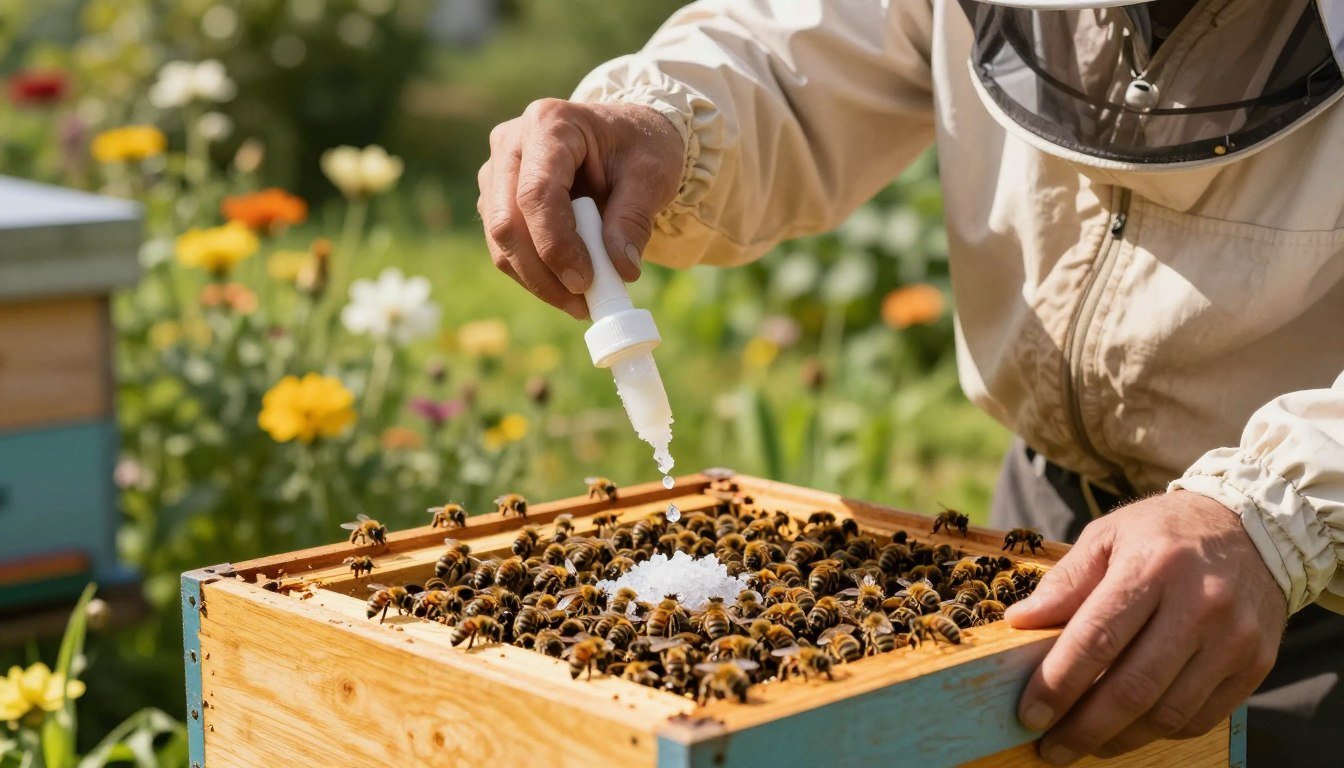
You mix the powder into warm sugar syrup, smoke the bees down off the top bars, and run a measured 5 mL of solution along each seam of bees with a syringe or applicator. It needs almost no equipment, it is fast, and the dose is easy to control. Its weakness is that it is a wet, ingestible exposure: the US label warns that under unfavourable conditions — weak colonies, hard overwintering — the method may cause some bee mortality or overwintering loss, and the UK authorisation notes significantly higher bee mortality in colonies given triple the trickling dose. For the full mixing, dosing and application walkthrough, see our dedicated guide to the oxalic acid dribble (trickle) method.
Vaporisation, in one paragraph
You heat dry oxalic acid crystals until they sublimate into the hive as a vapour that recrystallises on every surface, including the bees. The US label restricts this to outdoor colonies with a restricted lower entrance, with all upper entrances and cracks taped shut so the vapour cannot escape. It is quick per hive once you own the equipment, and it avoids the wet-ingestion problem of trickling, but it is the method with the most serious inhalation hazard for the person doing it. Our guide to oxalic acid vaporization covers the equipment, the sealing routine and the respirator requirement in detail.
Extended-release strips, in one paragraph
This is the route that changes the brood-cycle arithmetic. Because the strips stay in the brood chamber for 42 to 56 days, they are still releasing acid as successive cohorts of mites emerge from capped cells — which is exactly the gap a one-shot treatment cannot close. The label is specific: a maximum of four strips per brood chamber per application, one strip per 2.5 frames of bees, hung so the bees can walk on them, repositioned closer to the cluster if the bees are not contacting them by day 42, and removed at 56 days at the latest. It is also the only oxalic acid route whose US label headline explicitly states that the extended-release method is permitted with honey supers on. If you are weighing this against other recently registered options, our roundup of new varroa treatments puts it in context.
The primary documents behind the table are the EPA-stamped Api-Bioxal product label and the EPA-stamped VarroxSan product label. The USDA Agricultural Research Service’s Bee Research Laboratory also maintains a plain-language oxalic acid FAQ for beekeepers, which states that applying at rates or by methods other than those on the label is a violation.
Why the Legal Rules Differ From One Country to the Next
This is the part most oxalic acid articles skip, and it is the part that most often gets a beekeeper into trouble. Oxalic acid is regulated as a pesticide in the United States and as a veterinary medicine in the United Kingdom and the European Union. Same molecule, same brand name, two different regulators, two materially different sets of permissions. A beekeeper reading a US forum thread and applying it to a British hive can end up outside the terms of the authorisation without ever noticing.
The contrast below comes from two primary documents that anyone can open: the current EPA label for Api-Bioxal in the US, and the UK Veterinary Medicines Directorate’s Summary of Product Characteristics for the same brand.
| Point of difference | United States (EPA label, Api-Bioxal 73291-2) | United Kingdom (VMD SPC, Api-Bioxal 0.71 g/g) |
|---|---|---|
| Regulatory framework | Pesticide, registered by the EPA | Veterinary medicinal product, authorised by the VMD |
| Trickling dose | 5 mL per occupied bee space per brood box, maximum 50 mL per colony | 5 mL per seam of bees, maximum 50 mL per hive |
| Trickling solution strength | 35 g of product in 1 L of 1:1 sugar:water | 4.4% w/v oxalic acid in 60% w/v sucrose syrup (a 31 g bag in 500 mL of syrup) |
| Vaporisation dose | 1.0 g per brood chamber | 2 g per hive, as a single administration |
| Applications per year | No annual maximum stated on the label | Up to two trickling treatments per year; one vaporisation treatment per year |
| Honey supers | "Oxalic acid can be used when honey supers are on the hive" | "Do not use in colonies with supers or during honey flow" |
| Summer sublimation | No seasonal restriction stated | Sublimation is not recommended in summer |
| Respiratory protection | Particulate filtering facepiece for the solution method; elastomeric half mask with acid-gas cartridges for vaporising | Protective mask to EN149 (type FFP2) for handling, both during vaporisation and pre-treatment |
Two of those rows are worth pausing on. The honey-super rows are flat contradictions of each other — not nuance, not interpretation, but opposite instructions in two live official documents. And the applications-per-year row means a treatment schedule that is entirely legal in the US can exceed the UK authorisation on its second or third pass. If you beekeep outside these two countries, the useful takeaway is not to pick whichever rule you prefer but to find the equivalent document your own regulator publishes for the product you actually bought. You can read the UK document in full on the VMD product information database.
Timing: Matching the Method to the Colony’s Brood State
Because oxalic acid cannot reach capped brood, the right moment to use it is defined by the colony, not the calendar. There are four windows in which a single-application oxalic treatment does its best work.
- A broodless winter cluster. The classic window. In a genuinely broodless colony, essentially the entire mite population is exposed on the bees at once, so a single treatment reaches nearly all of it. The US label’s caution that the product must not be used in enclosed overwintering areas applies here.
- An induced summer brood break. Caging the queen creates an artificial broodless period. The UK authorisation is unusually specific about this: it reports that the highest levels of efficacy after queen caging were achieved with a caging period of at least 25 days, at which point the colonies were completely broodless.
- A fresh package or swarm. No comb, no brood, every mite on a bee. The US label carries a dedicated package-spraying direction for exactly this situation.
- A newly made split or nuc, before the new queen’s brood is capped. See our guide to varroa treatment after making a split for how to find that window without disrupting the new queen.
Outside those windows you have two honest choices: use the extended-release route, whose 42–56 day residence time is specifically designed to span a brood cycle, or choose a chemistry that penetrates cappings. Formic acid is the usual answer to the second, and our guide to Formic Pro and MAQS strips covers its own, much tighter temperature constraints. For fitting any of this into a year-round plan, the seasonal varroa treatment calendar is the better starting point than a single-product guide.
Treat on a number, not on a hunch
The US label’s use restrictions include a line that is easy to skim past: apply only when monitoring indicates treatment is required, and consult state guidelines and local extension experts for monitoring protocols and thresholds. That is a label instruction, not advice. A mite wash takes a few minutes and tells you whether a treatment is warranted at all — our walkthrough of how to test for varroa mites compares the three standard field methods.
Safety: The Required Protection Changes With the Method
Oxalic acid is not a gentle substance because it is described as organic or naturally occurring. The US label carries the signal word DANGER and the statements "Fatal if swallowed", "Corrosive", "Causes irreversible eye damage" and "Causes skin burns". Treat it with the same seriousness you would give any corrosive acid in a workshop.
The specific requirement that catches people out is that the personal protective equipment is not one list for all methods. Under the current US label, anyone applying by the solution method must wear long sleeves and trousers, socks and shoes, chemical-resistant gloves, protective eyewear such as goggles, and at minimum a NIOSH-approved particulate filtering facepiece respirator with an N, R or P filter. Anyone applying by the vaporiser method must wear the same clothing and gloves, goggles or a face shield, and at minimum a NIOSH-approved elastomeric half mask respirator with acid-gas cartridges and combination N, R or P filters. A disposable dust mask is not the vaporiser requirement, and the difference matters: sublimated oxalic acid is a respirable vapour you are deliberately generating at close range.
Two further practical points sit on the labels themselves. The extended-release strip label requires the same gloves, eyewear and particulate respirator when handling the strips — the sustained-release format does not remove the handling hazard. And the UK authorisation adds a warning the US label does not spell out in the same way: do not use oxalic acid simultaneously with other acaricides.
Honey, Residues and Supers
Oxalic acid already exists in honey. The UK Summary of Product Characteristics is explicit that oxalic acid is a natural honey constituent whose concentration depends on the botanical source, and that no increase in residues over the natural content of honey is expected as a consequence of proper administration of the product. The UK honey withdrawal period is accordingly set at zero days.
That is a residue statement, not a permission. The UK document sets the withdrawal period at zero days and, in the same document, instructs that the product must not be used in colonies with supers or during honey flow. The US position is different, and has moved: the current EPA label states that oxalic acid can be used when honey supers are on the hive, and the VarroxSan extended-release label says so in capitals as a headline of its directions. If you have been beekeeping long enough to remember the older US restriction, the point to take away is that this is a rule that has genuinely changed in one jurisdiction and not the other, which is a good reason to re-read the label on the tub you actually own rather than rely on what you learned when you started.
Where Oxalic Acid Fits in a Rotation
The US label devotes a full section to resistance management, and it is worth reading rather than skipping. It notes that oxalic acid’s mechanism of action is unknown at this time, that any varroa population has the potential to become resistant, and that resistance development is affected by both the frequency and the rate of application. Its recommendation is to rotate miticides so that a different mode of action is used each time before returning to a previously used one, and to base miticide use on integrated pest management rather than routine application.
In practice, oxalic acid earns its place in a rotation because it does something the synthetic strips do not: it is a short-residue, contact-only option that suits the broodless windows, which makes it a natural partner rather than a competitor to the products that cover the brood-rearing months. It also works well as what the US label calls a "clean up" treatment following the application of a different acaricide where infestations continue to be problematic. For the wider picture of how the chemistries compare against each other — formic acid, thymol, amitraz, hop beta acids and the non-chemical approaches — our varroa mite management guide is the comparison page; this one deliberately stays on oxalic acid.
Common Mistakes That Waste a Treatment
- Treating a colony full of capped brood and expecting a big drop. The acid did its job on the mites it could reach. The rest were sealed away. This is the single most common reason a treatment "doesn’t work".
- Scaling the dose to the hive rather than to the bees. Both the trickle and the strip rates are defined by seams or frames of bees occupied, not by box count. A half-full brood box does not take a full box’s dose.
- Using a dust mask for vaporising. The label requirement for the vaporiser method is acid-gas cartridges, not a particulate filter alone.
- Mixing more trickle solution than you will use that day. The UK authorisation gives the reconstituted solution a 24-hour shelf life after mixing.
- Applying without a mite count. Contrary to the label’s own use restrictions, and it leaves you with no way to tell whether the treatment achieved anything.
- Leaving extended-release strips in too long. The label sets a hard maximum of 56 days and prohibits reuse; strips left through the winter are outside the terms of the registration.
- Assuming a rule you read online applies where you live. As the comparison table above shows, two regulators currently give opposite instructions on the same question.
For the extended-release strip method in detail, see oxalic acid extended release: trials and legality.
Frequently Asked Questions
Does oxalic acid kill varroa mites inside capped brood?
No. Oxalic acid does not penetrate wax cappings, so mites reproducing inside sealed cells are not exposed. The US product label states plainly that it will not control varroa mites in capped brood and may damage bee brood, which is why it is directed at broodless or low-brood periods.
Is the dribble method or vaporisation more effective?
Neither is universally better; they deliver the same active ingredient by different routes. Trickling needs almost no equipment but is a wet, single exposure that can stress weak colonies. Vaporising avoids that but requires a vaporiser, a sealed hive and acid-gas respiratory protection. Your brood state and your equipment should decide it.
Can I treat with oxalic acid while honey supers are on?
It depends entirely on where you are. The current US EPA label states oxalic acid can be used when honey supers are on the hive, and the extended-release strip label permits it explicitly. The UK authorisation for the same brand says the opposite: do not use in colonies with supers or during honey flow.
How many times a year can I apply oxalic acid?
The current US label does not state an annual maximum, though it does warn that resistance development is affected by frequency of application. The UK authorisation is stricter and caps it: up to two trickling treatments per year, and one vaporisation treatment per year. Check the document your own regulator publishes.
What respirator do I need for oxalic acid vaporisation?
Under the current US label, the vaporiser method requires at minimum a NIOSH-approved elastomeric half mask respirator fitted with acid-gas cartridges and combination N, R or P filters, plus goggles or a face shield and chemical-resistant gloves. The solution method’s lower requirement, a particulate filtering facepiece, is not sufficient for vaporising.
Does oxalic acid leave residues in honey?
Oxalic acid is already a natural constituent of honey, and its level varies with the floral source. The UK Summary of Product Characteristics states that no increase over honey’s natural oxalic acid content is expected following proper administration, and sets the honey withdrawal period at zero days.
Can oxalic acid be used with other varroa treatments at the same time?
Not simultaneously. The UK authorisation instructs that it must not be used at the same time as other acaricides, and the US label’s resistance-management section advises rotating to a different mode of action between applications rather than stacking or repeating the same chemistry.
Before You Treat
The one habit worth building is the simplest: open the label for the specific tub, bag or box of strips you own, in your own country, on the day you treat. The rates, the brood-state guidance, the super rule and the respirator requirement all live there, and at least one of them has changed in the last few years in at least one jurisdiction. Then take a mite count before and a mite count after, so you know whether the treatment actually did anything.