Table of Contents
- What HopGuard Is
- A Third Distinct Chemistry: Hop Beta Acids
- What It Treats — and What It Doesn’t
- Dosing: Strips Per Frame Count
- How to Hang the Strips
- Step-by-Step Application
- Treatment Duration: 14 Days, Repeatable
- Temperature Range: The Widest of the Four
- Safe During Honey Flow — A Real Advantage
- How Often You Can Treat: Up to 4 Times a Year
- Best Timing: Spring and Fall, for Different Reasons
- HopGuard vs. the Other Three Treatments
- Who Should Reach for HopGuard First
- Signs the Treatment Is Working
- Scaling to Multiple Colonies
- Where HopGuard Fits in a Rotation Plan
- Organic and Natural Beekeeping Considerations
- Storage and Shelf Life
- Cost Per Treatment
- Common Mistakes
- FAQ
What HopGuard Is
HopGuard is an EPA-registered varroa mite treatment made from potassium salts of hop beta acids — a naturally derived compound sourced from hops, the same plant family used in brewing — supplied as folded strips containing 4.0 grams of active material each. It occupies a genuinely distinct position among the major commercial varroa treatments: not a synthetic acaricide like Apivar, not an organic acid like formic or oxalic acid, but a plant-derived compound with its own separate mode of action.
A Third Distinct Chemistry: Hop Beta Acids
If you’ve read the other varroa treatment guides on this site, you’ve now seen four genuinely different chemical approaches: oxalic acid (an organic acid, vapor-based), formic acid (an organic acid, vapor-based but capable of penetrating capped brood), amitraz (a synthetic acaricide, contact-based via Apivar), and thymol (a plant-derived essential oil compound, slow-release gel via Apiguard). Hop beta acids add a fifth distinct chemistry to that list — a different plant-derived active ingredient with its own specific mechanism, contact-based like Apivar but chemically and functionally its own category entirely.
What It Treats — and What It Doesn’t
HopGuard is effective against phoretic mites — those riding on adult bees — but like oxalic acid vaporization and unlike formic acid, it does not penetrate capped brood cells. This means the same fundamental limitation applies here as with any phoretic-only treatment: effectiveness depends heavily on how much of the colony’s total mite population happens to be phoretic at the time of treatment, which is generally higher during broodless or low-brood periods and lower during peak brood-rearing season when more mites are sheltered under cappings.
Dosing: Strips Per Frame Count
Standard dosing is one strip per 5 frames covered with bees, working out to roughly 2 strips per 10 frames of bee coverage — dosing calculated by actual bee coverage rather than simply by box count, since a lightly populated box needs less treatment material than a fully covered one. Strips are used exclusively in the brood chamber, never in honey supers, regardless of the honey-flow safety covered further below.
How to Hang the Strips
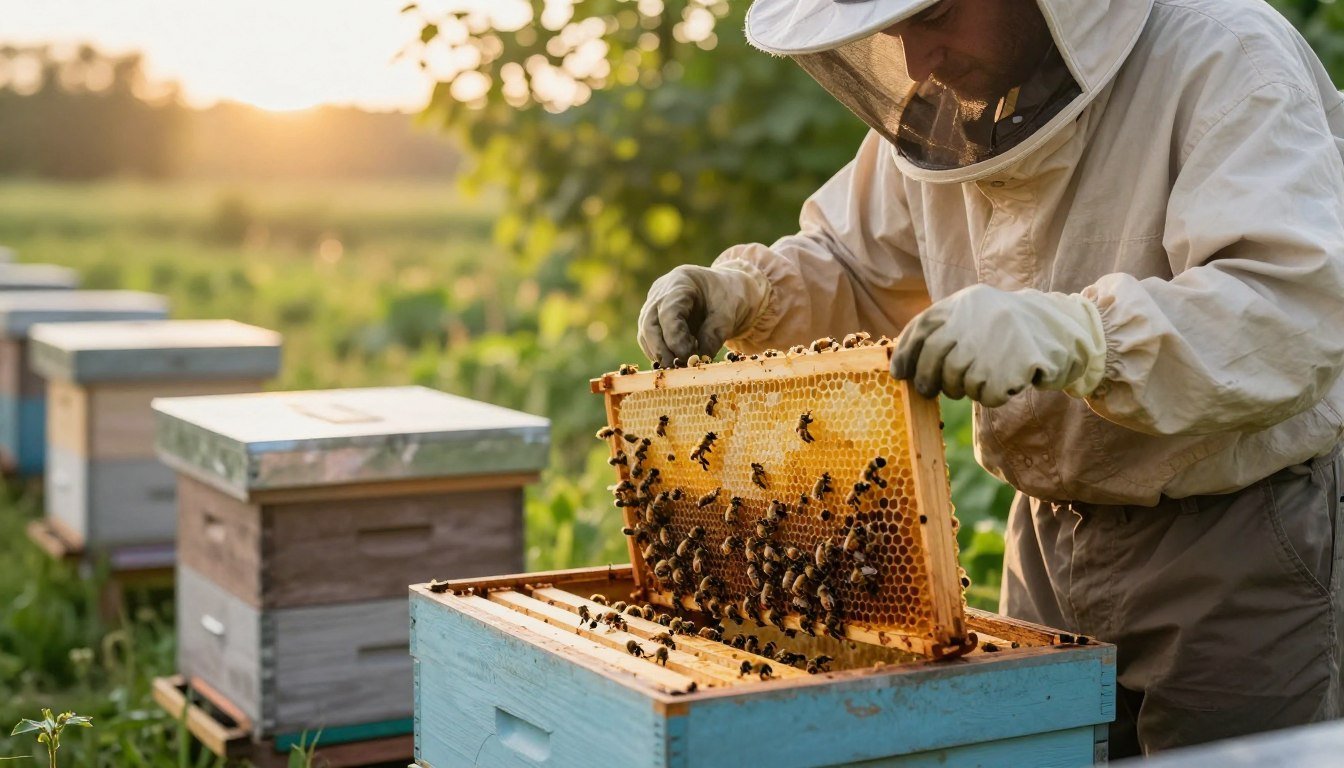
Each strip is designed to be unfolded and hung directly over a center brood frame within the colony’s actual cluster, with one half of the strip draped on each side of the frame — this straddling placement is a distinct physical setup from Apivar’s between-frame hang or Apiguard’s tray-on-top approach, and positions the strip where bees moving through the heart of the colony’s activity will have maximum contact opportunity.
Step-by-Step Application
- Confirm daytime temperatures fall within the 52-92°F range for the treatment period.
- Determine strip count based on actual bee-covered frame count, not total box size.
- Unfold each strip and hang it draped over a center brood frame within the cluster, half on each side.
- Close up the hive and leave strips in place for the labeled duration.
- Remove strips after 14 days (or per your specific product’s current label, up to a 30-day maximum).
- Repeat if needed, spaced roughly 2 weeks apart if mite levels remain above threshold, without exceeding the maximum annual treatment frequency.
Treatment Duration: 14 Days, Repeatable
The standard treatment window is 14 days, considerably shorter than Apivar’s 6-8 weeks or Apiguard’s roughly 6-week cycle, and closer to formic acid’s timeline. If mite pressure remains high after an initial treatment, back-to-back applications spaced about 2 weeks apart are a labeled option for boosting overall efficacy, though this needs to stay within the maximum total treatments allowed per year.
Temperature Range: The Widest of the Four
HopGuard’s labeled temperature range — roughly 52-92°F — is notably wider than the other three treatments covered on this site, both in how low and how high it tolerates. This gives it genuine flexibility across a broader range of conditions and seasons than a treatment with a narrower window, making it a reasonable option to reach for when weather conditions rule out some of the other choices.
Safe During Honey Flow — A Real Advantage
Unlike Apivar and Apiguard, both of which require pulling honey supers before treatment, HopGuard is labeled safe to use during an active honey flow, without disrupting foraging or tainting honey flavor. This puts it in the same practical category as formic acid on this specific point, and is a genuine advantage for beekeepers who don’t want treatment timing to force a choice between managing mites and maintaining continuous honey production.
How Often You Can Treat: Up to 4 Times a Year
HopGuard’s label permits up to 4 treatments per year — a notably higher allowed frequency than most other major treatments, reflecting both its relatively mild overall impact on the colony and the shorter individual treatment duration. This higher allowed frequency, combined with honey-flow safety, gives HopGuard more scheduling flexibility across a season than treatments that are restricted to narrow windows or limited to once or twice a year.
Best Timing: Spring and Fall, for Different Reasons
Spring application is commonly used to reduce mite levels early and support strong colony growth heading into the main season, while fall application targets phoretic mites specifically at a point when the colony’s population (and therefore its ability to absorb ongoing mite pressure) is naturally declining heading into winter — a vulnerable period where reducing mite load matters disproportionately. Treatment decisions should still be based on actual observed mite levels via routine monitoring, not purely a fixed calendar, regardless of season.
HopGuard vs. the Other Three Treatments
| HopGuard | Formic Acid | Apivar | Apiguard | |
|---|---|---|---|---|
| Chemistry | Hop beta acids (plant-derived) | Organic acid | Synthetic acaricide | Thymol (plant-derived) |
| Capped brood penetration | No | Yes | No | Limited |
| Honey flow safe? | Yes | Yes | No | No |
| Duration | 14 days | 10-20 days | 42-56 days | ~6 weeks |
| Max treatments/year | Up to 4 | Per label | Typically 2/year (spring/fall) | Per label |
| Temperature range | 52-92°F | 50-84°F | Best 65-85°F | Above 60°F |
Who Should Reach for HopGuard First
HopGuard suits beekeepers who want a treatment option compatible with ongoing honey production, a wider workable temperature window than formic acid, and more scheduling flexibility across a season than the longer-duration options. It’s also a reasonable choice for beekeepers specifically wanting to avoid synthetic acaricides while still needing a phoretic-mite treatment that isn’t restricted to a narrow broodless window the way oxalic acid vaporization is most effective within.
Signs the Treatment Is Working
Since HopGuard’s treatment window is relatively short at 14 days, a mite count taken before application and again right at removal gives you a genuinely useful comparison without needing to wait weeks for results the way some longer treatments require. Look for a clear downward trend in phoretic mite counts specifically, using a standard alcohol wash or sugar roll test — since HopGuard doesn’t reach mites under brood cappings, don’t expect it to fully resolve a heavy overall mite load on its own if a large share of the population happens to be sheltered there at the time of treatment. If counts aren’t declining meaningfully, consider whether timing coincided with a period of unusually heavy brood rearing (reducing the phoretic share of the population) rather than assuming the treatment itself failed.
Scaling to Multiple Colonies
Because dosing is calculated per bee-covered frame rather than a flat per-hive amount, treating multiple colonies of varying strength means calculating strip counts individually for each rather than applying a single standard dose across your whole apiary uniformly. This extra step is a minor administrative overhead compared to a flat-dose treatment, but it also means you’re not wasting material on weaker colonies or under-treating stronger ones — worth the modest planning effort if you’re managing more than a couple of hives with meaningfully different population levels.
Storage and Shelf Life
Unopened HopGuard strips should be kept in their original sealed foil pouch, away from direct heat and sunlight, where they typically hold their labeled potency for around two years from the manufacture date printed on the packaging. Once a pouch is opened, use the remaining strips within the same season rather than saving partial packs over winter, since hop beta acids can lose effectiveness with extended air exposure. Check the printed date before a treatment if strips have been sitting in a shed or vehicle through a hot summer, since sustained heat above typical storage recommendations can degrade the active compound faster than the shelf-life estimate assumes.
Cost Per Treatment
HopGuard strips are typically sold in packs sized for a set number of colony treatments, and per-colony cost generally lands in a similar range to Apivar and Apiguard rather than standing out as notably cheaper or more expensive — formic acid strip products are often the least expensive per treatment among the four, while the labor cost of HopGuard’s two-strip, two-visit application (versus a single visit for some other products) is worth factoring in alongside the sticker price when comparing options for a larger apiary.
Common Mistakes
| Mistake | Why it matters |
|---|---|
| Placing strips in honey supers | Strips are labeled for brood chamber use only, regardless of the treatment’s overall honey-flow safety |
| Dosing by box count instead of actual bee coverage | A lightly populated colony needs fewer strips than the standard per-box assumption |
| Exceeding the maximum 4 treatments per year | Going beyond labeled frequency is both a label violation and unnecessary added stress on the colony |
| Assuming honey-flow safety means it also penetrates capped brood | These are separate properties — HopGuard is honey-flow-safe but still phoretic-mite-only, same limitation as OAV |
Where HopGuard Fits in a Rotation Plan
Given its distinct hop-beta-acid chemistry, HopGuard is a genuinely useful rotation option alongside the organic acids and amitraz covered elsewhere on this site, adding chemical diversity to a season-long integrated pest management plan without requiring you to interrupt honey production the way Apivar or Apiguard would. A reasonable seasonal pattern might combine a spring HopGuard treatment (compatible with early nectar flow), formic acid mid-season when capped-brood penetration matters most, and oxalic acid vaporization during a late-fall broodless window — three genuinely different mechanisms spread across a season rather than leaning on any single product’s chemistry repeatedly.
Organic and Natural Beekeeping Considerations
Because hop beta acids are naturally derived rather than synthetic, HopGuard is often grouped alongside formic acid, oxalic acid, and thymol as an option more compatible with organic or natural-beekeeping philosophies, in contrast to Apivar’s synthetic classification. As with any of these products, confirm current specific certification standards with your relevant certifying body if formal organic certification status matters for your operation, since allowed-substances lists and specific requirements can vary and change over time.
Sources
Dosing, temperature range, and treatment frequency reflect published EPA product labeling and beekeeping equipment supplier documentation for HopGuard, consistent with current registered label instructions for hop beta acid varroa treatments. For current, authoritative detail, see the Honey Bee Health Coalition’s Tools for Varroa Management guide.
FAQ
Does HopGuard penetrate capped brood cells?
No — like oxalic acid vaporization, it only affects phoretic mites on adult bees, not mites sheltered under brood cappings.
Can I use HopGuard with honey supers on?
Yes for the treatment’s overall honey-flow safety, but strips themselves are still labeled for brood-chamber placement only, not directly in supers.
How many times per year can I use HopGuard?
Up to 4 times per year per the label — notably more frequent than most other major varroa treatments, reflecting its shorter individual treatment duration and relatively mild colony impact.
What temperature range does HopGuard need?
Roughly 52-92°F — the widest labeled range of the major commercial varroa treatments, giving it more scheduling flexibility across varying weather conditions.
Does HopGuard leave any residue in honey or wax?
Hop beta acids break down relatively quickly and the product is labeled safe for use with honey supers in place, which is a large part of why beekeepers reach for it during an active nectar flow when other treatments would require pulling supers first.